Table of contents

No public, methodologically transparent study isolates Meta Advantage+ against manual targeting for B2B SaaS specifically. Most of the "Advantage+ beats manual" numbers circulating online trace back to DTC ecommerce shopping studies, not B2B lead generation - so this page states that gap plainly and works from verified cross-industry Meta benchmarks plus two named, funnel-mapped B2B SaaS case studies as the closest real evidence.
Key Takeaways
- No public study isolates Advantage+ vs manual for B2B SaaS specifically.
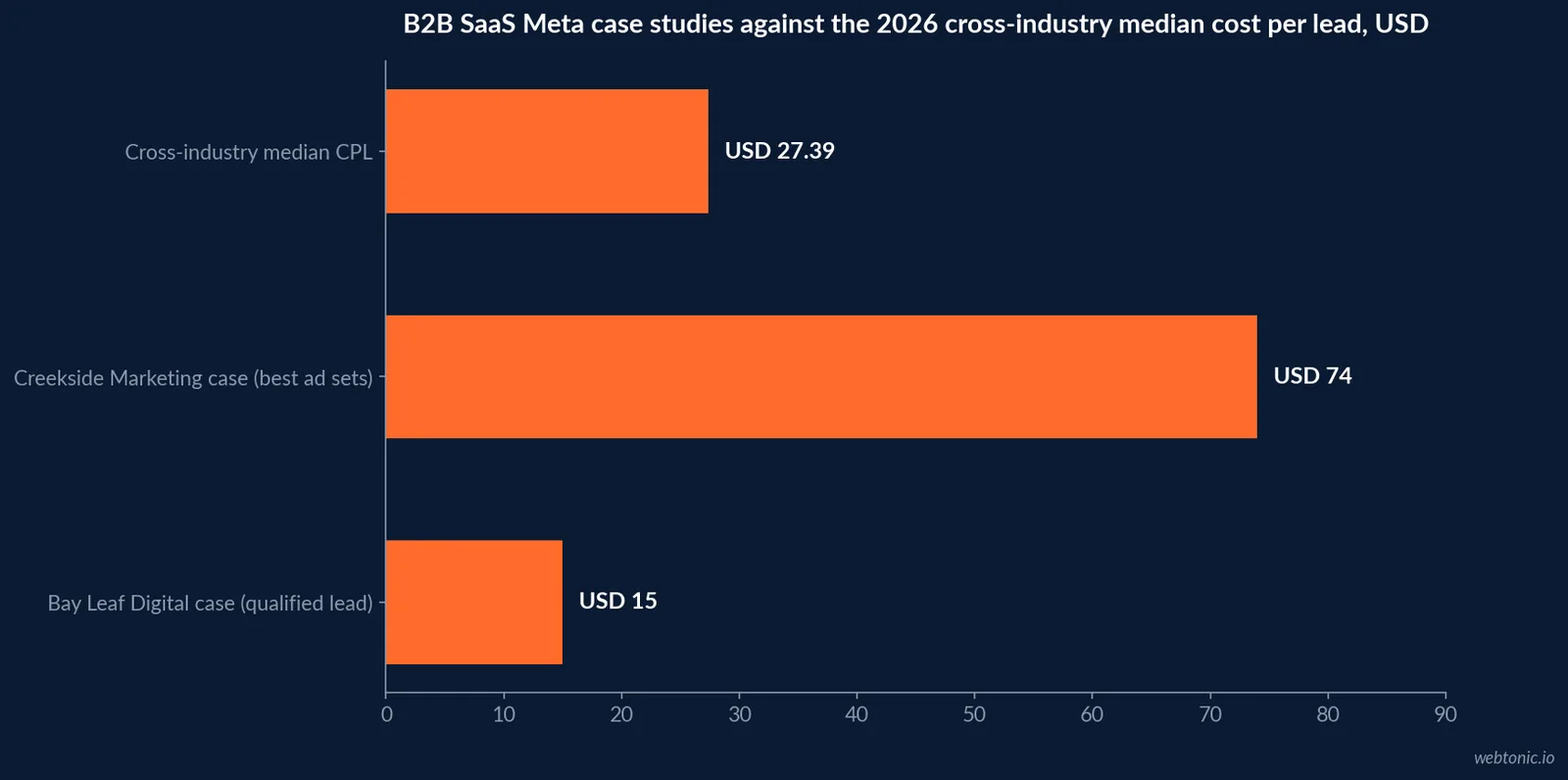
- Median cost per lead across all industries is $27.39 on Meta in 2026 (WordStream).
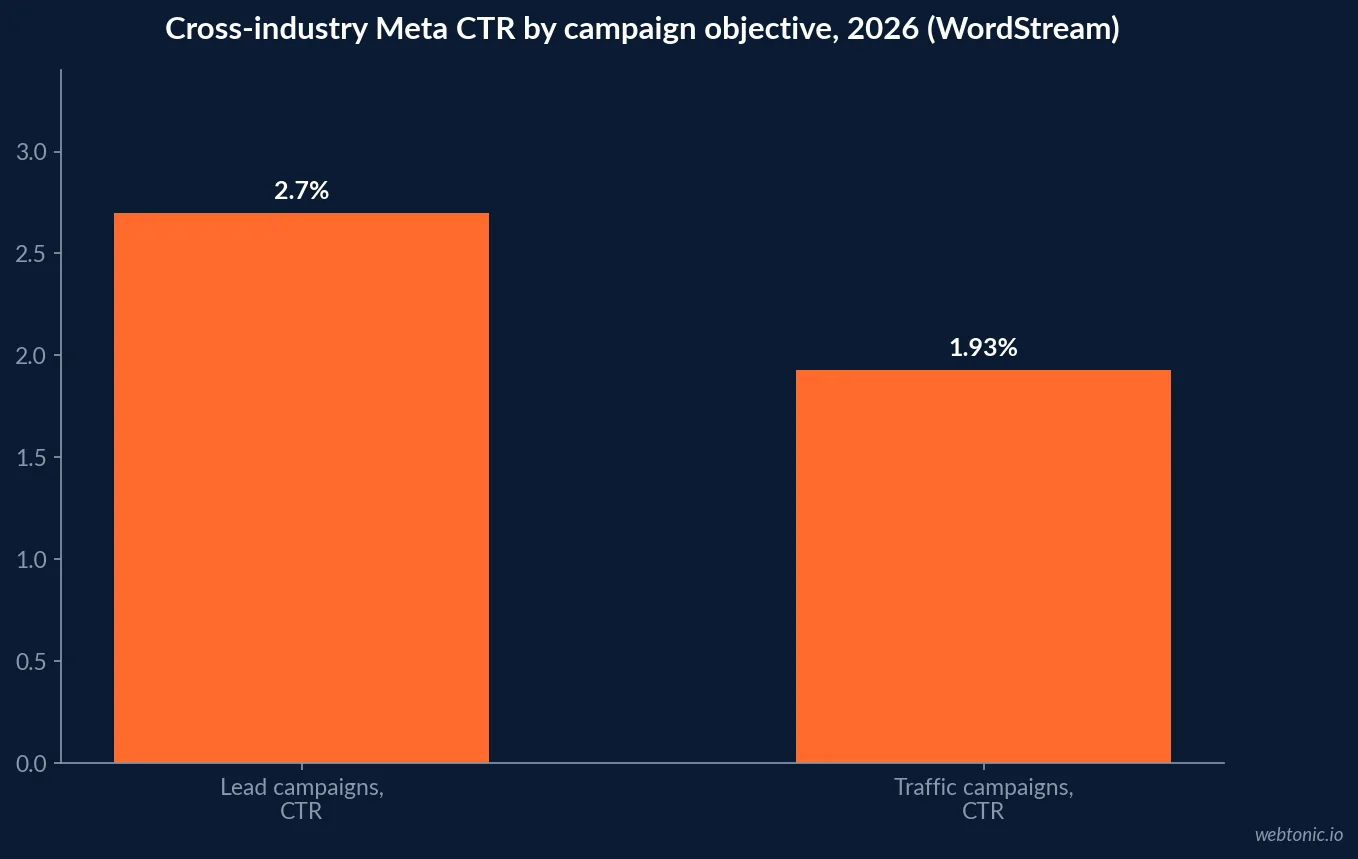
- Median lead-campaign click-through rate is 2.70%, up 4.25% year over year.
- Median cost per click for lead campaigns is $1.80, down 6.25% year over year.
- Business Services appears only in the traffic table, not the lead-cost table.
- Traffic-campaign median click-through rate is 1.93% at $0.60 cost per click.
- Bay Leaf Digital's B2B SaaS funnel delivered 209 leads at $15 each.
- The same funnel produced 11 trials at $278 each in 60 days.
- That funnel used manual job-title, interest and lookalike targeting, not Advantage+.
- Creekside Marketing cut cost per booked demo to $59-89 from a $250-plus starting point.
- That case study delivered 417 booked demos across 16 months on Meta.
- Generative AI use inside marketing activities more than tripled, 7.0% to 22.4%.
- AI use across all marketing activities rose from 13.1% to 24.2% (The CMO Survey).
- Technology and B2B product firms outsource 28% of digital activity to partners.
- 63% of B2B software buyers used AI to research a purchase in the past year.
- 94% of those buyers fact-checked the AI output before acting on it.
The comparison that does not exist yet
A search for "Advantage+ vs manual B2B SaaS" turns up dozens of blog posts quoting the same handful of headline figures - a specific campaign count, a specific brand count, a specific ROAS lift - almost always describing DTC ecommerce Advantage+ Shopping campaigns, not B2B lead generation on Meta. None of the B2B-labeled versions of that comparison this page could verify cited a methodology, a sample size, or a named research team. So rather than repeat an unverifiable number, this page separates what is provable (cross-industry Meta cost benchmarks, two named case studies) from what is not (a rigorous Advantage+-vs-manual study for B2B SaaS).
That gap is itself useful information: if you are being sold an "Advantage+ beats manual by X% for B2B SaaS" statistic, ask for the sample and the industry mix behind it before you believe it.
What the cross-industry Meta benchmarks actually show
WordStream's 2026 Facebook Ads Benchmarks, covering roughly 1,800 US campaigns split across 22 traffic verticals and 14 lead-generation verticals, put the median lead-campaign click-through rate at 2.70% (up 4.25% year over year), median cost per click for lead objectives at $1.80 (down 6.25%), and median cost per lead at $27.39 (essentially flat versus $27.66 a year earlier). Traffic-objective campaigns, a different bidding target, ran a median 1.93% click-through rate at $0.60 cost per click.
Business Services appears only in the traffic-campaign table this year, not the lead table - so there is no direct 2026 Meta cost-per-lead benchmark for the vertical closest to B2B software. Every number below labeled "cross-industry" should be read as a floor to benchmark against, not a software-specific target.
| Meta metric (2026, cross-industry) | Value | YoY move | Source |
|---|---|---|---|
| Lead campaigns, median CTR | 2.70% | +4.25% | WordStream 2026 |
| Lead campaigns, median CPC | $1.80 | -6.25% | WordStream 2026 |
| Lead campaigns, median CPL | $27.39 | -0.98% | WordStream 2026 |
| Traffic campaigns, median CTR | 1.93% | +12.87% | WordStream 2026 |
| Traffic campaigns, median CPC | $0.60 | -14.29% | WordStream 2026 |
Two named B2B SaaS case studies - both ran manual targeting
Bay Leaf Digital's published case study for a low-ACV B2B SaaS client built a three-stage funnel on Meta: a top-of-funnel video targeted at operator job titles, business-owner interest clusters and 1% lookalikes of existing customers (33,772 ThruPlays at $0.03 each), a mid-funnel vendor-comparison eBook (234 downloads at $6.51 each), and a bottom-funnel demo-request campaign (64 requests at $10 each). The full funnel produced 209 qualified leads at $15 each and 11 trials at $278 each on $3,061 in spend across 60 days - against a prior channel that took a full year to produce 13 trials.
Creekside Marketing's case study for a B2B medical AI SaaS client used a disciplined creative rotation against a narrow, manually defined audience of medical specialists, cutting cost per booked demo from over $250 to $59-89 in its best ad sets across 3.5 million-plus impressions and 16 months, delivering 417 booked sales demos from cold Meta traffic.
| Case (named, single-client) | Targeting approach | Result | Vs. cross-industry $27.39 CPL |
|---|---|---|---|
| Bay Leaf Digital - low-ACV B2B SaaS | Manual: job titles, interests, lookalikes | $15 cost per qualified lead | 45% below the median |
| Bay Leaf Digital - same funnel | Manual, bottom-funnel demo campaign | $10 cost per demo request | 63% below the median |
| Creekside Marketing - medical AI SaaS | Manual, narrow specialist audience | $59-89 cost per booked demo | Higher, but a demo not a form fill |
| Cross-industry reference (all leads) | Platform-reported median | $27.39 median cost per lead | Baseline |
Why manual targeting shows up in the wins so far
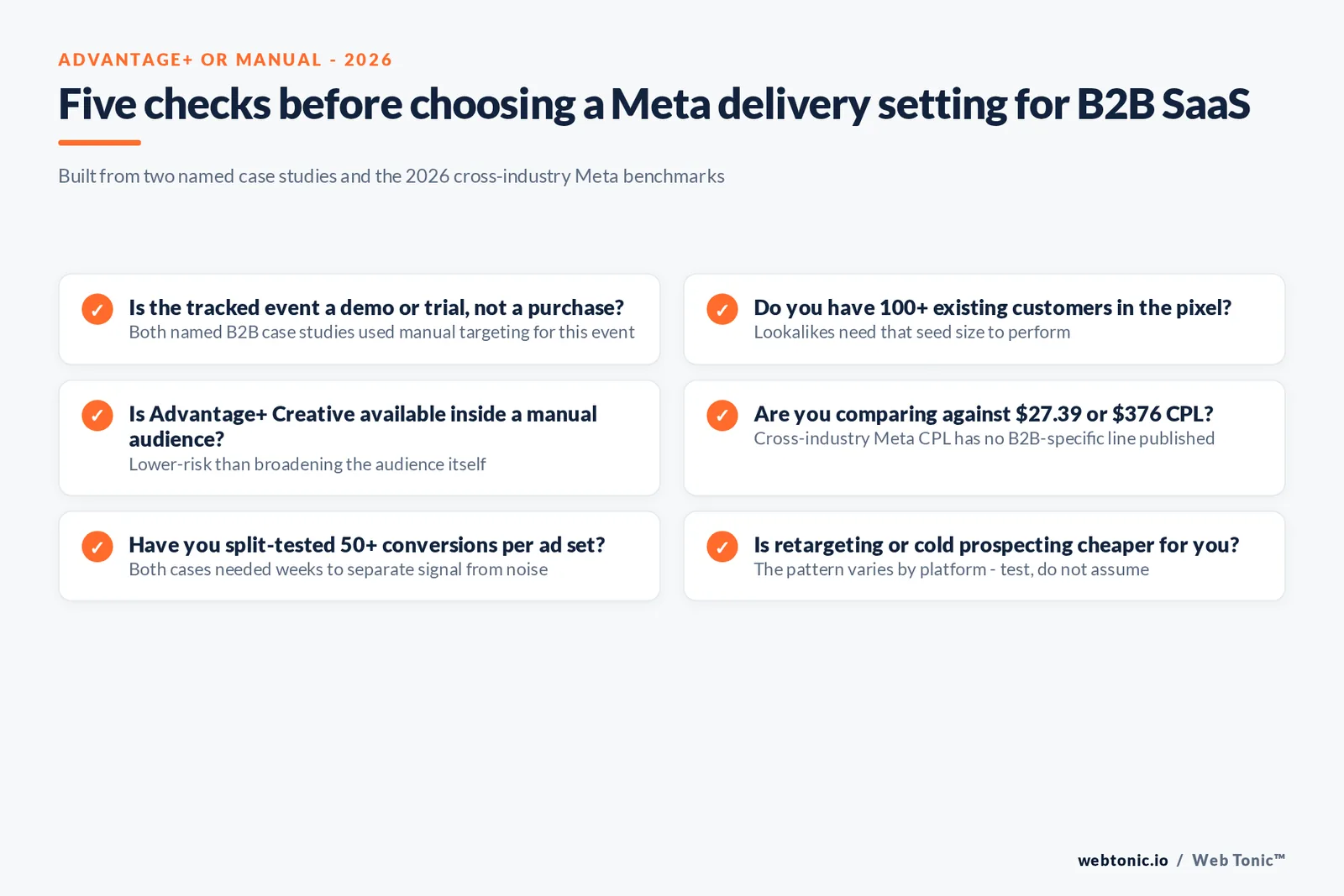
Advantage+ is built to find whoever is statistically likely to trigger the tracked conversion event across Meta's full user base - a strength when that event is a purchase with a strong, high-volume signal, which is why the DTC ecommerce Advantage+ studies exist and the B2B ones largely do not. A demo request or trial signup from a specific job title at a specific company size is a rarer, thinner signal, and both case studies above hit their numbers by explicitly constraining delivery to job titles, interest clusters and lookalikes of existing customers rather than letting Meta broaden automatically.
That is a reasonable mechanism, not proof that Advantage+ cannot work for B2B - only that the accounts willing to publish real numbers so far chose manual delivery for the audience layer while still using automated tools elsewhere in the stack.
| Delivery approach | What it optimizes for | Best-evidenced use case | Where to test it first |
|---|---|---|---|
| Advantage+ Audience | Broadest reach against the tracked event | High-volume DTC purchase events | Retargeting warm site visitors, not cold prospecting |
| Advantage+ Creative | Automated asset/copy combinations | Any account with 3+ creative variants | Inside a manually defined B2B audience |
| Manual, job-title/interest targeting | Precision on a defined buyer persona | B2B demo and trial funnels (both case studies above) | Cold prospecting to a named ICP |
| Manual lookalikes of customers | Extends a small seed list | Accounts with 100+ existing customers in Meta's pixel | Mid-funnel, post-awareness |
What a realistic test budget looks like
Neither named case study started with a large monthly budget: Bay Leaf Digital's full three-stage funnel ran on $3,061 across 60 days, and Creekside Marketing's account built its 417 demos across 16 months of steady, incremental spend rather than a single large launch. That pacing matters more than the delivery setting - Advantage+ or manual - because Meta's own optimization, whichever audience layer it runs against, needs a minimum volume of conversion events before it can learn reliably.
| Test budget tier | Suggested monthly spend | What to expect first | Delivery setting to start with |
|---|---|---|---|
| Pilot | $1,500-3,500 | Awareness and early form fills, thin sample | Manual, narrow ICP |
| Early scale | $3,500-10,000 | Enough volume to compare CPL by ad set | Manual vs. Advantage+ Creative split |
| Established | $10,000-30,000 | Statistically stable CPL and CPA trends | Test Advantage+ Audience on a slice |
| Scaled | $30,000+ | Enough volume to trust an audience-layer test | Formal split test, both settings live |
The AI layer changing how this gets tested
The CMO Survey 2026 found AI use across marketing activities rising from 13.1% to 24.2%, with generative AI specifically more than tripling from 7.0% to 22.4%. That adoption curve is exactly why Advantage+ Creative - the automated asset-combination layer, not the audience-broadening layer - is the lower-risk starting point: it still runs inside whatever audience you define manually.
On the buyer side, TrustRadius's 2026 B2B Buying Disconnect Report, based on 1,862 technology buyers, found 63% used AI to research a software purchase and 94% of those fact-checked the output - a reminder that a Meta ad, whichever way it is targeted, is one input into a research process the buyer is actively cross-checking elsewhere. G2's 2026 Buyer Behavior Report adds that nearly half of B2B software buyers have had an approved purchase vetoed by their own CFO in the past year, which is one more reason a low Meta cost per lead is not the same thing as a closed customer.
How to run your own test before committing budget
Split the audience layer, not the whole account: run one ad set with Advantage+ Audience switched on against your existing creative, and one ad set with a manually defined ICP (job title, company size, lookalike of paying customers), holding budget and creative equal. Give each at least 50 conversions before reading results - both of the case studies above needed several weeks to accumulate enough volume to separate signal from noise. Our performance creative team and Meta Ads practice run this split test as the first step on every new B2B SaaS account before recommending a delivery setting; talk to us if you want that test built around your own ACV and funnel stages.
If your account has under 100 pixel-tracked customers, skip lookalikes and Advantage+ Audience entirely for now - neither has enough seed data to work well, per the case studies' own audience construction - and put the budget into the job-title and interest-based manual targeting that both named cases used to hit their numbers.
| Signal to watch before scaling a delivery setting | Manual targeting | Advantage+ | Why it matters |
|---|---|---|---|
| Cost per lead in week 1-2 | Often higher, more predictable | Can spike then settle | Manual gives an earlier read |
| Lead quality (sales-accepted rate) | Higher in both named cases | Unverified for B2B SaaS | Track downstream, not just CPL |
| Volume ceiling | Capped by audience size | Broader, can scale faster | Matters once demand outstrips supply |
| Learning phase stability | Faster with a defined seed | Needs more raw conversions | Both need 50+ events per ad set |
For a cross-channel reference point, Metadata's 2026 B2B benchmark data puts LinkedIn's median cost per lead at $376 across the same kind of B2B buyer - useful context for deciding how much of a demo-gen budget to test on Meta at all.
Frequently Asked Questions
Does Meta Advantage+ outperform manual targeting for B2B SaaS?
There is no publicly available, methodologically transparent study that isolates Advantage+ against manual targeting for B2B SaaS specifically - most of the circulating comparison numbers trace back to DTC ecommerce shopping-campaign studies, not B2B lead generation. What is verifiable is that B2B SaaS case studies with strong results (Bay Leaf Digital's $15 cost per lead, Creekside Marketing's 417 booked demos) both used manual, funnel-mapped targeting - job titles, interest clusters and lookalikes - not broad Advantage+ delivery. That is evidence, not proof either way.
What does Meta charge for a lead in 2026, on average?
WordStream's 2026 Facebook Ads Benchmarks report, covering roughly 1,800 US campaigns, puts the median cost per lead at $27.39 and median lead-campaign click-through rate at 2.70%, with a median cost per click of $1.80 for lead objectives. There is no B2B Software or Technology line in that report - Business Services appears only in the traffic-campaign table, not the lead table - so treat $27.39 as a cross-industry floor, not a software-specific number.
Why would manual targeting beat Advantage+ for a B2B SaaS demo funnel?
Advantage+ is built to find whoever is statistically likely to convert on the tracked event across Meta's full user base, which works well when the event is a purchase with a clean signal. A demo request from a narrow buyer persona (a specific job title at a specific company size) is a rarer, thinner signal, and case studies that hit low B2B cost per lead did it by explicitly targeting job titles, interest clusters and lookalikes of existing customers rather than letting delivery broaden automatically.
Should a B2B SaaS account ever use Advantage+ at all?
The CMO Survey 2026 shows AI adoption inside marketing activities rising from 13.1% to 24.2% of tasks, with generative AI specifically more than tripling from 7.0% to 22.4%. Advantage+ Creative (automated asset combinations) is a reasonable place to start, since it still runs against an audience you define; Advantage+ Audience, which broadens targeting automatically, is the riskier layer for a narrow B2B buyer persona and is the one worth A/B testing against a manual audience before committing full budget to it.
What is a realistic B2B SaaS cost per lead to plan around on Meta?
Bay Leaf Digital's published case study for a low-ACV B2B SaaS client delivered 209 qualified leads at $15 each and 11 trials at $278 each on $3,061 in spend across 60 days, using a three-stage funnel (video awareness, eBook mid-funnel, demo-request bottom-funnel). Creekside Marketing's case study for a B2B medical AI SaaS client cut cost per booked demo to $59-89 in its best ad sets against a $250-plus starting point. Both sit well below the $27.39 cross-industry median cost per lead, which shows what a tightly built, funnel-mapped B2B account can do relative to the market average - but both are single client results, not benchmarks.
Sources
PPC Land - WordStream 2026 Facebook Ads Benchmarks coverage
WordStream - Facebook Ads Benchmarks (methodology reference)
Bay Leaf Digital - Full-funnel Meta case study, low-ACV B2B SaaS
Creekside Marketing - B2B medical AI SaaS Meta Ads case study
The CMO Survey - Highlights and Insights Report 2026
TrustRadius - 2026 B2B Buying Disconnect Report
G2 - 2026 Buyer Behavior Report
Metadata - LinkedIn Ads Cost for B2B in 2026