Table of contents
LinkedIn's spend-weighted B2B cost per lead is $202, but the typical advertiser paid $376 - nearly double. This page separates that distribution from the average, then layers on 2026 research into why the buying group behind the lead is scrutinizing harder and later than the cost-per-lead number alone suggests.
Key Takeaways
- LinkedIn's spend-weighted cost per lead is $202 across 138 advertisers (Metadata, 2025).
- The median advertiser actually paid $376 - the $202 figure sits at the 26th percentile.
- The bottom quarter of advertisers paid over $658 per lead, and the bottom 10% over $1,340.
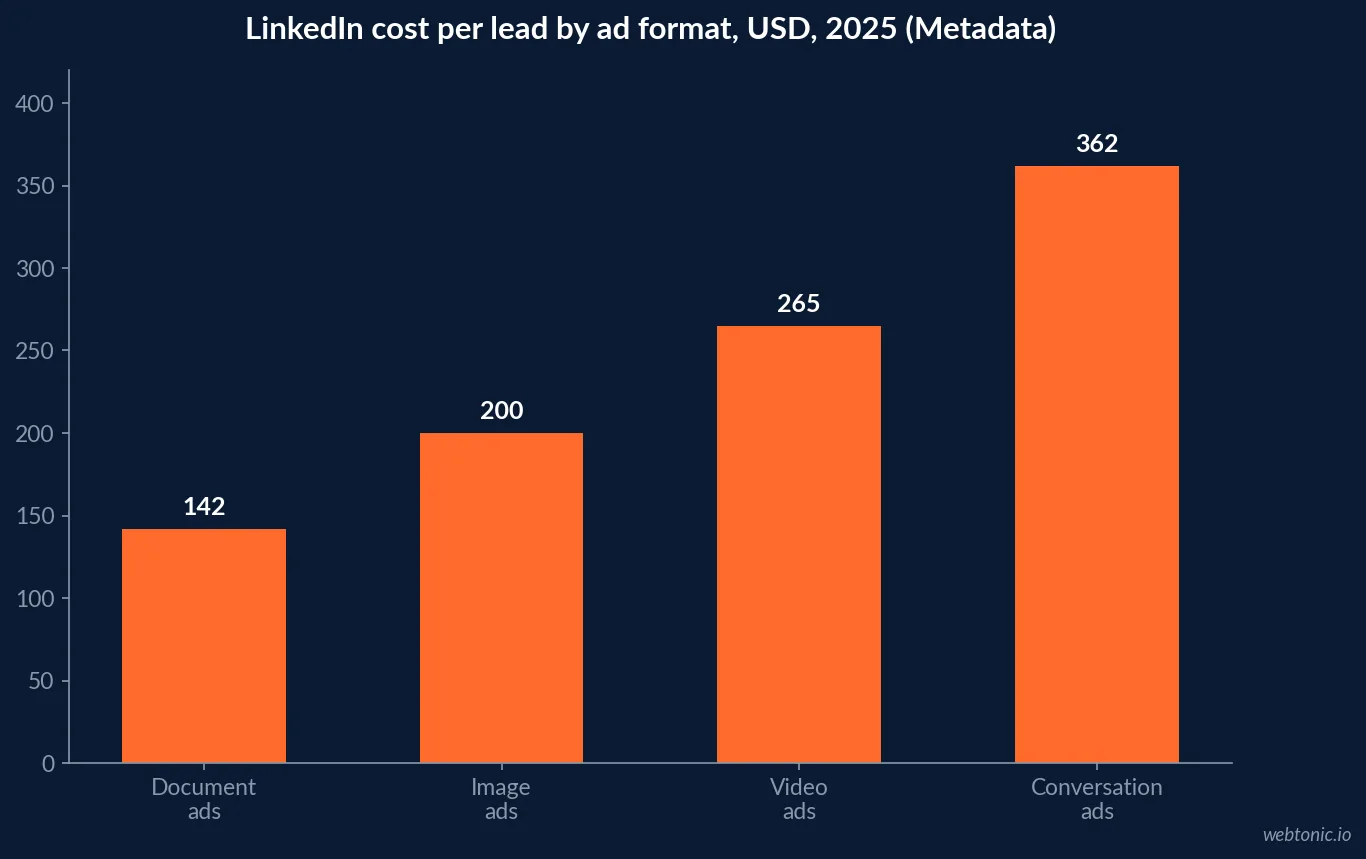
- Document ads cost $142 per lead, the cheapest format, converting at 11.9%.
- Conversation ads cost $362 per lead, the most expensive format tested.
- Native lead-gen forms cost $193 per lead versus $346 sending clicks to a landing page.
- LinkedIn retargeting costs more than cold prospecting: $234 versus $194 per lead.
- Click-through rate averages 0.67% and 5.9% of clicks convert to a lead.
- A LinkedIn lead-gen dollar sources $10.20 of pipeline across tracked advertisers.
- 19.5% of ad-sourced opportunities close won, at an average $58,572 per customer.
- Defensibility ranks above product confidence as B2B buyers' top emotional driver.
- 40% of B2B deals are abandoned over what LinkedIn's research calls Fear of Messing Up.
- Peer recommendations are 3x more influential than product features once vendors clear a basic bar.
- Analyst-report usage in buying decisions fell 63% since 2022, to just 13%.
- 63% of B2B software buyers used AI to research a purchase, and 94% fact-checked it.
- Evaluation, not research, is now the longest buying stage for 40% of software buyers.
- 83% of buyers shortlist three or fewer products before deciding.
The number everyone quotes is not the number to plan against
Metadata's 2026 B2B Advertising Benchmark report, built from 138 advertisers running LinkedIn campaigns in 2025 (part of a wider 153-advertiser, $57.6M dataset producing 211,000 leads), reports a spend-weighted cost per lead of $202 at a 0.67% click-through rate and 5.9% click-to-lead conversion. That headline number, though, sits at only the 26th percentile of individual advertiser results: the typical advertiser paid $376, and the bottom quarter paid more than $658.
The spend-weighted average is dragged down by a handful of very efficient large spenders, which is exactly why most published "average CPL" figures make ordinary advertisers feel like they are underperforming a number almost nobody actually hits. Plan against the distribution, not the headline.
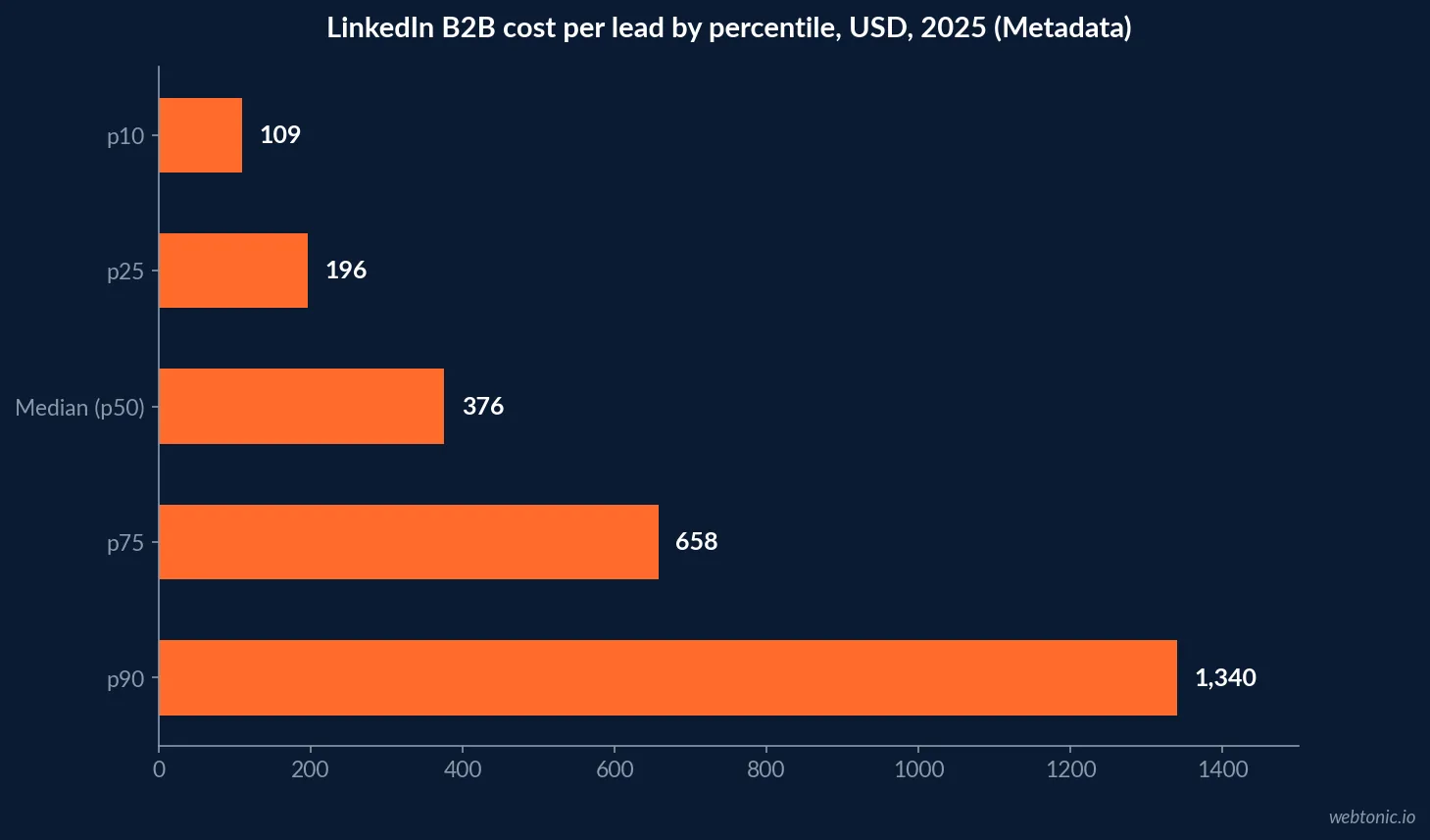
| LinkedIn cost-per-lead percentile (2025) | Value | What it means | Source |
|---|---|---|---|
| p10 | $109 | Top 10% of advertisers | Metadata 2026 Benchmark |
| p25 | $196 | Top quarter | Metadata 2026 Benchmark |
| Median (p50) | $376 | The typical advertiser | Metadata 2026 Benchmark |
| p75 | $658 | Bottom quarter | Metadata 2026 Benchmark |
| p90 | $1,340 | Bottom 10% | Metadata 2026 Benchmark |
| Spend-weighted average | $202 | 26th percentile, not typical | Metadata 2026 Benchmark |
Format and destination move the number more than most creative decisions
Within the same dataset, document ads cost $142 per lead and convert at 11.9% - roughly double the channel average - against $200 for image ads and $265 for video. Conversation ads were the most expensive tested format at $362 per lead. Destination matters just as much: a native lead-gen form produced a lead for $193, while sending the identical click to a landing page cost $346, a 79% premium, across 97 form advertisers and 65 landing-page advertisers.
The trade-off most teams skip is quality: cheaper form leads still need more downstream qualification before they resemble a landing-page lead in sales-readiness, which is exactly why the buyer-scrutiny data later on this page matters as much as the cost-per-lead table.
| LinkedIn lead source (2025 dataset) | Cost per lead | Note | Source |
|---|---|---|---|
| Document ads | $142 | Cheapest format, 11.9% conversion | Metadata 2026 Benchmark |
| Image ads | $200 | Channel-typical format | Metadata 2026 Benchmark |
| Video ads | $265 | Higher cost, awareness-oriented | Metadata 2026 Benchmark |
| Conversation ads | $362 | Most expensive tested format | Metadata 2026 Benchmark |
| Native lead-gen form | $193 | 97 advertisers | Metadata 2026 Benchmark |
| Landing page destination | $346 | 65 advertisers, 79% premium over forms | Metadata 2026 Benchmark |
Retargeting is the expensive audience on this channel
Metadata's data also flips a pattern most paid-social teams assume holds everywhere: LinkedIn retargeting costs $234 per lead against $194 for cold prospecting, across 94 advertisers. On Meta, warm audiences are typically the cheap win; on LinkedIn, a member who has already seen your brand and not converted is a harder sell than one seeing it cold - likely because LinkedIn's professional context makes repeated exposure feel like being sold to at work, not personalized relevance.
Downstream, a LinkedIn lead-gen dollar sourced $10.20 of pipeline across tracked advertisers, with 19.5% of ad-sourced opportunities closing at an average $58,572 per customer - though for companies under 200 employees the ratio improves to 4.0x pipeline per dollar and a 20.7% close rate at a lower $30,739 average customer value, across 29 advertisers. That customer value sits close to the median B2B SaaS deal size implied by Benchmarkit's CY-2025 report, which puts median ARR per employee at $175,000 - a useful sanity check on whether a $58,572 LinkedIn-sourced customer clears your own CAC payback math.
| Pipeline metric (2025, tracked advertisers) | All company sizes | Under 200 employees | Source |
|---|---|---|---|
| Pipeline sourced per ad dollar | $10.20 | $4.00 (n=29) | Metadata 2026 Benchmark |
| Close rate on ad-sourced opportunities | 19.5% | 20.7% | Metadata 2026 Benchmark |
| Average customer value | $58,572 | $30,739 | Metadata 2026 Benchmark |
| Cold prospecting cost per lead | $194 | n/a | Metadata 2026 Benchmark |
| Retargeting cost per lead | $234 | n/a | Metadata 2026 Benchmark |
What the form fill does not prove: the buying group has to agree
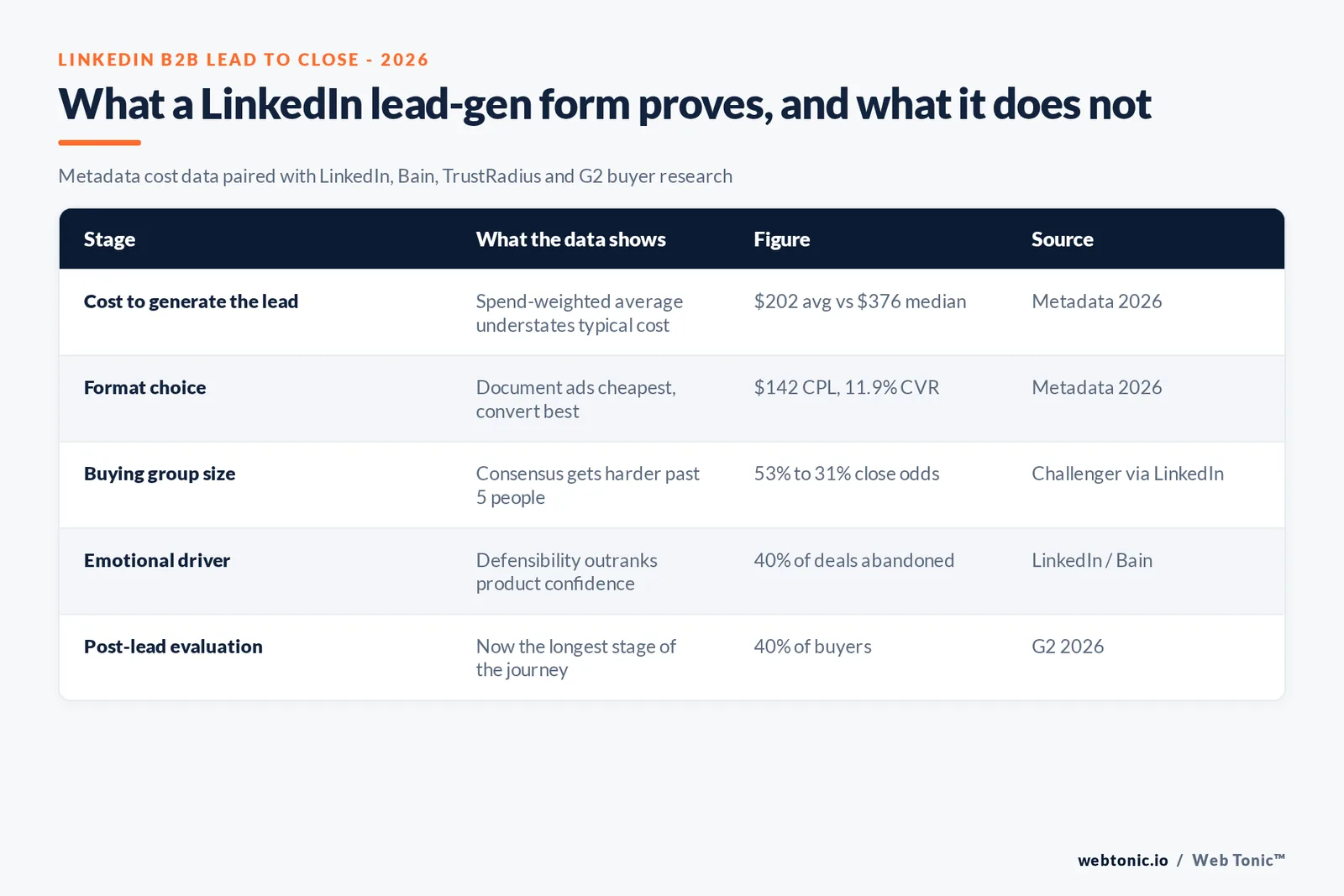
LinkedIn's B2B Institute, partnering with NewtonX and Bain & Company, found that "Hidden Buyers" - procurement, finance and legal stakeholders who rarely engage with ads or content - hold almost equal decision-making influence within a buying group compared to the product-focused "Target Buyer" (49% versus 51%), and are 70% more likely to reject brands they do not already trust. Separately, Challenger's research (cited in the same LinkedIn analysis) found that once a buying group grows past five people, deal completion odds drop from 53% to 31%.
A more recent LinkedIn research series, conducted with Bain and an alliance that includes the ANA and WARC, surveyed 750 multi-territory B2B buyers and found that defensibility - the ability to justify a decision to leadership two years later if it goes wrong - ranks above product confidence as the top emotional driver of a purchase. 40% of B2B deals are abandoned specifically because the buying group cannot clear that bar, a condition the research calls Fear of Messing Up. Once two vendors clear the basic capability threshold, peer recommendations proved more than 3 times as influential as product features in deciding the winner.
| Buyer-scrutiny finding (2026) | Figure | Source |
|---|---|---|
| Hidden Buyer share of decision influence | 49% vs 51% for Target Buyers | LinkedIn B2B Institute / Bain / NewtonX |
| Hidden Buyers rejecting untrusted brands | 70% more likely | LinkedIn B2B Institute |
| Deal completion odds past a 5-person buying group | 53% to 31% | Challenger, via LinkedIn |
| B2B deals abandoned over defensibility ("FOMU") | 40% | LinkedIn / Bain Buyability research |
| Peer recommendation influence vs. product features | 3x more influential | LinkedIn / Bain Buyability research |
What happens after the lead, per two 2026 buyer surveys
TrustRadius's 2026 B2B Buying Disconnect Report, surveying 1,862 technology buyers and 444 vendors, found analyst-report usage in purchase decisions down 63% since 2022, to just 13%, while 63% of buyers used AI during their research and 94% of those fact-checked the AI output before acting on it. Buyers also shortlisted conservatively: 83% considered three products or fewer.
G2's 2026 Buyer Behavior Report, based on more than 1,000 B2B software buyers plus interviews with 50-plus sales and marketing leaders, found evaluation is now the longest stage of the buying journey for 40% of buyers, ahead of research (36%) and final decision (22%). More than 80% of buyers sourced software recommendations from an AI chatbot in the past two years, and nearly half say their CFO vetoed an already-approved purchase in the last year.
| Post-lead buying behavior (2026) | Figure | Source |
|---|---|---|
| Analyst-report usage in purchase decisions | 13% (down 63% since 2022) | TrustRadius 2026 |
| Buyers who used AI to research a purchase | 63% | TrustRadius 2026 |
| Of those, buyers who fact-checked AI output | 94% | TrustRadius 2026 |
| Buyers shortlisting 3 products or fewer | 83% | TrustRadius 2026 |
| Evaluation as the longest buying stage | 40% of buyers | G2 2026 Buyer Behavior Report |
| Buyers sourcing recommendations from AI chatbots | 80%+ | G2 2026 Buyer Behavior Report |
| CFO vetoed an approved purchase in the last year | ~50% of buyers | G2 2026 Buyer Behavior Report |
What this means for a LinkedIn budget and a sales handoff
The budget conversation should also account for where LinkedIn sits inside the total marketing pool: The CMO Survey 2026 reports marketing spend growth of just 1.7% year over year, which means a bigger LinkedIn line is very likely a smaller Google Ads or Meta line, not new money.
Two conclusions follow directly from the data above. First, budget against the $376 median, not the $202 average, when forecasting - and treat sub-$200 cost per lead as a strong result worth protecting, not a baseline to expect from day one. Second, treat the lead-gen form as the start of a scrutiny process, not the end of one: with evaluation now the longest buying stage and 40% of buying groups still walking away over defensibility concerns, the sales follow-up needs a peer-proof and risk-reversal story ready at first contact, not just a demo booking link. Our growth marketing team and team at Web Tonic build that handoff sequence alongside the LinkedIn media plan itself; get in touch to see how your account compares to the distribution above.
Given that retargeting under-performs cold prospecting on this specific channel, resist the instinct to pour a second budget line into remarketing warm form-abandoners; the data argues for spending that increment on reaching new cold accounts in your ICP instead. For a cross-channel comparison, Meta's cross-industry median cost per lead sits at $27.39 (WordStream 2026) - lower on paper, but with no B2B-specific line published, while LinkedIn's $376 median at least carries a transparent, B2B-only sample behind it.
Frequently Asked Questions
What does a LinkedIn lead actually cost for B2B SaaS in 2025-2026?
Metadata's 2026 B2B benchmark report, built from 153 advertisers who spent $57.6M and produced 211,000 leads in 2025, puts LinkedIn's spend-weighted cost per lead at $202 - but that figure sits at only the 26th percentile. The median advertiser paid $376, nearly double, and the bottom quarter paid more than $658. If your account is paying $202, you are already outperforming three out of four advertisers in the dataset, not hitting a typical number.
Which LinkedIn ad format produces the cheapest B2B leads?
Document ads, at $142 per lead against $200 for image ads and $265 for video, and they convert at 11.9% - roughly double the channel average - per Metadata's 2025 dataset across advertisers running lead-generation campaigns. Conversation ads were the most expensive format at $362 per lead.
Do LinkedIn lead-gen forms beat sending clicks to a landing page?
Yes, by a wide margin: Metadata's data shows a native lead-gen form produces a lead for $193, while sending the same click to a landing page costs $346, a 79% premium. That comparison covers 97 form advertisers and 65 landing-page advertisers in the 2025 dataset. The trade-off is lead quality, which the same research does not resolve in the form's favor - form leads typically need more sales qualification.
Why do B2B SaaS deals stall even after a good lead-gen number?
Because the form fill is not the buying group. LinkedIn's own research with Bain & Company and NewtonX, surveying 750 multi-territory B2B buyers, found that defensibility - the ability to justify a purchase decision to leadership if it goes wrong - ranks above product confidence as the top emotional driver of a B2B purchase, and 40% of B2B deals are abandoned specifically because the buying group cannot clear that bar. TrustRadius's 2026 B2B Buying Disconnect Report separately found analyst-report usage down 63% since 2022, while G2's 2026 Buyer Behavior Report found evaluation, not initial research, is now the longest stage of the journey for 40% of software buyers.
Is retargeting cheaper than cold prospecting on LinkedIn?
No - and this is the opposite of the pattern on Meta. Metadata's data shows LinkedIn retargeting costs $234 per lead against $194 for cold prospecting, across 94 advertisers. On LinkedIn, a warm audience that has already seen your brand and not converted appears to be a harder sell than a cold one seeing it for the first time, which argues for weighting fresh prospecting over remarketing budget on this channel specifically.
Sources
Metadata - LinkedIn Ads Cost for B2B in 2026 (CPL, CPC, CPM, distribution)
Metadata - B2B Advertising Benchmarks 2026 (cross-channel)
LinkedIn B2B Institute - The Hidden Buyer Gap
PPC Land - LinkedIn/Bain Buyability research coverage
TrustRadius - 2026 B2B Buying Disconnect Report
G2 - 2026 Buyer Behavior Report
WordStream - Facebook Ads Benchmarks (methodology reference)
Benchmarkit - CY-2025 B2B SaaS Performance Metrics Benchmarks
The CMO Survey - Highlights and Insights Report 2026