Table of contents
Most B2B SaaS companies fail Google's own test for a Business Profile before the first review ever gets requested. Google's eligibility guidelines require a business to make in-person contact with customers during stated hours, and they name "brands, organizations, and other online-only businesses" as explicitly ineligible - which describes a pure cloud product with no office anyone can visit. The unit of analysis here is not "the product," it is the company's real HQ and office footprint, and whether that footprint is worth managing in-house or through a vendor.
Key Takeaways
- Google requires in-person contact with customers for Business Profile eligibility.
- Online-only businesses are explicitly listed as ineligible in Google's own guidelines.
- Lead generation agents and companies are also named ineligible for a profile.
- Individual practitioner rules (lawyers, doctors, agents) do not apply to a SaaS company's corporate listing.
- Primary GBP category scores 227 points, the top local ranking factor in Whitespark's 2026 survey - and it still applies to an office listing.
- Completeness of GBP scores 147 points in the same 2026 ranking-factor survey.
- GBPcentral's Starter plan lists at USD 49 a month for one profile.
- GBPcentral's Agency tier lists at USD 349 a month for up to 20 profiles.
- Vendasta's Professional tier carries a USD 499-a-month wholesale minimum.
- Vendasta's Starter tier carries a USD 99-a-month minimum with a one-seat cap.
- GatherUp lists single-location review management at USD 99 a month.
- B2B SaaS sales and marketing spend runs 33% to 47% of revenue in 2025 (Benchmarkit), the budget line a GBP program has to fit inside.
- Median ARR per employee is USD 175,000 in the same 2025 benchmark set.
- An authorized representative must have express owner consent before managing a profile, per Google's own guidelines.
- Video verification is Google's recommended method where it is offered.
Why the eligibility question comes first
Every other GBP decision is downstream of one gate. Google's business eligibility and ownership guidelines state plainly that a business must "make in-person contact with customers" during its stated hours to qualify for a profile, and the published list of ineligible business types names "brands, organizations, artists, and other online-only businesses" and "lead generation agents or companies" directly. A company selling software with no staffed, visitable location fails that test outright - no amount of review management fixes an eligibility problem.
What survives the test is narrower than most SaaS marketing teams assume: a headquarters with a staffed reception, a regional sales office that actually hosts client meetings, or a warehouse/data center with controlled but real staff access. A profile built around any of those locations is eligible. A profile built to rank the product name for "best CRM software" is not what Google's guidelines describe.
| Business type | Eligible for a Business Profile? | Google's stated reason |
|---|---|---|
| Staffed HQ or regional office | Yes | Makes in-person contact with customers during stated hours |
| Sales or leasing office | Yes | Explicitly listed as eligible even for otherwise ineligible property types |
| Pure cloud product, no office | No | Online-only businesses are explicitly ineligible |
| Lead-gen or affiliate operation | No | Lead generation agents or companies are explicitly ineligible |
| Warehouse/data center with staff access | Conditional | Eligible if staffed and reachable during stated hours |
| P.O. box or remote mailbox address | No | Remote mailbox addresses are explicitly ineligible |
What Google's own guidelines say a profile represents
Google's guidelines for representing your business on Google define an individual practitioner as "a public-facing professional, typically with their own customer base," naming doctors, lawyers, and real estate agents. That structure does not map onto a SaaS company's account executives or customer success managers - they are not individual practitioners under Google's definition, and giving each rep their own listing would violate the same guidelines that govern law firms and medical practices. A SaaS company gets one corporate profile per eligible office location, not one per salesperson.
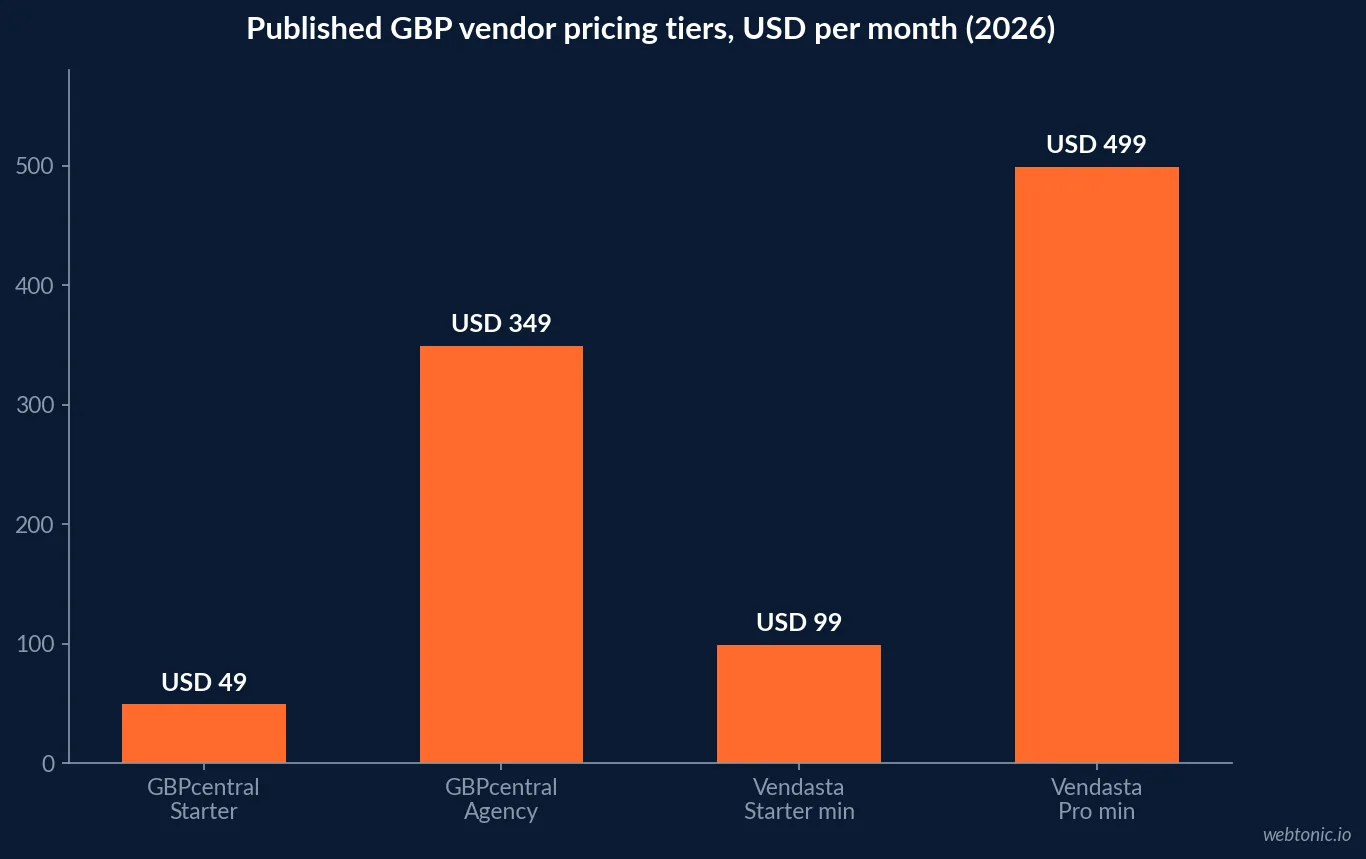
For companies with a single headquarters, that means exactly one decision worth making well: category, completeness, and verification on that one listing. Whitespark's 2026 Local Search Ranking Factors survey still scores Primary GBP Category at 227 points, the single highest-weighted local pack signal it tracks, and Completeness of GBP at 147 points - both apply just as much to a corporate HQ office listing as to a retail storefront.
| Ranking factor (Whitespark 2026) | Score | Applies to an office-only listing? |
|---|---|---|
| Primary GBP Category | 227 | Yes - pick the office's real function, not the product |
| Proximity of address to point of search | 225 | Only relevant if searches are geo-qualified |
| Keywords in GBP business title | 223 | No - do not stuff product keywords into the name |
| Physical address in city of search | 213 | Only relevant for geo-qualified searches |
| Completeness of GBP | 147 | Yes - hours, categories, services, photos all apply |
| Verified GBP | 123 | Yes - verification is mandatory regardless of location type |
The knowledge panel job, not the local-pack job
Most B2B SaaS searches that matter commercially are branded - a prospect typing the company name after a demo, a candidate researching an employer, a journalist checking hours before a call. A verified Business Profile is one of the strongest signals feeding the Knowledge Panel that Google shows for that branded query, carrying logo, hours, address, and aggregate review score. That is a trust signal for a query the company already won, not a discovery signal for buying-intent local keywords the company was never eligible to rank for in the first place.
Treating the profile as a knowledge-panel asset changes what "good" looks like: fewer, better photos of the actual office and team; accurate hours; a filled-out "from the business" description; and Q&A answers that pre-empt the questions candidates and partners actually ask, rather than product FAQ content that belongs on the website.
Pricing DIY against vendor-managed upkeep
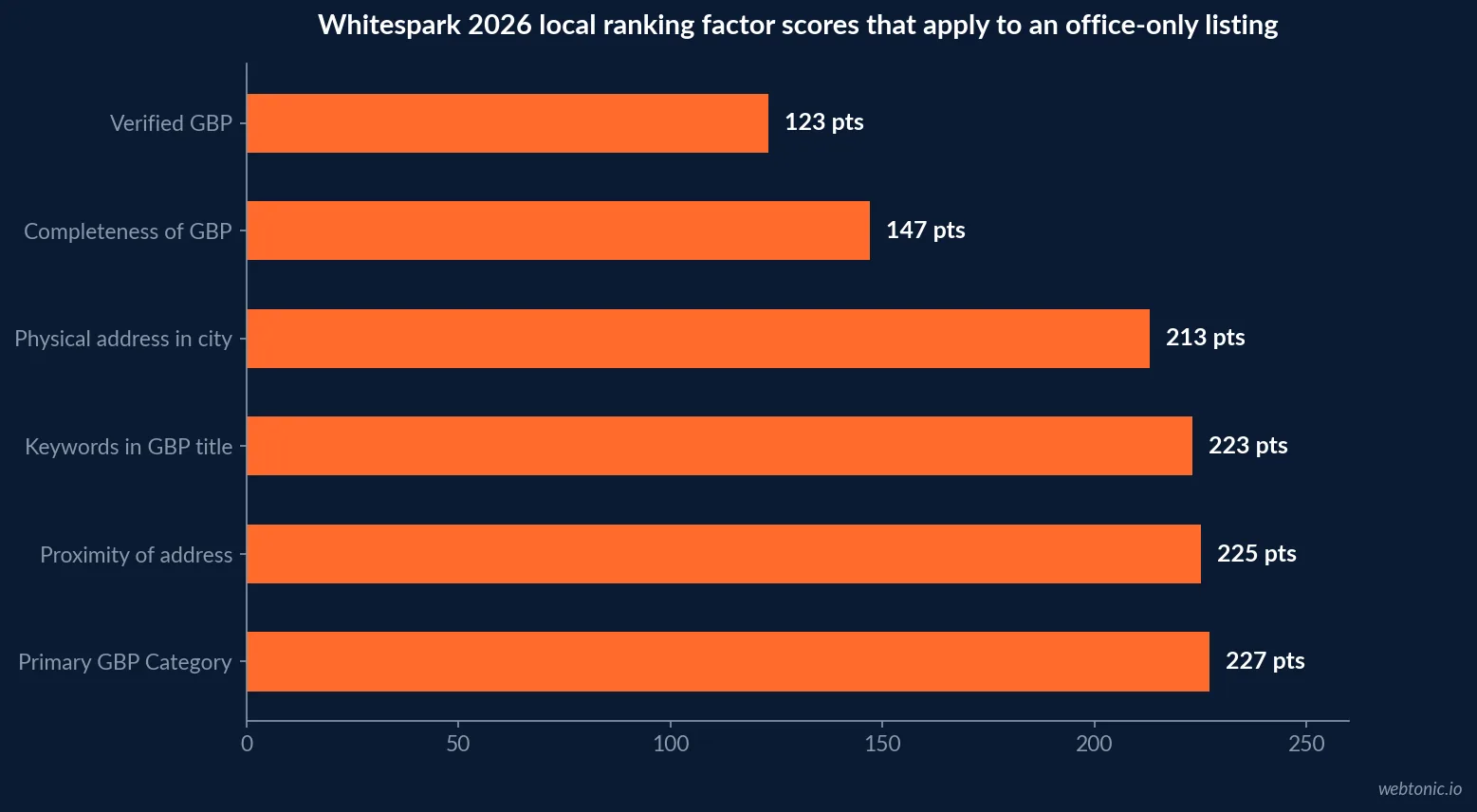
For a single-office company, DIY upkeep is close to free beyond the time it takes. Once a dashboard is worth paying for, GBPcentral's published pricing starts at USD 49 a month for one profile and rises to USD 349 a month for up to 20 profiles with white-label branding - a tier built for an agency, not a single company. Vendasta's published pricing works differently: a USD 99-a-month minimum spend on wholesale products for a single-seat Starter plan, rising to USD 499 a month for five seats and 25 monthly reports on the Professional tier. GatherUp prices single-location review management at USD 99 a month, with multi-location pricing at USD 60 a month per location after the first.
None of these vendors price "SaaS company profile management" as a line item - they price generic local-business software, and a SaaS company buying it is paying for a dashboard, not a specialist.
| Vendor (2026 published pricing) | Entry tier | Higher tier | What scales the price |
|---|---|---|---|
| GBPcentral | USD 49/mo, 1 profile | USD 349/mo, 20 profiles | Number of profiles, white-label branding |
| Vendasta | USD 99/mo minimum, 1 seat | USD 499/mo minimum, 5 seats | Seats and wholesale spend minimum |
| GatherUp | USD 99/mo, 1 location | USD 60/mo per location after that | Number of locations |
| Podium | Not published (sales-quoted) | Not published (sales-quoted) | Quoted per business, not listed |
The in-house case
For a company with one or two eligible office locations, the strongest argument for keeping this in-house is that there is almost nothing to manage: one category, one set of hours, a handful of photos, and periodic Q&A monitoring. That is a marketing coordinator's monthly task, not a specialist's, and paying a USD 349-a-month agency tier built for 20 locations to manage one listing is the same mismatch as buying an enterprise CRM for a two-person sales team.
The in-house case weakens once the company adds recruiting-office listings across multiple cities, opens regional sales offices, or starts fielding suspension appeals - Google's authorized-representative guidelines require anyone managing a profile on the company's behalf to hold express consent and follow strict conduct rules, and an internal team juggling that alongside product marketing tends to let Q&A and photos go stale.
Verification and suspension risk
Google's verification guidelines recommend live video verification where it is offered, requiring the business to show its location, signage, and proof of management access during the call. For a SaaS company's HQ, that is straightforward - a lobby, a sign, a badge reader. The risk is re-verification after an ownership dispute or a policy flag, which can take a listing offline for weeks precisely when a funding announcement or a press cycle is driving branded search volume.
Because eligibility is the more fragile constraint than review volume for this profile type, the practical guardrail is procedural: keep the location's staffing and hours genuinely accurate, keep a named internal owner who can respond to a Google verification request within days, and treat the profile the way a compliance-sensitive HQ asset should be treated, not as a marketing side project.
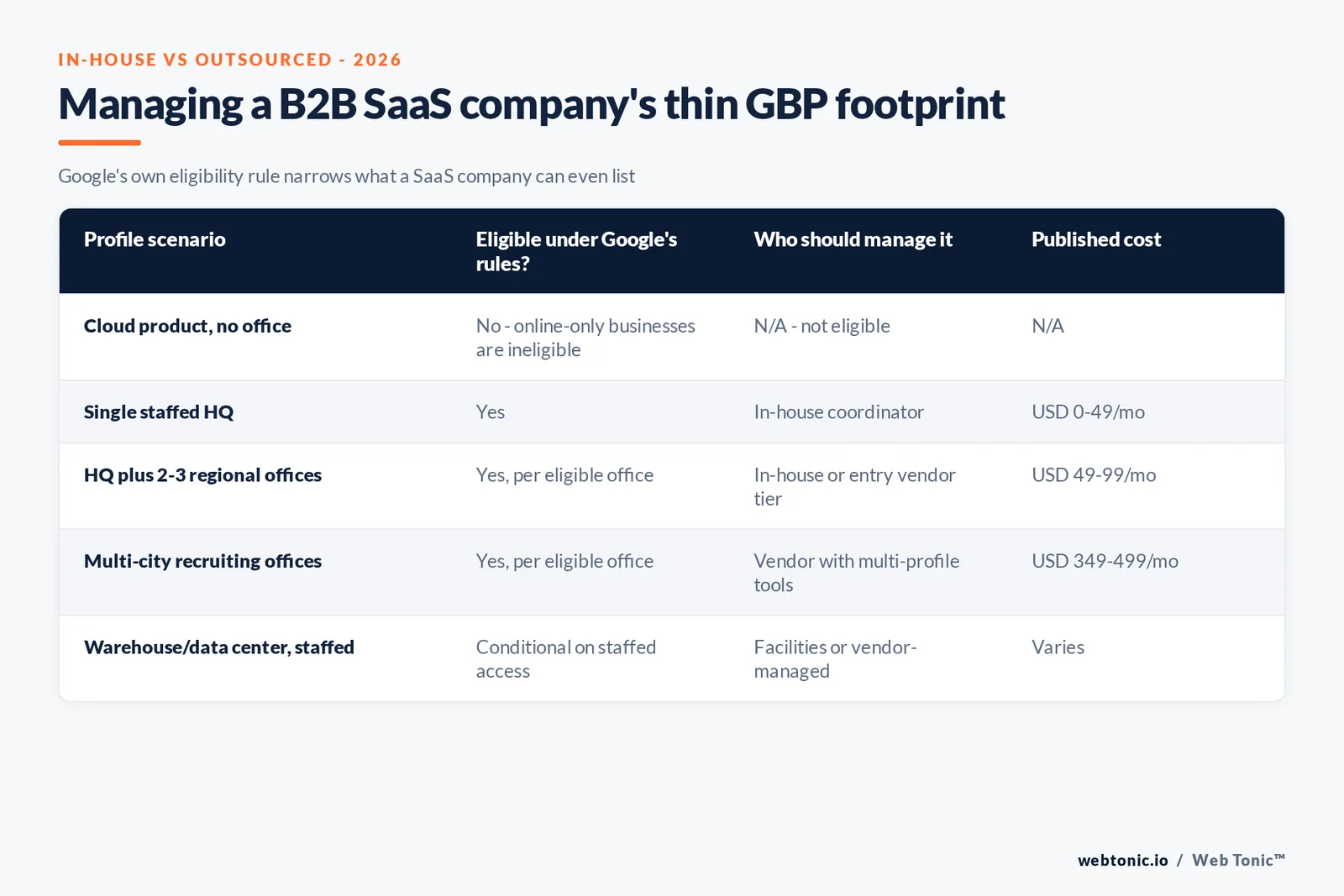
| Decision point | Keep in-house when... | Move to a vendor when... |
|---|---|---|
| Number of eligible office locations | One or two | Three or more, or multi-city recruiting offices |
| Internal capacity | A coordinator can spend under 2 hrs/month | No one owns Q&A, photos, or hours updates |
| Budget fit | Under the vendor's minimum spend tier | Spend already clears the USD 499/mo tier |
| Verification history | Clean, no suspensions | Repeated suspensions or ownership disputes |
| Reporting need | None beyond a glance at reviews | Cross-location reporting for leadership |
Budget context for the decision
Benchmarkit's 2025 SaaS Performance Metrics put sales and marketing expense at 47% of revenue for VC-backed companies versus 33% for PE-backed companies, with median ARR per employee at USD 175,000. Against that budget, a USD 49-to-499-a-month GBP tool is a rounding error - the real cost is the marketing hours spent debating a decision this small, not the subscription itself.
The more expensive mistake is spending those hours trying to make an ineligible product listing look like a local-pack contender. That budget is better redirected toward the channels our own growth marketing practice and paid search cost guide cover, where a SaaS company's buyer actually searches with commercial intent.
Posts, Q&A, and photos on an office-only listing
The features built for retail foot traffic still exist on an office listing, but the content has to match what the profile actually is. Posts work best used for hiring announcements, office moves, or event hosting rather than product updates, which belong on the company blog. The Q&A section is worth monitoring even on low-traffic listings, because Google lets any user post a question, and an unanswered "is this company hiring?" or "do you offer support in person here?" sitting unaddressed for months looks worse than having no Q&A activity at all.
Photos should show the real office - exterior signage, lobby, team spaces - rather than stock imagery or product screenshots, which do nothing for the Knowledge Panel's trust signal and can read as an attempt to dress up a listing that has little foot traffic to document.
| GBP feature | Recommended use for an office-only listing | Recommended avoid |
|---|---|---|
| Posts | Hiring news, office openings, community events | Product feature announcements |
| Q&A | Pre-empt hiring, visiting, and parking questions | Leaving user-submitted questions unanswered |
| Photos | Real exterior, lobby, and team space photos | Stock photography or product screenshots |
| Services/attributes | Accurate hours and accessibility details | Product feature lists |
| Description field | What the office is and who staffs it | Marketing copy aimed at product buyers |
Where review volume still matters, even for a thin footprint
Review signals matter less for a Knowledge Panel play than for a local-pack contest, but they are not irrelevant. BrightLocal's 2026 Local Consumer Review Survey found that 47% of consumers will not consider a business with fewer than 20 reviews, and that 68% expect at least a 4-star average before they trust a listing. For a SaaS company's HQ, those reviews are more likely to come from candidates, visiting partners, and vendors than from product users - which means the review base to build is smaller and slower, but the same trust thresholds apply once someone is looking at the profile.
| BrightLocal 2026 LCRS threshold | Figure | Relevance to an office listing |
|---|---|---|
| Won't use a business with fewer than 20 reviews | 47% | Sets a realistic minimum review target |
| Expect at least a 4-star average | 68% | Applies to whatever review base does accumulate |
| Only trust reviews from the last 3 months | 74% | Argues for periodically prompting recent visitors |
| Expect a business to reply to reviews | 89% | Applies even to a low-volume office listing |
What to check before publishing anything
Confirm each candidate location actually receives people in person during its stated hours, pull the exact category list Google offers for that office type, verify no listing uses a P.O. box or a remote mailbox as its address, and get express written consent on file before letting any outside vendor touch the profile. Skipping any one of these is what turns a small compliance task into a suspension appeal. If the review turns up a genuine local-pack opportunity - a regional office serving walk-in customers, for instance - talk to our team about scoping it properly.
Frequently Asked Questions
Can a B2B SaaS company have a Google Business Profile at all?
Only if a real address makes in-person contact with people during stated hours. Google's own eligibility guidelines require a business to make in-person contact with customers, and they explicitly list brands, organizations, and other online-only businesses as ineligible. A pure cloud product with no office anyone can walk into does not qualify for a profile built around that product; a headquarters, a staffed sales office, or a hiring-facing office location can.
What should the profile actually represent, if not the product?
The office, not the software. Google's guidelines describe eligible locations as ones where a business "makes in-person contact with customers," and for most SaaS companies the only such location is the headquarters reception, a regional sales office that hosts client meetings, or a data center or warehouse with staffed access. Category selection should follow the office's real function - corporate office, software company - not a generic "software" listing built to rank for product keywords it cannot serve.
Does GBP still matter if nobody visits the office?
Yes, but for a narrower job: the branded knowledge panel. A verified profile is one of the strongest signals feeding the Knowledge Panel that appears when someone searches the company name, and it is where candidates, investors, and partners see logo, hours, address, and review signal before they ever open the website. It is a trust layer for brand search, not a local-pack play for buying-intent keywords.
Is DIY or agency-managed cheaper for a company with one or two offices?
For one or two offices, DIY is usually cheaper on paper: GBPcentral's published Starter plan runs USD 49 a month for a single profile. The agency case strengthens fast once a company adds recruiting locations, regional offices, or a channel-partner network - Vendasta's published Professional tier requires a USD 499-a-month wholesale minimum, which only pencils out once there are enough profiles to spread that minimum across.
What is the biggest compliance risk for a SaaS company's GBP?
Losing eligibility outright. Google's authorized-representative rules require any agency managing the profile to have express consent from the business owner and to never make misleading claims, and repeated suspension appeals are the single most common way an under-resourced marketing team loses a profile for months. A named internal or agency owner who actually reads Google's own guidelines before publishing posts or Q&A answers is cheaper than a reinstatement fight.
Sources
Google Business Profile Help - Business eligibility and ownership guidelines
Google Business Profile Help - Guidelines for representing your business on Google
Google Business Profile Help - Verify your business on Google
Whitespark - 2026 Local Search Ranking Factors Report
GBPcentral - GBP management software pricing
Vendasta - Pricing plans
GatherUp - Review software pricing
Benchmarkit - 2025 SaaS Performance Metrics
BrightLocal - Local Consumer Review Survey 2026