Table of contents
A 53-million-email analysis found the average cold outbound reply rate sitting at 3.7% - while the top 1% of campaigns reached 15% to 30% sending the same channel to the same buyers. For B2B SaaS and tech, that gap is not a volume problem. It is a personalization problem, and generic outbound is the version tech buyers have already learned to filter out.
Key Takeaways
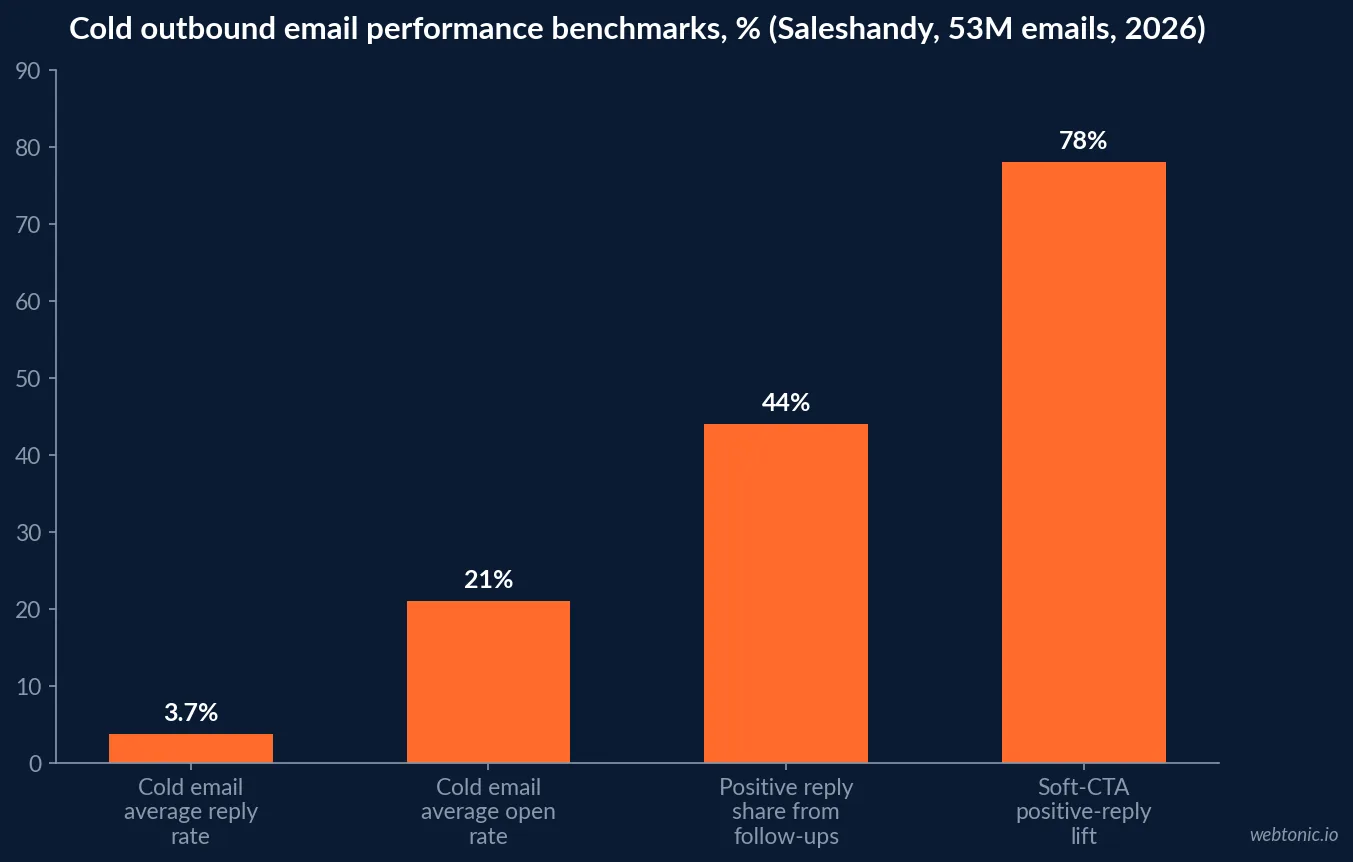
- Average cold email reply rate is 3.7% across 53 million emails sent Jan-Jun 2026 (Saleshandy).
- The top 1% of campaigns reach 15% to 30% reply rates - 4 to 8x the average.
- SaaS was the most responsive industry in the dataset, ahead of Information Services and eCommerce.
- Average cold email open rate is 21%.
- Small, hyper-personalized segments under 200 prospects get nearly 2x more replies than large sends.
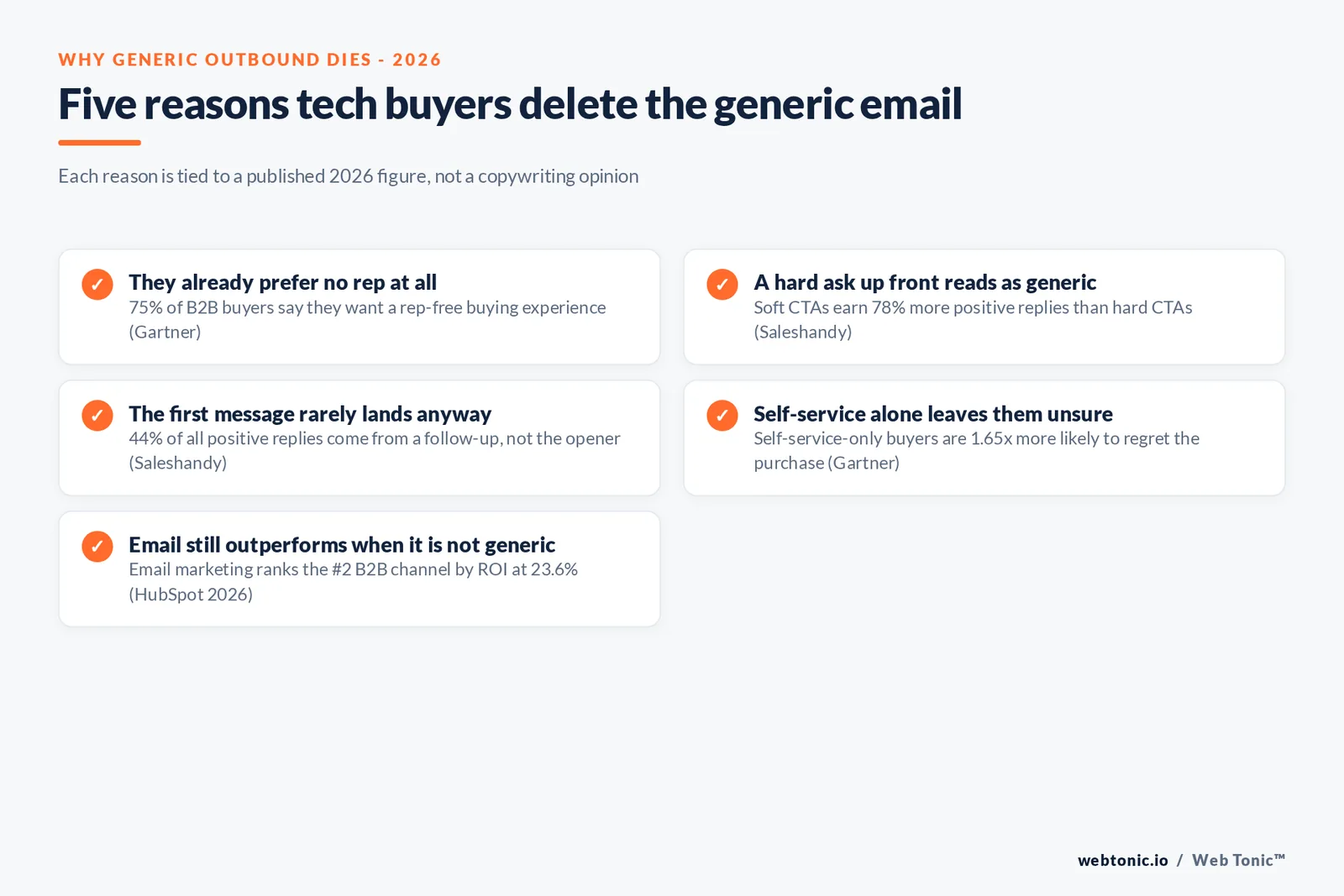
- Soft CTAs generate 78% more positive replies than hard CTAs.
- 44% of all positive replies come from a follow-up, not the opening email.
- The first follow-up alone drives 26% of all positive replies.
- Verified prospect lists bounce 40% less than unverified lists.
- Google Workspace delivers 97% of cold emails analyzed in the study's deliverability sample.
- 75% of B2B buyers prefer a rep-free purchase experience (Gartner).
- Self-service-only buyers are 1.65x more likely to regret a purchase than rep-led buyers.
- Email marketing is the #2 B2B channel by usage, at 39.3% of B2B marketers (HubSpot).
- Email marketing ranks #2 by ROI at 23.6%, behind only website/blog/SEO.
- Email-sourced leads convert lead-to-MQL at 43%, the strongest of any channel measured (First Page Sage).
The average hides where the real gap is
Saleshandy's analysis of 53 million cold emails, sent between January and June 2026, found an average reply rate of 3.7%, with most campaigns landing between 3% and 5%. The top 1% of campaigns reached 15% to 30% - four to eight times the average, sending the same channel to comparable buyers. SaaS generated the highest reply rates of any industry the study measured, ahead of Information Services and eCommerce, while Financial Services and Real Estate produced the lowest engagement.
That spread is the whole story: cold email is not broken as a channel for B2B tech, but the median execution of it is.
| Performance tier | Reply rate range | What separates it from the average |
|---|---|---|
| Top 1% of campaigns | 15%-30% | Small, hyper-personalized segments + soft CTAs |
| Top 5% of campaigns | 11%-15% | Verified lists, structured follow-up cadence |
| Average campaigns | 3%-10% | Larger lists, mixed personalization |
| Dataset-wide average | 3.7% | All 53M emails analyzed, Jan-Jun 2026 |
Why tech buyers filter out the generic version
The Gartner B2B Buying Report finds 75% of B2B buyers prefer a rep-free purchase experience. A cold email that opens with a generic pitch is the clearest possible signal that the sender has not earned an exception to that preference - it reads as exactly the kind of interruption the buyer already decided to avoid.
Gartner's data also complicates the simple "buyers hate reps" reading: buyers who complete a purchase entirely through self-service digital channels are 1.65x more likely to report purchase regret than rep-led buyers, and a rep-plus-digital path is 1.8x more likely to close a high-quality deal than either alone. The lesson for email is specific - do not disappear, but earn the right to show up with something the buyer could not get from self-service alone.
| Purchase path | Relative purchase regret | Relative high-quality-deal likelihood |
|---|---|---|
| Self-service digital only | 1.65x baseline | 1x (baseline) |
| Traditional, rep-led | 1x (baseline) | 1x (baseline) |
| Rep-assisted digital commerce | Roughly half of self-service-only | 1.8x self-service alone |
What actually earns a reply, mechanically
Saleshandy's dataset isolates the specific mechanics that separate the top-performing campaigns from the average. Hyper-personalized campaigns sent to fewer than 200 prospects generated nearly 2x more replies than broad, unsegmented sends. Emails with one clear, soft call to action generated 78% more positive replies than emails asking for a hard commitment up front, and emails with multiple competing CTAs performed worst of all. 44% of all positive replies came from a follow-up, not the opening message, with the first follow-up alone responsible for 26% of all positive replies in the dataset.
List quality compounds all of it: verified prospect lists bounced 40% less than unverified lists, protecting the sender reputation the entire sequence depends on.
| Tactic | Measured effect | Source |
|---|---|---|
| Segment to under 200 hyper-personalized prospects | ~2x more replies than broad sends | Saleshandy 2026 |
| Use one clear, soft CTA instead of a hard ask | +78% more positive replies | Saleshandy 2026 |
| Send a structured follow-up sequence | 44% of all positive replies come from follow-ups | Saleshandy 2026 |
| Verify the prospect list before sending | 40% lower bounce rate | Saleshandy 2026 |
| Route revenue-critical leads to nurture, not one-off blasts | 43% lead-to-MQL, the strongest channel measured | First Page Sage 2025 |
Deliverability is the layer that decides whether any of this matters
None of the reply-rate or personalization data above matters if the email never reaches an inbox. In Saleshandy's deliverability sample, Google Workspace handled 44% of all cold emails sent and Microsoft 365 handled 33%, with the remaining 23% split across Zoho, Azure and custom SMTP setups. Custom SMTP and Azure-based setups achieved the lowest bounce rate in the dataset, at 1.80% - a reminder that sender infrastructure is a variable a B2B SaaS team controls directly, unlike buyer behavior.
Verified prospect lists bounced 40% less than unverified lists in the same dataset, which compounds with infrastructure choice: a clean list on a well-configured sending domain protects the sender reputation the entire outbound program depends on, while a bad list on a shared domain can quietly suppress deliverability for every campaign that follows it.
| Email service provider | Share of cold emails sent | Deliverability note |
|---|---|---|
| Google Workspace | 44% | Most widely used ESP in the sample |
| Microsoft 365 | 33% | Second most widely used |
| Zoho / Azure / custom SMTP | 23% combined | Custom SMTP and Azure had the lowest bounce rate, 1.80% |
Where email still ranks, once it is done right
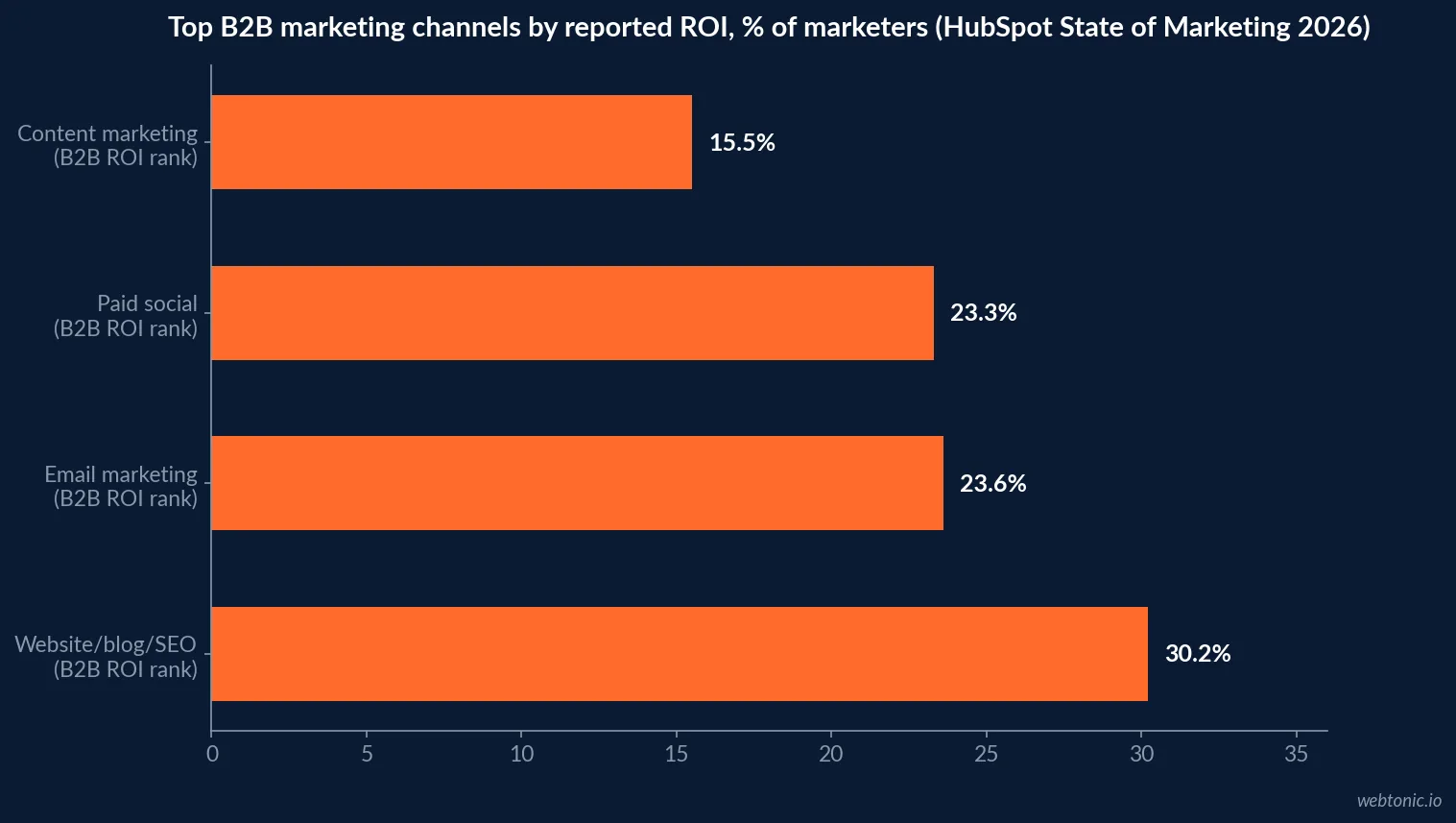
HubSpot's 2026 State of Marketing data ranks email marketing as the #2 B2B channel both by usage (39.3% of B2B marketers) and by reported ROI (23.6%), trailing only website/blog/SEO on both measures. Further down the funnel, First Page Sage's benchmark data shows email-sourced leads converting lead-to-MQL at 43%, the strongest rate of any channel the study measured - ahead of SEO, LinkedIn, webinar and PPC.
Read against Sagefrog's finding that bandwidth (22%) and speed (18%) are the top reasons B2B teams reach outside for marketing help, the practical reading is: cold outbound earns attention at the top of the funnel in small, well-researched batches, and nurture email - built on the same personalization discipline - is what actually converts the leads it produces.
A sending cadence built from the data, not a guess
Saleshandy's dataset also breaks down reply volume by follow-up step, which gives a concrete cadence to plan against rather than an arbitrary "send three follow-ups" rule of thumb. Positive replies decay with each additional touch, but they do not disappear - which argues for a fixed, short sequence rather than either a single blast or an indefinite drip.
| Email step | Total replies | Positive replies | % of all positive replies |
|---|---|---|---|
| Follow-up 1 | 116,920 | 15,626 | 26.41% |
| Follow-up 2 | 60,473 | 6,436 | 10.88% |
| Follow-up 3+ | 30,063 | 4,276 | 7.23% |
| Opening email (implied remainder) | - | - | ~55.5% |
The budget scrutiny email has to survive
G2's 2026 Buyer Behavior Report finds budget approval is cited by 39% of buyers as a deal-slowing factor, rising to 50% among enterprise buyers, and finance involvement in software purchases jumped from 31% to 46% in a single year. A nurture email that cannot answer a cost or ROI question head-on is competing against that scrutiny with nothing. Benchmarkit's CY-2025 data puts median B2B SaaS customer acquisition cost payback at 16 months - a number worth putting in the nurture sequence itself, since it is exactly the kind of proof point the G2 data says now gets asked for earlier in the deal.
What this means for a B2B SaaS email program
Budget cold outbound as a small-batch, high-personalization channel, not a volume play - the data says a tighter list with a soft CTA and a real follow-up cadence beats a broader blast by multiples. Route the leads it produces into a nurture sequence rather than treating cold and lifecycle email as one program, since the two convert on entirely different mechanics. Our growth marketing team builds that split intentionally, and our breakdown of how B2B teams evaluate an email marketing partner is a useful next read if you're deciding whether to build this in-house or bring in help.
Frequently Asked Questions
What is a realistic cold email reply rate for B2B SaaS in 2026?
Saleshandy's analysis of 53 million cold emails sent between January and June 2026 found an average reply rate of 3.7%, with most campaigns landing between 3% and 5%. The top 1% of campaigns reached 15% to 30%, and SaaS was the single most responsive industry in the dataset - so the gap between average and excellent is personalization and targeting, not the channel itself.
Why do B2B tech buyers ignore generic cold outbound?
Because they have already decided they would rather not deal with a rep at all. Gartner's B2B Buyer Survey finds 75% of B2B buyers prefer a rep-free purchase experience, and a generic, unpersonalized cold email is the clearest possible signal that the sender has not done the work to earn an exception to that preference.
Does personalization actually change reply rates, or is that a myth?
Saleshandy's data says it changes them substantially. Hyper-personalized campaigns sent to fewer than 200 prospects generated nearly 2x more replies than broad, large-list sends, and emails with one clear, soft call to action generated 78% more positive replies than emails with a hard, immediate ask. Follow-up emails, not the opener, generated 44% of all positive replies in the dataset.
Where does email marketing actually rank against other B2B channels?
High, but second to organic content. HubSpot's 2026 State of Marketing data ranks email marketing as the #2 B2B channel both by usage (39.3% of B2B marketers) and by reported ROI (23.6%), trailing only website/blog/SEO on both measures. Email is not the top channel, but it is a close second, and it pairs unusually well with SEO-driven content in a nurture sequence.
Should a SaaS company invest in cold outbound or lifecycle nurture email?
Both, for different jobs. Cold outbound at Saleshandy's measured 3.7% average reply rate is a top-of-funnel prospecting tool that rewards small, personalized segments. Lifecycle and nurture email works further down the funnel, where First Page Sage's benchmark data shows email-sourced leads converting lead-to-MQL at 43%, the strongest rate of any channel measured - a reason to route revenue-critical follow-up into a nurture sequence rather than another wave of generic outbound.
Sources
Saleshandy - Cold Email Statistics: 53 Million Emails Analyzed, 2026
Gartner - B2B Buying Report
HubSpot - Top Marketing Channels of 2026
First Page Sage - Sales Funnel Conversion Rate Benchmarks Report 2025
Sagefrog - 2026 B2B Marketing Mix Report
G2 - 2026 Buyer Behavior Report: The Evaluation Maze
Benchmarkit - CY-2025 B2B SaaS Performance Metrics Benchmarks