



Table of contents
Key Takeaways
- Email generates $36–$42 for every dollar spent in the auto sector, with properly segmented dealership campaigns achieving an even higher ROI of $40–$44 per dollar.
- Automated email campaigns produce $5.47 per recipient versus $0.16 for standard sends — a 34× revenue advantage that makes automation essential for competitive dealers.
- The average open rate for auto industry emails is 39.5%, nearly double the cross-industry average of 21.3%, while click-through rates average 2.9% with a click-to-open ratio of 11.5%.
- UK dealership sales campaigns achieve a 59% open rate, with "We Want Your Car" acquisition emails reaching an extraordinary 83% open rate and 24% click rate.
- 78% of car buyers purchase from the first responder, yet the average dealer response time is 42–47 hours — a gap costing thousands in lost conversions annually.
- A 15,000-customer database can generate $2 million in annual revenue with proper email strategy, while most dealerships achieve only $200,000 from the same list size.
Email ROI and Revenue Benchmarks for Auto Dealers
No channel in the dealership promotion stack matches email for return on investment. According to Demand Local's automotive email statistics, email generates $36–$42 for every dollar spent across industries, with the auto sector performing even better at $40–$44 ROI per dollar when campaigns are properly segmented and automated. This 3,600%+ return makes email the highest-performing channel available to dealerships.
Rework's 2026 dealership email guide puts this in concrete terms: a 15,000-customer database generates $2 million in annual revenue with proper strategy, while most dealers achieve only $200,000 from the same list size. The 10× difference comes down to automation, segmentation, and value-based messaging — not database size. Top-performing dealers run 12–15 distinct campaigns targeting specific customer segments and generate a 38:1 ROI. Compare this to direct mail (18:1), paid search (12:1), or display advertising (8:1).
| Channel | ROI per Dollar Spent | Advantage vs. Email |
|---|---|---|
| Email (Segmented) | $40–$44 | Baseline |
| Email (Standard) | $36–$42 | — |
| Direct Mail | $18 | −57% |
| Paid Search | $12 | −71% |
| Display Ads | $8 | −80% |
Open Rates, Click-Through Rates, and Engagement Metrics
Auto industry emails consistently outperform cross-industry averages on engagement. CuFinder's 2026 automotive manufacturing benchmarks report an average open rate of 24.8% with a CTR of 2.9%, a click-to-open ratio (CTOR) of 11.5%, an unsubscribe rate of 0.18%, and a bounce rate of 0.6%. CuFinder's broader auto retail data shows the sector-wide open rate reaching 39.5% — nearly double the cross-industry average.
Rework provides dealership-specific numbers: permission-based customer emails achieve open rates of 22–28% compared to 15–18% for cold outreach. Click-through rates average 3.2% for permission-based lists versus 0.8% for non-permission campaigns. The takeaway is clear — auto emails perform well because they carry high relevance: service reminders, recall notices, and model updates that directly affect the vehicle owner.
Campaign-Level Performance by Message Type
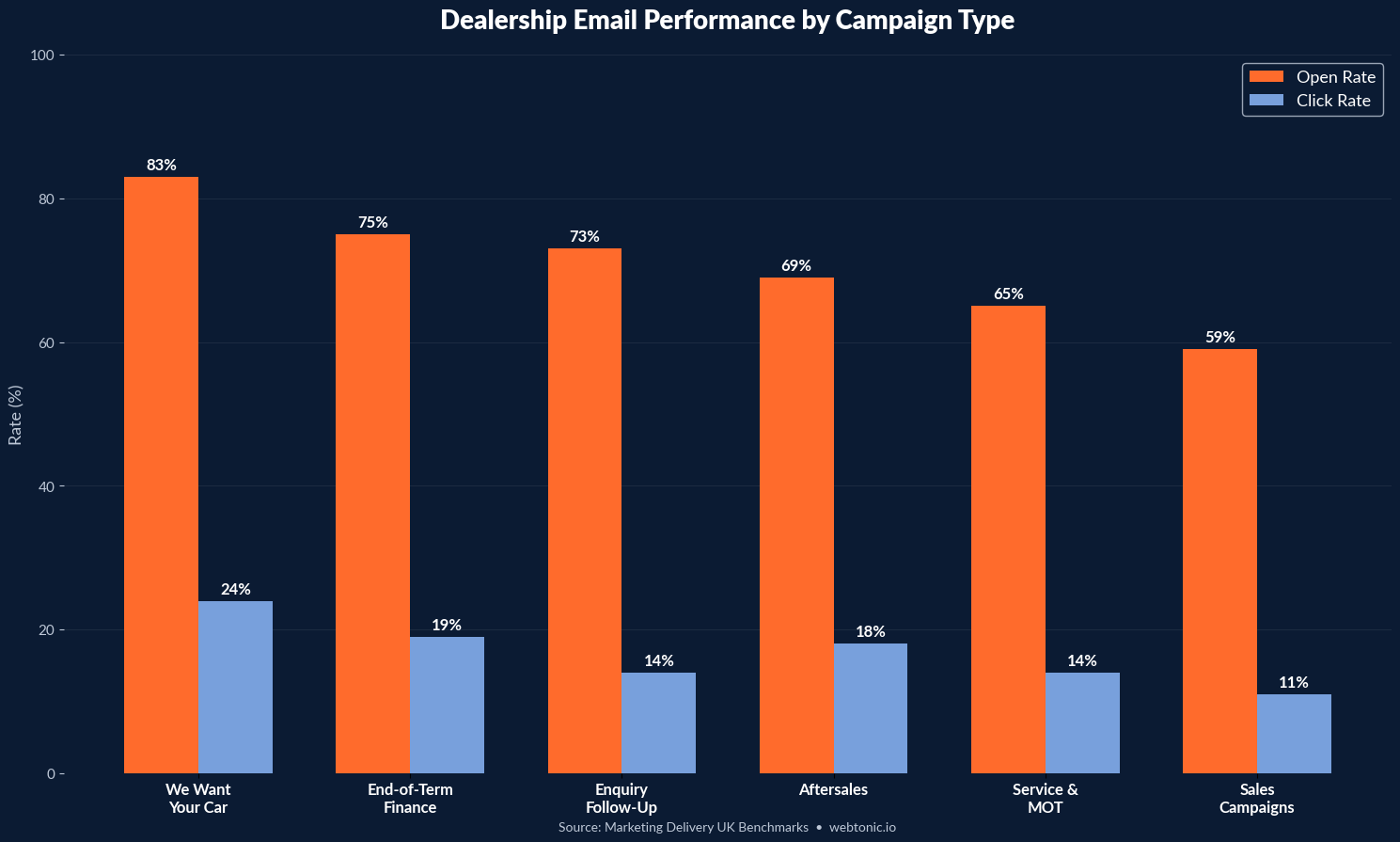
Not all dealership emails perform equally. Marketing Delivery's UK benchmarks provide granular data by message type that reveals dramatic performance differences based on relevance and urgency.
| Campaign Type | Open Rate | Click Rate | Unsubscribe |
|---|---|---|---|
| We Want Your Car | 83% | 24% | 1.0% |
| End-of-Term Finance | 75% | 19% | 0.6% |
| Aftersales Campaigns | 69% | 18% | 0.4% |
| Service & MOT Reminders | 65% | 14% | 0.7% |
| Enquiry Follow-Up | 73% | 14% | 1.25% |
| Sales Campaigns | 59% | 11% | 0.5% |
The standout finding is that acquisition-focused "We Want Your Car" messages achieve 83% open rates and 24% click rates — by far the highest of any campaign type. These outperform general sales promotions by 40% on opens and 118% on clicks. The reason is straightforward: vehicle owners receiving a personalized trade-in offer based on their specific car, mileage, and market value find the message immediately relevant and financially actionable. This data reinforces the importance of performance creative strategies that leverage first-party CRM data for hyper-relevant messaging.
Automation and Lead Nurture Performance
The gap between automated and manual email campaigns is one of the starkest performance divides in auto promotion. Demand Local reports that automated campaigns generate $5.47 per recipient versus $0.16 for standard campaigns — a 34× per-recipient revenue advantage. This gap reflects the power of behavioral triggers: a shopper who views a specific vehicle on the dealer website and receives a follow-up email within minutes with that vehicle's details, financing options, and a scheduling link converts at dramatically higher rates than one receiving a generic weekly newsletter.
Marketing Delivery's Q2 2025 benchmarks analyzed data from over 500 retailer clients processing 263,734 new enquiries and distributing 2,897,006 emails in a single quarter. Their AI-powered system communicates key information specific to each customer — stock alerts, maintenance reminders, and end-of-term renewals. The data quality foundation matters enormously: 9% of customer records lacked an email address, 7% were missing phone numbers, and among records with email, 27% did not have consent for marketing messages. These data gaps represent substantial lost revenue potential for any dealership growth strategy.
Lead Response Speed and Sales Impact
Response velocity is arguably the most important variable in dealership email conversion. Demand Local's research shows that 78% of customers buy from whoever responds first. Responding within 5 minutes makes a dealership 21–100× more likely to convert the lead — a staggering multiplier. Yet the average dealer response time remains 42–47 hours, which effectively hands qualified buyers to faster-responding competitors.
The financial impact of this gap is substantial. A dealership generating 500 online leads per month with a 10% close rate and an average gross profit of $2,500 per vehicle stands to gain an additional $125,000–$250,000 in annual gross profit simply by reducing response time from hours to minutes. Automated lead routing, instant CRM-triggered welcome sequences, and AI-powered initial responses are the tools closing this gap at scale-oriented dealerships. The combination of rapid first contact with a structured drip sequence that provides relevant vehicle information, financing pre-qualification, and appointment scheduling creates a data-driven nurture funnel that consistently outperforms manual follow-up.
| Response Metric | Benchmark | Impact |
|---|---|---|
| Buyers Who Purchase from First Responder | 78% | Speed is the top conversion factor |
| Conversion Lift (5-min Response) | 21–100× | Minutes matter exponentially |
| Avg Dealer Response Time | 42–47 hours | Massive competitive disadvantage |
| Automated Revenue per Recipient | $5.47 | 34× vs. standard ($0.16) |
| Top Dealer Campaigns Running | 12–15 distinct | Segment-specific targeting |

Data Quality and List Health Statistics
The performance of any dealership email program is fundamentally constrained by data quality. Marketing Delivery's Q2 2025 analysis of over 500 retailer clients revealed significant data gaps: 9% of customer records lacked an email address entirely, 7% were missing phone numbers, and among records with email, 27% did not have consent to receive marketing messages. These numbers mean that roughly one-third of a typical dealership's database is unusable for email campaigns — representing tens of thousands of dollars in missed revenue annually.
Bounce rates offer another lens on data health. CuFinder reports a hard bounce rate of 0.6% for the auto industry, which is healthy by cross-industry standards. However, Marketing Delivery's campaign-level data shows hard bounces ranging from 0–2% depending on message type, with trade-in acquisition campaigns hitting the highest bounce rates as they target older records. Unsubscribe rates remain low at 0.18–1.25% across campaign types, indicating that auto industry recipients generally find value in dealership communications when messaging is relevant. Dealers running regular data hygiene — deduplication, re-consent campaigns, and progressive profiling — maintain measurably higher deliverability and engagement than those treating their CRM as a static repository. According to Ritner Digital's channel analysis, email remains one of the most cost-efficient channels in the dealership stack, and DealerSmart confirms that dealers who combine email nurture with paid search retargeting see measurably lower overall cost per acquisition.
Automotive vs. Cross-Industry Email Benchmarks
| Metric | Automotive | Cross-Industry Avg | Δ |
|---|---|---|---|
| Open Rate | 24.8–39.5% | 21.3% | +16% to +85% |
| Click-Through Rate | 2.9% | 2.6% | +12% |
| CTOR | 11.5% | 10.5% | +10% |
| Unsubscribe Rate | 0.18% | 0.26% | −31% |
| Bounce Rate | 0.6% | 0.7% | −14% |
| ROI per Dollar | $40–$44 | $36–$42 | +5–10% |
Best Practices for Dealership Email Campaigns
- Automate everything possible. The 34× revenue gap between automated and manual campaigns is definitive. Set up triggered sequences for enquiry follow-up, vehicle-specific retargeting, service reminders, end-of-term finance renewals, and trade-in offers.
- Fix your data foundation. Marketing Delivery found 9% of dealer records missing email addresses and 27% lacking consent. Regular data hygiene — deduplication, consent refresh campaigns, and progressive profiling — is essential before scaling any email program.
- Prioritize trade-in and acquisition messages. "We Want Your Car" campaigns achieve 83% open rates and 24% click rates — dramatically above any other message type. Build a systematic conquest and retention program around personalized trade-in valuations.
- Implement instant lead response. With 78% of buyers going to the first responder, set up automated welcome emails that fire within 60 seconds of form submission. Include the specific vehicle viewed, financing options, and a scheduling link.
- Run 12+ distinct campaigns. Top dealers segment by buyer stage (new lead, active shopper, purchased, service due, lease expiring) and vehicle interest (make, model, new vs. used). Each segment responds to different messaging angles and offers.
- Measure beyond opens. CTOR (click-to-open rate) at 11.5% tells you whether content resonates once opened. Track revenue per recipient and cost per conversion to identify which campaigns drive actual sales.
Related reading
- Auto Repair Email Marketing, by the Numbers (2026)
- Cold Email vs. Newsletter: General Contracting Remodeling Email Marketing Data
- Real Estate Email Marketing, by the Numbers (2026)
- Email Marketing services at Web Tonic
FAQ
What is the average email open rate for auto dealerships?
The average open rate varies by data source and campaign type. CuFinder's broad auto retail benchmark shows 39.5%, while manufacturing-specific data shows 24.8%. UK dealership data from Marketing Delivery shows 59% for sales campaigns and up to 83% for trade-in acquisition messages. Permission-based lists achieve 22–28% versus 15–18% for cold outreach.
How much revenue can email campaigns generate for a dealership?
A 15,000-customer database can generate $2 million in annual revenue with proper segmentation and automation, according to Rework's 2026 guide. Most dealers achieve only $200,000 from the same list. The difference comes from running 12–15 distinct campaigns with automated triggers rather than generic batch sends. Email ROI ranges from $36–$44 per dollar spent.
How fast should a dealership respond to email leads?
Within 5 minutes. Research shows responding within 5 minutes makes conversion 21–100× more likely, and 78% of buyers purchase from the first dealership to respond. The average dealer response time of 42–47 hours means most dealers are losing the majority of their leads to faster competitors before even making contact.
What types of dealership emails get the highest engagement?
Trade-in acquisition emails ("We Want Your Car") achieve the highest engagement with 83% open rates and 24% click rates. End-of-term finance renewals come second at 75% opens and 19% clicks. Aftersales service messages achieve 69% opens and 18% clicks. Standard sales promotions perform lowest at 59% opens and 11% clicks.
Is email automation worth the investment for a small dealership?
Absolutely. Automated campaigns generate $5.47 per recipient versus $0.16 for standard sends — a 34× advantage that scales regardless of dealership size. Even a small dealer with a 5,000-contact database can generate significant incremental revenue by automating service reminders, enquiry follow-ups, and end-of-term renewal sequences. The cost of modern marketing automation platforms is minimal compared to the revenue lift.
Sources
demandlocal.com — email lead nurturing statistics
resources.rework.com — dealership email marketing guide
cufinder.io — automotive manufacturing benchmarks
cufinder.io — automotive industry benchmarks
marketingdelivery.co.uk — automotive email benchmarks
marketingdelivery.co.uk — Q2 2025 automotive email benchmarks
ritnerdigital.com — car dealership advertising costs
dealersmart.com — dealership benchmarks


