



Table of contents
Key Takeaways
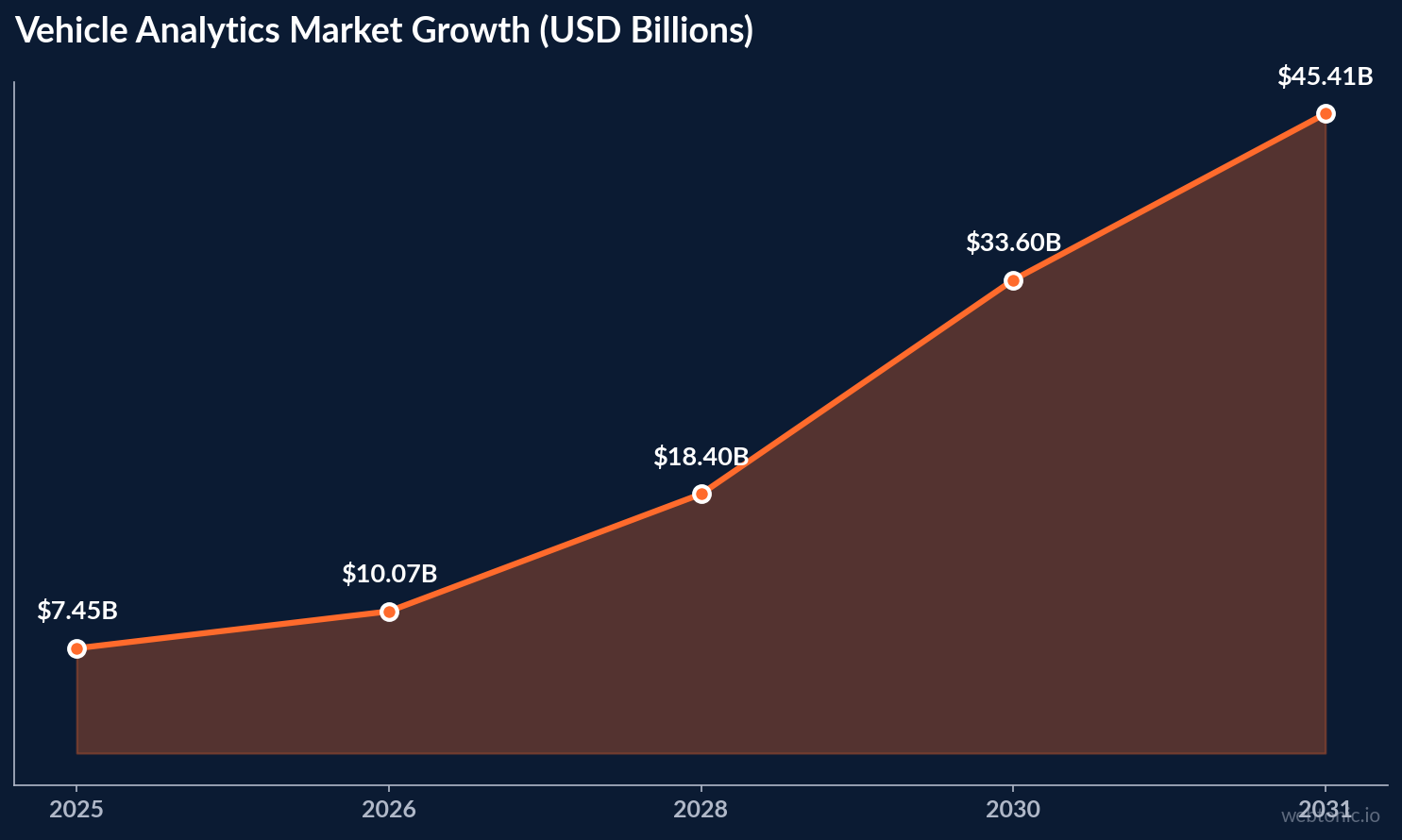
- The vehicle analytics market is projected to grow from $7.45 billion in 2025 to $45.41 billion by 2031, expanding at a 35.16% CAGR — one of the fastest growth rates in the automotive technology sector.
- The automotive data analytics market was valued at $3.5 billion in 2025 and is forecast to reach $10.5 billion by 2034 at a 12.5% CAGR.
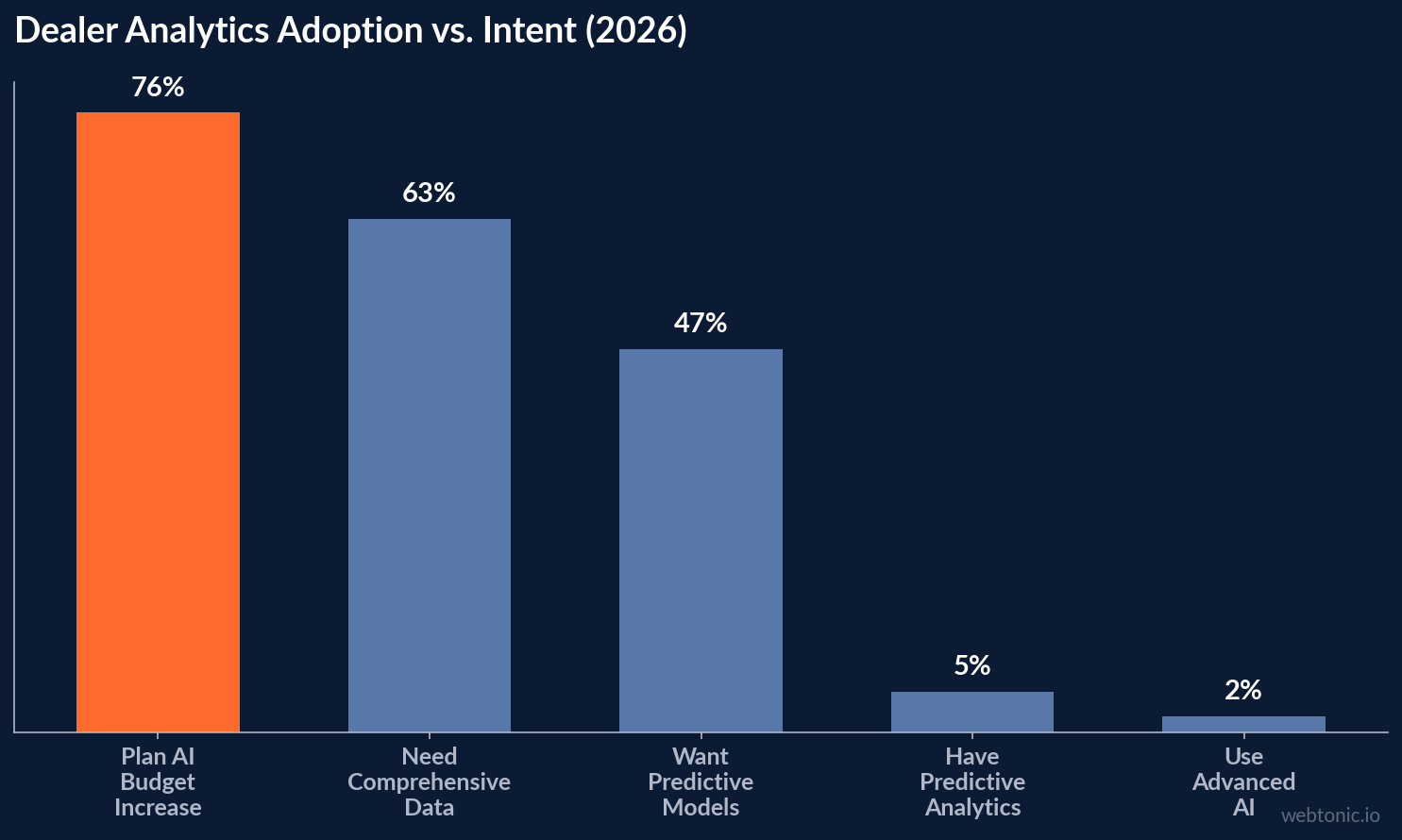
- 76% of U.S. dealerships plan to increase their AI and analytics budgets in 2026, though only ~5% have adopted predictive analytics tools so far.
- The predictive maintenance market for vehicles is forecast to reach $13.7 billion by 2036, growing at 14.7% CAGR from a $3 billion base in 2025.
- IoT adoption in automotive supply chain tracking reached 45%, and predictive analytics reduce inventory stockouts by 35%.
- The average U.S. dealer's technology stack depth is just 3.8 out of 15 available categories, revealing significant room for analytics adoption.
Vehicle Analytics Market Size and Growth Forecast
The global vehicle analytics market is experiencing explosive growth. Mordor Intelligence estimates the market size at $7.45 billion in 2025, growing to $10.07 billion in 2026 and reaching $45.41 billion by 2031 at a 35.16% CAGR. This growth is driven by the proliferation of connected vehicles, the increasing volume of data generated per vehicle, and the need for real time decision-making across manufacturing, sales, and after-market services.
A parallel report from Persistence Market Research projects the global vehicle analytics market rising from $5.09 billion in 2025 to $22.2 billion by 2032 at a 23.4% CAGR. While the exact figures differ between research firms — reflecting different market scope definitions — both reports agree on double-digit growth and a multi-billion-dollar opportunity within the next decade.
| Market Segment | 2025 Value | Forecast Value | CAGR |
|---|---|---|---|
| Vehicle Analytics | $7.45B | $45.41B (2031) | 35.16% |
| Automotive Data Analytics | $3.5B | $10.5B (2034) | 12.5% |
| Vehicle Analytics (Alt.) | $5.09B | $22.2B (2032) | 23.4% |
| Predictive Maintenance | $3.0B | $13.7B (2036) | 14.7% |
Automotive Data Analytics Market Breakdown
The broader automotive data analytics market — encompassing software platforms, consulting services, and managed analytics solutions — was valued at $3.5 billion in 2025 and is estimated to reach $10.5 billion by 2034, exhibiting a CAGR of 12.5% according to Verified Market Reports. This growth reflects the industry's shift from intuition-based decision-making to data-driven strategies across the entire vehicle lifecycle.
Key growth drivers include the exponential increase in vehicle-generated data (modern connected vehicles produce up to 25 GB of data per hour), the maturation of cloud-based analytics platforms, and tightening regulatory requirements around emissions tracking and safety reporting. OEMs, dealership groups, and aftermarket service providers all contribute to market demand, though OEMs currently represent the largest share of analytics software spending.
Predictive Analytics and Maintenance Market
Predictive maintenance represents one of the highest-ROI applications of automotive analytics. Transparency Market Research forecasts the vehicle predictive maintenance market at $3 billion in 2025, growing to $13.7 billion by 2036 at a CAGR of 14.7%. The U.S. alone generated $1.46 billion in predictive maintenance revenue in 2024, benefiting from advanced sensor infrastructure and fleet management demand.
The technology uses real time sensor data, historical maintenance records, and machine learning models to predict component failures before they occur. This approach reduces unplanned downtime by an estimated 30–50% and extends component life by 20–40%. For dealership service departments, predictive analytics transforms the customer relationship from reactive repairs to proactive maintenance scheduling — improving customer retention and lifetime value.
Dealer Technology Adoption and AI Readiness
Despite the massive market opportunity, dealership adoption of analytics tools remains in early stages. Dealer Signals' 2026 State of Dealer Technology report, based on analysis of 1,760 dealers across 22 states, found that the average dealer's technology stack depth is just 3.8 out of 15 available categories. This means most dealerships have implemented barely a quarter of the analytics and software tools available to them.
AI adoption shows more momentum, however. CDK Global found that 63% of dealers emphasize the need for comprehensive industry data and 47% want predictive models trained by automotive experts. A Spyne survey of nearly 1,200 dealership leaders cited by RingLead reveals that 76% of U.S. dealerships plan to increase AI budgets in 2026 — yet only approximately 5% have deployed predictive analytics and just 2% use advanced AI for forecasting and analysis.
| Dealer Tech Metric | Current State | Industry Signal |
|---|---|---|
| Avg. Stack Depth | 3.8 / 15 categories | Significant adoption gap |
| AI Budget Increase Planned | 76% of dealerships | Strong intent |
| Predictive Analytics Adoption | ~5% | Early stage |
| Advanced AI Forecasting | ~2% | Nascent |
| Data Comprehensiveness Need | 63% prioritize | Data quality gap |
Supply Chain Analytics and IoT Integration
The automotive supply chain — a $2.5 trillion global market — is undergoing a data-driven transformation. Gitnux reports that IoT adoption in supply chain tracking reached 45% among automotive manufacturers, and predictive analytics reduce stockouts by 35%. These figures reflect the industry's recognition that real time visibility across the supply chain is no longer optional — disruptions from semiconductor shortages and logistics bottlenecks have permanently elevated the role of analytics in procurement and production planning.
Connected vehicle data feeds are creating new opportunities for supply chain optimization. Vehicles equipped with telematics transmit real time performance and component wear data back to OEMs, enabling data-driven demand forecasting for replacement parts. This closed-loop feedback mechanism between in-field vehicles and manufacturing operations represents a fundamental shift from historical sales-based forecasting to predictive, usage-based inventory management.
Connected Vehicle Data and Real-Time Analytics
The connected vehicle ecosystem is generating unprecedented volumes of data. Modern vehicles equipped with telematics, cameras, and sensor arrays produce up to 25 GB of data per hour — creating both an opportunity and a challenge for the analytics industry. This data spans driving behavior, component performance, environmental conditions, and infotainment usage patterns, feeding applications across insurance telematics, fleet management, urban planning, and personalized marketing.
Real-time analytics platforms process this data stream to enable immediate decision-making. Fleet operators use live vehicle telemetry to optimize routing, monitor driver behavior, and predict fuel consumption. OEMs analyze aggregated vehicle performance data to identify emerging quality issues before they escalate to costly recalls. For dealership groups, connected vehicle data opens new revenue opportunities in predictive service marketing — reaching customers with maintenance recommendations based on actual vehicle usage rather than generic mileage intervals. The analytics software layer that translates raw vehicle data into actionable business intelligence represents the fastest-growing segment of the broader automotive technology market. For organizations evaluating analytics platforms, the decision increasingly comes down to integration breadth: the most effective solutions connect vehicle telemetry data with CRM, DMS, and marketing performance data to create a unified operational view that drives both immediate efficiency gains and long-term strategic advantage.
Industry Analysis and Market Report Trends
Independent industry analysis from multiple research firms converges on a consistent theme: the global automotive analytics market is transitioning from a niche software category to a foundational industry requirement. Market reports valued in USD consistently project double-digit growth across every geographic region and application segment. A detailed analysis of the competitive landscape reveals that established enterprise software vendors — including SAP, Oracle, and IBM — are competing with specialized automotive analytics startups for dealer and OEM contracts.
The most comprehensive industry reports highlight that real time data processing capabilities are the primary differentiator between analytics platforms. Fleet operators and OEMs that deploy real time analysis tools report measurably faster response times to quality issues, supply disruptions, and demand shifts. The global shift toward electrification adds another analysis dimension: EV-specific analytics covering battery health prediction, charging infrastructure optimization, and energy cost forecasting represent an entirely new USD multi-billion sub-segment that barely existed three years ago. Industry forecasts project this EV analytics niche alone will exceed $2 billion globally by 2030, driven by regulatory mandates requiring OEMs to report real time battery degradation data across their vehicle fleets.
Regional Market Analysis
North America leads the global automotive analytics market in terms of revenue, driven by the region's high concentration of technology vendors, advanced connected vehicle infrastructure, and mature dealership networks. The U.S. predictive maintenance segment alone generated $1.46 billion in 2024. Europe follows as the second-largest market, propelled by stringent emissions regulations that require comprehensive data tracking and reporting capabilities.
Asia-Pacific is the fastest-growing region, with China and India driving expansion through rapid automotive production growth, increasing connected vehicle penetration, and government mandates for vehicle safety data reporting. The region benefits from lower software development costs and a large pool of data science talent, making it an attractive market for analytics platform providers seeking scale.
| Region | Market Position | Key Growth Driver |
|---|---|---|
| North America | Largest revenue share | Connected vehicles, tech vendors |
| Europe | Second-largest | Emissions regulations, data mandates |
| Asia-Pacific | Fastest growing | Production volume, EV adoption |
| Middle East & Africa | Emerging | Fleet management, smart city initiatives |
Software Platforms and Technology Forecast
The global automotive analytics software landscape is rapidly consolidating. Enterprise software vendors are acquiring specialized vehicle analytics startups to build end-to-end platforms that span the entire automotive value chain. The latest industry analysis from multiple research firms forecasts that analytics software will become the fastest-growing category within the broader automotive technology market by USD value through 2030.
Cloud-based analytics platforms now dominate new deployments, accounting for an estimated 70% of new automotive analytics software contracts globally. North America leads adoption of cloud-native analytics solutions, while Asia-Pacific and the Middle East and Africa regions show the strongest growth in on-premise deployments — driven by data sovereignty requirements and limited cloud infrastructure in emerging markets. The market size in USD for real time analytics software alone is projected to exceed $8 billion globally by 2030, as OEMs and fleet operators demand sub second analysis of vehicle telemetry streams.
Industry analysis also reveals that the competitive landscape varies significantly by application. In predictive maintenance, specialized vendors with deep automotive domain expertise outperform general-purpose analytics platforms. In marketing and sales analytics, broad-spectrum software providers that integrate with dealer management systems hold the advantage. This segmentation drives a forecast of continued market fragmentation rather than winner-take-all consolidation — a global trend that creates opportunities for both established software enterprises and innovative startups focused on specific automotive analytics use cases. The industry report consensus projects that total software spending in the automotive analytics sector will triple in USD terms between 2025 and 2031, with the steepest growth curve in North America and Asia-Pacific regions.
Best Practices for Automotive Analytics Adoption
- Start with high-impact use cases — Focus initial analytics investments on areas with clear ROI: marketing attribution, inventory turn optimization, and service department predictive scheduling. These deliver measurable returns within 3–6 months.
- Invest in data infrastructure first — Clean, connected data is the foundation. Integrate DMS, CRM, website analytics, and advertising platforms into a unified data layer before deploying advanced analytics or AI models.
- Adopt predictive maintenance gradually — Begin with fleet vehicles or high-volume service customers. The $13.7 billion forecast for this segment reflects proven ROI, but implementation requires sensor integration and staff training.
- Bridge the stack-depth gap — With the average dealer at only 3.8 of 15 technology categories, identify the missing tools that would generate the highest marginal value. Analytics, advertising intelligence, and customer data platforms are typically the highest-impact additions.
- Use IoT for supply chain visibility — With 45% adoption among manufacturers, IoT-enabled supply chain tracking is approaching mainstream status. Dealers can benefit by connecting parts ordering to real time demand signals from service analytics.
- Plan for data volume growth — Connected vehicles generate up to 25 GB of data per hour. Ensure your analytics infrastructure can scale with the exponential growth in vehicle-generated data without degrading analysis speed or insight quality.
The vehicle analytics market continues to attract investment as both established software firms and venture-backed startups compete for market share. The predictive analytics market within the broader automotive sector is forecast to be one of the highest growth segments globally. Analytics market segmentation by region shows North America and Asia Pacific as the two largest contributors by market size in USD. Vehicle analytics market projections from the Middle East and Africa indicate emerging demand driven by smart city initiatives and fleet modernization programs. The global vehicle analytics opportunity represents a generational shift in how the automotive industry leverages data for competitive advantage — and the market size in USD terms underscores the scale of investment flowing into this rapidly expanding sector.
Related reading
- Attribution Analytics: Models, Tools, and the 2026 Reality
- Google Analytics Tips: Essential GA4 Strategies for Better Data
- Automotive Email Marketing Statistics: 2026 Benchmarks & Insights
- Marketing Analytics services at Web Tonic
FAQ
How large is the automotive analytics market?
The vehicle analytics market was valued at $7.45 billion in 2025 and is projected to reach $45.41 billion by 2031 at a 35.16% CAGR. The broader automotive data analytics market was valued at $3.5 billion in 2025 with a forecast of $10.5 billion by 2034. Multiple research firms confirm double-digit growth across all segments.
What percentage of dealerships use predictive analytics?
Currently only about 5% of dealerships have deployed predictive analytics, and just 2% use advanced AI-driven forecasting. However, 76% of U.S. dealerships plan to increase AI budgets in 2026, indicating a significant adoption wave is approaching. The gap between intent and deployment represents a competitive window for early adopters.
What is the predictive maintenance market forecast for vehicles?
The vehicle predictive maintenance market is forecast to grow from $3 billion in 2025 to $13.7 billion by 2036 at a 14.7% CAGR. The U.S. market alone generated $1.46 billion in 2024. This growth is driven by increasing sensor penetration, connected vehicle data availability, and proven ROI in reducing unplanned downtime by 30–50%.
How is IoT changing automotive supply chains?
IoT adoption in automotive supply chain tracking has reached 45%, and predictive analytics reduce inventory stockouts by 35%. Connected vehicles transmit real time performance data that feeds back into manufacturing and parts ordering systems, enabling a shift from historical forecasting to predictive, usage-based inventory management.
What technology gaps exist in dealership analytics?
The average U.S. dealer's technology stack covers only 3.8 out of 15 available categories, meaning most dealerships utilize barely a quarter of available tools. Key gaps typically include advanced analytics platforms, customer data integration, AI-powered forecasting, and connected service department tools. Closing these gaps represents one of the highest-ROI opportunities for forward-thinking dealer groups.
Sources
mordorintelligence.com — Vehicle Analytics Market Size & Growth 2031
verifiedmarketreports.com — Automotive Data Analytics Market Forecast
persistencemarketresearch.com — Vehicle Analytics Market Growth 2032
transparencymarketresearch.com — Vehicle Predictive Maintenance Market
dealersignals.com — 2026 State of Dealer Technology
cdkglobal.com — AI at the Dealership
ringlead.ca — State of AI Automotive 2026
gitnux.org — Supply Chain Automobile Industry Statistics


