Table of contents
No published study prices TikTok ads for auto repair specifically, so this page says that plainly and builds the case from 2026 cross-industry data on how ad budget is actually moving between Meta and TikTok. Every figure below is labeled by its real source: either a cross-platform average or a cross-industry study, never a fabricated automotive-specific number.
Key Takeaways
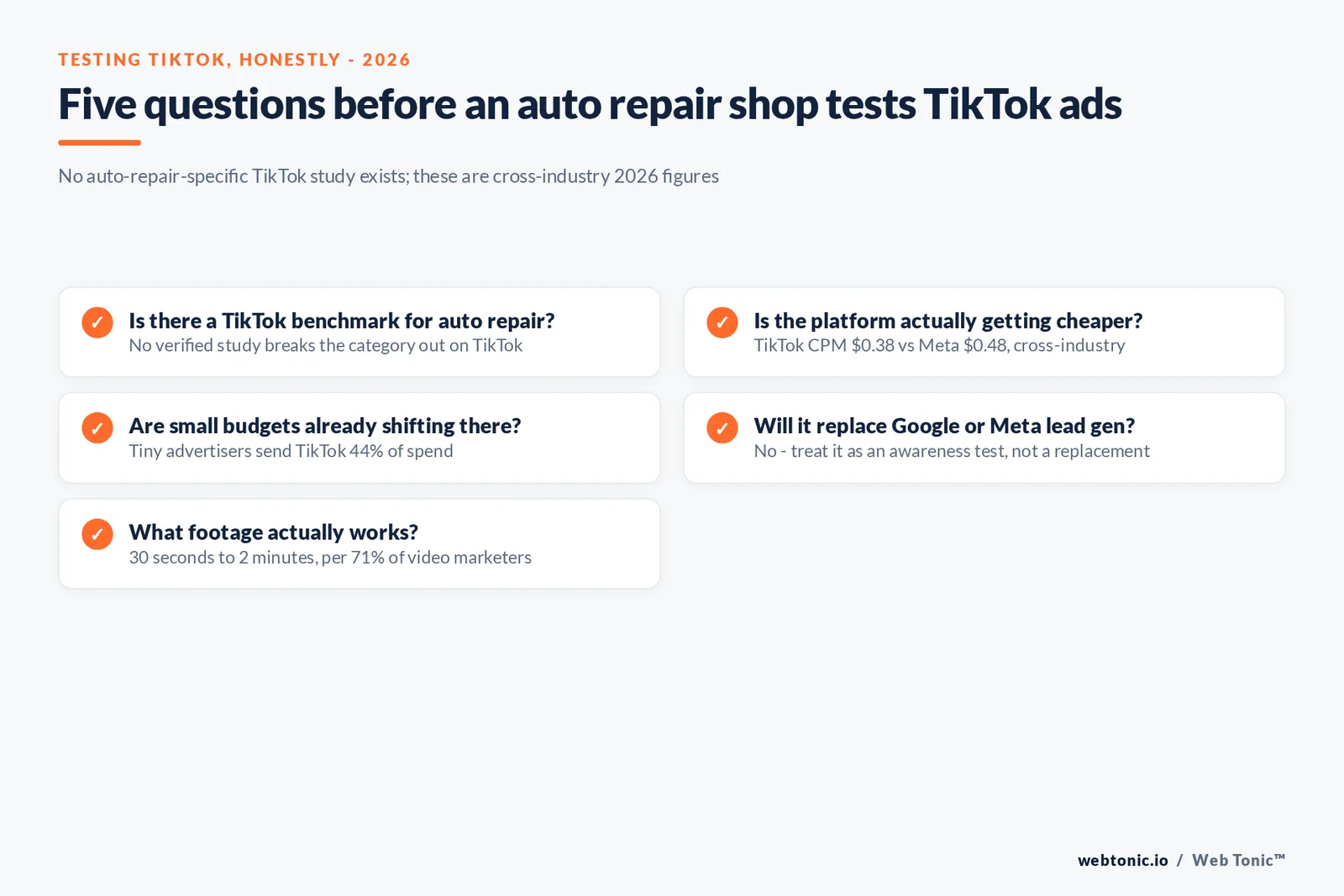
- No benchmark study breaks out TikTok ad costs for auto repair — this is a genuinely thin data category.
- TikTok's cross-industry CPM is $0.38 against Meta's $0.48 (Metricool 2026).
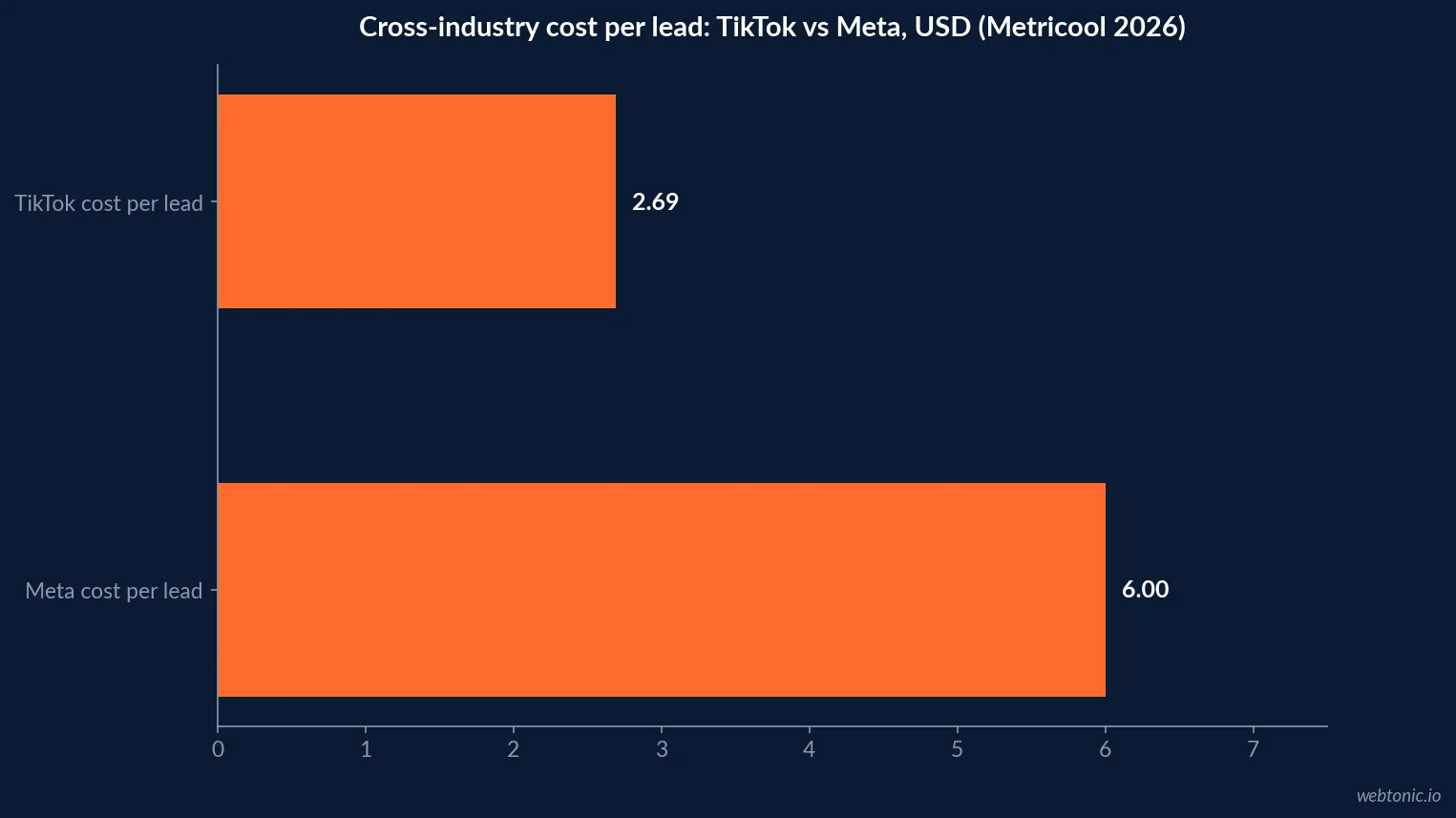
- TikTok's cross-industry cost per lead is $2.69 against Meta's $6.00 (Metricool 2026).
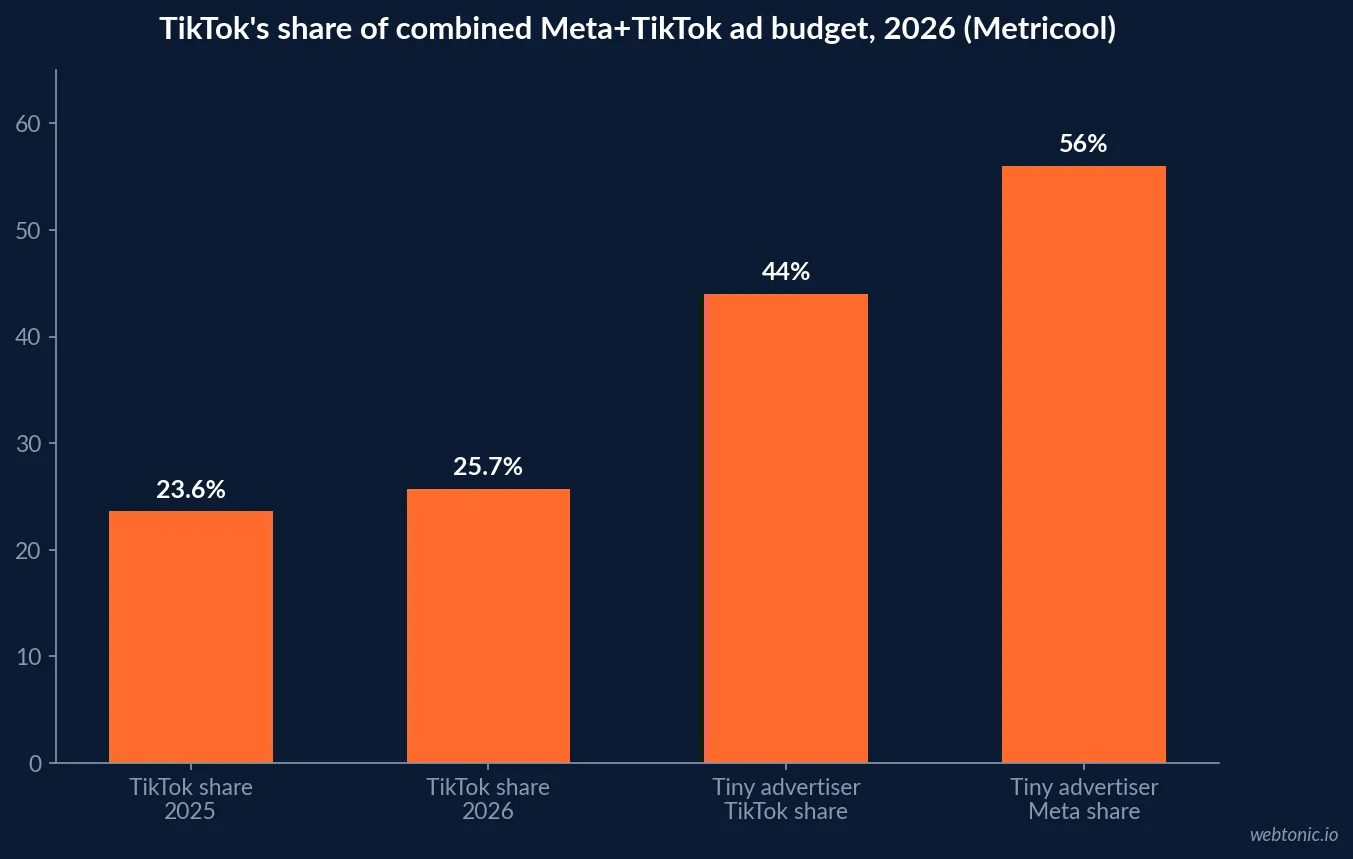
- Tiny advertisers already send TikTok 44% of combined budget, against Meta's 56% (Metricool 2026).
- Across all account sizes, TikTok's spend share rose from 23.6% to 25.7% year over year.
- Skai's Q2 2026 data puts TikTok at about 17% of tracked social budgets, cross-industry.
- 91% of advertisers analyzed by Metricool still run ads on Meta alone, versus 5% on TikTok only.
- Meta's average traffic-campaign CPC rose to $2.64 CPM, up from $1.97 a year earlier.
- TikTok's average CPM barely moved year over year, per Metricool.
- Meta's auto repair CTR is already 0.80%, the same in-market-intent problem TikTok inherits and likely worsens.
- 71% of video marketers say 30 seconds to 2 minutes is the most effective video length (Wyzowl 2026).
- 48% of video marketers have made video ads, the fourth most common video use case (Wyzowl 2026).
- 63% of video marketers now use AI video tools, up from 51% a year earlier (Wyzowl 2026).
- About 299,000 auto mechanic businesses operate in the U.S., up 12% since 2018 (IBISWorld via Cox Automotive).
- General Repair captured 27% of service visits in 2025, a share growing since 2018 (Cox Automotive).
Be honest about what does not exist yet
We looked for a TikTok-specific auto repair benchmark the way LocaliQ and WordStream publish one for Google and Meta, and it does not exist in any study we could verify and open. TikTok's own ad platform, the major benchmark firms, and the automotive-specific research houses (LocaliQ, Cox Automotive, Invoca) all cover Google Ads and Meta Ads for this category; none of them break out TikTok cost-per-click or cost-per-lead for auto repair specifically.
That gap is the honest starting point. What follows is cross-industry and cross-platform data, clearly labeled, applied to the question a shop owner is actually asking: is the budget shift toward TikTok real enough to justify a test, and at what scale.
| What exists (2026, cross-industry unless noted) | Figure | Source |
|---|---|---|
| TikTok share of combined Meta+TikTok spend, all accounts | 25.7%, up from 23.6% | Metricool 2026 Social Ads Report |
| TikTok share of spend, Tiny advertisers (under $100/mo) | 44%, against Meta's 56% | Metricool 2026 Social Ads Report |
| TikTok share of tracked social budgets (Skai, Q2 2026) | ~17% | Skai Q2 2026 Digital Trends Report |
| Auto repair CTR on Meta (nearest available comparison) | 0.80%, lowest tracked industry | WordStream Facebook Ads Benchmarks |
| Auto repair CTR/CPC/CPL on TikTok | Not published by any verified source | — |
The budget-shift data that actually exists
Metricool's 2026 Social Ads Report, drawn from 44,355 advertisers and 628,969 Meta and TikTok campaigns worth over $471 million in spend, found that among accounts running both platforms, TikTok's share of combined budget rose from 23.6% in 2025 to 25.7% in 2026. The shift is sharpest at small budget levels: Tiny advertisers, spending under $100 a month on both platforms, already send TikTok 44% of that budget against Meta's 56%. Skai's Q2 2026 Digital Trends Report independently puts TikTok's share of tracked social budgets at roughly 17%, a figure that has climbed across the last several quarters.
An independent repair shop's monthly ad budget looks far closer to Metricool's "Tiny" bracket than to a national brand's spend, which is exactly the segment where TikTok is already earning the biggest share shift.
Where TikTok's cost advantage comes from, cross-industry
Metricool's data shows TikTok undercutting Meta on nearly every cost metric it tracks: a $0.38 CPM against Meta's $0.48, an average cost per click of $0.03 against Meta's $0.07, and a $2.69 cost per lead against Meta's $6.00 at a comparable overall spend level. Meta's average cost per thousand impressions also rose the furthest of the two platforms in 2026, climbing from $1.97 to $2.64, while TikTok's barely moved.
None of this is automotive-specific, and it should not be read as a guarantee for a repair shop's account. It is, however, a reasonable case for treating a small TikTok test as cheap insurance against Meta's rising costs, rather than dismissing the platform outright.
| Metric (cross-industry, Metricool 2026) | TikTok | Meta | Gap |
|---|---|---|---|
| Average CPM | $0.38 | $0.48 | TikTok 22% cheaper |
| Average CPC (traffic) | $0.03 | $0.07 | TikTok ~2x cheaper |
| Average cost per lead | $2.69 | $6.00 | TikTok ~2.2x cheaper |
| Average CTR (leads objective) | 0.75% | 2.04% | Meta earns more clicks |
| Leads per 100 clicks | ~6 | ~5 | TikTok converts more of its clicks |
Why the intent gap likely persists on TikTok
The same mismatch that already caps auto repair's Meta performance applies at least as strongly to TikTok. WordStream's 2026 benchmark shows the category's Meta traffic-campaign CTR at a 0.80%, the lowest of any tracked industry, because "only some of the audience is going to be in market" for a repair at any given moment. TikTok's format is built even more around entertainment-first discovery than Meta's feed, so a repair shop testing the platform should plan for an awareness and local-recall role rather than a search-replacement lead-generation channel.
That framing matters for who should even test it: a shop with a strong Google Ads and Meta retargeting base already covering lead generation, testing TikTok as an incremental, low-cost awareness line, not a shop trying to replace search spend with it.
What the creative side should look like
If a shop does test the platform, format matters more than platform choice. Wyzowl's 2026 Video Marketing Statistics report found video ads are the fourth most common video use case among marketers, at 48% adoption, and that 71% of video marketers consider 30 seconds to 2 minutes the most effective length — a window that matches a single repair walkthrough well, and that 63% of video marketers now use AI video tools to help produce that content, up from 51% a year earlier, which lowers the production bar for a shop testing the format for the first time.
Our performance creative team builds exactly this kind of short-form testing plan — small spend, clear labeling of what is proven versus untested, and a format built for the platform rather than repurposed from a TV spot.
Sizing the shop population this could reach
The demand side has not gone anywhere regardless of which platform a shop tests. Cox Automotive's Fixed Ops study puts General Repair's share of service visits at 27% in 2025, up from 25% in 2018, and Cox Automotive, citing IBISWorld, counts roughly 299,000 auto mechanic businesses in the U.S., up 12% from about 266,000 in 2018. More independent shops competing for a stable base of repair demand is the backdrop against which any new-channel test, TikTok included, has to earn its keep.
| Context metric | Figure | Source |
|---|---|---|
| U.S. auto mechanic businesses, 2025 | ~299,000 (+12% vs. 2018) | IBISWorld via Cox Automotive |
| General Repair share of service visits, 2025 | 27%, up from 25% in 2018 | Cox Automotive 2026 |
| U.S. aftermarket growth forecast, 2026 | 5.4%, reaching $599.7B | Auto Care Association |
What a small test budget actually looks like
Translate the cross-industry numbers into a real test rather than an abstract percentage. Metricool's data shows Tiny advertisers already running comparable spend on both platforms, so a shop currently spending $500 a month on Meta could redirect a modest slice, not the whole budget, into a TikTok test and still be operating inside the same "Tiny" bracket the 44% share figure describes.
| Test budget structure (illustrative, based on cross-industry ratios) | Suggested share |
|---|---|
| Proven Google Ads lead generation | Unchanged |
| Proven Meta retargeting/awareness | Unchanged, or trimmed slightly |
| New TikTok test line | 10-15% of existing social budget, capped |
| Reporting/measurement setup | One-time cost before the test starts |
Signals that would justify scaling the test
Watch for a cost per lead on TikTok that beats the shop's own Meta and Google numbers, not the cross-industry averages above — those averages describe the broader market, not a guarantee for one repair shop's creative and targeting. A second signal worth tracking is engagement on organic TikTok content before spending on ads at all; if a shop's own repair videos are not getting organic traction, paid distribution of the same content is unlikely to outperform it.
A reasonable test plan given the honest gap in data
Start with a capped, clearly-labeled test budget rather than a reallocation from proven Google or Meta lead-generation spend. Track cost per lead against your own Google and Meta numbers, not against the cross-industry figures above, since those are the only benchmark this specific shop actually needs to beat. If the test converts, treat that as shop-specific evidence, not confirmation of an industry pattern that has not been measured yet.
To pressure-test the media plan before committing spend, talk to our team, or see how our growth marketing practice structures small test budgets against proven channels.
Frequently Asked Questions
Is there real benchmark data for TikTok ads in auto repair specifically?
No. Unlike Google Ads and Meta Ads, neither WordStream, LocaliQ nor any other named study we could verify publishes a TikTok cost-per-click or cost-per-lead figure broken out for the auto repair or broader automotive-repair category. What does exist is 2026 cross-industry data on how budget is moving between Meta and TikTok, which this page uses and labels clearly as cross-industry, not automotive-specific.
Should a shop even be testing TikTok ads?
As a small test line, plausibly, based on where the platform's economics currently sit. Metricool's 2026 Social Ads Report, covering 628,969 Meta and TikTok campaigns, found TikTok's cost per lead at $2.69 against Meta's $6.00 on a comparable spend level, and a CPM of $0.38 against Meta's $0.48. Those are cross-industry averages, not an auto repair guarantee, but they are cheap enough that a small, clearly-labeled test budget is a reasonable way to find out if they hold for a specific shop.
Why is auto repair thin ground for TikTok in the first place?
Repair need is triggered by a breakdown or a maintenance interval, not by browsing short-form video, which is the same intent mismatch that already caps auto repair's performance on Meta (a 0.80% click-through rate per WordStream's 2026 benchmark). TikTok skews toward entertainment and discovery intent even more than Meta's feed does, so a shop testing it should expect a brand-awareness and local-recall role, not a direct lead-generation replacement for search.
Who is actually buying TikTok ads at the budget level a repair shop operates at?
Small accounts are leading the shift, not lagging it. Metricool's 2026 data found that among 'Tiny' advertisers spending under $100 a month on both platforms, TikTok already takes 44% of combined budget against Meta's 56% — a far bigger TikTok share than the 25.7% average across all account sizes. An independent repair shop's budget looks a lot more like that Tiny-advertiser profile than a national auto brand's.
What content actually works if a shop tests the platform?
Short repair-process video, the same format style that performs well organically on TikTok and Reels for trades businesses. Wyzowl's 2026 survey found video ads are the second most common video use case for marketers at 48% adoption, and that 71% of video marketers consider 30 seconds to 2 minutes the most effective length — well matched to a single repair job, a diagnostic explainer, or a before-and-after reveal, rather than a polished commercial.
Sources
Metricool - Social Media Advertising Trends 2026 (2026 Social Ads Report)
Skai - Q2 2026 Quarterly Digital Trends Report
WordStream - Facebook Ads Benchmarks 2025/2026
Wyzowl - Video Marketing Statistics 2026
Cox Automotive - 2026 Fixed Ops and Ownership Study
Auto Care Association - 2027 Auto Care Factbook release