Table of contents
Organic search costs an auto repair shop nothing per click once it ranks, against a published average of USD 29.96 per paid search lead in the category (WordStream, 2026). That gap is the entire economic case for SEO in this vertical, and it is opening wider as independent shops take service volume away from dealerships.
Key Takeaways
- Automotive repair's average cost per lead in paid search is USD 29.96 (WordStream 2026).
- That is 55% below the USD 66.69 cross-industry average.
- But category CPL rose 5.12% year over year, one of the largest increases WordStream tracked.
- Average cost per click for the category is USD 4.35, against USD 5.42 across all industries.
- Average click-through rate is 5.56%, slightly below the 6.64% cross-industry rate.
- Search-ad conversion rate is 15.51%, nearly double the 8.18% all-industry average.
- The U.S. auto care industry is worth USD 568.7 billion (Auto Care Association 2026).
- It is projected to reach USD 676.5 billion by 2029.
- There are 269,548 service outlets competing for that demand.
- And 303 million vehicles on U.S. roads that will eventually need one of them.
- About 299,000 auto mechanic businesses now operate in the U.S., up 12% since 2018 (Cox Automotive).
- Dealership share of service visits fell from 33% to 29% over that period.
- General repair shops now average USD 275 per visit, ahead of dealerships at USD 261
- 16% of consumers used an AI tool during their last service search (Cox Automotive 2026).
- 4.9 million people are employed in the auto care industry.
What paid search says about the channel you are not paying for
WordStream by LocaliQ's 2026 Search Advertising Benchmarks, built from more than 13,000 customer campaigns running Google Ads and Microsoft Ads between April 2025 and March 2026, lists Automotive - Repair, Service and Parts at USD 4.35 average cost per click, 5.56% average click-through rate and USD 29.96 average cost per lead - all of it cheaper than the cross-industry average.
That is the paid-search baseline every organic ranking is quietly competing against. Every visitor SEO earns instead of buying is a lead priced, on this data, at close to USD 30.
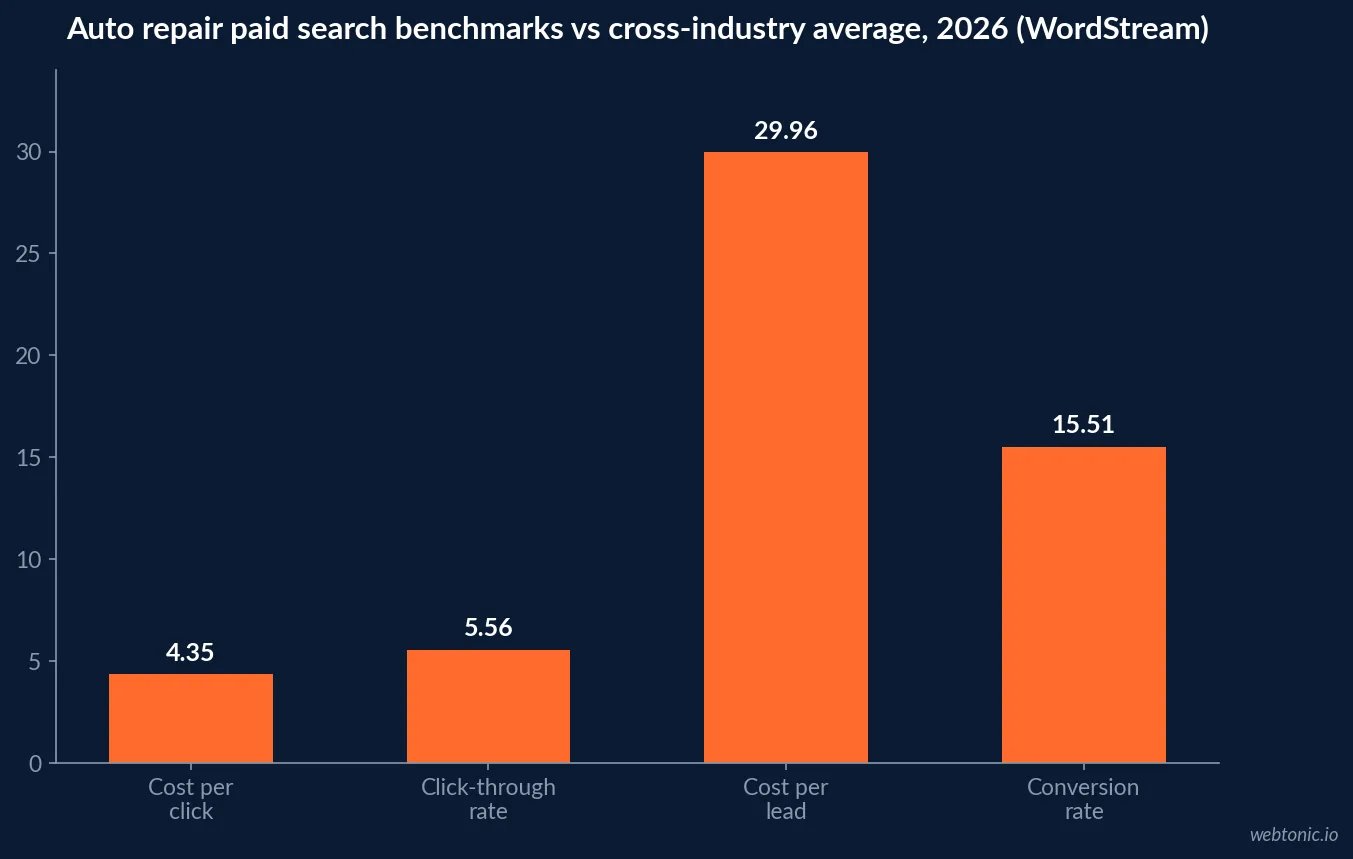
| Metric (2026, paid search) | Auto repair category | Cross-industry average | Source |
|---|---|---|---|
| Average cost per click | USD 4.35 | USD 5.42 | WordStream |
| Average click-through rate | 5.56% | 6.64% | WordStream |
| Average cost per lead | USD 29.96 | USD 66.69 | WordStream |
| Average conversion rate | 15.51% | 8.18% | WordStream |
| Year-over-year change in CPL | +5.12% | First industry-wide decline in 5 years | WordStream |
The one number moving the wrong way
WordStream's headline finding for 2026 is that cost per lead fell across the board for the first time in five years - except in a handful of categories tied to tariff exposure. Automotive - Repair, Service and Parts rose 5.12%, alongside Automotive - For Sale (up 13.90%) and Health and Fitness and Career and Employment (both up 7.26%). Rising parts costs are showing up in the auction, not just at the counter.
A category getting more expensive to buy into is precisely the category where an unpaid ranking is worth defending, because the alternative cost keeps climbing under it every year the ranking is neglected.
Why the market is bigger than the keyword volume suggests
The Auto Care Association's 2026 Factbook sizes the U.S. auto care industry at USD 568.7 billion, projected to reach USD 676.5 billion by 2029, across 269,548 service outlets, 303 million vehicles on the road and 4.9 million people employed in the sector. Every one of those vehicles will eventually generate a repair search, and every one of those outlets is a competitor for it.
| Auto care industry fact (2026) | Figure | Source |
|---|---|---|
| Industry size | USD 568.7 billion | Auto Care Association Factbook |
| Projected size by 2029 | USD 676.5 billion | Auto Care Association Factbook |
| Service outlets | 269,548 | Auto Care Association Factbook |
| Vehicles on the road | 303 million | Auto Care Association Factbook |
| People employed | 4.9 million | Auto Care Association Factbook |
Who is winning the search, not just the keyword
Cox Automotive's 2026 Fixed Ops and Ownership Study counts roughly 299,000 auto mechanic businesses operating in the U.S., up 12% since 2018, while dealership share of service visits slid from 33% to 29%. General repair shops now average USD 275 per visit against USD 261 at a dealership, and 16% of consumers used an AI tool while researching their last service visit.
That share shift is a search-visibility story as much as a pricing one. Independent shops are capturing volume that used to default to the dealer of purchase, and the ones ranking for repair keywords are the ones capturing it fastest.
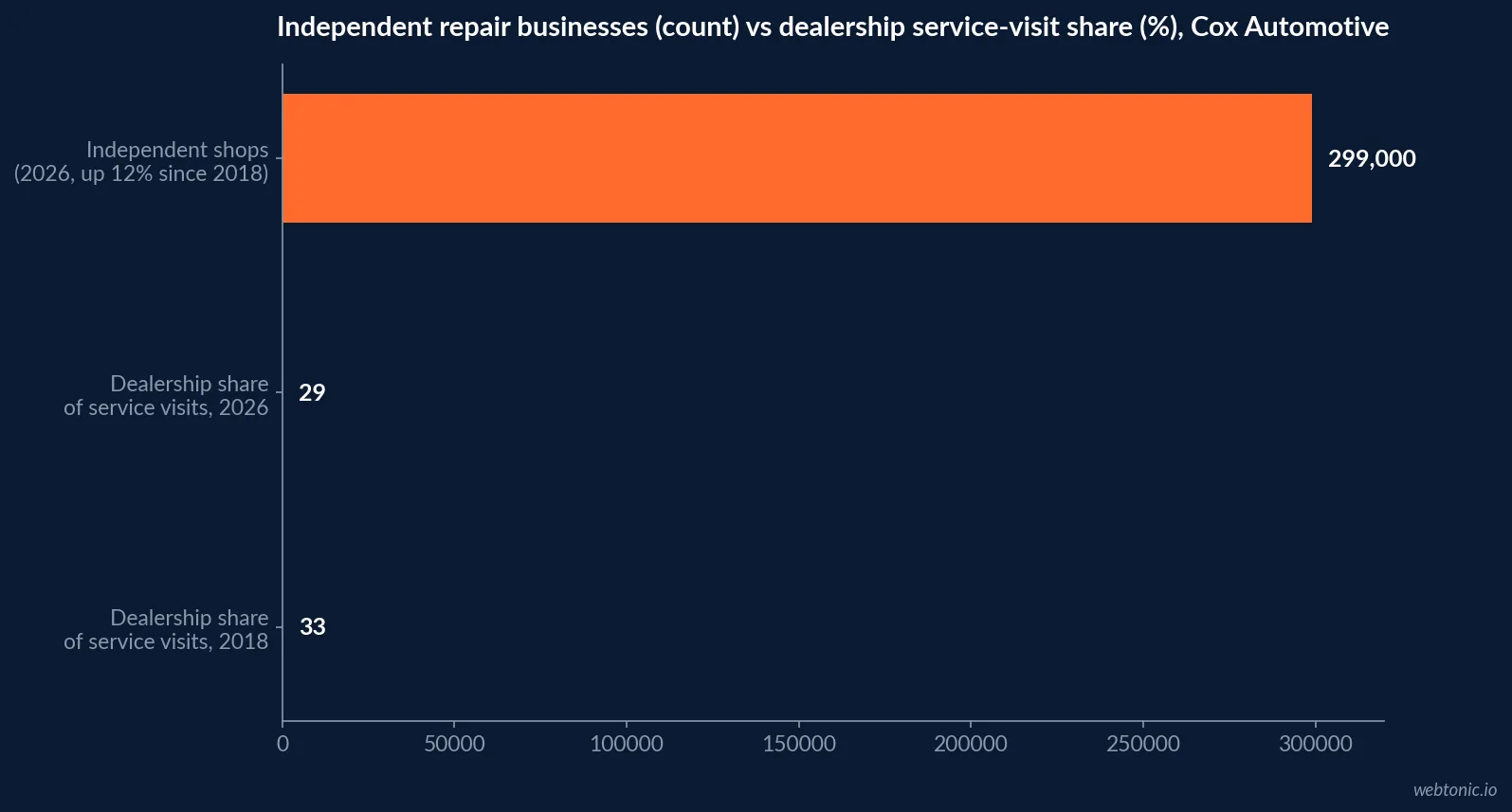
| Shift in the market (2018-2026) | Figure | Source |
|---|---|---|
| Independent repair businesses operating | ~299,000, up 12% since 2018 | Cox Automotive |
| Dealership share of service visits | Fell from 33% to 29% | Cox Automotive |
| Average spend, general repair | USD 275 | Cox Automotive |
| Average spend, dealership | USD 261 | Cox Automotive |
| Consumers using an AI tool in the service journey | 16% | Cox Automotive |
What the conversion-rate gap means for page priorities
WordStream's 15.51% conversion rate for automotive repair search ads, against an 8.18% cross-industry average, says the intent behind a repair search is already close to transactional. A driver typing "brake repair [city]" is rarely browsing. The page that ranks for it needs a phone number, an appointment path and a service-specific answer above the fold, not a generic homepage that makes the visitor search again.
The shops losing that conversion premium are usually the ones ranking their homepage for every service instead of building a dedicated page per repair type, which is also the single biggest content gap AI Overviews and answer engines reward with a citation. SearchLab Digital's automotive ranking study found that a dealer ranking tenth in the map pack would need to spend an estimated USD 245,203 a month in PPC to match the traffic a first-position competitor gets from organic search alone - a scale of the SEO opportunity that applies just as directly to independent repair shops.
What the keyword-level picture looks like
Beyond the category averages, the individual repair keywords behave differently from each other. Emergency and breakdown terms ("towing near me", "car won't start") carry the highest urgency and the steepest mobile share; scheduled-maintenance terms ("oil change coupon", "brake pad replacement cost") carry more price-comparison behavior and a longer research window. Aftermarket News' coverage of the 2026 Auto Care Factbook notes the light-duty aftermarket grew 5.7% in 2024 alone, which is demand growth a shop's keyword set should be expanding to match, not treating as static from one year to the next.
| Keyword type | Typical intent | Mobile share | Page priority |
|---|---|---|---|
| Emergency / breakdown | Immediate, high urgency | Highest | Click-to-call above the fold |
| Named repair (brakes, transmission) | Transactional, price-aware | High | Dedicated service page with price range |
| Scheduled maintenance (oil change) | Comparison shopping | Medium | Coupon or membership offer |
| Diagnostic / symptom ("check engine light") | Research, pre-decision | Medium | Educational content, soft CTA |
| Brand or location ("[shop name] reviews") | Late-funnel, trust check | High | Review aggregation on the page |
Best practices the data points to
- Build one page per repair category instead of a single services list, matching the 15.51% conversion rate WordStream measures on that kind of high-intent click.
- Publish real price ranges, since SearchLab Digital's automotive ranking work and Cox Automotive's trust data both point to transparency as a conversion driver, not just a ranking one.
- Refresh content on a quarterly cadence tied to the Auto Care Association's published growth rate, so the page set expands with the market instead of lagging it.
- Track paid CPL trend as an early warning: a repeat of the 5.12% year-over-year increase is the signal to accelerate organic investment, not just watch the paid budget.
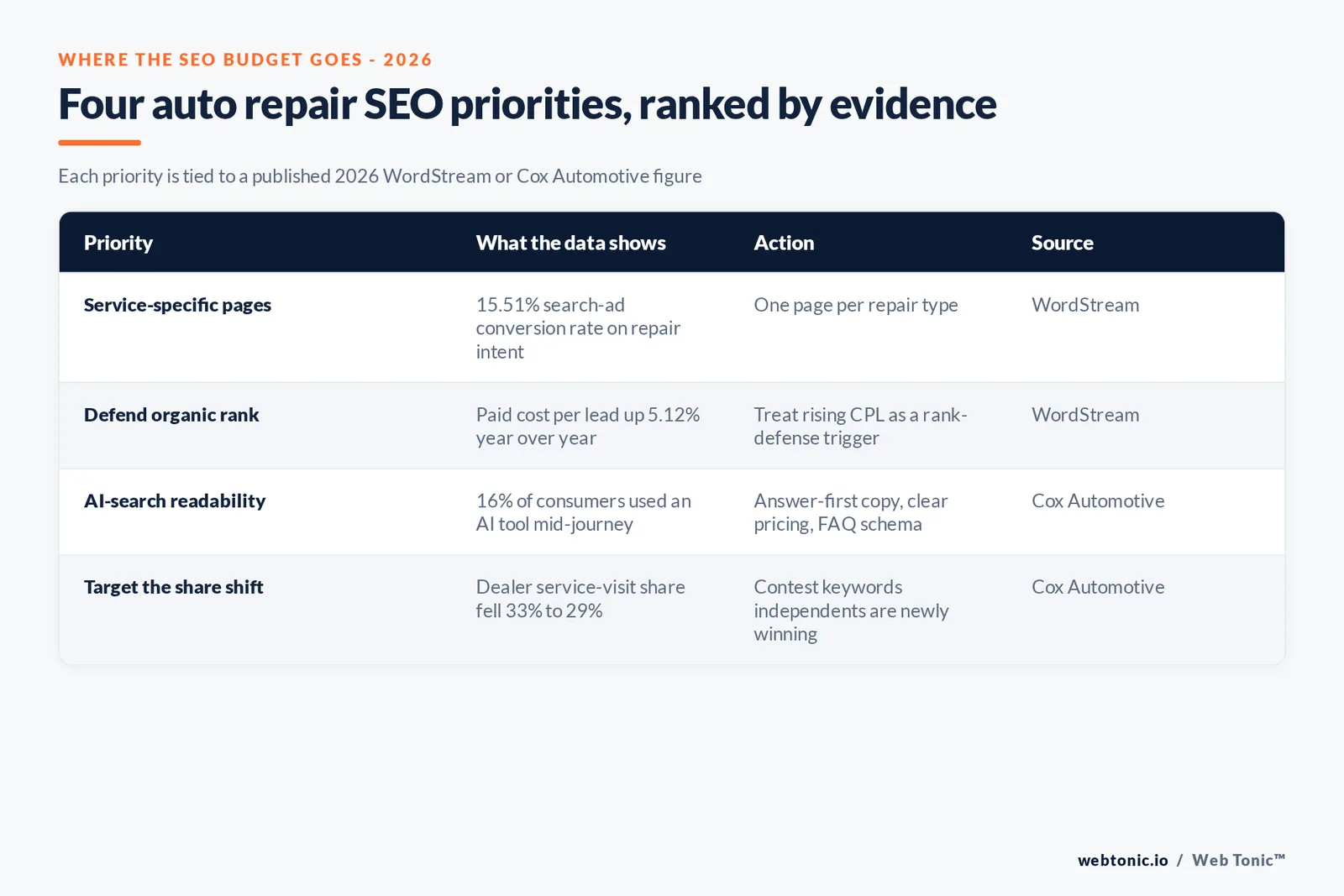
Where the SEO budget should go first
Three moves follow directly from the data above. First, build a dedicated page per repair category (brakes, transmissions, diagnostics, tires) rather than routing all of it to one service list, matching the transactional intent WordStream's conversion data implies. Second, treat cost-per-lead trend, not just the current number, as the trigger - a 5.12% year-over-year rise is an early signal, not a one-off. Third, instrument the AI-search surface: with 16% of consumers already using an AI tool mid-journey, pages need clear, quotable answers as much as keyword density.
Our growth marketing practice builds that page architecture before touching paid budget, our breakdown of what Google Ads actually costs is a useful companion read before setting a paid-search floor to defend against with SEO, and our data and analytics practice builds the reporting that separates organic-lead cost from the paid benchmark above.
What to track once the pages are live
Watch organic share of total leads against the WordStream CPL benchmark quarter over quarter - if organic leads are landing below USD 29.96 in blended acquisition cost, the channel is out-performing paid on its own published economics. Watch dealership-versus-independent share language in the next Cox Automotive release, since that share shift is the demand tailwind behind every repair keyword. Watch category CPL in WordStream's next edition; if the 5.12% increase repeats, the paid alternative to SEO keeps getting more expensive, not less.
| Priority | What the data shows | Action |
|---|---|---|
| Service-specific pages | 15.51% conversion on high-intent search clicks | One page per repair type, not one service list |
| Defend organic rank | Paid CPL up 5.12% year over year | Treat rising paid CPL as a rank-defense trigger |
| AI-search readability | 16% of consumers used an AI tool mid-journey | Answer-first copy, clear pricing ranges, FAQ schema |
| Track the share shift | Dealer share fell 33% to 29% | Target keywords independents are newly contesting |
| Benchmark blended CAC | USD 29.96 average paid CPL | Compare organic-lead cost against that ceiling |
Frequently Asked Questions
What does SEO save an auto repair shop compared to paid search?
WordStream's 2026 Search Advertising Benchmarks put the average cost per lead for Automotive - Repair, Service and Parts search ads at USD 29.96, itself one of the cheapest categories WordStream tracks and well under the USD 66.69 cross-industry average. That is still money leaving the account on every click. Organic rankings carry no per-click charge once built, which is why shops that already convert well should treat SEO as the channel that removes the cost per lead entirely rather than just lowering it.
Is auto repair a cheap or expensive category to advertise in?
Cheap by WordStream's standard, expensive by trend. The category's USD 4.35 average cost per click and USD 29.96 cost per lead both sit below most of the 23 industries WordStream tracks for 2026. But Automotive - Repair, Service and Parts was also one of the few categories where cost per lead rose year over year, up 5.12%, which WordStream attributes to tariff-driven cost pressure across the automotive sector. A cheap category that is getting more expensive is exactly where organic share should be defended.
Why is search demand for repair shops changing right now?
Because who performs the repair is changing. Cox Automotive's 2026 Fixed Ops and Ownership Study counts roughly 299,000 auto mechanic businesses operating in the U.S., up 12% since 2018, while dealership share of service visits fell from 33% to 29% over the same stretch. Independent and general repair shops are absorbing that share, and every one of those searches still has to resolve to somebody's website.
Does organic search actually convert well for repair shops?
Better than most categories advertise for, on the paid-search evidence available. WordStream's 2026 data shows Automotive - Repair, Service and Parts converting search ad clicks at 15.51%, nearly double the 8.18% cross-industry average conversion rate. Search traffic for repair intent is close to transactional already; the gap most shops leave on the table is service-specific landing pages that match that intent.
What is the market actually worth chasing?
The Auto Care Association's 2026 Factbook sizes the U.S. auto care industry at USD 568.7 billion, projected to reach USD 676.5 billion by 2029, spread across 269,548 service outlets and 303 million vehicles on the road. A search visibility gap in that market is not a rounding error; it is a queue of vehicle owners typing a repair query who will land on a competitor's page instead of yours.
Sources
WordStream by LocaliQ - 2026 Search Advertising Benchmarks
WordStream - full 2026 Search Advertising Benchmarks PDF
Auto Care Association - 2026 Auto Care Factbook, industry data
Aftermarket News - 2026 Auto Care Factbook coverage
Cox Automotive - 2026 Fixed Ops and Ownership Study
SearchLab Digital - Automotive GBP ranking study
Whitespark - 2026 Local Search Ranking Factors Report