Table of contents
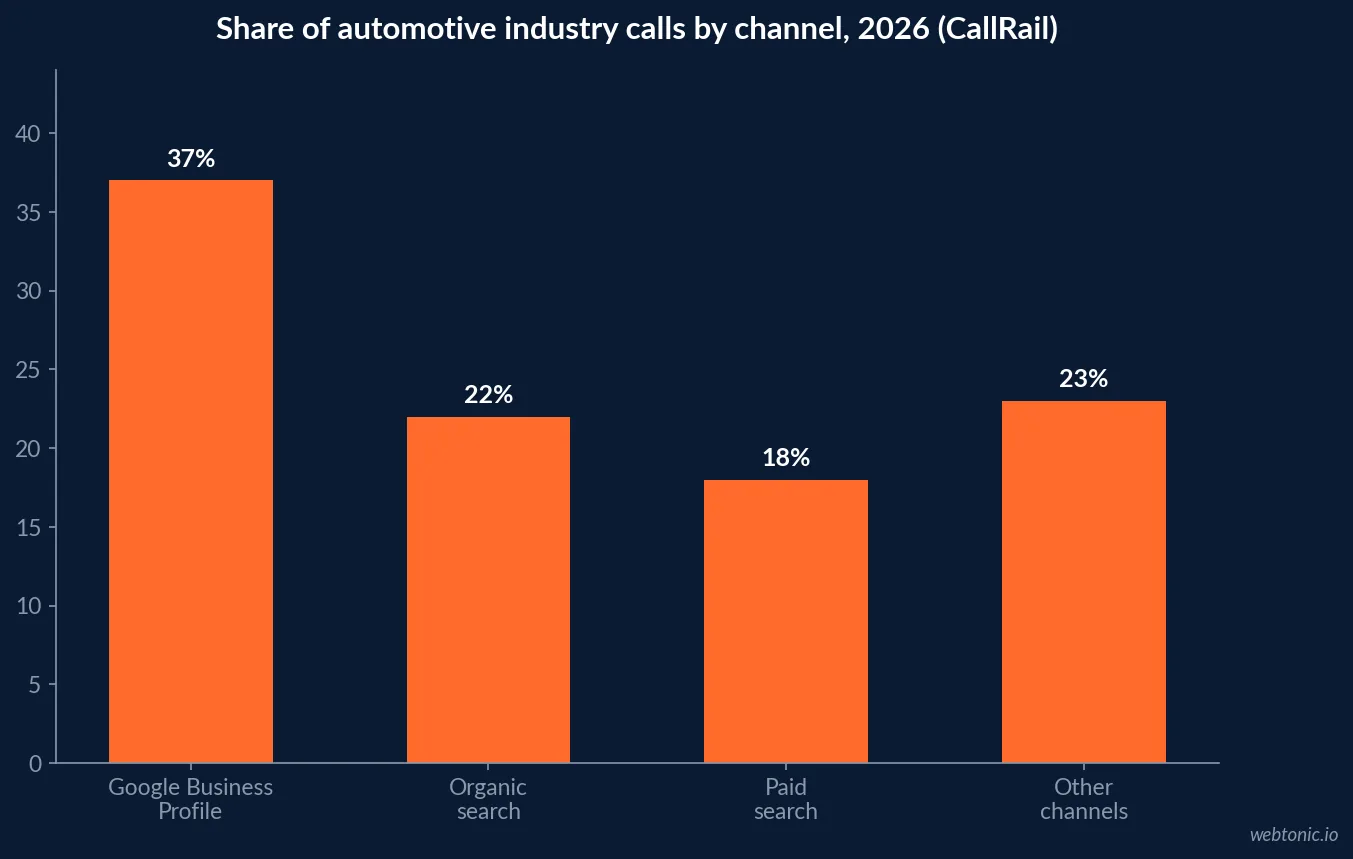
37% of automotive industry calls trace back to a Google Business Profile listing, more than any other channel CallRail measured across 1.1 million leads. Yet Whitespark's 2026 ranking-factor survey shows GBP category selection, not review volume or website content, is what actually earns that listing its spot in the Local Pack.
Key Takeaways
- 37% of automotive industry calls originate from Google Business Profile (CallRail 2026).
- Primary GBP Category scores 227, the single highest-weighted local ranking factor (Whitespark 2026).
- Proximity of address to the searcher scores 225, the second-highest factor.
- Additional GBP categories score 173, the eighth-highest factor.
- GBP signals make up 32% of local pack ranking weight, grouped by category.
- Reviews make up 20% of local pack ranking weight, up from 16% in 2023.
- On-page content is only 15% of local pack weight but 33% of local organic weight
- 85% of customers whose calls go unanswered will not call back (CallRail 2026).
- 97% of consumers read reviews before choosing a local business (BrightLocal 2026).
- 41% now "always" read reviews, up from 29% the year before.
- Google's share of recommendation sources fell from 83% to 71% year over year.
- AI tools jumped from 6% to 45% share of local recommendation usage.
- The average consumer checks six different review platforms before deciding.
- Recency of reviews scores 164 on Whitespark's factor list, inside the top 15.
The channel that actually rings the phone
CallRail's 2026 conversation report, built from 1.1 million leads across seven industries, found Google Business Profile driving 37% of calls in the automotive industry specifically - the largest single channel share the report measured for that vertical. Organic search and paid channels split most of the remainder, but neither approaches GBP's share of the phone ringing.
That is the practical case for treating Maps as the primary surface, not a secondary listing to "also" claim once the website is built.
| Local ranking factor group (2026) | Local Pack weight | Local organic weight | Source |
|---|---|---|---|
| Google Business Profile signals | 32% | 7% | Whitespark |
| Review signals | 20% | 6% | Whitespark |
| On-page signals | 15% | 33% | Whitespark |
| Behavioral signals | 9% | 10% | Whitespark |
| Link signals | 8% | 24% | Whitespark |
| Citation signals | 6% | 7% | Whitespark |
Why category selection outranks everything else
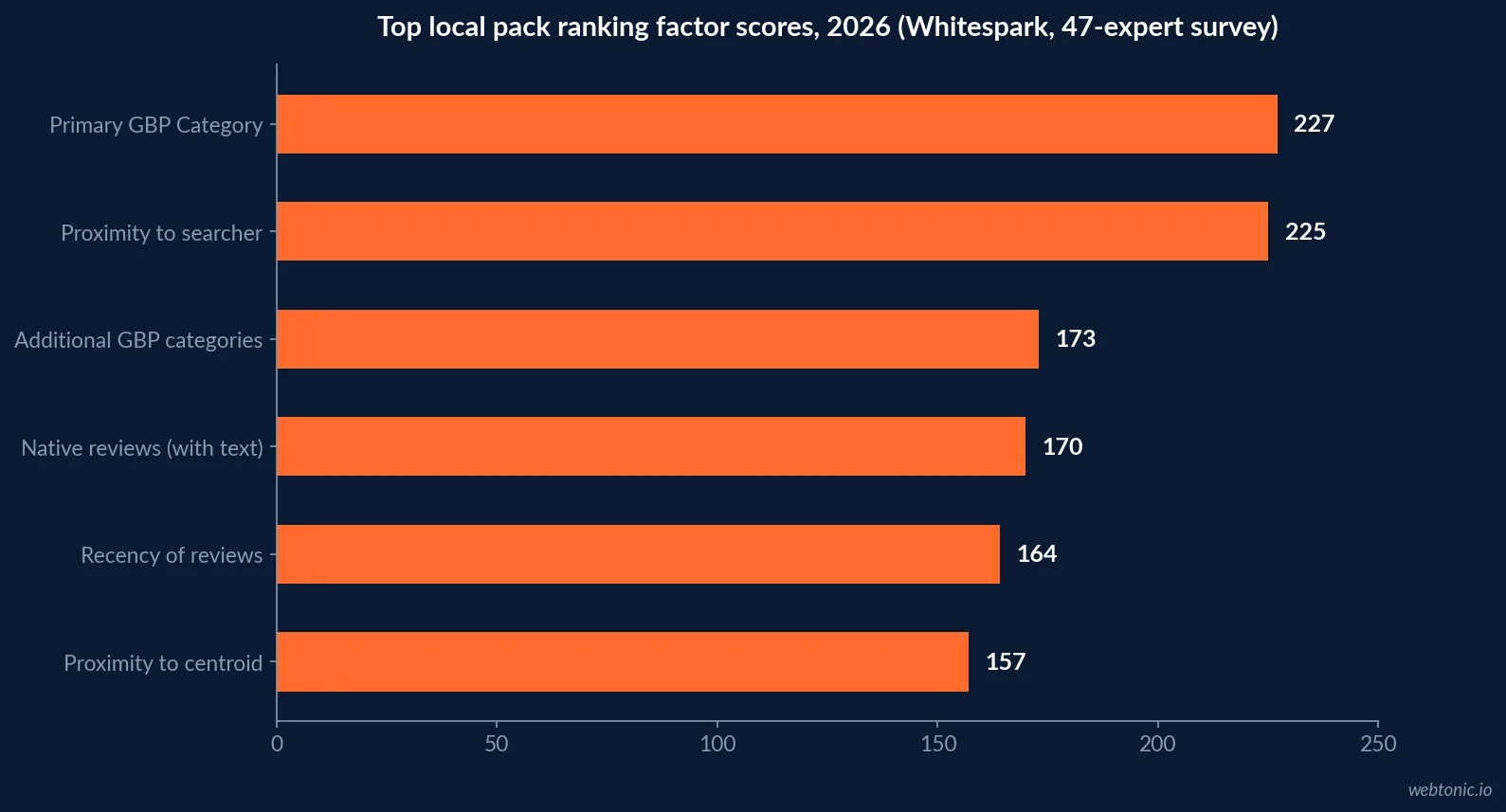
Whitespark's 2026 Local Search Ranking Factors report, a survey of 47 local search experts scoring 187 factors, puts Primary GBP Category at a score of 227 - the single highest-weighted individual factor in the entire study, ahead of proximity of address to the point of search at 225 and additional GBP categories at 173. Quantity of native Google reviews with text scores 170, and recency of reviews scores 164.
For a repair shop, that means the single highest-leverage local SEO task is not a blog post: it is confirming the primary category is "Auto Repair Shop" rather than a generic "Car Dealer" or "Automotive Store" catch-all, and filling every relevant secondary category the listing allows. Google's own Business Profile guidance is explicit that all locations of a multi-site business must share one primary category and can add up to nine more - which is exactly where Whitespark's #1 and #8 factors point a multi-bay operator to spend the audit hour.
| Whitespark 2026 factor | Score | Rank | What it means for a repair shop |
|---|---|---|---|
| Primary GBP Category | 227 | #1 | Set it to the exact repair specialty, not a generic label |
| Proximity of address to searcher | 225 | #2 | Each bay/location needs its own separate listing |
| Additional GBP Categories | 173 | #8 | Fill every relevant secondary category available |
| Quantity of native Google reviews (with text) | 170 | #9 | Volume of written reviews, not just star count |
| Recency of reviews | 164 | #11 | A steady drip beats a one-time review push |
| Proximity of address to centroid | 157 | #12 | Location relative to the city center still counts |
Reviews decide the click, even where they don't decide the rank
BrightLocal's 2026 Local Consumer Review Survey found 97% of consumers read reviews before choosing a local business, and 41% now "always" read reviews, up from 29% the year before. The average consumer checks six different review platforms - meaning a repair shop's Yelp, Facebook and BBB listings are now part of the conversion path even when Google decides the ranking.
Missed calls compound the cost of winning that click. CallRail's report found 85% of customers whose calls go unanswered will not call back - the ranking work is wasted the moment the phone rings into voicemail.
| Consumer review behavior (2026) | Figure | Source |
|---|---|---|
| Read reviews before choosing a business | 97% | BrightLocal |
| "Always" read reviews | 41%, up from 29% | BrightLocal |
| Average review platforms checked | 6 | BrightLocal |
| Google's share of recommendation sources | 71%, down from 83% | BrightLocal |
| AI tools' share of recommendation sources | 45%, up from 6% | BrightLocal |
| Customers who won't call back after a missed call | 85% | CallRail |
The AI-search wrinkle Maps optimization now has to answer
BrightLocal's companion research on AI recommendations found the share of consumers asking an AI tool for a local business recommendation climbing from 6% to 45% year over year, with ChatGPT the most-used tool and Google's own AI Mode close behind. Whitespark's 2026 survey added an "AI Search visibility impact" score to every ranking factor for the first time, reflecting how much each signal seems to move visibility inside AI answers, not just the classic Local Pack.
For a repair shop, the practical read is that a complete, consistently categorized GBP listing now feeds two surfaces at once - the Map and the AI answer - and starving either one starves the other.
Where local organic content still earns its keep
Local Pack weight and local organic weight are not the same table, which is easy to miss when GBP dominates the headline. Whitespark's grouped scores show on-page signals at 33% of local organic weight - more than double their 15% weight inside the Local Pack - and link signals at 24% of organic weight against just 8% for the pack. A repair shop's website content and backlink profile still decide who ranks in the ten blue links below the map, even though the map itself answers to a different, GBP-heavy scorecard.
Advice Local's breakdown of the same 2026 survey flags business hours accuracy as one of the year's biggest swing factors inside GBP signals - a detail that costs nothing to fix and is frequently wrong on multi-bay listings during seasonal hour changes.
| Ranking surface | Top-weighted signal group | Weight | What that means |
|---|---|---|---|
| Local Pack / Maps | Google Business Profile | 32% | Category and completeness dominate |
| Local organic (blue links) | On-page content | 33% | Service pages and content still decide this |
| Local organic (blue links) | Link signals | 24% | Backlink profile still matters here |
| Local Pack / Maps | Review signals | 20% | Up from 16% in 2023 - growing fast |
A quick local SEO checklist, ranked by evidence
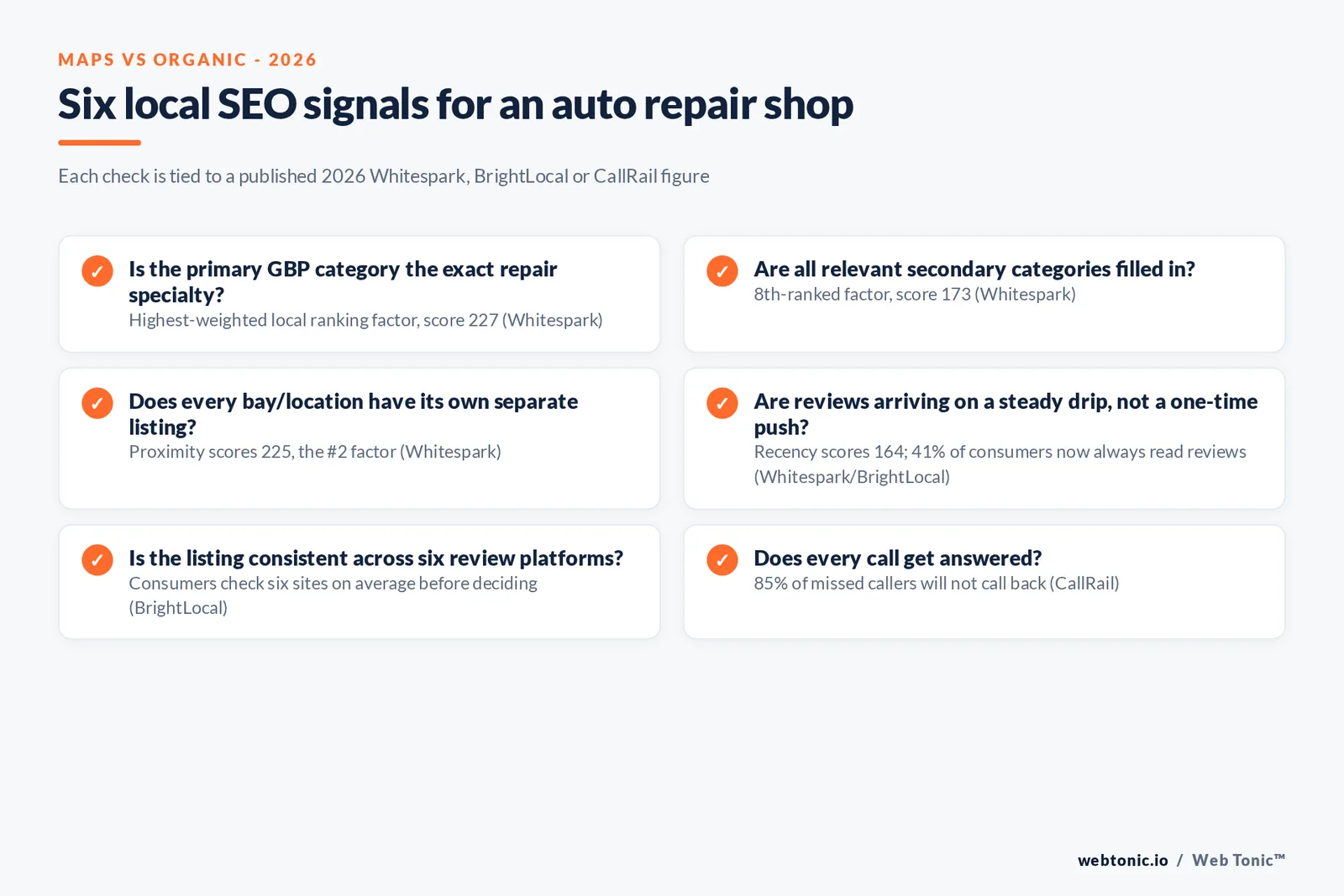
- Set the exact primary GBP category - the single highest-weighted factor Whitespark measured, at a score of 227.
- List every relevant secondary category the profile allows, the #8 factor at 173.
- Give each bay or location its own listing, since proximity to the searcher is the #2 factor at 225 and a shared profile cannot serve two addresses.
- Keep the on-page content current for organic rankings specifically, where content carries 33% of the weight versus 15% inside the Local Pack.
- Route every call to someone who answers, since 85% of customers whose calls go unanswered will not call back, per CallRail.
What a repair shop should actually do with this
Audit the primary GBP category first - it outweighs every other local signal in Whitespark's 2026 data. Then check listing completeness across the six platforms BrightLocal says consumers check, not just Google. Then fix call handling, since CallRail's data means a ranking win is wasted the moment a call goes unanswered. Our growth marketing team treats GBP category and call routing as the first two line items on every local audit, ahead of content work, our data and analytics practice builds the call-attribution reporting that catches a missed-call problem before it shows up in lost revenue, and our related piece on automotive local SEO statistics covers the dealership side of this same Maps-versus-organic question if that is the audience you serve.
| Fix | Ranking-factor evidence | Consumer-behavior evidence |
|---|---|---|
| Set the exact primary GBP category | Highest-weighted factor at 227 (Whitespark) | - |
| Fill every secondary category | 8th-ranked factor at 173 (Whitespark) | - |
| Separate listing per location | Proximity scores 225, #2 factor (Whitespark) | - |
| Keep reviews recent, not just numerous | Recency scores 164 (Whitespark) | 41% now always read reviews (BrightLocal) |
| Route calls so none go unanswered | - | 85% of missed callers won't call back (CallRail) |
Frequently Asked Questions
Does the Google Local Pack or the organic blue links drive more repair shop calls?
The Local Pack, by a wide margin among vendors who measure it. CallRail's analysis of 1.1 million leads across seven industries found Google Business Profile driving 37% of calls in the automotive industry specifically, ahead of every other channel measured, with Google Ads and organic search splitting most of the remainder. A repair shop that treats its GBP listing as a secondary asset to the website is optimizing for the smaller of the two surfaces.
What actually moves a repair shop's Local Pack ranking in 2026?
Category selection, overwhelmingly. Whitespark's 2026 Local Search Ranking Factors survey of 47 local search experts scores Primary GBP Category at 227 out of a possible top score, the single highest-weighted factor in the study, followed by proximity of the business address to the searcher at 225 and additional GBP categories at 173. Grouped by category, Google Business Profile signals make up 32% of local pack ranking weight, more than reviews (20%) and on-page content (15%) combined.
Do reviews matter as much as the ranking factor score suggests?
For the click, more than for the ranking. Whitespark scores review signals as a group at 20% of local pack weight, but BrightLocal's 2026 Local Consumer Review Survey shows the conversion side of that coin: 41% of consumers now 'always' read reviews before choosing a business, up from 29% a year earlier, and consumers use an average of six different review platforms before deciding. Ranking gets the shop into the pack; reviews decide who gets the call once it is there.
Is Google still the only review platform that matters for a repair shop?
No, and that is moving fast. BrightLocal's 2026 survey found Google's share of local recommendation sources slipping while AI tools climb into third place behind Google and Facebook. For a category-specific read, BrightLocal's separate research on AI recommendations found the share of consumers asking an AI tool for a local business recommendation jumped from 6% to 45% year over year. A repair shop's listing consistency across platforms, not just its Google star rating, is now part of the local SEO job.
Should a multi-bay repair shop optimize differently than a single-location shop?
The ranking-factor weighting does not change, but the execution does. Whitespark's second-ranked factor, proximity of the business address to the point of search, means each location needs its own listing with its own primary category rather than one consolidated profile serving several addresses. Shops running several bays under one brand should audit for duplicate or thin location pages before spending on new content, since that structural gap blocks every location but the flagship from ranking at all.
Sources
Whitespark - 2026 Local Search Ranking Factors Report
Google - Manage your Business Profile category, official guidance
Advice Local - 2026 Local Search Ranking Factors breakdown
BrightLocal - Local Consumer Review Survey 2026
BrightLocal - Consumers Asking AI for Business Recommendations
BrightLocal - 35+ Local SEO Statistics for 2026
CallRail - From Conversations to Conversions, 2026