Table of contents
Auto repair email marketing in 2026 has one honest job: keep a customer on a maintenance cadence for a vehicle that is now 13.0 years old on average, not chase reviews that SMS has largely taken over. No vendor publishes a dedicated auto-repair email benchmark, so this page builds the case from aftermarket sizing data, dealership service data, and cross-industry email and review research, and states plainly which numbers are auto-repair-specific and which are not.
Key Takeaways
- Average U.S. vehicle age hit a record 13.0 years at the start of 2026.
- The U.S. aftermarket is worth USD 599.7 billion in 2026, up 5.4%.
- It is forecast to reach USD 676.5 billion by 2029.
- About 299,000 auto mechanic businesses operate in the U.S., up 12% since 2018.
- Dealer share of service visits fell from 33% to 29% since 2018.
- Dealer service and parts revenue still rose 33% to USD 9.23 million per store.
- 80% of new-car buyers are likely to service at the selling dealership.
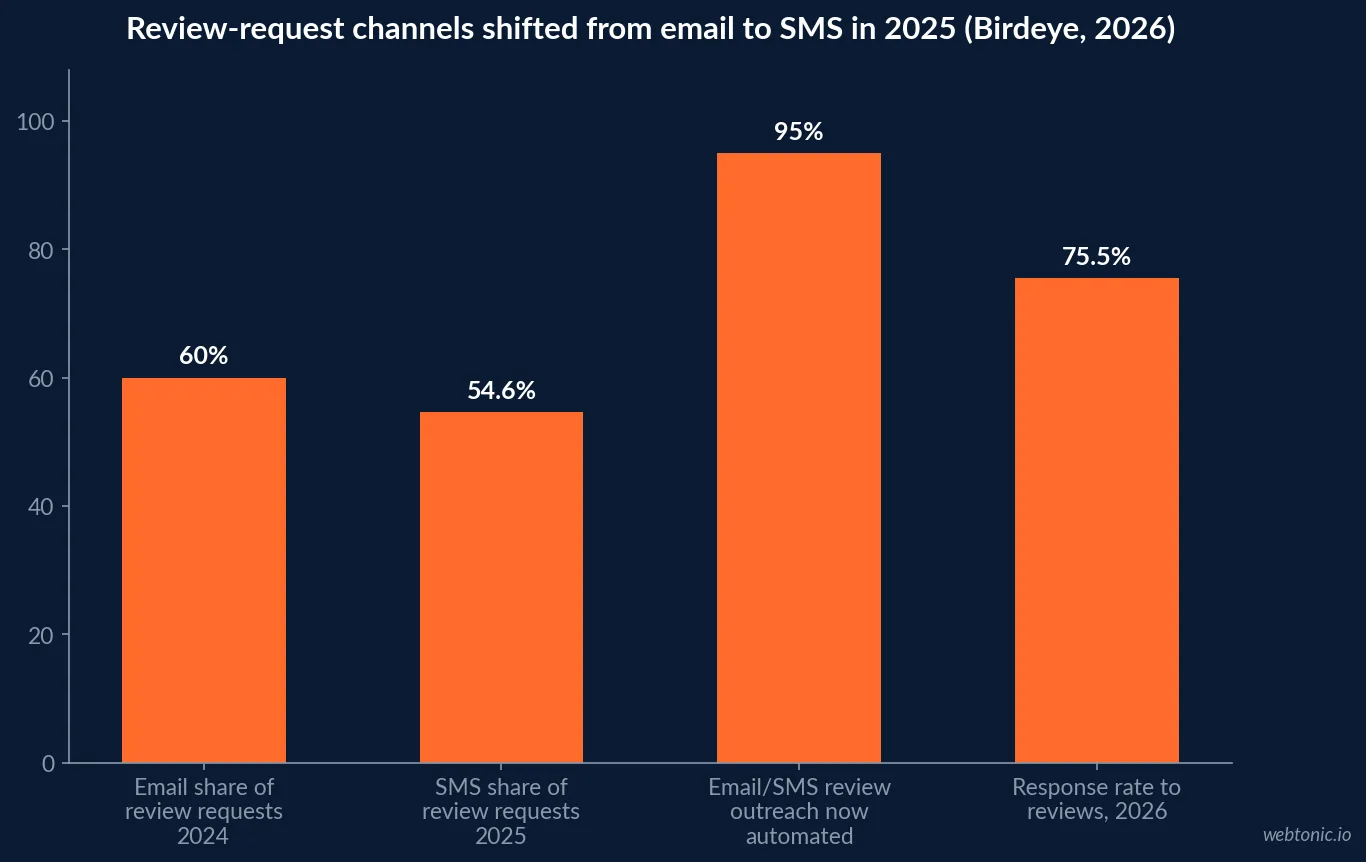
- SMS carries 54.6% of review requests, overtaking email's 60% share in 2024.
- About 95% of email and SMS review outreach is now automated.
- Cross-industry open rate benchmark sits at 35.63% (Mailchimp, All Users).
- Cross-industry click rate benchmark sits at 2.62%.
- Ecommerce, the closest analogue, opens at 29.81% with a 1.74% click rate.
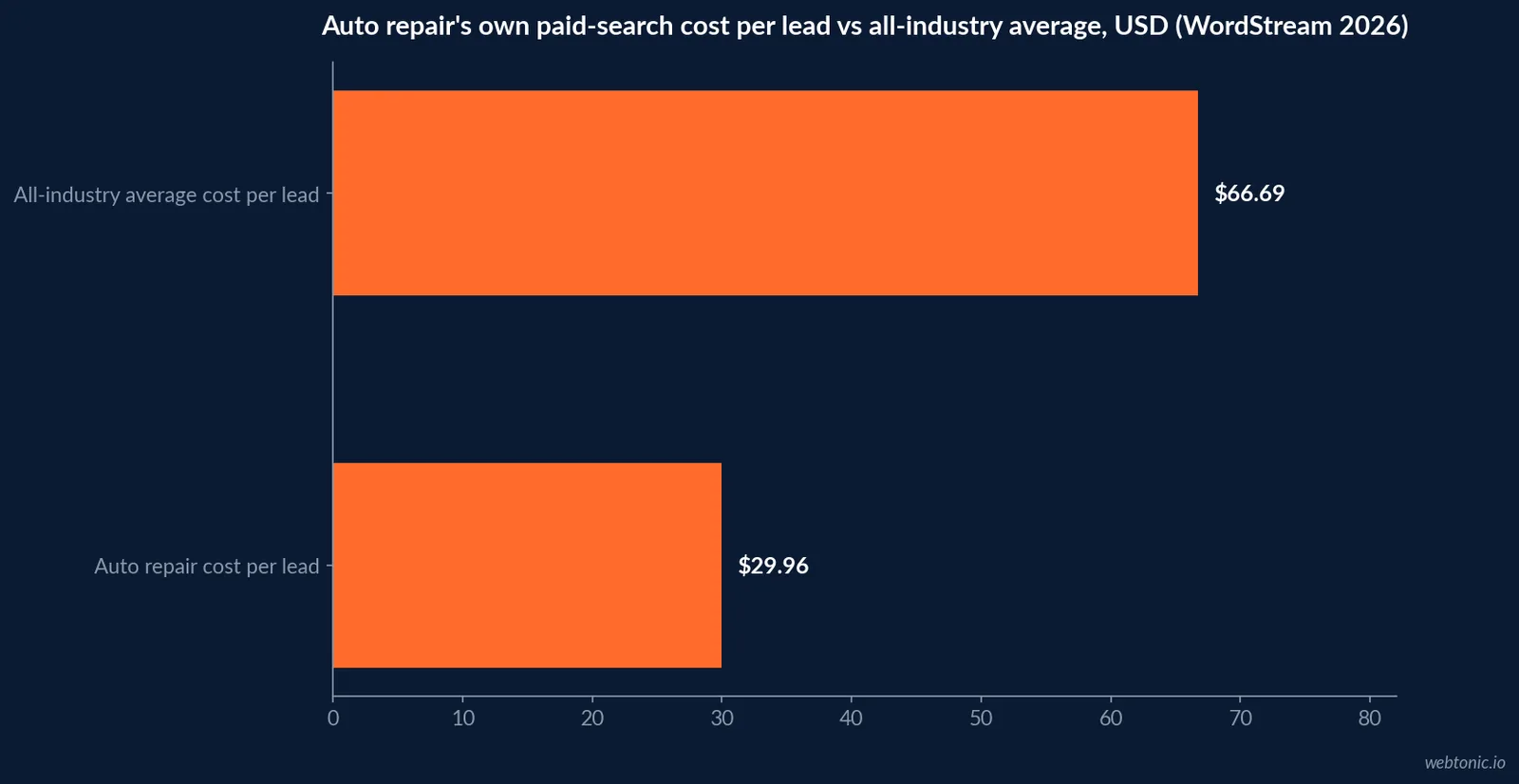
- Auto repair's own paid-search CPL is USD 29.96, under half the USD 66.69 all-industry average.
- Auto repair's paid-search conversion rate is 15.51%, second-highest of 23 industries tracked.
- Auto repair's click-through rate is 5.56%, the lowest of those 23 industries.
- 47% of consumers won't use a business with fewer than 20 reviews.
- 31% of consumers now require 4.5+ stars, up from 17% a year earlier.
- 68% require at least 4 stars, up from 55%.
Benchmarks at a glance
The figures below come from three different research lines - aftermarket sizing, dealership fixed ops, and cross-industry email/review data - because no single study covers all three for an independent repair shop's email program.
| Metric | 2026 figure | Source |
|---|---|---|
| Average U.S. light vehicle age | 13.0 years (record high) | S&P Global Mobility / Lang Aftermarket iReport |
| U.S. total aftermarket size | USD 599.7 billion, +5.4% YoY | Auto Care Association |
| Aftermarket forecast, 2029 | USD 676.5 billion | Auto Care Association |
| Auto mechanic businesses, U.S. | ~299,000, +12% since 2018 | Cox Automotive 2026 Fixed Ops Study |
| Review-request share, email vs SMS | Email 60% (2024) -> SMS 54.6% (2025) | Birdeye State of Online Reviews 2026 |
| Cross-industry email open rate | 35.63% (All Users) | Mailchimp Email Marketing Benchmarks |
Why the fleet email is chasing keeps getting older
S&P Global Mobility's Lang Aftermarket iReport puts the average U.S. light vehicle at a record 13.0 years old at the beginning of 2026, the oldest mix of cars and light trucks the country has recorded. An older fleet needs more frequent service, which is precisely the workload a reminder-and-recall email sequence is built to automate: oil-change intervals, brake wear windows, and inspection due-dates that a one-off promotional email cannot track on its own.
That aging trend also explains why the aftermarket keeps growing even in a slow new-car year. The Auto Care Association reports the U.S. total aftermarket reached USD 599.7 billion in 2026, up 5.4%, and projects USD 676.5 billion by 2029. Every point of that growth is a maintenance visit somebody has to be reminded to book.
| Aftermarket metric | 2026 value | Direction |
|---|---|---|
| U.S. total aftermarket size | USD 599.7 billion | +5.4% vs 2025 |
| 2025 aftermarket size (base year) | USD 599.7B implies ~USD 569B in 2025 | Growth base |
| 2029 aftermarket forecast | USD 676.5 billion | Compounding forward |
| Average light vehicle age | 13.0 years | Record high |
The competitive set an email list is defending
Cox Automotive's 2026 Fixed Operations and Ownership Study counts roughly 299,000 auto mechanic businesses operating in the U.S., up 12% since 2018 - a genuinely more crowded field than it was even a few years ago. Dealerships are part of that field but are losing ground inside it: dealer share of total service visits fell from 33% to 29% since 2018, even as average dealer service and parts revenue rose 33% to about USD 9.23 million per store. 80% of new-car buyers say they are likely to service at the selling dealership, yet the visit-share numbers show plenty of that traffic is leaking to independents and general repair - the exact customers an email retention program is meant to keep once they arrive.
Average spend per visit is close between the two channels: USD 261 at a dealership versus USD 275 at general repair, so price is not the differentiator keeping either side's customers. Communication cadence is one of the few levers a shop fully controls.
What paid search costs, and why that matters for email
WordStream's 2026 Google Ads benchmarks put Automotive - Repair, Service & Parts at a 5.56% click-through rate, the lowest of the 23 industries it tracks, against a USD 4.35 average cost per click. The payoff shows up further down the funnel: a 15.51% conversion rate, the second-highest of all 23 industries, and a USD 29.96 cost per lead - well under half the USD 66.69 all-industry average. LocalIQ's separate 2026 automotive report puts the sub-category's overall CTR at 6.17%, down 5.66% year over year, with a cohort-wide cost per lead of USD 32.79.
Every one of those leads still has to be turned into a repeat customer, and that retention work is cheaper than acquisition. Email cannot be benchmarked against that CPL directly - no vendor publishes an auto-repair email cost-per-lead figure - but the arithmetic favors keeping an acquired customer over re-buying the same click twice.
| Paid search metric (2026) | Auto repair value | All-industry average | Source |
|---|---|---|---|
| Click-through rate | 5.56% | 6.64% | WordStream 2026 Google Ads Benchmarks |
| Cost per click | USD 4.35 | USD 5.42 | WordStream 2026 Google Ads Benchmarks |
| Conversion rate | 15.51% | 8.18% | WordStream 2026 Google Ads Benchmarks |
| Cost per lead | USD 29.96 | USD 66.69 | WordStream 2026 Google Ads Benchmarks |
| Cohort CTR (LocalIQ automotive report) | 6.17%, -5.66% YoY | n/a | LocalIQ 2026 Automotive Report |
Where email actually sits, now that SMS has taken reviews
Birdeye's State of Online Reviews 2026 report found a real channel shift in 2025: SMS became the leading review-request channel at 54.6% of all requests, overtaking email, which had carried 60% of requests the year before. About 95% of email and SMS review outreach is now automated, and response rates to reviews climbed to 75.5% in 2026 from 73% in 2025. None of that retires email - it means a shop's email program should stop treating "ask for a review" as its main job and let SMS carry that load instead.
What email keeps is the higher-context work: service due-date reminders, estimate follow-ups, seasonal maintenance pushes, and win-back sequences for lapsed customers, all of which suit a longer message format and a mailbox people check less urgently than a text.
| Cross-industry email benchmark (Mailchimp) | Open rate | Click rate | Unsubscribe rate |
|---|---|---|---|
| Business + Finance | 31.35% | 2.78% | 0.15% |
| Non-Profits | 40.04% | 3.27% | 0.18% |
| Education + Training | 35.64% | 3.02% | 0.18% |
| Ecommerce (closest transactional analogue) | 29.81% | 1.74% | 0.19% |
| All Users (cross-industry average) | 35.63% | 2.62% | 0.22% |
Why star ratings raise the stakes on every send
BrightLocal's 2026 Local Consumer Review Survey found consumer expectations moved fast in a single year: 31% of consumers will only use a business with 4.5 stars or more, up from 17% a year earlier, and 68% require at least 4 stars, up from 55%. Separately, 47% of consumers won't use a business with fewer than 20 reviews, and 74% only care about reviews written in the last three months. A shop whose email program stops nudging customers toward reviews - even as SMS takes the volume - risks falling behind that fast-rising bar.
| Review-trust signal (BrightLocal 2026) | Share of consumers | Change vs prior year |
|---|---|---|
| Require 4.5+ stars | 31% | up from 17% |
| Require 4+ stars | 68% | up from 55% |
| Won't use a business with <20 reviews | 47% | n/a |
| Only trust reviews from the last 3 months | 74% | n/a |
Building the email calendar around the data
Three inputs should drive the send calendar: the 13.0-year average vehicle age sets the maintenance cadence, the USD 29.96 paid-search cost per lead sets the price of the customer email is meant to retain, and the 54.6% SMS share of review requests sets what email should stop trying to own. That leaves email with four defensible jobs: appointment reminders tied to mileage or time since last visit, estimate follow-ups for declined work, seasonal campaigns (pre-winter battery and tire checks, pre-summer AC checks), and win-back sequences for customers who haven't booked in 9-12 months.
None of that requires a large list. A shop keeping even a few hundred customers on a maintenance cadence is defending real revenue against 299,000 competitors and a dealership channel that is already losing 4 points of visit share to exactly this kind of independent retention work.
One more variable: AI is entering the service journey
Cox Automotive's 2026 study found 16% of consumers used an AI website or tool during their most recent service journey - researching providers, comparing options, or trying to understand a repair before booking it. That is still a minority, but it is large enough that an email program built only around a static reminder template will look dated within a year or two. The near-term fix is simple: keep the copy specific (mileage, part, and price range) rather than generic, since that is exactly the kind of detail both a human reader and an AI summarizer can act on.
A 12-month send calendar built from the data above
Mapping the aftermarket's own seasonality against the retention jobs email is actually good at produces a simple annual structure, rather than a single "send more" instruction.
| Period | Campaign type | Trigger from the data |
|---|---|---|
| Pre-winter (Sep-Nov) | Battery, tire, and antifreeze reminder | 13.0-year average vehicle age raises cold-weather failure risk |
| Pre-summer (Mar-May) | A/C and cooling-system reminder | Seasonal service spike independent of dealer visits |
| Ongoing | Mileage/time-based service due-date reminder | Core reminder cadence every repeat-visit shop needs |
| Post-estimate, 3-7 days | Declined-work follow-up | Captures deferred repairs before the customer forgets |
| 9-12 months since last visit | Win-back sequence | Targets the visit share dealers are already losing (33% to 29%) |
| Post-service, 1-2 days | Short satisfaction check-in (not a review ask) | Leaves review requests to the SMS channel per Birdeye data |
Common mistakes that shrink these numbers
- Sending only promotions, which ignores the reminder cadence the 13.0-year fleet age actually calls for.
- Still asking for reviews by email as the primary channel, when SMS already carries 54.6% of requests.
- Treating the whole list the same instead of separating recent customers from the 9-12 month lapsed segment that a win-back sequence is built for.
- Never mentioning price ranges or mileage, the specific detail that both readers and AI tools use to act on a reminder.
Frequently Asked Questions
What open rate should an auto repair shop expect from email?
No vendor publishes an auto-repair-only open rate, so the honest anchor is Mailchimp's cross-industry benchmark: 35.63% open rate, 2.62% click rate and a 0.22% unsubscribe rate across All Users. Ecommerce, the closest transactional analogue Mailchimp tracks, opens at 29.81% with a 1.74% click rate. A repair shop's list is smaller and more relationship-based than either, which typically pushes reminder and recall sends toward the higher end of that range, but treat any single number quoted as auto-repair-specific as unverified until the shop's own platform reports it.
Is email still the right channel for review requests?
It is no longer the leading one. Birdeye's State of Online Reviews 2026 report found SMS became the top review-request channel in 2025 at 54.6% of all requests, overtaking email, which had carried 60% of requests the year before. About 95% of email and SMS review outreach is now automated. That does not retire email for reviews, but it does mean a shop planning its next review push should not assume email is still the default rail.
Why does vehicle age matter for a repair shop's email calendar?
Because it sets how often a customer actually needs to hear from you. S&P Global Mobility's Lang Aftermarket iReport puts the average U.S. light vehicle at a record 13.0 years old at the start of 2026. Older fleets need more frequent maintenance touches, which is exactly the cadence a reminder-and-recall email program is built to automate, rather than the occasional promotional blast.
How big is the market an auto repair shop's email list is competing inside?
The Auto Care Association's 2026 factbook release puts the U.S. total aftermarket at USD 599.7 billion in 2026, growing 5.4% and projected to reach USD 676.5 billion by 2029. Cox Automotive's 2026 Fixed Operations and Ownership Study separately counts roughly 299,000 auto mechanic businesses operating in the U.S., up 12% since 2018. A shop's email list is a small claim on a large and increasingly crowded market.
Does email need to compete with dealership service departments?
Only partly, and the data cuts both ways. Cox Automotive's 2026 study found 80% of new-car buyers are likely to service at the selling dealership, yet dealer share of total service visits has fallen from 33% to 29% since 2018 even as dealer service and parts revenue rose 33% to about USD 9.23 million per store. Independent shops are absorbing the visits dealers are losing, which is exactly the audience a retention email program should be built to keep.
Web Tonic builds growth marketing programs, including lifecycle email, for local service businesses. See how paid channels compare in this Google Ads pricing breakdown, or read our take on automotive local SEO statistics for how reviews and rankings interact. Questions about a shop's own retention math? Talk to our team.
Sources
S&P Global Mobility / Lang Aftermarket iReport, 2026
Auto Care Association, 2026 factbook release
Cox Automotive, 2026 Fixed Operations and Ownership Study
WordStream, 2026 Google Ads Benchmarks
LocalIQ, 2026 Automotive Search Advertising Benchmarks
Birdeye, State of Online Reviews 2026
Mailchimp, Email Marketing Benchmarks
BrightLocal, 2026 Local Consumer Review Survey