Table of contents
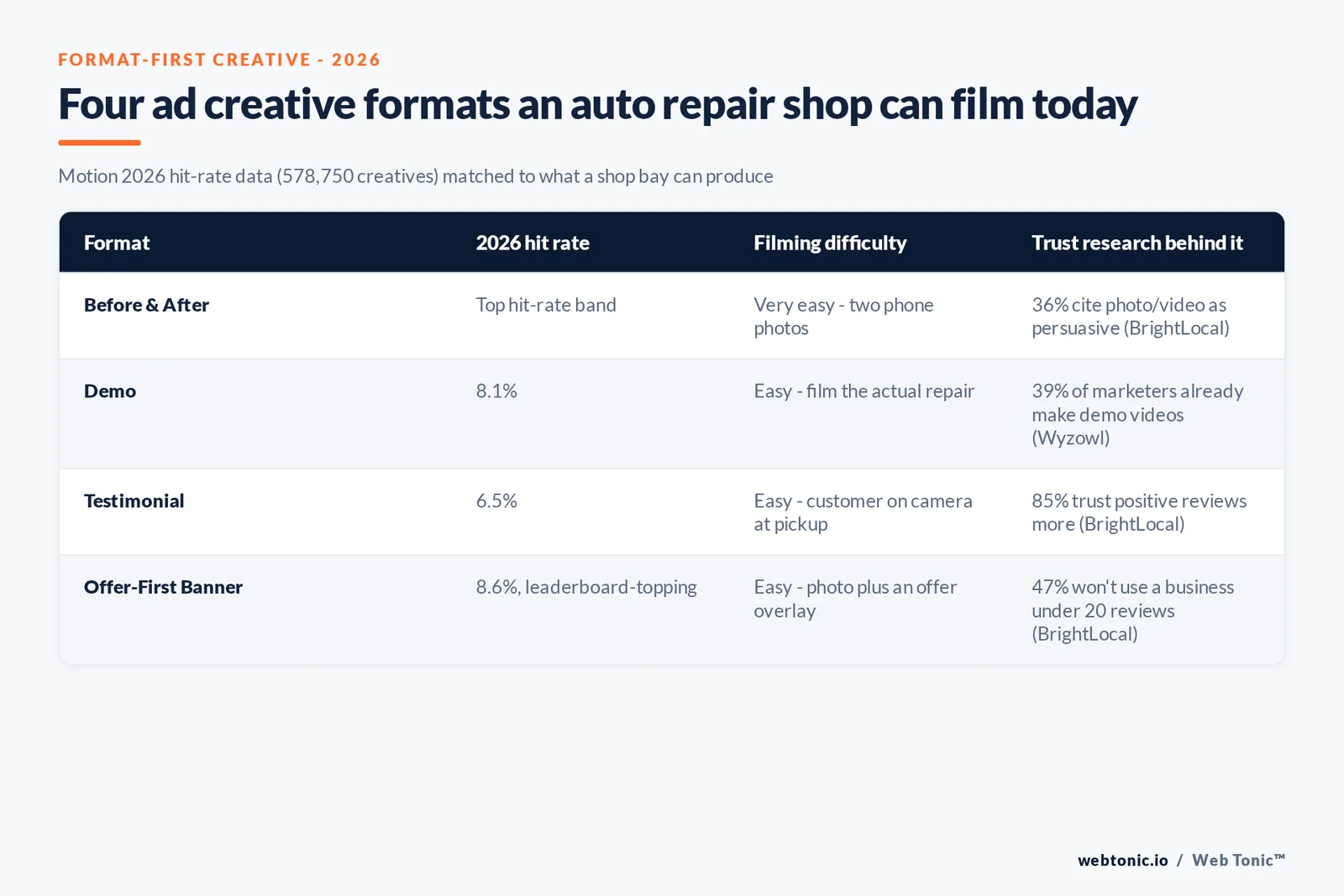
Across Motion's 2026 benchmark of 578,750 Meta ad creatives, Offer-First Banner (8.6% hit rate), Demo (8.1%) and Testimonial (6.5%) lead the format leaderboard, with Before & After in the same top band — and three of those four are formats an auto repair shop can film with a phone in its own bay. This page is cross-industry creative-format data, clearly labeled, applied to the specific footage a repair shop actually has available to shoot.
Key Takeaways
- Offer-First Banner leads Meta's 2026 format leaderboard at an 8.6% hit rate (Motion, 578,750 creatives).
- Demo format follows at an 8.1% hit rate, one of the most filmable formats for a shop.
- Testimonial format posts a 6.5% hit rate and a 1.0 spend-use ratio, a steady workhorse.
- Before & After sits in the same top hit-rate band as Demo and Testimonial.
- Celebrity format hits only 5.9% but absorbs 2.1 times its fair share of spend when used.
- 91% of businesses use video as a marketing tool in 2026 (Wyzowl), up from a dip in 2025.
- 82% of marketers using video report a good ROI, per Wyzowl's 2026 survey.
- 71% of video marketers say 30 seconds to 2 minutes is the most effective length.
- Video ads are the 4th most common video use case, at 48% adoption (Wyzowl 2026).
- 97% of consumers read reviews for local businesses (BrightLocal 2026).
- 85% of consumers say positive reviews make them more likely to use a business.
- 47% of consumers won't use a business with fewer than 20 reviews.
- 36% of consumers say an appealing photo or video makes a review more persuasive (BrightLocal 2026).
- 53% of dealers who add photos or video to service work report increased consumer trust (Cox Automotive 2026).
- 63% of video marketers now use AI tools to help produce video, up from 51% a year earlier.
The format leaderboard behind "what converts"
Motion's Creative Benchmarks 2026, built from 578,750 Meta ad creatives, scores every visual format on two axes: hit rate (how often it becomes an account-level winner) and spend-use ratio (whether it earns more or less budget than its creative share). Offer-First Banner leads both lists at an 8.6% hit rate and a 1.3 spend-use ratio. Demo (8.1%) and Testimonial (6.5%) follow as steady, high-volume performers, and Before & After appears in the same top hit-rate band on Motion's full leaderboard.
None of this is automotive-specific — Motion's dataset spans every advertiser category it tracks — but the formats at the top of the list happen to be exactly the footage a repair bay naturally produces: a car coming in broken, a technician explaining the fix, and a customer saying thank you on the way out.
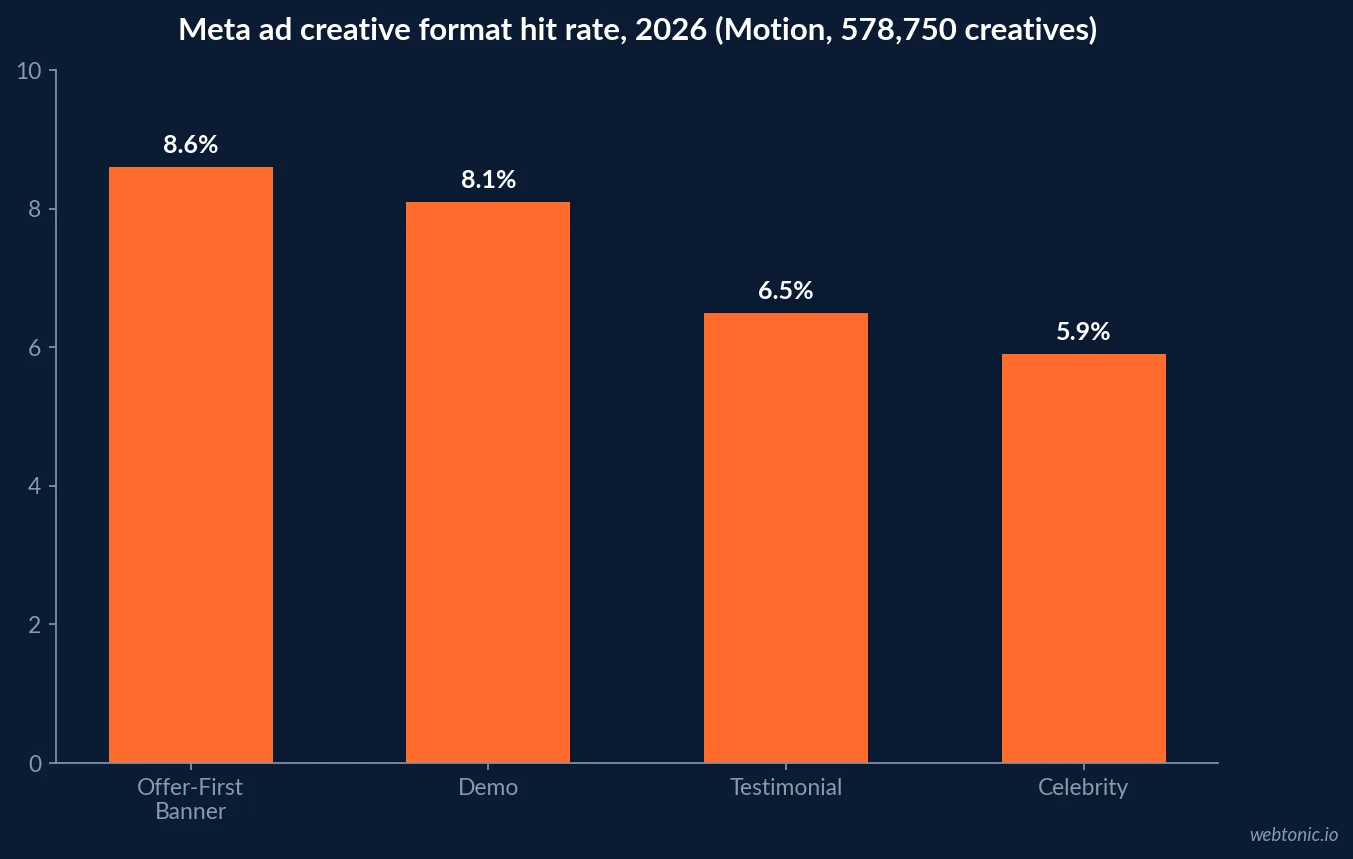
| Visual format (Motion 2026, 578,750 creatives) | Hit rate | Spend-use ratio | How filmable for a repair shop |
|---|---|---|---|
| Offer-First Banner | 8.6% | 1.3 | Easy - a phone photo plus a price or offer overlay |
| Demo | 8.1% | 1.0 | Very easy - film the actual repair or diagnostic step |
| Testimonial | 6.5% | 1.0 | Easy - a customer on camera at pickup |
| Before & After | – (top band) | – | Very easy - two phone photos, no edit needed |
| Celebrity | 5.9% | 2.1 | Not realistic for an independent shop |
Why "documentary" formats beat polish for this category
The formats a repair shop can produce cheaply are, per Motion's data, also close to the top of the leaderboard, while Celebrity-style, high-production formats absorb outsized spend without a matching hit rate for most advertisers. That is a rare case where the low-cost option and the high-hit-rate option point the same direction, rather than trading budget for performance.
Wyzowl's 2026 survey backs the format choice from a different angle: testimonial videos are the second most common video type marketers make, at 57% adoption, and demo/product videos sit at 39% — both filmable in a shop bay with no script.
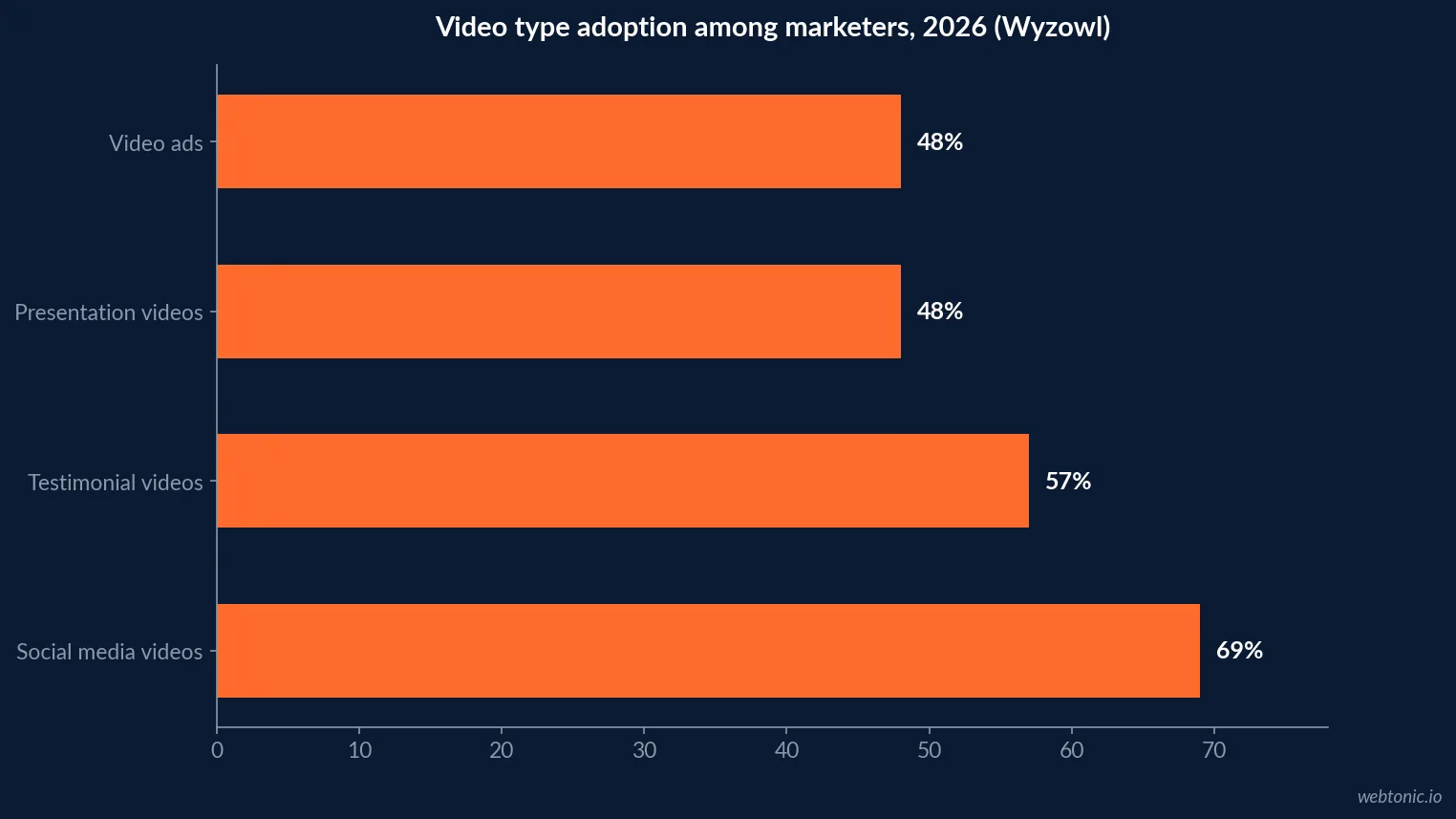
| Video type (Wyzowl 2026 adoption among video marketers) | Adoption |
|---|---|
| Social media videos | 69% |
| Testimonial videos | 57% |
| Presentation videos | 48% |
| Video ads | 48% |
| Teaser videos | 45% |
| Product / service demo videos | 39% |
The trust research behind why testimonials and photos work
BrightLocal's 2026 Local Consumer Review Survey found 97% of consumers read reviews for local businesses, 85% say positive reviews make them more likely to use a business, and 47% won't use a business with fewer than 20 reviews at all. On the creative side specifically, 36% of consumers name an appealing photo or video as a factor that makes a review more persuasive, and 44% weight a high star rating attached to it.
Cox Automotive's 2026 Fixed Ops study reports a parallel effect inside the auto industry itself: dealers who add photos or video to service work cite 53% increased consumer trust, 45% higher customer engagement and 44% more transparency as a result. That is dealership fixed-ops data, not independent-shop ad creative, but the underlying mechanism — visual proof reduces uncertainty about unseen mechanical work — applies directly to a repair shop's own creative.
| Trust signal (BrightLocal 2026, general local business) | Share of consumers |
|---|---|
| Read reviews for local businesses at all | 97% |
| More likely to use a business after positive reviews | 85% |
| Won't use a business with fewer than 20 reviews | 47% |
| Only use a business with 4+ stars | 68% |
| Say an appealing photo/video makes a review more persuasive | 36% |
Video's ROI case, and its ceiling
Wyzowl's 2026 survey found 91% of businesses now use video as a marketing tool and 82% of marketers who use video report a good ROI from it, though that is down from a 93% all-time high the year before. 71% of video marketers consider 30 seconds to 2 minutes the most effective length, which comfortably fits a single diagnostic walkthrough or a before-and-after reveal without needing a script or a studio.
The ceiling worth naming: with 91% of businesses already using video, video itself is no longer a differentiator. Format and proof point, not "video versus static," is what Motion's hit-rate data says actually separates a winning creative from an average one. It's also worth remembering that the underlying media cost still runs through the channel benchmarks covered elsewhere on this site: WordStream's 2026 Facebook Ads Benchmarks puts the average leads-objective cost per click at $1.92, so a stronger-hitting creative still has to run inside that same media cost, not around it.
What separates a winning creative from an average one
Motion's hit-rate methodology is worth understanding before applying it: a "winner" is a creative that clearly outperforms the account's own median, not an absolute benchmark every advertiser hits. That means the 8.6% figure for Offer-First Banner describes how often that format produces an outlier, not how well every single Offer-First Banner ad performs. A shop testing format for the first time should expect a spread of results within any one format, and judge the format by its batting average across several creatives, not by one ad's outcome.
| Format testing discipline | What it looks like in practice |
|---|---|
| Test in pairs, not singles | Run two Demo ads and two Testimonial ads together, not one of each |
| Judge by format, not by ad | Compare average performance across a format's creatives |
| Refresh before fatigue sets in | Rotate new footage every 4-6 weeks rather than waiting for a drop-off |
| Keep the proof point specific | Name the repair, the part, or the customer - avoid generic claims |
Why the review count threshold matters before the creative does
A Testimonial-format ad is only as strong as the review base behind it. BrightLocal's 2026 data found 47% of consumers won't use a business with fewer than 20 reviews, and 31% will only use a business with a 4.5-star rating or higher, up sharply from the prior year. A shop with fewer than 20 reviews is better served spending the next marketing dollar on collecting reviews — a follow-up text after every visit, for example — before investing further in Testimonial-format creative that references a review base too thin to clear that threshold.
A practical testing order for a repair shop
Start with the two lowest-cost, highest-hit-rate formats a shop already has the raw footage for: a Before & After pair from a recent job, and a Testimonial clip from a satisfied customer at pickup. Layer in a Demo format — a technician narrating a common repair — once the first two are running, and reserve Offer-First Banner-style creative for a specific, time-boxed promotion rather than always-on brand spend.
Our performance creative team builds exactly this kind of format-first testing plan, and our Facebook Ads pricing breakdown shows how creative testing budget fits alongside the media spend covered elsewhere on this site.
What to measure once the formats are live
Track hit rate the way Motion does — the share of creatives that clearly outperform the account median — rather than judging a single ad on its own. Pair that with a simple review count and star-rating check per BrightLocal's thresholds (20 reviews, four stars) before spending more on creative than on actually earning the reviews the creative references.
If your account needs a second opinion on which format to test first, talk to our team, or see our roundup of Facebook Ads agencies for how other shops structure creative testing budgets.
Frequently Asked Questions
What ad creative format converts best for a local service business right now?
Motion's 2026 Creative Benchmarks, built from 578,750 Meta ad creatives, ranks Offer-First Banner (8.6% hit rate), Demo (8.1%) and Testimonial (6.5%) as the top-performing formats by how often they become account-level winners, with Before & After appearing in the same top band. None of this is auto-repair-specific — it is Motion's full cross-industry dataset — but a repair shop can film Demo, Testimonial and Before & After formats with a phone and no studio, which makes them the most realistic starting point.
Do before-and-after repair photos actually outperform generic ads?
There is no auto-repair-specific study proving a lift percentage, so treat any single number from an agency case study as one data point, not a benchmark. What is verifiable is that Before & After sits in Motion's top hit-rate band across 578,750 creatives, alongside Demo and Testimonial, and that reviews and photos measurably build trust in local services generally: BrightLocal's 2026 survey found 36% of consumers rate an appealing photo or video as a factor that makes a review more persuasive.
Should an auto repair shop invest in video ads or stick with static images?
Test both, but do not assume video wins by default. Motion's data shows Demo and Testimonial, both typically filmed, in the top hit-rate band, while static formats like Offer-First Banner actually lead the full leaderboard. Wyzowl's 2026 survey found 82% of marketers who use video say it has delivered good ROI, but that same survey shows 91% of businesses already use video, meaning it is no longer a differentiator by itself — the specific format and proof point inside the video is what separates a winner from the crowd.
How much does showing real reviews in an ad actually matter?
More than most creative choices a shop controls directly. BrightLocal's 2026 Local Consumer Review Survey found 97% of consumers read reviews for local businesses, 85% say positive reviews make them more likely to use a business, and 47% of consumers will not use a business with fewer than 20 reviews. Pulling a real, recent, star-rated review into ad creative is one of the few tactics with both a hit-rate signal (Testimonial format) and a trust-research backing (BrightLocal) behind it.
What is the biggest creative mistake an auto repair shop makes in ads?
Running a single polished, generic 'trust us' ad instead of testing several documentary-style formats. Motion's data shows a wide spread between top and bottom formats on hit rate, meaning format choice alone materially changes how often a creative becomes a winner. A shop that never tests Demo, Testimonial or Before & After alongside its brand ad is leaving a measurable share of that hit-rate gap on the table.
Sources
Motion - Creative Benchmarks 2026 (Top Visual Formats on Meta)
Wyzowl - Video Marketing Statistics 2026
BrightLocal - Local Consumer Review Survey 2026
Cox Automotive - 2026 Fixed Ops and Ownership Study
WordStream - Facebook Ads Benchmarks 2025/2026