Table of contents
Key Takeaways
- Audience targeting directs marketing messages to specific groups based on demographics, behaviors, interests, and intent — transforming generic campaigns into precision instruments that reach customers ready to convert.
- Targeted campaigns achieve 2–5× higher ROI than untargeted equivalents, according to benchmarks from WordStream and HubSpot.
- 80% of consumers prefer to buy from brands offering personalized experiences, making audience targeting essential for every modern marketing strategy.
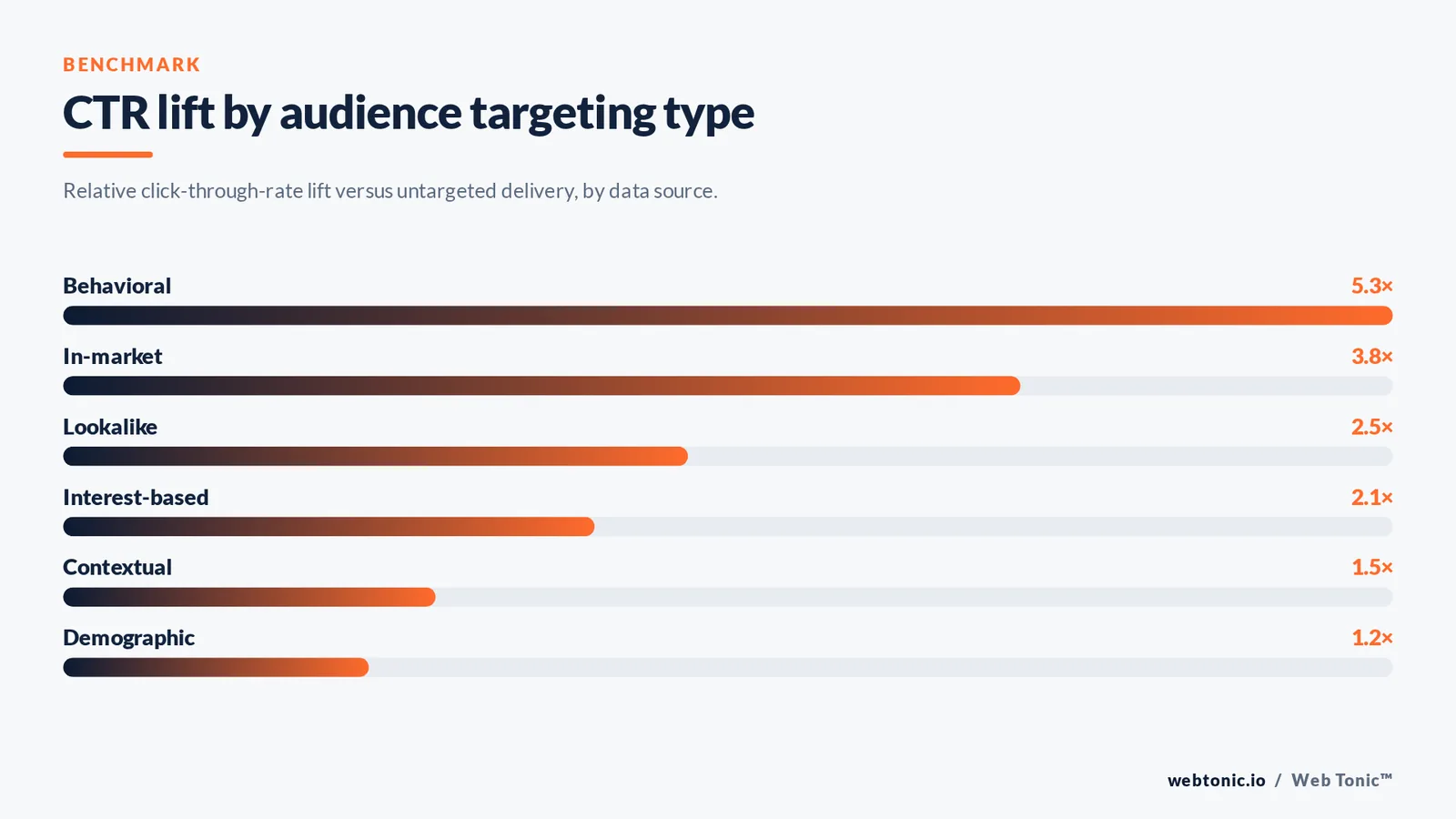
- Behavioral targeting delivers click-through rates 5.3× higher than non-targeted display ads, the strongest lift of any targeting type.
- Third-party cookies are being phased out, pushing marketers toward first-party data, contextual targeting, and tools like Google's Privacy Sandbox.
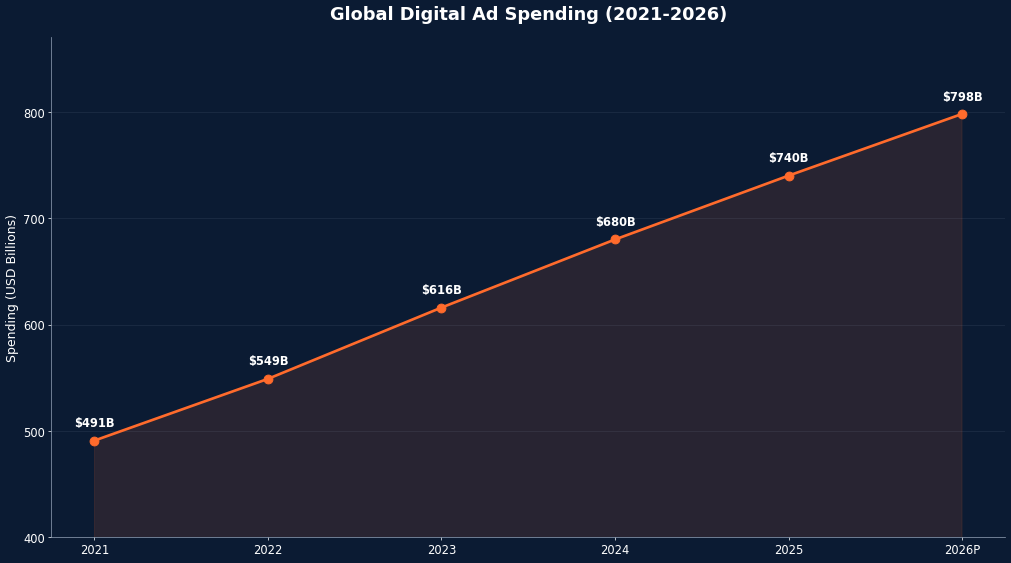
- The global digital advertising market exceeded $740 billion in 2025, and targeting precision is the primary lever separating high-ROI campaigns from wasted spend.

What Is Audience Targeting?
Audience targeting is the process of identifying and reaching specific groups of people — your target audience — based on shared characteristics such as age, gender, income, location, interests, online behavior, and purchase intent. Rather than broadcasting a single message to everyone, it lets marketers deliver content and ads that resonate with the people most likely to buy.
Every major advertising platform — Google Ads, Meta, LinkedIn, TikTok — provides audience targeting tools that let you define exactly who sees your campaigns. The process follows three stages: defining your ideal customer profile, segmenting audiences into actionable groups, and delivering tailored creative to each segment. Understanding your target audience is the foundation of any successful data-driven marketing strategy.
| Targeting Approach | What It Uses | Best For | Typical Platform |
|---|---|---|---|
| Demographic | Age, gender, income, education | Broad awareness campaigns | Google Ads, Meta Ads |
| Behavioral | Purchase history, browsing patterns | Retargeting and mid-funnel conversion | Meta Ads, Google Ads |
| Interest-Based | Hobbies, content consumption, affinity | Prospecting and awareness | Meta Ads, TikTok Ads |
| Contextual | Page content, keywords on publisher sites | Privacy-compliant reach without cookies | Google Display, Programmatic |
| Intent / In-Market | Active purchase signals, search queries | Bottom-funnel conversions | Google Ads, LinkedIn |
| Lookalike / Similar | Profiles similar to existing customers | Scaling proven audiences | Meta Ads, LinkedIn |
| Custom / First-Party | CRM lists, email subscribers, website visitors | Retargeting and loyalty campaigns | All major platforms |
Why Audience Targeting Matters
Audience targeting is essential because it directly controls the efficiency of every advertising dollar. Research from Epsilon found that 80% of consumers are more likely to make a purchase when brands offer personalized experiences — and targeting is how personalization starts in performance creative campaigns.
Without proper targeting, campaigns spray messages across broad populations: low engagement, poor conversion rates, inflated cost per acquisition. The average Google Ads account wastes 76% of its budget on irrelevant search terms and misaligned audiences. Proper audience segmentation eliminates most of that leakage by ensuring ads appear only for people who match your ideal customer profile.
Audience targeting also feeds the data loop that makes campaigns smarter over time. Platform algorithms — Google's Smart Bidding, Meta's Advantage+ — learn faster from high-quality conversion signals produced by well-defined audience segments. Advertisers using first-party data with audience targeting see 29% higher conversion rates than those relying on platform defaults alone. This compounding effect means that brands investing in targeting infrastructure today build a durable competitive advantage that widens each quarter.
Types of Audience Targeting in Digital Advertising
Several distinct types of audience targeting exist, each suited to different stages of the marketing funnel.
Demographic targeting segments audiences by age, gender, income, and education level. Google Ads covers 6 primary demographic dimensions including parental status and household income brackets. While demographic targeting alone rarely drives strong conversions, it is effective for excluding irrelevant audiences.
Behavioral targeting uses customer data from browsing history, purchase behavior, and app interactions. Behavioral targeting campaigns deliver CTR lifts of 5.3× over non-targeted display ads, making it the top performer for mid-funnel and retargeting. As third-party cookies face deprecation, behavioral targeting is shifting toward first-party data and server-side tracking.
Interest-based targeting groups audiences by affinities — topics, hobbies, and content categories they engage with regularly. Interest-based segments on Meta Ads reach 12–45 million users per category, making them ideal for prospecting at scale.
In-market targeting captures people actively researching products and services in your category. Google Ads offers over 500 in-market audience segments. In-market audiences convert at rates 10–50% higher than standard affinity audiences.
Contextual targeting places ads on pages whose content is relevant to your product — without user-level tracking. As third-party cookies disappear, contextual targeting spend is projected to exceed $562 billion globally by 2030.
| Targeting Type | Data Source | Funnel Stage | Cookie Dependency | CTR Lift |
|---|---|---|---|---|
| Demographic | Platform-declared data | Top of funnel | None | 1.2× |
| Behavioral | Browsing and purchase signals | Mid to bottom | High (shifting to 1P) | 5.3× |
| Interest-Based | Content engagement patterns | Top to mid | Low | 2.1× |
| In-Market | Active search and comparison | Bottom of funnel | Medium | 3.8× |
| Contextual | Page content analysis | All stages | None | 1.5× |
| Lookalike | Seed audience modeling | Top to mid | Low | 2.5× |
How to Define Your Target Audience
Building an effective audience targeting strategy starts with understanding who your best customers are. Follow this audience targeting process:
Step 1: Analyze existing customer data. Pull demographics, purchase patterns, and engagement metrics from your CRM and analytics. Look for common traits shared by your highest-value customers — age, gender, income, location, and the channels they use.
Step 2: Build buyer personas. Translate raw data into 3–5 personas representing your core audience segments. Each should include demographics, pain points, preferred content formats, and the social media platforms they use.
Step 3: Map personas to funnel stages. Not every segment sits at the same buying stage. Separate awareness, consideration, and decision-stage audiences so you can tailor messaging and targeting type for each.
Step 4: Choose targeting parameters per platform. Google Ads excels at intent targeting; Meta offers granular interest-based targeting and lookalike audiences; LinkedIn provides unmatched B2B targeting by job title and industry.
Step 5: Layer and exclude. Combine multiple targeting dimensions — interest plus demographic filters — to narrow reach without shrinking below minimum viable audience size. Audience layering reduces cost per acquisition by 15–30% versus single-dimension targeting.
Step 6: Test and refine. Launch with 2–3 audience variations. Monitor for 7+ days, then reallocate budget toward the highest-performing segments.
Audience Targeting Tools and Platforms Compared
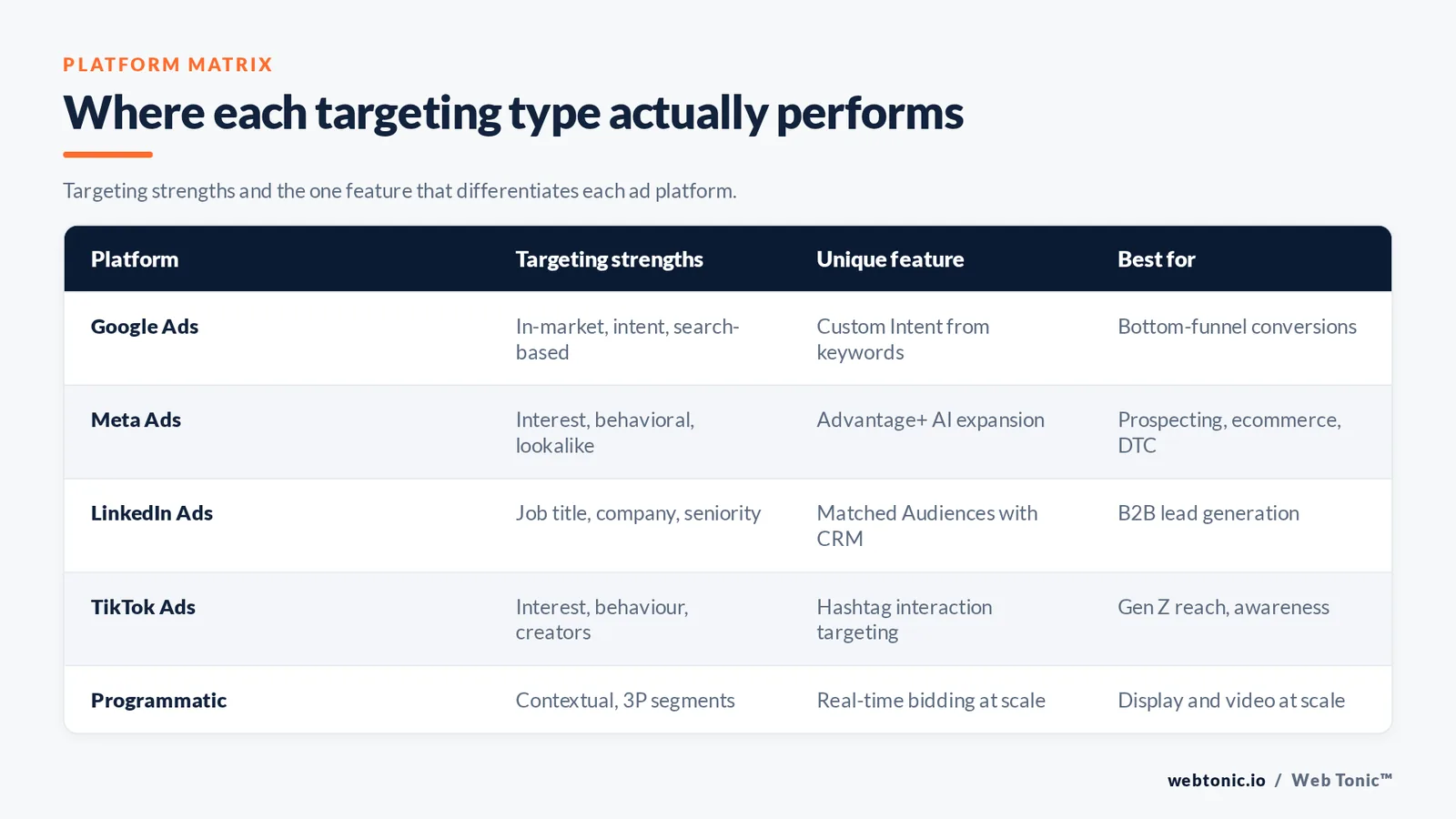
Each advertising platform provides distinct audience targeting tools. The right choice depends on your business model, funnel stage, and available customer data.
| Platform | Targeting Strengths | Unique Feature | Best For |
|---|---|---|---|
| Google Ads | In-market, intent, search-based | Custom Intent audiences from keywords | Bottom-funnel conversions |
| Meta Ads | Interest, behavioral, lookalike | Advantage+ AI-driven expansion | Prospecting, ecommerce, DTC |
| LinkedIn Ads | Job title, company, seniority | Matched Audiences with CRM | B2B lead generation |
| TikTok Ads | Interest, behavior, creator interactions | Hashtag interaction targeting | Gen Z reach, brand awareness |
| Programmatic | Contextual, third-party segments | Real-time bidding at scale | Display, video across the open web |
Google Ads dominates intent-driven audience targeting. Its combination of search query data, in-market signals, and custom intent audiences reaches customers at the exact purchase moment. Over 8.5 billion Google searches occur daily, giving the platform unmatched demand-capture reach. Advertisers can build custom intent audiences from their own keyword lists, letting them target users actively searching for specific products and services.
Meta Ads excels at interest-based targeting and audience segmentation for prospecting. Its lookalike audience tool builds segments matching your best customers' traits and scales reach while maintaining relevance. Meta's platform reaches 3.07 billion monthly active users — the largest addressable audience in digital advertising. The Advantage+ audience feature uses machine learning to expand targeting beyond your manual selections when it detects additional conversion opportunities.
First-Party Data and the Future of Audience Targeting
The deprecation of third-party cookies is reshaping audience targeting. Google's Privacy Sandbox, Apple's App Tracking Transparency, and regulations like GDPR and CCPA have made it clear: the future belongs to first-party data.
First-party data — information collected directly from your customers through your website, app, CRM, and email lists — is privacy-compliant, consent-based, and uniquely tied to your business. Brands that build robust first-party strategies gain three advantages:
- Higher match rates: Customer lists uploaded to Google Ads and Meta Ads typically achieve 40–70% match rates for retargeting and lookalike expansion.
- Faster algorithm learning: Strong conversion signals reduce learning phase duration by 25–40%.
- Reduced cookie reliance: Server-side tracking through Meta's Conversions API and Google's Enhanced Conversions maintains data quality as browser tracking degrades.
Dynamic creative optimization (DCO) takes first-party data further by automatically tailoring ad creative to each audience segment in real time, increasing conversion rates by 10–20% compared to static creative. For a deeper look at how brands combine data strategy with creative performance, explore our marketing insights library.
Audience Targeting Strategy by Business Model
| Business Model | Primary Targeting | Platforms | Key Metric |
|---|---|---|---|
| DTC Ecommerce | Behavioral + lookalike | Meta Ads, Google Shopping | ROAS |
| B2B SaaS | Job title + firmographics | LinkedIn, Google Ads | Cost per MQL |
| Local Services | Geo + in-market audiences | Google Ads, Meta local | Cost per lead |
| Enterprise / ABM | Account list + contact matching | LinkedIn, programmatic ABM | Pipeline influenced |
For ecommerce brands, behavioral targeting and dynamic product ads powered by customer data create the strongest performance loop. Use audience segmentation to separate new customers from repeat buyers — each group responds to different messaging and creative angles.
For B2B companies, LinkedIn's professional targeting data is unmatched. Combine job-title targeting with company-size filters and layer in intent signals from Google Ads in-market audiences. B2B campaigns using multi-platform audience targeting see 22% lower cost per lead versus single-platform approaches.
For local businesses, geo-targeting is the starting point. Combine radius or zip-code targeting with in-market audiences relevant to your service category. Local campaigns combining audience targeting with location layering see 34% higher conversion rates than location-only campaigns.
FAQ
What is the difference between audience targeting and audience segmentation?
Audience segmentation divides a broad customer base into smaller groups based on shared characteristics — demographics, behavior, interests, or purchase history. Audience targeting directs specific marketing messages to those segments. Segmentation defines the groups; targeting delivers the message. Both are essential, but segmentation always comes first.
How do I define my target audience from scratch?
Start with competitive research using tools like Semrush or platform audience insights to identify who your competitors' customers are. Analyze their demographics, the social media channels they use, and the content topics they engage with. Then validate with your own data — even a small customer sample reveals patterns in age, gender, income, and customer behavior. Build 2–3 personas and test them with small-budget campaigns before scaling.
Is audience targeting effective without third-party cookies?
Yes. The deprecation of third-party cookies shifts targeting toward first-party data, contextual targeting, and platform-native signals. Brands investing in server-side tracking, CRM data uploads, and Google's Privacy Sandbox maintain strong targeting precision. First-party data strategies deliver 2× higher match rates than third-party approaches.
What audience size should I target on Meta Ads and Google Ads?
On Meta Ads, aim for 1–10 million users for prospecting — large enough for algorithm optimization, small enough for relevance. On Google Ads, custom audiences need at least 1,000 members. Lookalike audiences perform best at 1–3% similarity, typically yielding 2–6 million users.
How often should I refresh audience targeting?
Refresh your targeting strategy quarterly. Update lookalike seed audiences after meaningful customer base shifts. Refresh exclusion lists weekly. Monitor audience fatigue — rising frequency and declining CTR — and rotate segments before performance drops. Contact our team for a free audience targeting audit.
Sources: HubSpot · WordStream · Sprout Social · Google Ads Help · Neil Patel · LinkedIn Advertising · Shopify · Semrush · IAB · Epsilon · TikTok Ads