Table of contents
Analyst relations and public relations get reported on the same slide more often than their own survey data would suggest they should be. Constellation Research's AR-specific surveys, Spotlight's direct analyst survey and Muck Rack and Meltwater's PR-specific surveys let the two functions be compared on their own terms — budget pressure, measurement gaps and where generative AI is already changing the job.
Key Takeaways
- Constellation Research's 2025 AR Survey found AR funding largely flat while stakeholder demands from product, marketing, comms and sales all grew.
- The 2026 follow-up found AI running as default AR infrastructure, not an experiment, per roughly 75 practitioners at Constellation's ARX event.
- 58% of analysts discuss vendor shortlists with buyers daily, weekly or monthly, per Spotlight's 175-analyst 2026 survey.
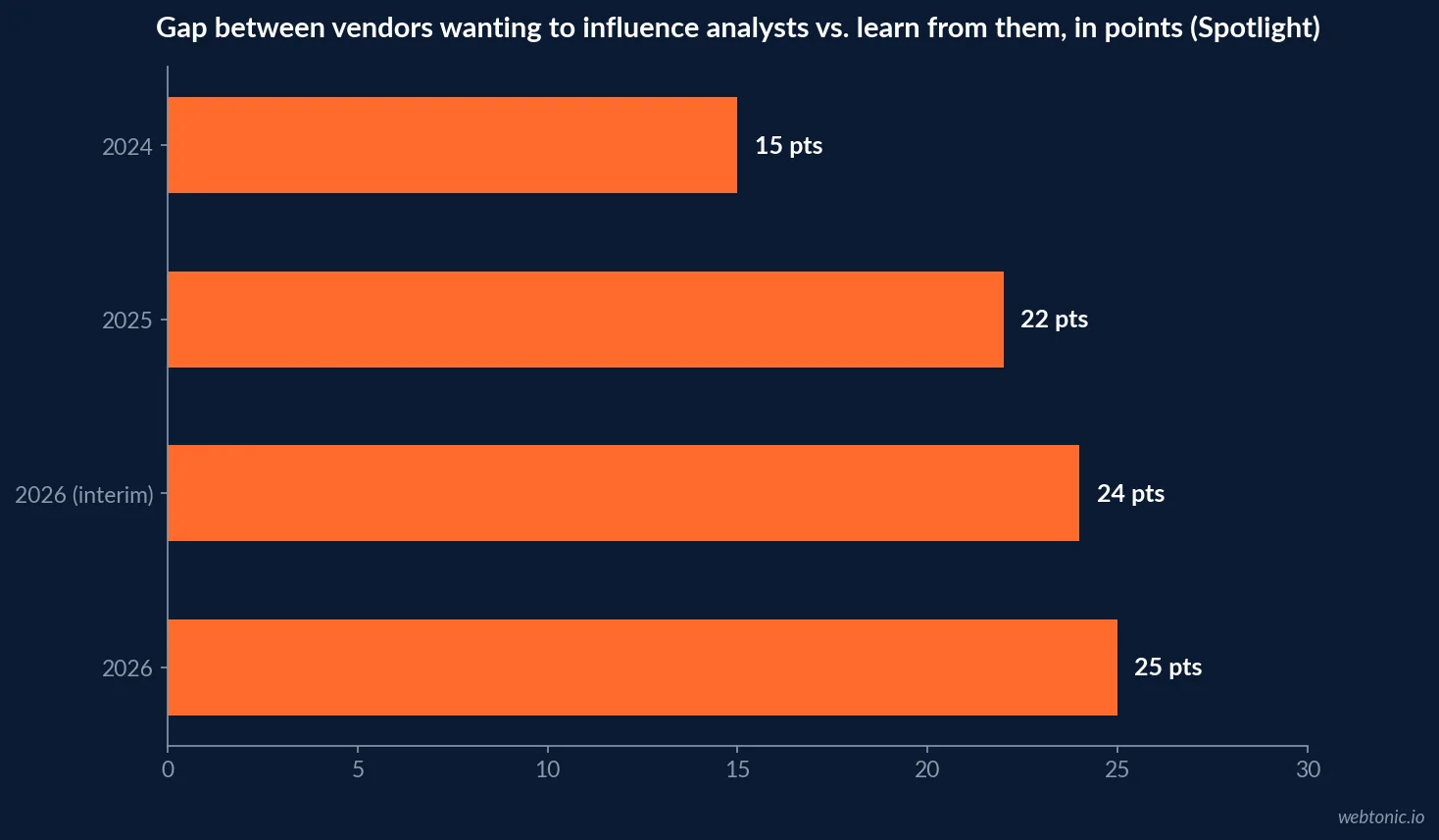
- The gap between vendors wanting to influence analysts and wanting to learn from them has widened for four straight years: 15, then 22, then 24, then 25 percentage points.
- 45% of analysts say answer engines make their own research more influential.
- 34% of analysts have not noticed a meaningful change in buyer conversations from generative AI; the rest report shifts in how buyers show up prepared.
- Muck Rack's State of PR 2026 surveyed 971 PR professionals (from 1,115 fielded).
- 73% of PR professionals say generative-engine optimization matters to their strategy, but 29% say no one owns it.
- 39% of PR professionals are not measuring GEO success at all.
- 61% expect AI and automation to grow in PR over the next five years.
- 71% of PR professionals cite low journalist response rates as the top obstacle to earned coverage.
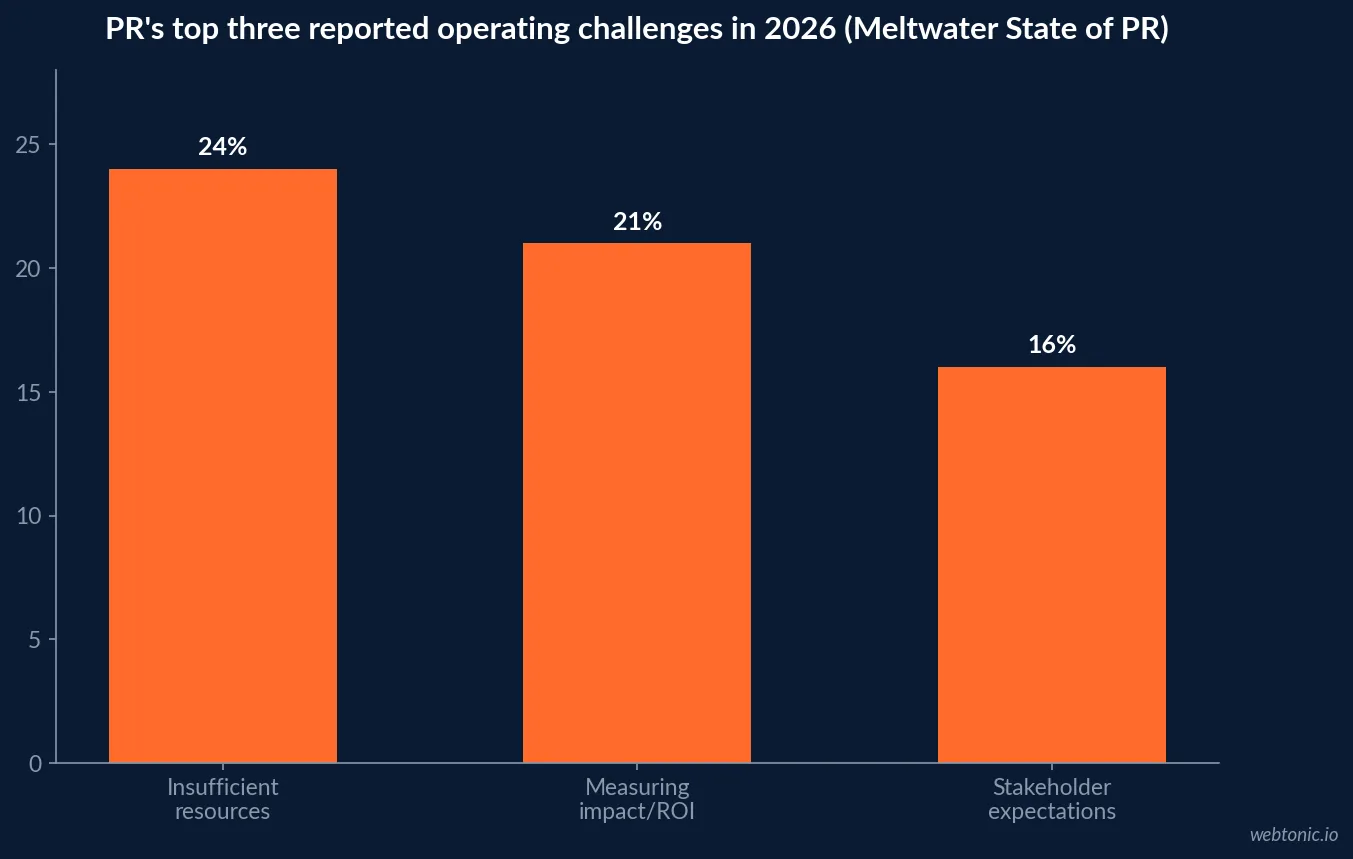
- Meltwater's 2026 State of PR survey of 1,100+ professionals found insufficient resources is the top challenge, at 24%.
- Difficulty measuring impact and ROI ranks second among PR challenges, at 21%.
- Half of PR teams operate with fewer than five people.
- Over half of PR teams expect flat budgets next year.
- Analyst engagement on ungated content has climbed every year Spotlight has asked: 38%, then 41%, now 45% increasing it.
Two functions, two survey traditions
The clearest sign AR and PR are not one function is that they are not measured by the same studies. Constellation Research's 2025 Analyst Relations Survey, fielded from 19 organizations during its Analyst Relations Experience event, examined AR budgets, reporting lines and the discipline's expanding role in sales enablement specifically. Its 2026 follow-up layered live discussion from roughly 75 AR professionals onto that baseline. PR's equivalent is Meltwater's State of PR 2026, surveying more than 1,100 PR and communications professionals worldwide, and Muck Rack's own State of PR 2026, surveying 971 qualified PR professionals after cleaning 1,115 responses.
Neither AR study asks about media relations. Neither PR study asks about analyst briefings. The overlap that vendors assume exists is mostly in the org chart, not in the day-to-day metric each function is actually accountable for.
| Study | Publisher | Sample | Field period |
|---|---|---|---|
| 2025 Analyst Relations Survey | Constellation Research | 19 organizations | Q2 2025 |
| 2026 Analyst Relations Survey | Constellation Research | ~75 practitioners (live discussion) | Jul 2026 |
| 2026 Analyst Survey Report | Spotlight | 175 industry analysts | Jun-Aug 2026 |
| State of PR 2026 | Muck Rack | 971 professionals (of 1,115 fielded) | May-Jun 2026 |
| State of PR 2026 | Meltwater | 1,100+ professionals | 2026 |
Budget and pressure: AR's side of the ledger
Constellation's 2025 survey describes AR budgets as largely flat while product, marketing, communications and sales leaders all lean on the function to prove measurable outcomes at the same time. That is a squeeze, not a cut: the money is not shrinking, but the number of stakeholders asking what it bought is growing. The 2026 follow-up describes AI moving from an emerging experiment to default infrastructure inside that same flat-to-stable budget picture, which means AR teams are being asked to run more workflow through the same headcount.
PR's budget story, per Meltwater, is more explicitly resource-constrained: insufficient resources is the single most-cited challenge among PR professionals at 24%, ahead of measurement difficulty at 21% and stakeholder-expectation management at 16%. Half of PR teams run with fewer than five people, and over half expect their budget to stay flat next year.
| Pressure point | AR (Constellation 2025/2026) | PR (Meltwater 2026) |
|---|---|---|
| Budget trend | Largely flat, more stakeholders pulling on it | Flat budget expected by over half of teams |
| Top cited challenge | Proving measurable outcomes across 4 stakeholder groups | Insufficient resources (24%) |
| Second challenge | AI workflow adoption without added headcount | Measuring impact/ROI (21%) |
| Team size signal | Not separately reported | Half of teams under 5 people |
Influence: what analysts and journalists each report about their own leverage
The most direct influence data comes from asking the influencers, not the vendors courting them. Spotlight's 2026 Analyst Survey Report, now in its 7th year and built from 175 industry analysts surveyed anonymously between June and August 2026, found 58% of analysts discuss vendor shortlists with buyers daily, weekly or monthly. That is a recurring, working relationship with buyer decisions, not an occasional briefing.
The same survey tracks a widening disconnect: the gap between vendors wanting to influence analysts and vendors wanting to learn from them has grown every year it has asked, from 15 percentage points to 22, to 24, to 25. Analysts are also increasingly willing to be found without a briefing at all — the share increasing their ungated published output has climbed from 38% to 41% to 45% across three consecutive years, with nine analysts increasing ungated output for every one decreasing it.
| Analyst-reported metric (Spotlight 2026) | Figure |
|---|---|
| Analysts discussing shortlists with buyers regularly | 58% |
| Vendor-influence vs vendor-learning gap, 2024 | 15 pts |
| Same gap, 2025 | 22 pts |
| Same gap, 2026 | 25 pts (via 24 pts in interim year) |
| Analysts increasing ungated content output | 45%, up from 38% (2024) and 41% (2025) |
| Analysts saying answer engines make them more influential | 45% |
PR's influence data runs through a harder-to-reach press corps
Muck Rack's State of PR 2026 measures the opposite side of a similar problem: not whether the influencer will talk to you, but whether you can reach them at all. 71% of PR professionals cite low response rates from journalists as the biggest obstacle to securing earned coverage, and 61% point to shrinking media lists as newsrooms keep contracting. Both functions are chasing a smaller, harder-to-reach set of gatekeepers, just different gatekeepers.
Where the two functions are visibly converging is generative-engine visibility. Muck Rack's full State of PR 2026 report found 73% of PR professionals consider AI search visibility at least somewhat important to their strategy, yet 29% say no one at their organization owns it and 39% are not measuring GEO success despite 45% citing media measurement as a major part of the job. AR's analysts report the same shift from the buyer side: 45% say answer engines already make their research more influential.
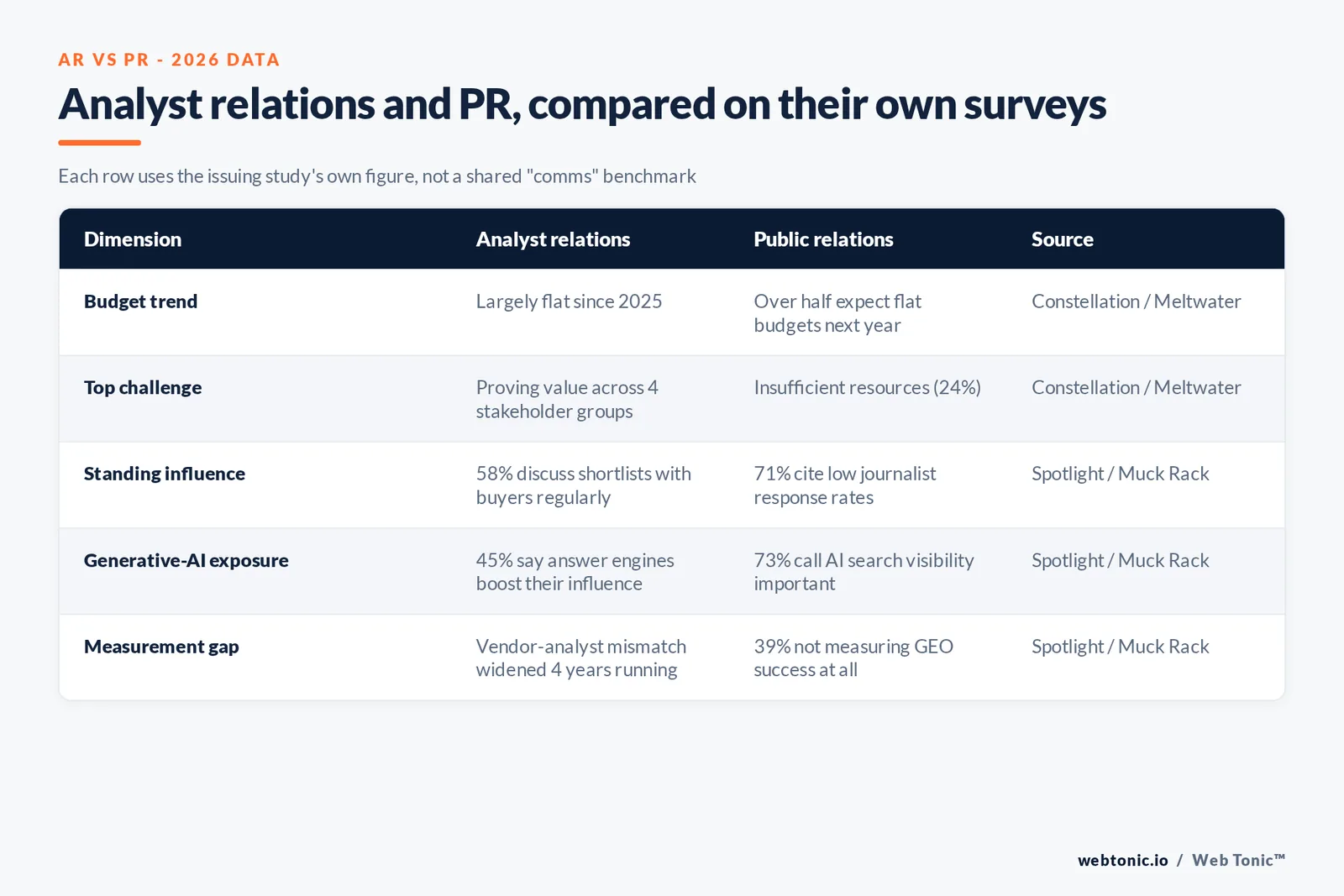
| Dimension | Analyst relations | Public relations |
|---|---|---|
| Primary influence channel | Direct analyst-buyer shortlist conversations (58% regular) | Earned media coverage, now harder to secure (71% cite low response rates) |
| Measurement gap | Structural: vendor-analyst priority mismatch widening 4 years running | Technical: 39% not measuring GEO at all |
| Generative-AI exposure | 45% of analysts say answer engines boost their influence | 73% call AI search visibility strategically important |
| Ownership of the AI-era metric | Not separately reported by AR studies | 29% say no one owns GEO internally |
Staffing: both functions are leaning on contractors, not headcount
Neither function is solving its resource squeeze by hiring. Ragan Communications' 2026 Salary & Workplace Satisfaction Survey, covering nearly 500 communications professionals, found nearly six in ten respondents say their team now uses freelancers or contract workers, up sharply from the prior year, and more than one in five say contractors have already replaced full-time positions outright. Comms and AR both typically sit under the same marketing or executive umbrella, so a staffing shift this broad touches both functions even though the survey itself is comms-focused.
Ragan's data adds a wrinkle to the AI narrative both AR and PR studies repeat: roughly equal shares of respondents say AI tools have increased their workload as say AI has decreased it. AI adoption climbing, per Muck Rack and Spotlight, is not the same claim as AI making the job lighter, and Ragan's data is the clearest evidence the two are not the same thing.
| Staffing signal (Ragan 2026 Salary Survey, ~500 comms professionals) | Figure |
|---|---|
| Teams now using freelancers or contract workers | ~60%, up sharply YoY |
| Respondents saying contractors have replaced full-time roles | >20% |
| Say AI increased their workload | Roughly equal to those saying decreased |
What both functions should actually be tracking in 2026
The AR data argues for treating analyst engagement as a recurring input to buyer shortlists, not an annual briefing calendar — 58% regular shortlist discussion is a standing relationship to manage, and the widening 25-point gap between what vendors want and what analysts want means the relationship needs tending on the analyst's terms, not just the vendor's launch calendar. The PR data argues for assigning explicit ownership of generative-engine visibility before the next survey cycle, since 29% with no owner and 39% with no measurement is a gap that will only get more expensive to close the longer it sits open.
Our growth marketing team builds the measurement layer that connects earned-channel activity, whether analyst-sourced or press-sourced, back to pipeline, and our team page has more on how we structure that work for B2B accounts specifically. For the paid side of the same visibility problem, see our guide to what Google Ads costs when earned coverage alone cannot carry a launch.
Frequently Asked Questions
Are analyst relations and public relations the same function?
No, and the survey data treats them separately for good reason. Constellation Research's 2025 Analyst Relations Survey found AR reports into product, marketing, communications or sales leadership depending on the company, and practitioners are under pressure from all four to prove measurable outcomes. Muck Rack's State of PR 2026, surveying 971 PR professionals, describes a distinct discipline centered on media relations, earned coverage and now generative-engine visibility. They overlap in reporting lines far more than they overlap in daily work.
Is analyst relations budget growing in 2026?
Constellation's 2025 survey described AR budgets as largely flat even as stakeholder demands grew. Its 2026 follow-up, drawn from live discussion with roughly 75 AR professionals at Constellation's ARX event, found the profession being asked to prove value in more places at once, which reads as pressure on a budget that has not moved much, not evidence of new investment.
Do analysts still shape which vendors get shortlisted?
Yes, and recently. Spotlight's 2026 Analyst Survey Report, its 7th year running and based on 175 industry analysts surveyed between June and August 2026, found 58% of analysts discuss vendor shortlists with buyers daily, weekly or monthly. That is a direct, self-reported measure of ongoing shortlist influence, not a vendor's guess at it.
How is generative AI changing what PR and AR teams are measured on?
Both functions are being pulled toward the same new metric. Muck Rack's State of PR 2026 found 73% of PR professionals see AI search visibility as at least somewhat important to their strategy, while Spotlight's analyst survey found 45% of analysts believe answer engines make their own research more influential. The two functions are converging on generative-engine visibility from opposite directions: PR through earned coverage, AR through analyst citations.
Which function has a bigger measurement gap right now?
PR does, by its own numbers. Muck Rack found 39% of PR professionals are not measuring GEO success at all despite 45% citing media measurement as a major part of their work, and Meltwater's 2026 State of PR survey found difficulty measuring impact and ROI is the second-most-cited challenge in the profession, after insufficient resources. AR's equivalent gap, per Spotlight, is structural rather than technical: the widening disconnect between what analysts want from vendors and what vendors ask of analysts has grown for four straight years.
Sources
Constellation Research - 2025 Analyst Relations Survey
Constellation Research - 2026 Analyst Relations Survey
Spotlight - The 2026 Analyst Survey Report
Muck Rack - State of PR 2026 (full report PDF)
Meltwater - State of PR 2026 Report: Key Trends, Challenges & Insights
Ragan Communications - 2026 Salary & Workplace Satisfaction Survey