Table of contents
Algorithmic pricing software has three real budget tiers in 2026 - a self-serve SaaS layer priced by order volume, a scoped mid-market implementation priced in the tens of thousands, and a custom enterprise contract - plus a regulatory and trust cost that rarely makes it onto a vendor's pricing page. This page prices all three from named 2026 sources.
Key Takeaways
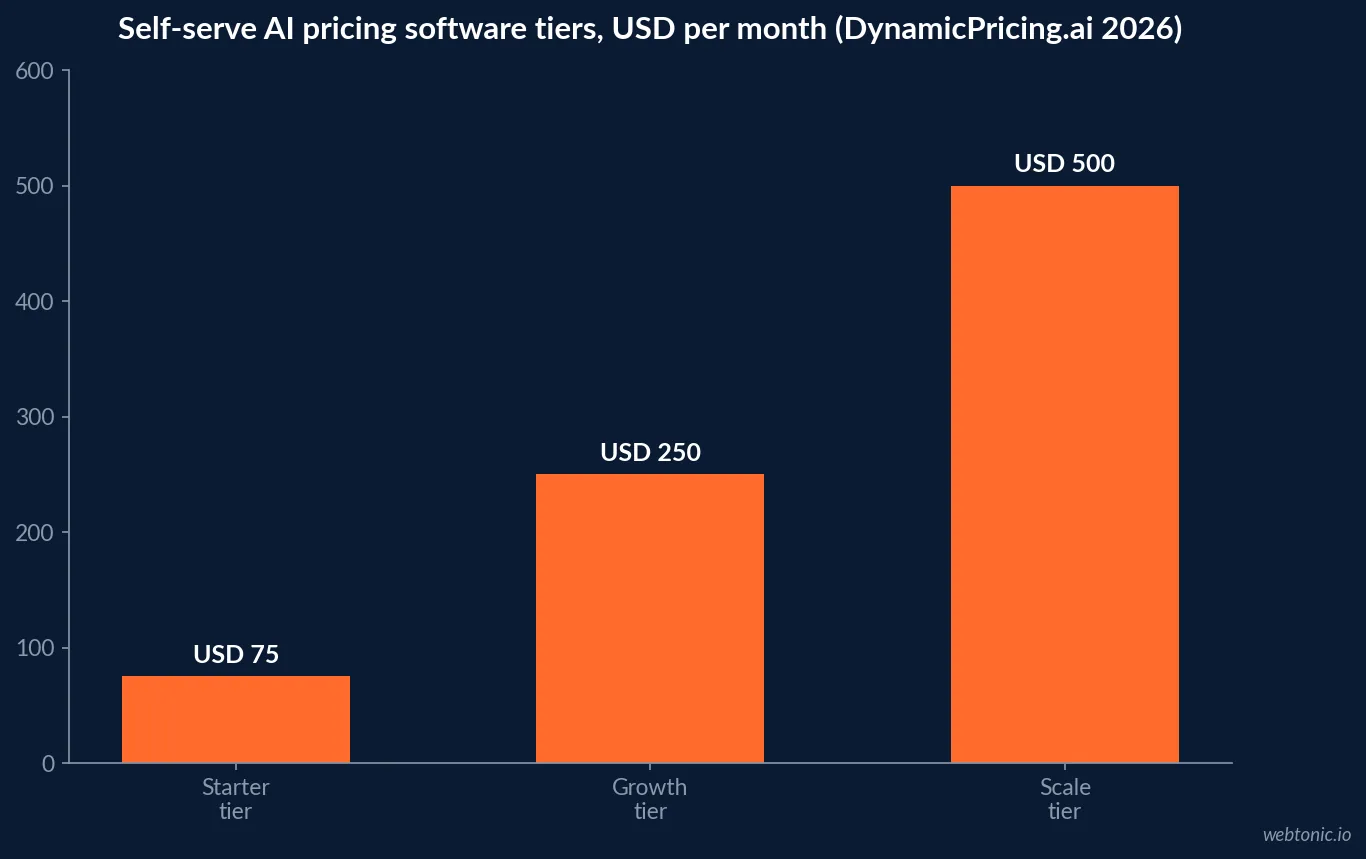
- Entry-tier pricing software starts at USD 75 a month for up to 500 orders.
- Mid-tier plans run USD 250 to USD 500 a month for 2,500 to 10,000 orders.
- Overage charges add USD 0.03 per order above the plan cap.
- A single-shop European plan starts at EUR 399 a month.
- Scoped implementations are quoted at USD 30,000 to USD 50,000.
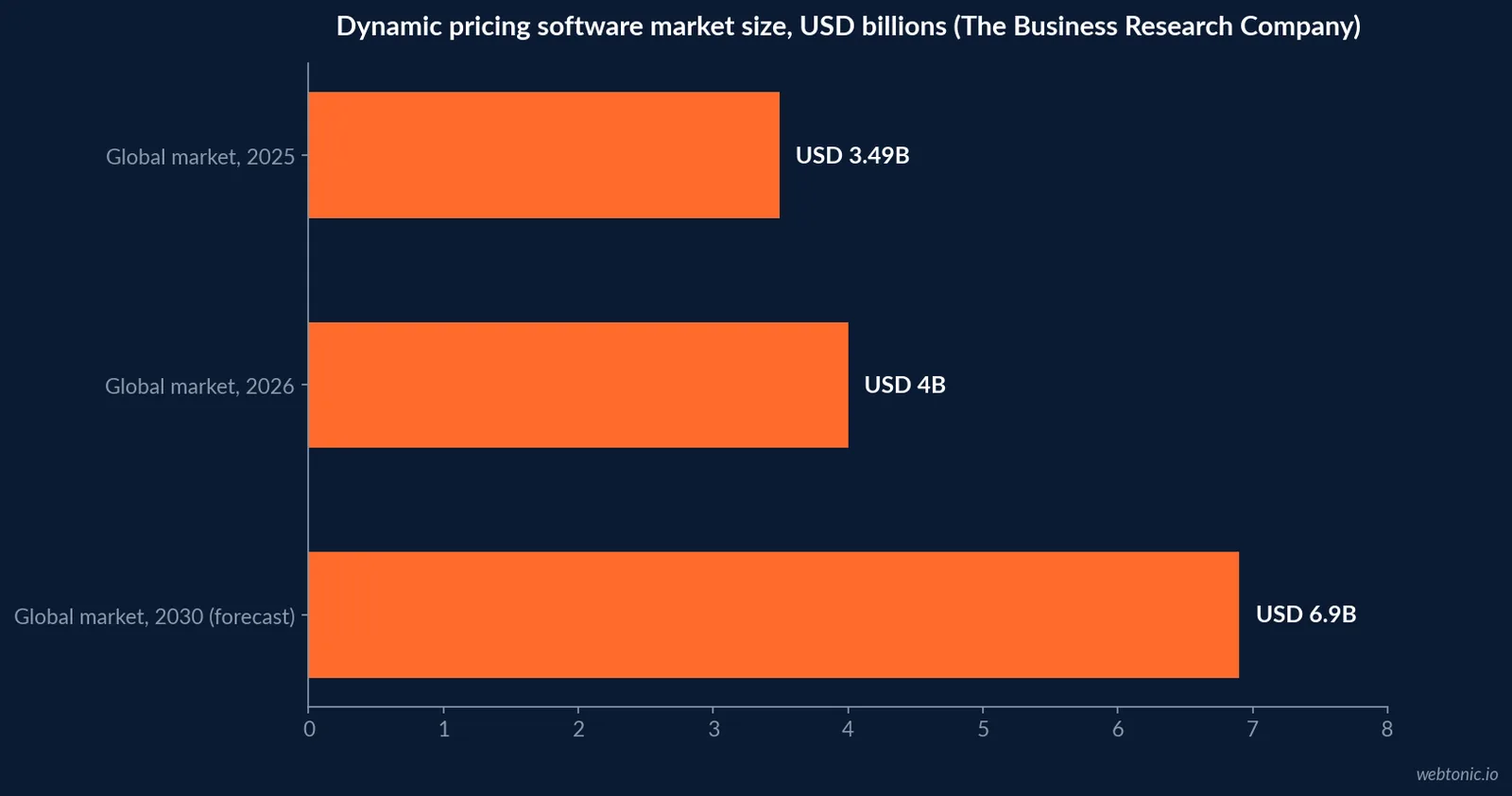
- The global market reached USD 4 billion in 2026, up from USD 3.49 billion in 2025.
- It is forecast to hit USD 6.9 billion by 2030, a 14.6% CAGR.
- 67% of retailers expect to use AI pricing within 18 months.
- 84% expect their AI pricing investment to grow or hold over the next two years.
- 66% agree AI agents will be essential to pricing competitiveness by 2030.
- Yet only 21% have a clear roadmap for agentic AI pricing.
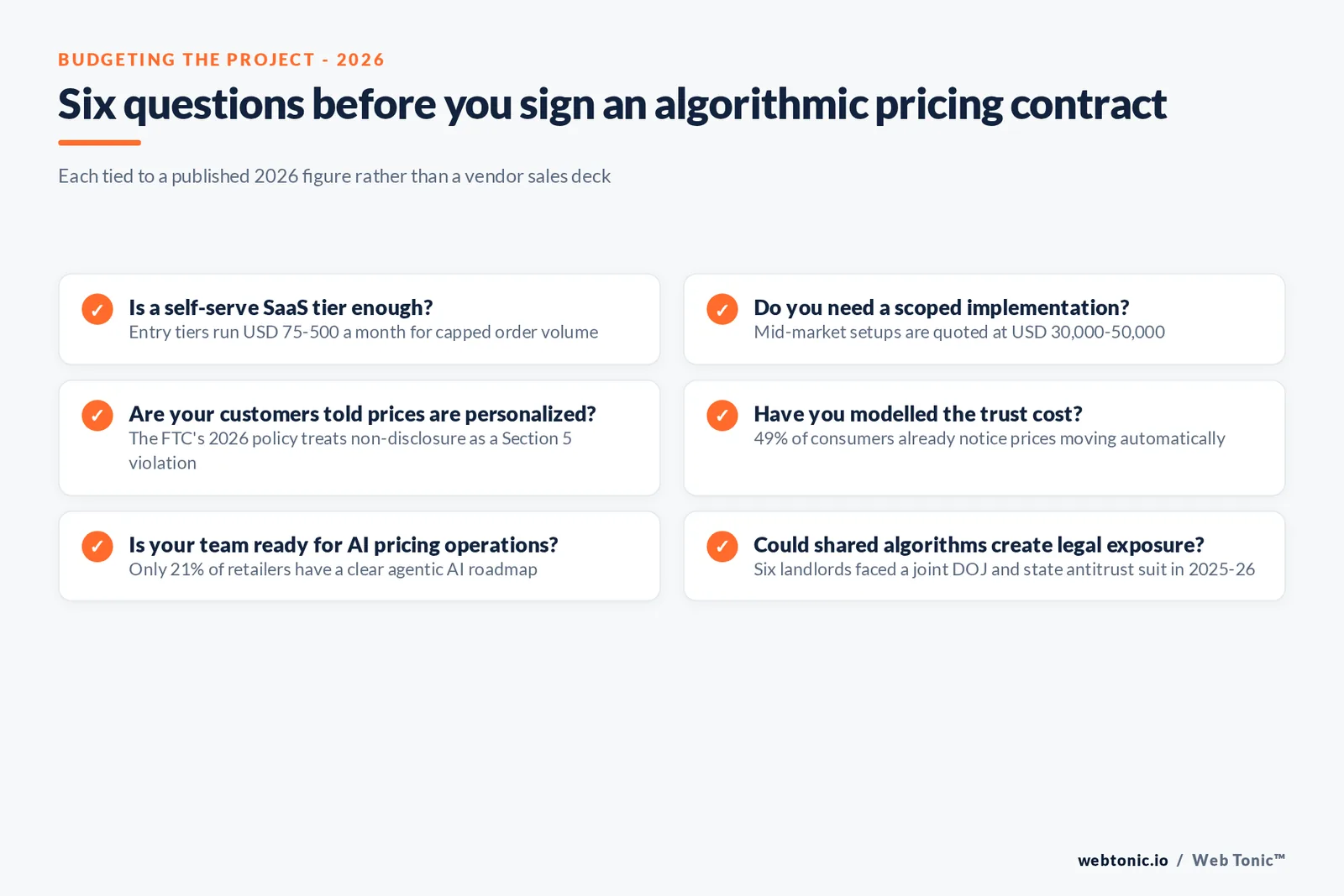
- 49% of consumers have noticed an automated-feeling price change.
- Only 13% recognize the term "algorithmic pricing" unprompted.
- 58% believe prices change by algorithm often or sometimes.
- The FTC's 2026 policy treats non-disclosure as a likely Section 5 violation.
- Six landlords faced a joint DOJ and state lawsuit over shared pricing algorithms.
- That case covers more than 1.3 million rental units across 43 states.
The three budget tiers, priced from real vendor pages
Most coverage of algorithmic pricing talks about the market, not the invoice. The published 2026 pricing pages of two working vendors give an actual budget range instead of a market forecast dressed up as a quote.
| Budget tier | 2026 published price | Vendor | What it buys |
|---|---|---|---|
| Self-serve, small catalog | USD 75/month, up to 500 orders | DynamicPricing.ai | 1 price test, 1 pricing rule, 50 products |
| Self-serve, growth tier | USD 250/month, up to 2,500 orders | DynamicPricing.ai | 10 pricing experiments, inventory optimization |
| Self-serve, scale tier | USD 500/month, up to 10,000 orders | DynamicPricing.ai | 30 experiments, revenue optimization |
| European single-shop | From EUR 399/month | Omnia Retail | AI dynamic pricing plus competitor monitoring |
| Scoped mid-market build | USD 30,000-50,000 | DynamicPricing.ai (Intelligence Starter) | Full setup, guardrails, onboarding training |
| Enterprise, full stack | Custom quote | DynamicPricing.ai / Omnia Retail | Omnichannel pricing, dedicated account management |
Amazon and marketplace repricing has its own price ladder
If the budget is specifically for marketplace repricing rather than a full pricing engine, Repricer.com's published 2026 tiers give a second, comparable reference point: USD 99 a month covers up to 5,000 SKUs with realtime repricing, rising to USD 499 a month for 250,000 SKUs with net-margin logic and dedicated account management.
| Repricer.com tier (2026) | Monthly price | SKU limit | Headline feature |
|---|---|---|---|
| Core | USD 99 | 5,000 | Automated pricing strategies, up to 3 channels |
| Scale | USD 299 | 50,000 | AI price optimization, Buy Box optimizer |
| Premium | USD 499 | 250,000 | Net margin repricing, unlimited channels |
Why the market keeps growing under the price tiers
The Business Research Company's 2026 global market report sizes the dynamic pricing software category at USD 4 billion this year, up from USD 3.49 billion in 2025, a 14.7% CAGR. It attributes the growth to e-commerce expansion, price transparency pressure and rising SME adoption of tools that used to be enterprise-only - which lines up with the sub-USD-100-a-month tiers vendors are now shipping.
| Market metric | 2025 | 2026 | 2030 (forecast) |
|---|---|---|---|
| Global market size (USD billions) | 3.49 | 4.0 | 6.9 |
| Compound annual growth rate | - | 14.7% | 14.6% |
The adoption survey behind the budget request
A November 2025 survey of 98 retail professionals, conducted by Chain Store Age in partnership with Revionics, is the clearest published read on retailer intent. Two-thirds of respondents expect to use AI for pricing within 18 months, and investment appetite is not cooling: 84% of retail executives anticipate the same or more AI pricing investment over the next two years, with none forecasting a decrease.
| Adoption signal (2026) | Figure | Source |
|---|---|---|
| Retailers not expecting AI pricing within 18 months | 33% (implies ~67% do) | Revionics/Chain Store Age |
| Executives expecting flat-or-more AI pricing investment | 84% | Revionics/Chain Store Age |
| Respondents expecting a significant investment increase | ~33% | Revionics/Chain Store Age |
| Agree AI agents essential by 2030 | 66% | Revionics/Chain Store Age |
| Have a clear agentic AI pricing roadmap | 21% | Revionics/Chain Store Age |
The line item most budgets skip: disclosure
The Federal Trade Commission's proposed enforcement policy statement on personalized pricing, published August 2026, does not ban data-driven pricing, but it puts a specific cost on hiding it: a business that fails to clearly disclose that a price is personalized, and the data basis for that personalization, is likely in violation of Section 5 of the FTC Act. Legal review of your disclosure language is a real line item, not a nice-to-have, once a pricing engine goes live.
The legal exposure that changes the calculus entirely
Algorithmic pricing and algorithmic collusion are not the same thing, but the RealPage litigation shows how close they can sit. In an amended complaint, the Department of Justice and multiple state attorneys general sued six of the largest US landlords - together operating more than 1.3 million units across 43 states - alleging they used a shared pricing algorithm and competitively sensitive data to suppress rental competition. One landlord, Cortland, agreed to a consent decree requiring it to stop using competitors' data and using the same algorithm as its rivals without a corporate monitor. Any e-commerce team evaluating a shared or pooled pricing model, not just a single-company one, should budget for legal review of exactly that boundary.
Why 49% of your customers may already distrust the price
Abacus Data's March 2026 national survey of 1,931 Canadians found that while only 13% recognize the term "algorithmic pricing" unprompted, 49% have already noticed an online price change they believed was automated, and 58% believe prices are adjusted by algorithm often or sometimes. That gap between low awareness of the term and high suspicion of the practice is a trust cost that shows up in support tickets and cart abandonment long before it shows up in a compliance filing.
| Consumer trust signal (Abacus Data, March 2026) | Figure |
|---|---|
| Recognize the term "algorithmic pricing" unprompted | 13% |
| Noticed a price change they believed was automated | 49% |
| Believe algorithmic pricing happens often or sometimes | 58% |
| Believe it happens "often" | 30% |
Where the budget conversation usually goes wrong
Most vendor conversations start from the market forecast - a USD 4 billion category growing at 14.7% a year sounds like a category everyone must already be spending on - and skip the fact that published self-serve tiers still start under USD 100 a month. That gap between the market-size headline and the actual invoice is where budget requests get inflated. Anchor the internal ask to the tier your catalog size and order volume actually require, not to the category's total addressable market.
The second common mistake is budgeting for the software and stopping there. The FTC's 2026 policy statement, the RealPage litigation, and Abacus Data's trust numbers are not edge cases - they are the cost structure of running a pricing engine at all once it touches real customers rather than a test catalog. A rollout plan that prices the software but not the legal review and customer communication is an incomplete budget, not a lean one.
The third mistake is sequencing the rollout backwards: buying the enterprise tier before the team has run a self-serve pilot long enough to know which SKUs actually benefit from automated pricing. The published tier structure above exists precisely so a team can start at the USD 75-99 a month level, prove the model against a small catalog slice, and only then scope the USD 30,000-plus implementation against demonstrated ROI rather than a vendor's projection of it.
| Common budgeting mistake | What the 2026 data actually shows |
|---|---|
| Anchoring the ask to the market-size headline | Self-serve tiers start at USD 75-99/month, far below the market's average deal size |
| Treating disclosure as a legal afterthought | FTC's 2026 policy treats non-disclosure as a likely Section 5 violation |
| Assuming shared algorithms are automatically legal | Six landlords faced a joint DOJ and state suit over shared pricing data |
| Ignoring the trust cost of visible price changes | 49% of consumers already notice automated-feeling price moves |
| Budgeting software but not team training | Only 21% of retailers have a clear agentic AI pricing roadmap |
Building the honest budget line
Price the software from a real vendor tier, not a market forecast: USD 75-500 a month for self-serve tools at low order volumes, USD 30,000-50,000 for a scoped mid-market build, and a custom quote once you need omnichannel or multi-region pricing. Then add three lines most quotes leave out: legal review of your disclosure language, a customer-facing explanation of how prices move, and a governance process for any shared-data pricing arrangement with partners or franchisees. Our data and analytics team can model that full budget, including the compliance review, before you commit to a vendor contract. If pricing sits inside a larger growth plan, our growth marketing practice can help sequence it against the rest of the roadmap, and you can talk to us before signing anything.
Frequently Asked Questions
How much does algorithmic pricing software cost?
Self-serve tools price by monthly order volume: DynamicPricing.ai's published 2026 tiers run from USD 75 a month for up to 500 orders to USD 500 a month for up to 10,000, with a USD 0.03 per-order overage charge above the plan cap. Omnia Retail's single-shop plan starts at EUR 399 a month. A scoped mid-market implementation is a different budget line - DynamicPricing.ai quotes USD 30,000 to USD 50,000 for its Intelligence Starter tier, and enterprise packages are custom-quoted.
Is the market for this software actually growing?
Yes. The Business Research Company sizes the global dynamic pricing software market at USD 3.49 billion in 2025, growing to USD 4 billion in 2026 at a 14.7% CAGR, and projects USD 6.9 billion by 2030. Growth is attributed to AI and machine learning advances, SME adoption and real-time demand signal integration, not just enterprise retail replacing spreadsheets.
Do most retailers plan to adopt AI pricing?
A November 2025 survey of 98 retail professionals by Chain Store Age and Revionics found only one-third of retailers do not expect to use AI for pricing within 18 months, meaning roughly 67% do. Looking further out, 66% agree AI agents will be essential to staying competitive by 2030, but only 21% say they have a clear roadmap to get there - the budget conversation is running ahead of the plan.
Is algorithmic pricing legally risky to budget for?
It can be, and that risk belongs in the budget. The FTC's proposed August 2026 enforcement policy on personalized pricing treats non-disclosure of data-driven pricing as a likely Section 5 violation. Separately, six large US landlords faced a joint Department of Justice and multi-state antitrust complaint over shared rent-setting algorithms affecting more than 1.3 million units - a reminder that algorithmic pricing and algorithmic collusion are legally distinct, and the line depends on how the system is built.
Do consumers notice or trust algorithmic pricing?
Trust is the real hidden cost. Abacus Data's March 2026 national survey of 1,931 Canadians found 49% had already noticed an online price change they believed was automated, and 58% believe prices are adjusted by algorithm often or sometimes - even though only 13% recognized the term "algorithmic pricing" unprompted. Budgeting for disclosure and communication is cheaper than repairing the trust damage after the fact.
Sources
DynamicPricing.ai - Pricing tiers, 2026
Repricer.com - Pricing tiers, 2026
Omnia Retail - Pricing plans
The Business Research Company - Dynamic Pricing Software Global Market Report 2026
Revionics / Chain Store Age - Retail Pricing Gets Smarter, Nov 2025 survey
Federal Trade Commission - Proposed Enforcement Policy Statement on Personalized Pricing, 2026
Connecticut Attorney General - States and DOJ sue six landlords over algorithmic pricing
Abacus Data - Canadians and algorithmic pricing, March 2026 survey