Table of contents
An AI paragraph generator is a writing tool powered by large language models that creates coherent, contextually relevant paragraphs from a short prompt or topic description. You give it a subject, a desired tone, and optionally a length — the tool generates one or more paragraphs that you can use as a first draft, refine, or publish directly. The technology behind these generators has evolved from basic text spinners into sophisticated neural networks capable of producing content that reads naturally and stays on topic.
Key Takeaways
- 77% of knowledge workers now use AI writing tools at least occasionally, but only 31% use them daily for substantive work — the gap is a quality and trust issue, not a technology limitation.
- AI paragraph generators use transformer-based large language models (primarily GPT-4, Claude, and Gemini) that predict the next word based on statistical patterns in their training data.
- Experienced users report a 40-56% reduction in time-to-first-draft, making these tools most valuable for overcoming writer's block and generating initial structure.
- The best free paragraph generators include ChatGPT (free tier), Copy.ai, and Ahrefs Paragraph Generator — each with different strengths for tone control and SEO optimization.
- For professional content, AI-generated paragraphs should always be fact-checked, edited for brand voice, and reviewed for accuracy before publishing — treating AI output as a polished first draft rather than finished copy.
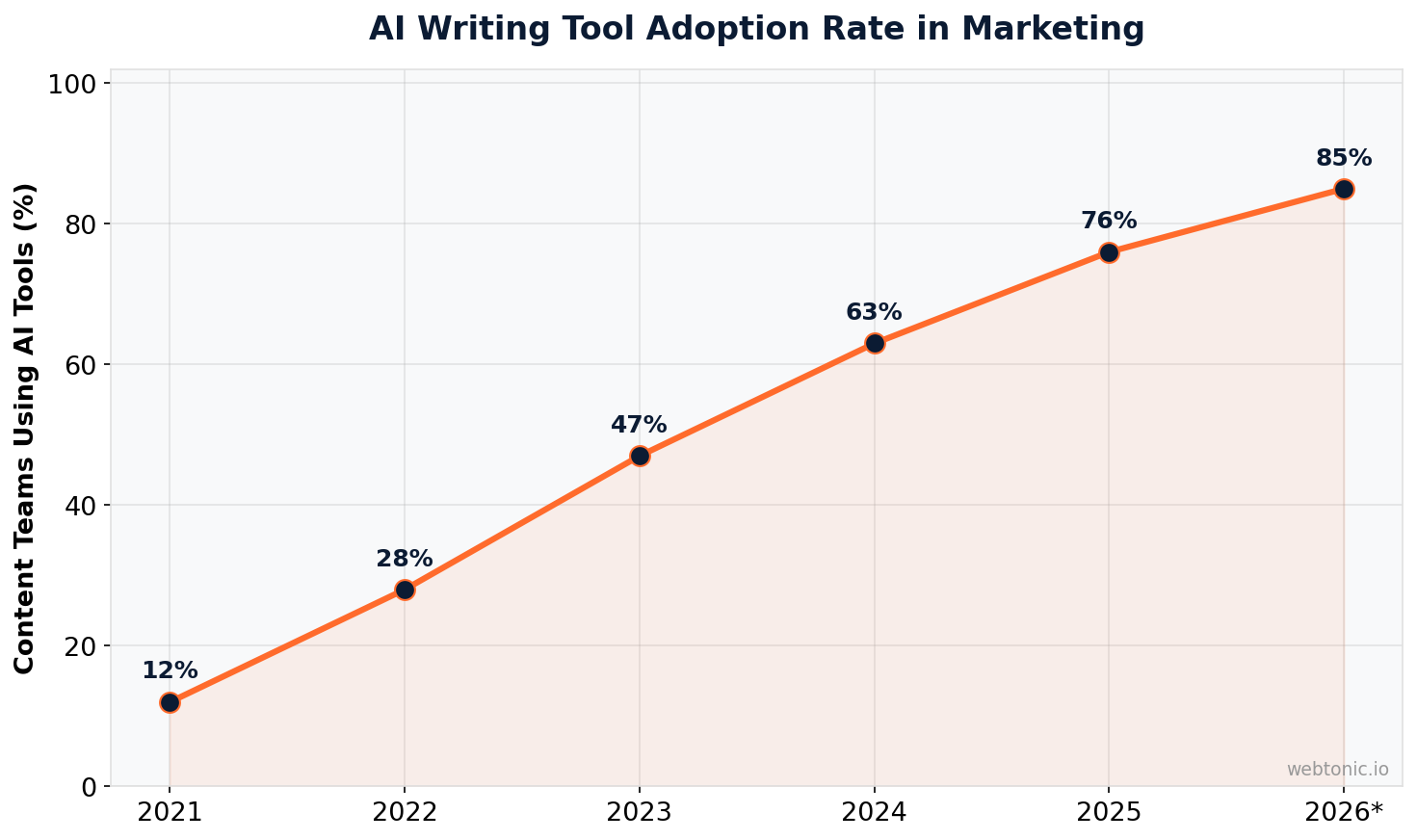
77% of knowledge workers now use AI writing tools at least occasionally, up from 52% in 2024, according to Stealth Agents research. The enterprise AI writing tool market reached $4.2 billion in 2025 and continues to grow as content teams realize that AI paragraph generators can cut time-to-first-draft by 40 to 56% without sacrificing quality — provided the writer knows how to prompt effectively and edits the output.
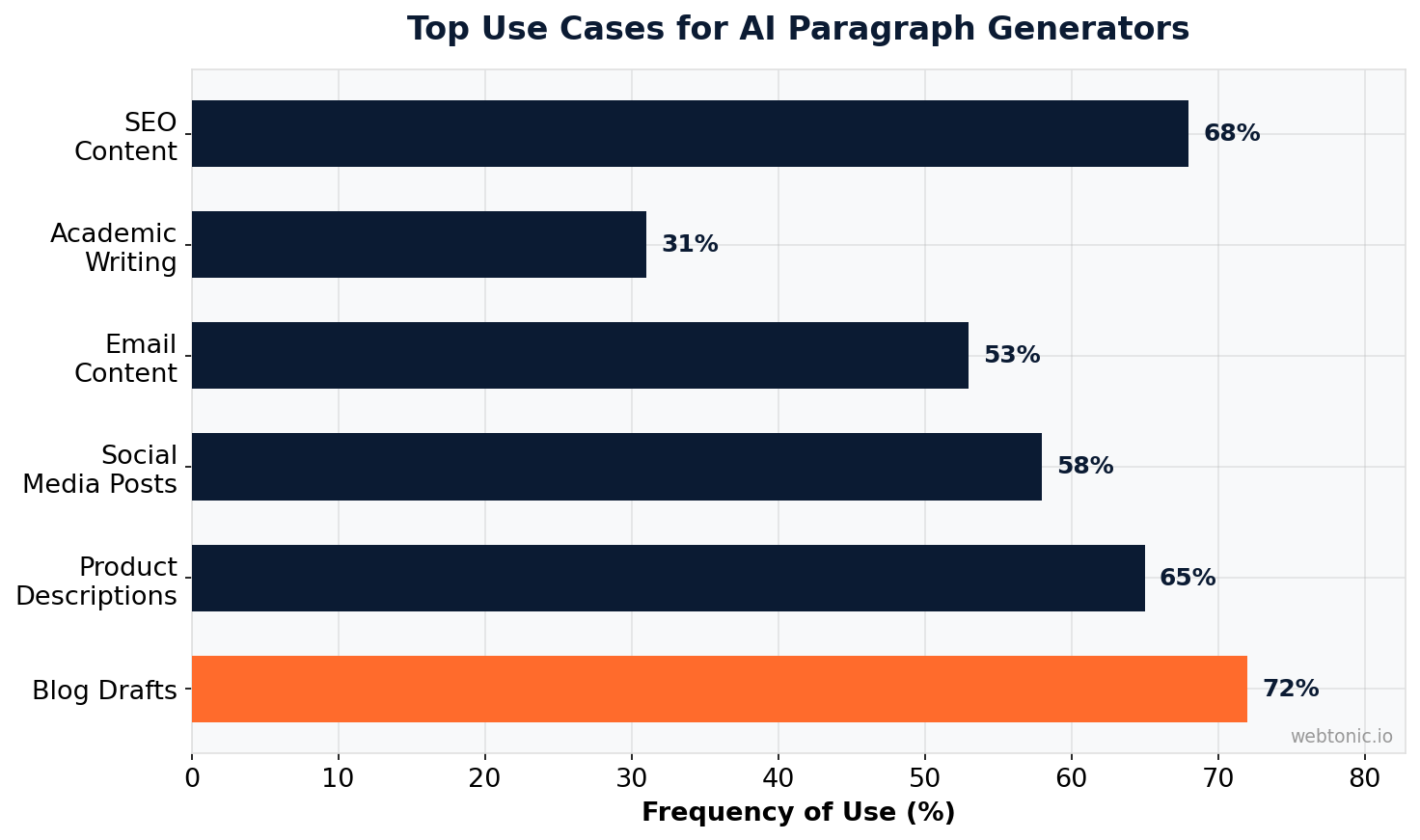
This guide compares the best free and paid paragraph generators, explains how the technology works, and covers the practical strategies for getting the most out of these tools whether you are writing blog drafts, product descriptions, social media posts, or email content.
How AI Paragraph Generators Work
Every modern AI paragraph generator runs on a large language model (LLM) — a neural network trained on billions of words from books, websites, and other text sources. When you enter a prompt like "write a paragraph about the benefits of remote work," the model does not retrieve a pre-written paragraph from a database. Instead, it generates text one word at a time, predicting the most likely next word based on everything that came before it.
This process is called autoregressive generation. The model reads your prompt, generates the first word, then uses the prompt plus that first word to predict the second word, and so on until it reaches the desired length. Each prediction draws on the statistical patterns the model learned during training — which words tend to follow which, how sentences are typically structured, and what kind of information is relevant to a given topic.
The result is text that reads naturally because it follows the same patterns as human writing. However, this is also the source of AI content's biggest limitation: the model does not understand truth the way a human does. It generates text that is statistically plausible, not factually verified. A paragraph generator might produce a sentence like "a 2024 study by Harvard found that remote workers are 43% more productive" — and that statistic could be entirely fabricated. This is why fact-checking AI-generated paragraphs is not optional. It is mandatory.
Best Free AI Paragraph Generators
The free tier of the AI paragraph generator market has matured considerably. Several tools now produce high quality paragraphs at no cost, though each has trade-offs in terms of daily limits, tone customization, and output consistency.
| Tool | Free Tier Limits | Best For | Key Strength |
|---|---|---|---|
| ChatGPT (OpenAI) | Unlimited messages on GPT-4o mini, limited GPT-4o access | General-purpose writing, brainstorming, tone adaptation | Widest range of writing styles, remembers conversation context |
| Copy.ai | 2,000 words per month | Marketing copy, product descriptions, social media posts | Marketing-optimized templates, brand voice training |
| Ahrefs Paragraph Generator | Unlimited (no signup required) | SEO-focused paragraphs, blog content | Built-in SEO awareness, generates content optimized for search |
| Writesonic | 10,000 words per month | Long-form blog content, article outlines | Multiple output variations, built-in article workflow |
| QuillBot | 125-word paraphrasing limit | Rewriting and paraphrasing existing text | Paragraph rewriter with 7 tone modes, grammar checker |
| Google Gemini | Unlimited messages on 2.0 Flash | Research-backed writing, Google ecosystem integration | Can access real-time web data for up-to-date content |
Paid AI Paragraph Generators Worth Considering
For content teams producing paragraphs at scale — 50+ articles per month, product descriptions for thousands of SKUs, or multi-channel marketing copy — the free tiers hit their limits fast. Paid tools offer higher word counts, team collaboration features, brand voice training, and direct integrations with CMS platforms.
Jasper (starting at $49/month) remains the most popular dedicated AI writing tool for marketing teams. It offers 50+ templates specifically designed for marketing content, a brand voice feature that learns your company's style, and team collaboration with approval workflows. The paragraph generator inside Jasper is fine-tuned for marketing copy, which means it tends to produce more persuasive, benefit-driven text than general-purpose models.
ChatGPT Plus (at $20/month) gives you full access to GPT-4o and higher usage limits. For solo marketers and small teams, this is honestly the best value proposition in the market right now. As StackJot's 2026 comparison notes: "Do you still need a dedicated AI writer when a $20/month general-purpose chatbot can write almost anything?" For most users, the answer is no.
Claude Pro (at $20/month) is the alternative for writers who prioritize nuance, longer-form output, and editorial quality. Claude tends to produce longer, more well-structured paragraphs with smoother transitions and better handling of complex topics. Content teams working on thought leadership articles, whitepapers, and technical documentation often prefer Claude's output over GPT-based tools.
Step-by-Step: How to Generate High Quality Paragraphs with AI
The quality of AI-generated content depends almost entirely on the quality of your prompt. Vague prompts produce generic, unusable paragraphs. Specific prompts produce text that is close to publish-ready. Here is the process our content team uses when leveraging AI paragraph generators for client work.
Step 1: Define your context. Tell the AI what the content is for, who the audience is, and what tone to use. Instead of "write a paragraph about email marketing," try: "Write a 150-word paragraph for a blog post targeting small business owners who are new to email marketing. Use a professional but approachable tone. Include a specific statistic about email marketing ROI."
Step 2: Specify the structure. If you want the paragraph to start with a bold claim, lead with data, or end with a transition, say so explicitly. AI models follow structural instructions remarkably well. You can even provide a sentence structure: "Start with a statistic, explain why it matters, give an example, then transition to the next section."
Step 3: Generate multiple versions. Never accept the first output. Generate 3 to 5 variations and pick the strongest one, or combine elements from several outputs. Most paragraph generators allow you to adjust the creativity or temperature setting — lower values produce more predictable text, higher values produce more creative (but less reliable) output.
Step 4: Edit ruthlessly. AI-generated paragraphs almost always need editing. Remove filler phrases like "in today's fast-paced world," replace generic claims with specific data, and adjust the voice to match your brand. The goal is to use the AI output as well structured scaffolding, not finished copy.
Step 5: Fact-check everything. Any statistic, claim, or attribution generated by the AI must be verified against a primary source. AI models are trained to produce text that sounds authoritative, but they regularly fabricate citations and invent data points. If you cannot verify a claim, remove it.
AI Paragraph Generators for SEO Content
Using an AI paragraph generator for SEO content requires additional discipline beyond basic prompt engineering. Search engines can detect low-quality AI-generated content, and Google's helpful content guidelines explicitly prioritize content that demonstrates experience, expertise, authoritativeness, and trustworthiness (E-E-A-T).
The key is to use AI generators for the structure and first draft, then layer in genuine expertise. A generated paragraph about "the benefits of local SEO" becomes valuable content when you add your own case study data, client results, and industry observations that no AI model could have. As Fuel Your Digital notes, AI-generated paragraphs are performing well in search rankings, but only when they receive strategic human input on keyword placement, internal linking, and expertise signals.
Our approach at Web Tonic for content marketing projects: use the AI generator to create an initial structure and populate sections with placeholder paragraphs, then have a subject matter expert rewrite 30 to 50% of the content with original analysis, proprietary data, and experience-based insights. The result is content that is both efficient to produce and genuinely valuable to the reader — exactly what Google's algorithms reward.
| Use Case | AI Contribution | Human Contribution | Typical Edit Ratio |
|---|---|---|---|
| Blog Drafts | Structure, section scaffolding, initial paragraphs | Expertise, case studies, original analysis, fact-checking | 30-50% human rewrite |
| Product Descriptions | Feature-benefit paragraphs, variation at scale | Brand voice, accuracy verification, UX copy | 10-20% human edit |
| Social Media Posts | Multiple hook variations, hashtag suggestions | Brand personality, timely references, visual pairing | 20-40% human edit |
| Email Content | Subject lines, body copy drafts, CTA variations | Personalization, segmentation strategy, A/B test design | 25-35% human rewrite |
| SEO Content | Keyword-targeted paragraphs, FAQ sections, meta descriptions | E-E-A-T signals, internal links, proprietary data, schema | 40-60% human rewrite |
Limitations and Risks of AI Paragraph Generators
AI paragraph generators are powerful tools, but they come with real limitations that every user needs to understand before relying on them for business content.
Factual accuracy is not guaranteed. As mentioned earlier, AI models generate text based on patterns, not verified facts. A well structured paragraph about medical advice, legal guidance, or financial information could contain completely wrong information presented with full confidence. In regulated industries, publishing unverified AI-generated content can create legal liability.
Repetitive output across users. Because AI generators draw from the same training data and respond to similar prompts in similar ways, there is a real risk of producing content that reads identically to what your competitors published using the same tool. Without significant human editing, AI-generated paragraphs tend toward generic, middle-of-the-road text that does not differentiate your brand.
Tone drift in longer content. Paragraph generators work well for isolated paragraphs, but maintaining a consistent voice across a 2,000-word article is harder. The tone can shift between paragraphs, especially if you generate them separately. This is why the step-by-step approach — generating, reviewing, and editing in sequence — produces far better results than generating an entire article at once.
Copyright and plagiarism concerns. While AI models do not copy text verbatim (in most cases), the generated content is derived from copyrighted training data. The legal landscape around AI-generated content ownership remains unsettled. For businesses, the practical advice is to edit AI output significantly enough that it becomes a derivative work representing your original expression.
Frequently Asked Questions
How does an AI paragraph generator create content?
AI paragraph generators use large language models — neural networks trained on billions of words — that predict the most likely next word based on your prompt and all previously generated words. The technology is called autoregressive generation. The model does not pull pre-written text from a database. It creates new text one token at a time based on statistical patterns learned during training, which is why the output reads naturally but must be verified for factual accuracy.
Is it free to use an AI paragraph generator?
Yes, several high quality AI paragraph generators are completely free to use. ChatGPT offers unlimited messages on its base model, Copy.ai provides 2,000 free words per month, and the Ahrefs paragraph generator requires no signup at all. For heavier usage, paid plans from tools like Jasper start at $49 per month and ChatGPT Plus costs $20 per month for full model access and higher limits.
Can I use AI-generated paragraphs for SEO?
Yes, but with important caveats. Google does not penalize AI-generated content simply for being AI-generated. However, Google does penalize content that is unhelpful, unoriginal, or created primarily to manipulate search rankings. To rank well, AI-generated paragraphs need to be edited with genuine expertise, fact-checked against primary sources, enriched with original data or insights, and structured with proper internal and external linking. Use the AI as a starting point, not the finished product.
What types of paragraphs can AI generators create?
Modern AI paragraph generators can create virtually any type of written content. Common use cases include blog post paragraphs, product descriptions, social media captions, email body copy, academic writing drafts, creative fiction, technical documentation, and call-to-action copy. The quality varies by use case — AI generators excel at structured, informational content and struggle more with highly creative or deeply technical writing that requires specialized domain knowledge.
How accurate is the text from AI paragraph generators?
The text is grammatically accurate and reads naturally, but factual accuracy is not guaranteed. AI models generate content based on statistical patterns, not verified knowledge. Any statistics, citations, historical claims, or technical details in AI-generated content must be fact-checked by a human before publishing. Treat AI output as a well written first draft that needs editorial review, not as verified truth. For businesses, the cost of publishing a factual error far exceeds the time saved by skipping the review step.
Looking for more ways to improve your digital marketing? Explore our full range of services, check out our latest blog articles, or reach out to our team for a free consultation.
Sources
Stealth Agents — AI Writing Tools Adoption Statistics 2026
StackJot — Jasper vs Copy.ai vs ChatGPT 2026
Fuel Your Digital — AI Paragraph Generators for SEO
Google — Creating Helpful Content
Neural Digest — How AI Language Models Generate Text
Jasper AI — Enterprise AI Writing Platform
Copy.ai — AI Marketing Content Platform
Fibr.ai — Free AI Paragraph Generator