



Table of contents
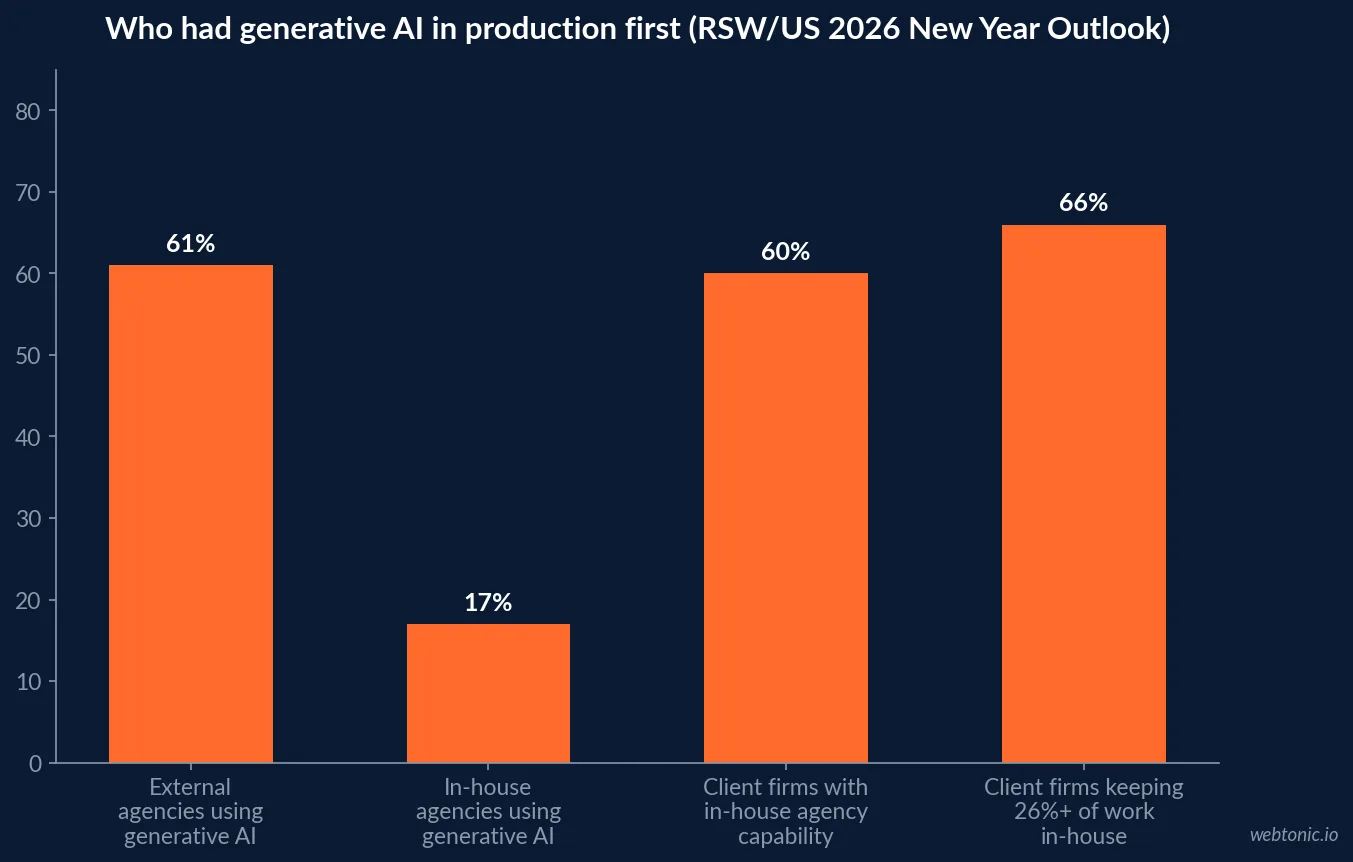
Roughly 61% of external agencies used generative AI in 2025, against 17% of in-house agencies. That gap, not a preference for outsourcing, is the strongest 2026 argument for renting AI capability before building it.
Key Takeaways
- About 61% of external agencies used generative AI against 17% in-house.
- 66% of client firms keep at least 26% of work in-house.
- 60% now have some in-house agency capability, up from 40%.
- 59.5% of marketing work is built in-house.
- 38.5% is bought from outside partners.
- Agencies take 15.5%, consultancies 12.7%, other partners 10.4%.
- 33.6% of digital marketing activity is delivered externally.
- Education builds most in-house at 83.0%.
- Professional services build 70.0% in-house.
- Skill gaps block AI adoption for 35.7% of marketers.
- Marketing self-rates hiring at 3.7 out of 7.
- Headcount growth fell 50% year on year.
- A US CMO costs USD 293,575 in total cash.
- Senior mis-hires can reach 213% of salary.
- Average CMO tenure is 4.1 years, and 31% of firms have no CMO.
- Demand for fractional executives grew 149% year on year.
The delivery side got there first
RSW/US's 2026 New Year Outlook reports roughly 61% of external agencies using generative AI in 2025 against 17% of in-house agencies, while 66% of client firms keep at least 26% of work in-house and 60% now have some in-house agency capability, up from 40% a year earlier.
So in-house capacity is growing and in-house AI practice is not keeping up with it. That is the specific gap an outside engagement can close quickly, and it has a shelf life.
Where the work actually sits
The CMO Survey 2026 splits delivery 59.5% in-house against 38.5% bought outside - agencies 15.5%, consultancies 12.7% and other partners 10.4%. In-house share has climbed from 57.9% in 2020. For digital activity specifically, 33.6% is delivered externally, up from 31.6% in 2022, and marketers expect 34.3% within two years.
The headline is stability, not a swing. Outsourcing is not collapsing; it is being reserved for the parts where outside practice is genuinely ahead - which in 2026 includes generative AI.
| Delivery route | Share of marketing work | Direction |
|---|---|---|
| Built in-house | 59.5% | Up from 57.9% in 2020 |
| Agencies | 15.5% | Largest external route |
| Consultancies | 12.7% | Where advisory scopes land |
| Other outside partners | 10.4% | Freelance and specialist |
| All outside partners | 38.5% | Broadly flat year on year |
| Digital activity delivered externally | 33.6% | Expected to reach 34.3% in two years |
Your sector already has a default
The CMO Survey's most in-house sectors are education at 83.0%, consumer services at 73.3% and professional services at 70.0%, with firms under USD 10 million in revenue at 64.1%. At the other end, retail delivers 57% of digital activity externally, followed by consumer packaged goods at 55%, while technology sits at 28%, media at 10% and education at 3%.
Sector default is a useful prior, not a rule. If you are in a building sector with no standardised AI use case, you are the case where a short rented engagement pays for itself.
Business model matters more than size
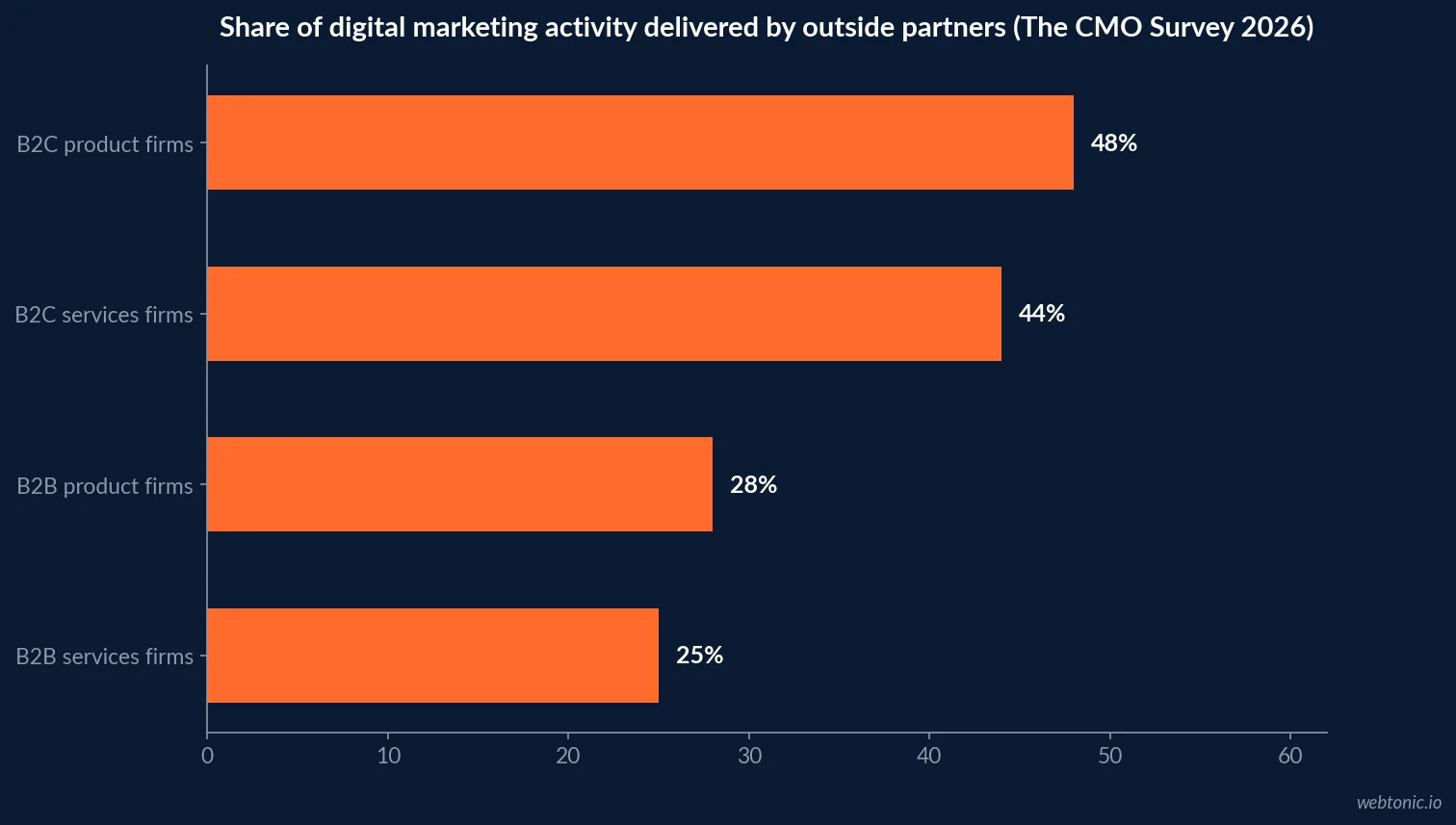
External delivery of digital activity splits sharply by model: B2C product firms at 48%, B2C services at 44%, B2B product at 28% and B2B services at 25%. B2C firms buy volume execution; B2B firms buy judgement and keep execution close.
For AI work that reverses the usual advice. A B2B firm outsourcing an AI readiness assessment is buying exactly what it normally keeps - and that is the right call while 17% of in-house teams have generative AI in production.
The barrier is skills, and hiring is the weakest self-rating
The CMO Survey ranks AI barriers as knowledge and skill gaps 35.7%, resourcing 22.3%, data architecture 19.1%, team bandwidth 14.1% and talent availability 13.1%. On martech capability, the 1-to-7 self-ratings put hiring last at 3.7 and training at 3.9, with nothing above 5.
An organisation that rates itself 3.7 at hiring should not solve a skills problem by hiring first. It should rent the practice, watch what a competent operator actually does, then write the job description from evidence.
The sequence matters more than the choice. Rent, document, then hire against a written role is a path that survives a bad quarter; hiring into an undefined AI remit and hoping the scope resolves itself does not.
| Constraint | 2026 figure | Build or rent |
|---|---|---|
| AI knowledge and skill gaps | 35.7% of marketers | Rent, then document |
| Resourcing | 22.3% | Rent a narrow scope |
| Data architecture | 19.1% | Build - it is yours to own |
| Team bandwidth | 14.1% | Rent for the peak |
| Hiring self-rating | 3.7 out of 7 | Rent while you learn the role |
| Headcount growth | Down 50% year on year | Rent - the seat may not exist |
What a hire really costs
Built In puts US CMO pay at USD 225,908 base and USD 293,575 total cash. Talentfoot prices a bad hire at a floor of 30% of first-year earnings, senior mis-hires at up to 213% of salary, and retained search at 25% to 35%.
Against that, Go Fractional reports fractional leadership at a median USD 175 an hour across roughly nine hours a week, an interquartile range of USD 130 to 220. The rented option is cancellable; the hire is not.
The seat itself is unstable
Spencer Stuart's 2026 CMO tenure snapshot reports average tenure of 4.1 years against a 5.0-year C-suite average, 31% of S&P 500 companies with no CMO title and 77% of vacancies filled within six months.
If the senior marketing seat turns over every four years, an AI programme tied to one person is a programme with an expiry date. Documented process outlasts both hires and vendors.
How firms are structuring outside help
Sagefrog's 2026 B2B Marketing Mix Report finds outside work structured as hybrid 35%, project 28%, retainer 24% and freelancers 12%, with reasons led by bandwidth 22%, speed 18%, expertise 15% and cost efficiency 13%, then rebrand 11%, fresh ideas 11% and launches 8%.
Hybrid leads because it matches how capability transfers: a project to establish the practice, a thin retainer to keep it honest. That is the shape our growth team recommends for a first AI engagement.
| Structure | Share of B2B firms | Best fit for AI work |
|---|---|---|
| Hybrid retainer plus projects | 35% | Establish, then steward |
| Project only | 28% | A readiness assessment |
| Retainer only | 24% | Governance after standardisation |
| Freelancers | 12% | Single-task execution |
| Named reason: bandwidth | 22% | Peak coverage, not capability |
| Named reason: expertise | 15% | The AI case specifically |
Rented capability is not a stopgap any more
Fractional Jobs reports 149% year-on-year demand growth, roughly 150,000 US practitioners, marketing at 20% of demand, 87% with eleven or more years of experience, 64% serving multiple clients and 90% saying they will not return to full-time work.
Multi-client exposure is the point. Someone who has run the same AI use case across four companies is a faster route to working practice than a first-time internal hire, whatever the org chart prefers.
What the outside engagement must hand over
Renting capability only beats hiring if the practice stays behind. With CMO tenure at 4.1 years, training self-rated 3.9 out of 7 and training spend down to 3.8% of marketing spend, the handover is the part most likely to be skipped - and the part that decides whether you ever get to hire with confidence.
Write the deliverables into the scope rather than the kickoff deck. Each one below should exist as a file your team can open after the engagement ends, not as knowledge sitting in someone else's head.
| Handover artefact | Why it matters in 2026 | Owner after handover |
|---|---|---|
| Written use-case procedure | Only content generation clears 70% adoption | In-house marketing lead |
| Prompt and input library | Skill gaps block 35.7% of teams | The team doing the work |
| Review and approval step | Governance is mature for 52% of leaders | A named reviewer |
| Tool inventory with usage caps | 56% of martech spend is usage-priced | Marketing operations |
| A job description drafted from evidence | Hiring self-rates 3.7 out of 7 | Hiring manager |
| Baseline and target numbers | Demonstrating ROI self-rates 4.2 out of 7 | Whoever owns the budget |
A decision rule you can defend
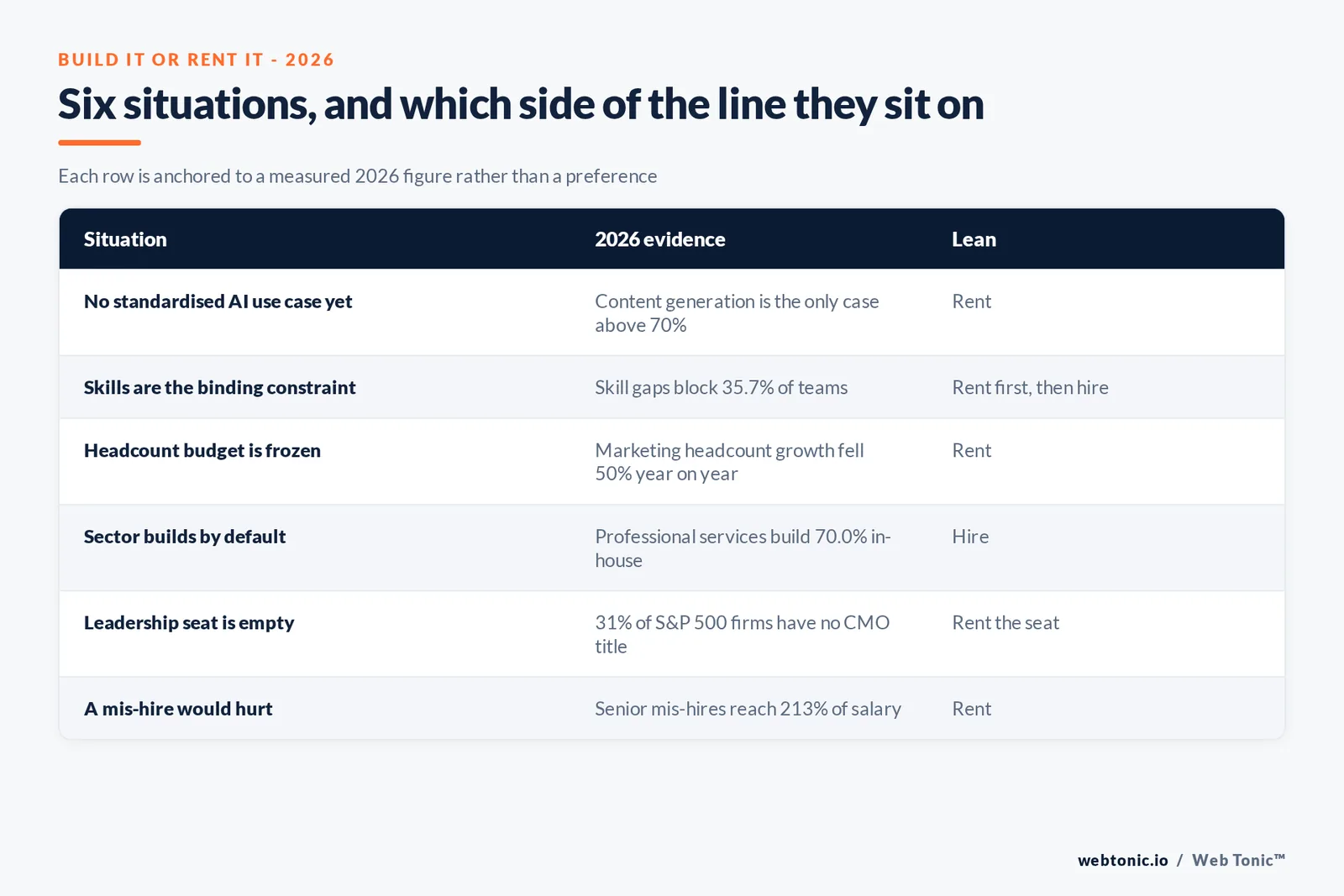
Rent while skill gaps are the constraint for 35.7% of marketers and your own hiring self-rating sits at 3.7. Hire when one use case is standardised, the training line is funded above 3.8% of spend, and your sector default - 70.0% in-house for professional services - actually supports it.
Everything else is preference dressed as strategy. If you want the decision written up against your own numbers, send us your current org chart and reporting pack, or see how we split execution and advisory in our agency selection guide and performance creative team.
Related reading
- Marketing KPI Scorecard Statistics: Hiring vs Outsourcing
- Growth Consulting Statistics: Hiring vs Outsourcing in 2026
- AI Marketing Advisory / AI Readiness: vs hiring in-house
- Marketing Strategy Consulting services at Web Tonic
Frequently Asked Questions
Should we hire for AI marketing or outsource it?
In 2026 the evidence favours renting the capability first. RSW/US reports roughly 61% of external agencies using generative AI in 2025 against 17% of in-house agencies, and The CMO Survey names AI knowledge and skill gaps as the top adoption barrier for 35.7% of marketers while marketing headcount growth fell 50% year on year. Rent working practice, then hire once one use case is standardised.
How much marketing work is built in-house in 2026?
The CMO Survey 2026 reports 59.5% of marketing work built in-house, 38.5% bought from outside partners (agencies 15.5%, consultancies 12.7%, other partners 10.4%) and 1.9% classed as other. In-house share has risen from 57.9% in 2020. For digital activity specifically, 33.6% is delivered externally.
Which sectors keep AI and marketing work inside?
The most in-house sectors in The CMO Survey 2026 are education at 83.0%, consumer services at 73.3%, professional services at 70.0%, and firms under USD 10 million in revenue at 64.1%. At the other end, retail outsources heavily, with 57% of digital activity delivered externally, followed by consumer packaged goods at 55%.
What does a mis-hire cost if we get it wrong?
Talentfoot's 2026 data puts the floor at 30% of first-year earnings per US Department of Labor guidance, with senior mis-hires reaching up to 213% of salary, and retained search adding 25% to 35%. Against Built In's USD 293,575 total cash for a US CMO, that is a large downside on a role whose scope is still being defined.
How long does marketing leadership stay?
Spencer Stuart's 2026 snapshot puts average CMO tenure at 4.1 years, below the 5.0-year C-suite average, with 31% of S&P 500 companies having no CMO title at all and 77% of vacancies filled within six months. Short tenure is an argument for documenting the AI programme rather than attaching it to one person.
Sources
RSW/US - 2026 New Year Outlook Report
The CMO Survey - Highlights and Insights Report 2026
Sagefrog - 2026 B2B Marketing Mix Report
Built In - CMO salary data
Talentfoot - The cost of a leadership mis-hire, 2026 data
Go Fractional - Fractional CMO rates
Spencer Stuart - CMO Tenure 2026 Snapshot
Fractional Jobs - The Fractional Work Report


