



Table of contents

No published 2026 study prices AI marketing advisory as its own product. What does exist is a consulting-wide rate base - and it is enough to build a defensible budget.
Key Takeaways
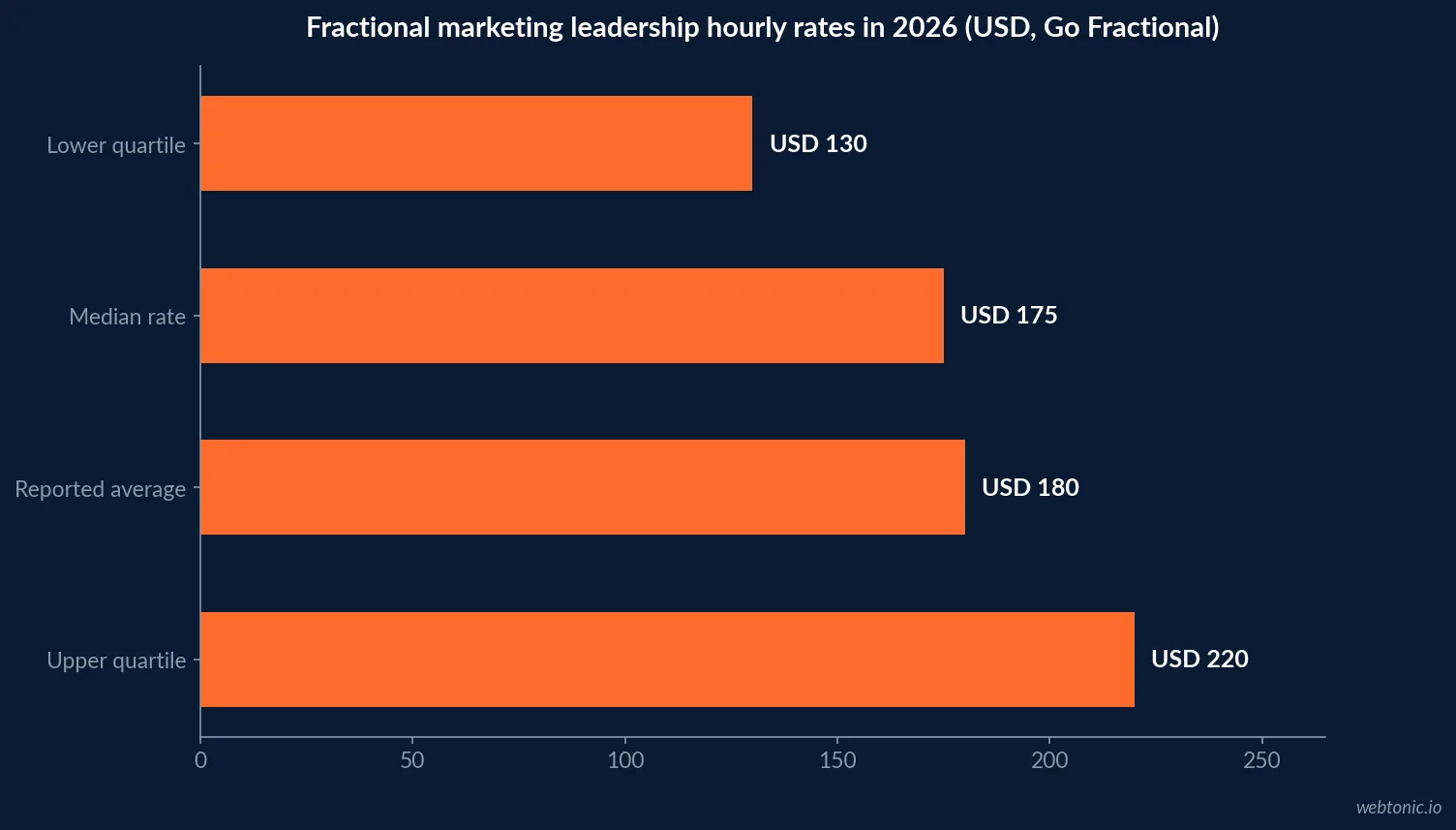
- Fractional marketing leadership runs a median USD 175 an hour.
- The interquartile range is USD 130 to 220 an hour.
- Reported average fractional rate is USD 180 an hour.
- Project work carries loaded rates of USD 300 to 700 an hour.
- Hourly advisory runs USD 200 to 600 loaded.
- Retainers run USD 5,000 to 25,000 a month.
- Retainer-shaped buying costs four to five times more than fixed scope.
- Fixed-price projects are 30% of how consultants bill.
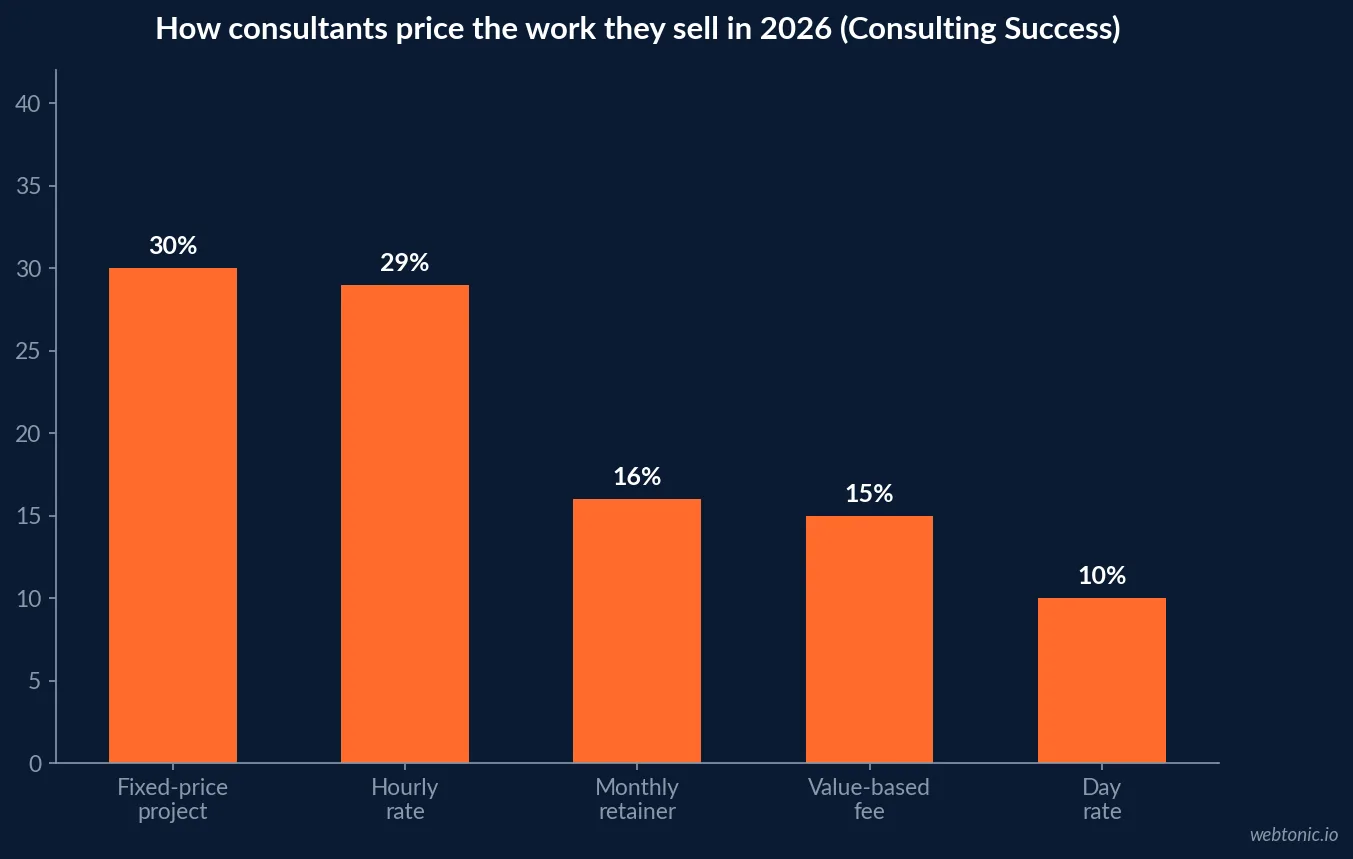
- Hourly is 29%, retainers 16%, value-based 15%, day rates 10%.
- 79% of consultants say they want to charge more.
- A full-time CMO costs USD 293,575 in total cash.
- A senior mis-hire can reach 213% of salary.
- Fractional engagement averages about nine hours a week.
- Martech has fallen to 19.4% of the marketing budget.
- Marketing spend growth is just 1.7% year on year.
- Demand for fractional work grew 149% year on year.
Start with what is actually published
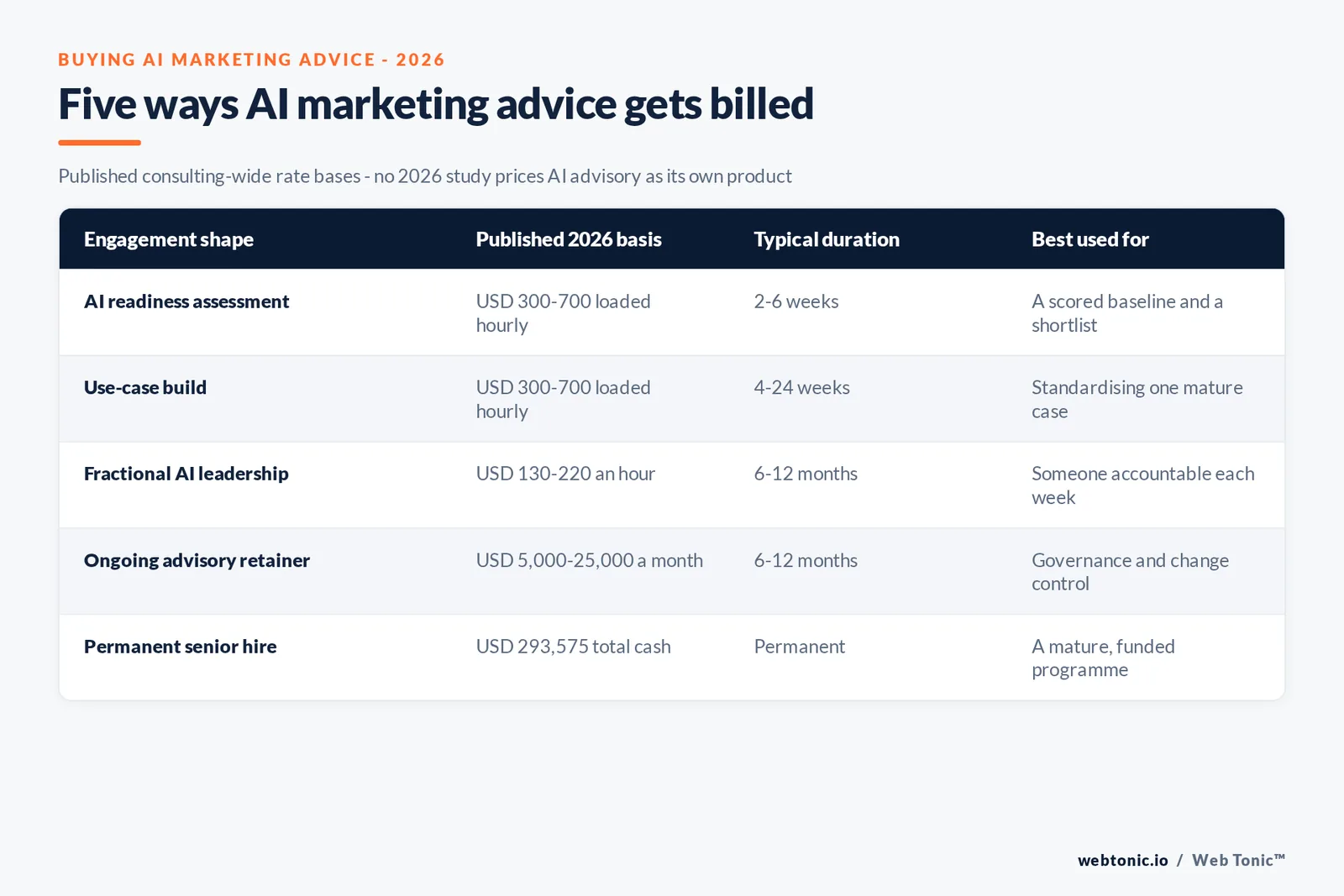
Ask what AI marketing consulting costs and you will be quoted, not answered. The reason is simple: no 2026 benchmark study prices AI readiness work as a discrete service line. The credible base is consulting-wide. Fractional Pulse's 2026 comparison reports loaded hourly rates of USD 300 to 700 for project work, USD 200 to 600 for hourly advisory and USD 200 to 500 inside a retainer, with retainers at USD 5,000 to 25,000 a month on six to twelve month terms plus a 30-day notice period.
Anyone quoting a single "AI consultant rate" is either compressing that range or inventing it. The useful question is which shape you are buying, because the shape moves the invoice more than the rate does.
| Engagement shape | Loaded hourly (2026) | Commitment | What it suits |
|---|---|---|---|
| Fixed-scope project | USD 300-700 | 4-24 weeks | A readiness assessment or one build |
| Hourly advisory | USD 200-600 | No minimum | Second opinions and reviews |
| Inside a retainer | USD 200-500 | 6-12 months + 30 days | Ongoing governance |
| Fractional leadership | USD 130-220 | ~9 hours a week | Weekly accountability |
| Permanent hire | USD 293,575 total cash | Permanent | A funded, mature programme |
The billing model explains most of the variance
Consulting Success surveyed roughly 1,000 consultants and found fixed-price projects at 30%, hourly at 29%, monthly retainers at 16%, value-based fees at 15% and day rates at 10%. Some 79% say they want to charge more, 38% earn USD 10,000 or more a month, and specialists land USD 10,000-plus projects at 51% against 39% for generalists.
Two quotes for the same AI readiness scope can arrive on two different billing shapes and differ by a multiple. Normalise them onto deliverables before you compare a single figure.
Buying a project through a retainer is the expensive mistake
Fractional Pulse's worked comparison is blunt: buying project-shaped work through a monthly retainer costs four to five times more - USD 180,000 against USD 40,000 in its example. Projects there run 4 to 24 weeks; retainers commit for 6 to 12 months.
An AI readiness assessment is a project. It has a start, a scored output and an end. Signing a twelve-month retainer to get one is how a USD 40,000 answer becomes a six-figure line item.
What the fractional market charges
Go Fractional reports an average of USD 180 an hour, a median of USD 175, an interquartile range of USD 130 to 220, and engagements of roughly nine hours a week - about 468 hours a year.
At the median, that is roughly USD 82,000 a year of senior attention. It is the cleanest comparator for an AI advisory retainer, because it prices the same thing: recurring judgement rather than deliverables.
| Rate measure | 2026 figure | What it implies |
|---|---|---|
| Average hourly | USD 180 | Above the median - a few large mandates pull it up |
| Median hourly | USD 175 | The number to negotiate against |
| Lower quartile | USD 130 | Narrow scope or an earlier-career operator |
| Upper quartile | USD 220 | Category specialists and turnaround work |
| Typical commitment | ~9 hours a week | About 468 hours a year |
Compare it to the payroll alternative properly
Built In puts US chief marketing officer pay at USD 225,908 base and USD 293,575 total cash. Talentfoot's 2026 data prices a bad hire at a floor of 30% of first-year earnings per US Department of Labor guidance, with senior mis-hires reaching 213% of salary and retained search adding 25% to 35%.
That is the risk-adjusted comparison an AI hire deserves. You are not choosing between a salary and a retainer; you are choosing between a salary plus search plus mis-hire exposure, and a cancellable engagement.
The budget it has to fit inside
The CMO Survey 2026 reports marketing budgets at 9.0% of revenue, spend growth of just 1.7%, headcount growth down 50% year on year and training down to 3.8% of marketing spend from 5.8%. Meanwhile Gartner's 2026 CMO Spend Survey puts martech at 19.4% of budget, a five-year low against 26.6% in 2021, with 56% of spend on consumption pricing and 41% adding usage controls.
Advisory fees compete with a shrinking tooling line and a flat overall budget. That argues for one fixed-scope engagement with a decision attached, not a standing arrangement.
| Budget constraint | 2026 figure | Effect on an advisory quote |
|---|---|---|
| Marketing budget of revenue | 9.0% | Little headroom for open-ended scopes |
| Marketing spend growth | 1.7% | New spend must displace old spend |
| Headcount growth | Down 50% year on year | Rented capability is the realistic route |
| Training share of spend | 3.8%, from 5.8% | Fund it inside the engagement |
| Martech share of budget | 19.4%, from 26.6% in 2021 | Tool costs are being squeezed too |
| Consumption-priced martech | 56% of spend | Cap usage before you scale a pilot |
Why the demand curve is pushing prices up
Fractional Jobs reports 149% year-on-year demand growth, roughly 150,000 US practitioners, marketing accounting for 20% of demand, 87% of practitioners with eleven or more years of experience and 90% saying they will not return to full-time work. Vendux cites Gartner expecting more than 30% of midsize companies to use fractional executives by 2027.
A tightening senior market is not a reason to overpay. It is a reason to define scope narrowly enough that experienced people can quote it confidently.
What you should be paying for at each phase
The CMO Survey reports AI covering 24.2% of marketing activities, up from 13.1%, with generative AI at 22.4% against 7.0% - a 220% rise - and 55.9% projected within three years. Skill gaps are the top barrier at 35.7%.
Phase one buys a benchmarked baseline against those figures. Phase two buys one standardised use case. Phase three, if the first two land, buys stewardship. Our growth marketing team scopes it in that order for exactly this reason.
| Phase | What you buy | Sensible shape | Exit test |
|---|---|---|---|
| Baseline | A scored readiness assessment | Fixed-scope project | A ranked shortlist exists |
| Standardise | One documented use case | Fixed-scope project | It runs without the consultant |
| Govern | Review cadence and usage caps | Retainer or fractional | Costs stay inside the cap |
| Scale | A second and third use case | Project per case | Each case has an owner |
| Own | Internal capability | Hire | Training line is funded |
Where the market itself is heading
The Business Research Company sizes management consulting at USD 1,063.77 billion in 2025, USD 1,111.35 billion in 2026 and USD 1,407.09 billion by 2030. Against that supply, the CMO Survey reports overall marketing spend growth of just 1.7% and agility being called key by 71% of marketing leaders.
Supply of advice is growing faster than the budgets that fund it. That is quiet leverage for buyers who arrive with a written scope instead of a discovery call.
How to make the quotes comparable
Ask every candidate for the same five things: the deliverable list, the billing shape, the hours behind the number, what happens at the end, and the notice period. With fixed-price at 30% and hourly at 29% of the market, you will get both shapes back, and only a deliverable list makes them commensurable.
If you want a second read on a quote you have already received, send it over and we will map it onto these published rate bases. We take the same approach to platform budgets in our Google Ads cost guide.
The short version
Budget USD 130 to 220 an hour for fractional leadership, USD 300 to 700 loaded for project work and USD 5,000 to 25,000 a month for a retainer you actually need. Buy the readiness assessment as a project, refuse to buy a project through a retainer at four to five times the cost, and hold the training line at more than 3.8% of spend.
That is a budget built from published numbers. Everything else in an AI pricing conversation is positioning - and our team is happy to say so out loud.
Related reading
- Marketing KPI Scorecard Cost and Pricing Statistics
- Marketing Audit Statistics: Cost and Pricing
- Marketing Team Structure Statistics: Cost and Pricing
- Marketing Strategy Consulting services at Web Tonic
Frequently Asked Questions
How much does an AI marketing consultant cost in 2026?
No published 2026 study prices AI marketing advisory as its own product, so the honest answer is the consulting-wide rate base. Fractional Pulse reports loaded hourly rates of USD 300 to 700 for project work, USD 200 to 600 for hourly advisory and USD 200 to 500 inside a retainer, with retainers running USD 5,000 to 25,000 a month on six to twelve month terms. Go Fractional puts fractional marketing leadership at a median USD 175 an hour, with a USD 130 to 220 interquartile range.
Is a retainer or a fixed-scope project cheaper?
For a defined piece of work, fixed scope wins by a wide margin. Fractional Pulse's 2026 comparison finds that buying project-shaped work through a monthly retainer costs four to five times more - USD 180,000 against USD 40,000 in its worked example. Buy the readiness assessment as a project, and only move to a retainer once a use case is standardised and needs stewardship.
How does that compare with hiring someone?
Built In reports US chief marketing officer pay at USD 225,908 base and USD 293,575 total cash. Go Fractional puts fractional engagement at roughly nine hours a week, about 468 hours a year, which at the USD 175 median is well under half that number - before the mis-hire risk Talentfoot prices at 30% of first-year earnings as a floor and up to 213% of salary for a senior mis-hire.
Why do quotes for the same work vary so much?
Because pricing models differ more than rates do. Consulting Success's survey of roughly 1,000 consultants finds fixed-price projects at 30%, hourly at 29%, monthly retainers at 16%, value-based fees at 15% and day rates at 10%, with 79% saying they want to charge more. Two quotes can describe the same scope on different billing shapes, which is why you should ask for the deliverable list before comparing numbers.
What should the first AI engagement actually buy?
A scored baseline and a shortlist, not a tool rollout. The CMO Survey 2026 reports AI covering 24.2% of marketing activities and names knowledge and skill gaps as the top barrier for 35.7% of marketers - while training spend fell to 3.8% of marketing spend from 5.8%. A first engagement that produces a benchmarked baseline, one standardised use case and a funded training line is worth more than a licence.
Sources
Fractional Pulse - Fractional executive engagement comparison 2026
Go Fractional - Fractional CMO rates
Consulting Success - Consulting fees study
Built In - CMO salary data
Talentfoot - The cost of a leadership mis-hire, 2026 data
The CMO Survey - Highlights and Insights Report 2026
Gartner 2026 CMO Spend Survey via Chief Marketer
Fractional Jobs - The Fractional Work Report
Vendux - Ten numbers on fractional executives in 2026
The Business Research Company - Management consulting services market report


