



Table of contents
Martech has fallen to 19.4% of the marketing budget, a five-year low, and only 9% of stacks are described as fully AI-optimised. AI adoption in 2026 is a tooling and governance problem, not an ambition problem.
Key Takeaways
- Martech is 19.4% of marketing budget, against 26.6% in 2021.
- Only 9% of stacks are called fully AI-optimised.
- 62% of CMOs plan to invest more in martech.
- 56% of martech spend has moved to consumption pricing.
- 41% are adding usage controls and 24% overhauling systems.
- No martech capability self-rates above 5 out of 7.
- Vendor selection scores 4.9 and systems integration 4.8.
- Training scores 3.9 and hiring 3.7 out of 7.
- AI covers 24.2% of marketing activities, up from 13.1%.
- Generative AI covers 22.4%, up from 7.0% - a 220% rise.
- Content generation leads use cases at 73.9%.
- 80% use AI for content and 75% for media production.
- Skill gaps block 35.7% of teams; architecture blocks 19.1%.
- Training spend fell to 3.8% of marketing spend from 5.8%.
- Governance is mature for only 52% of top performers.
- 41.5% of marketers now work on generative engine optimisation.
The tooling line is shrinking while the ask grows
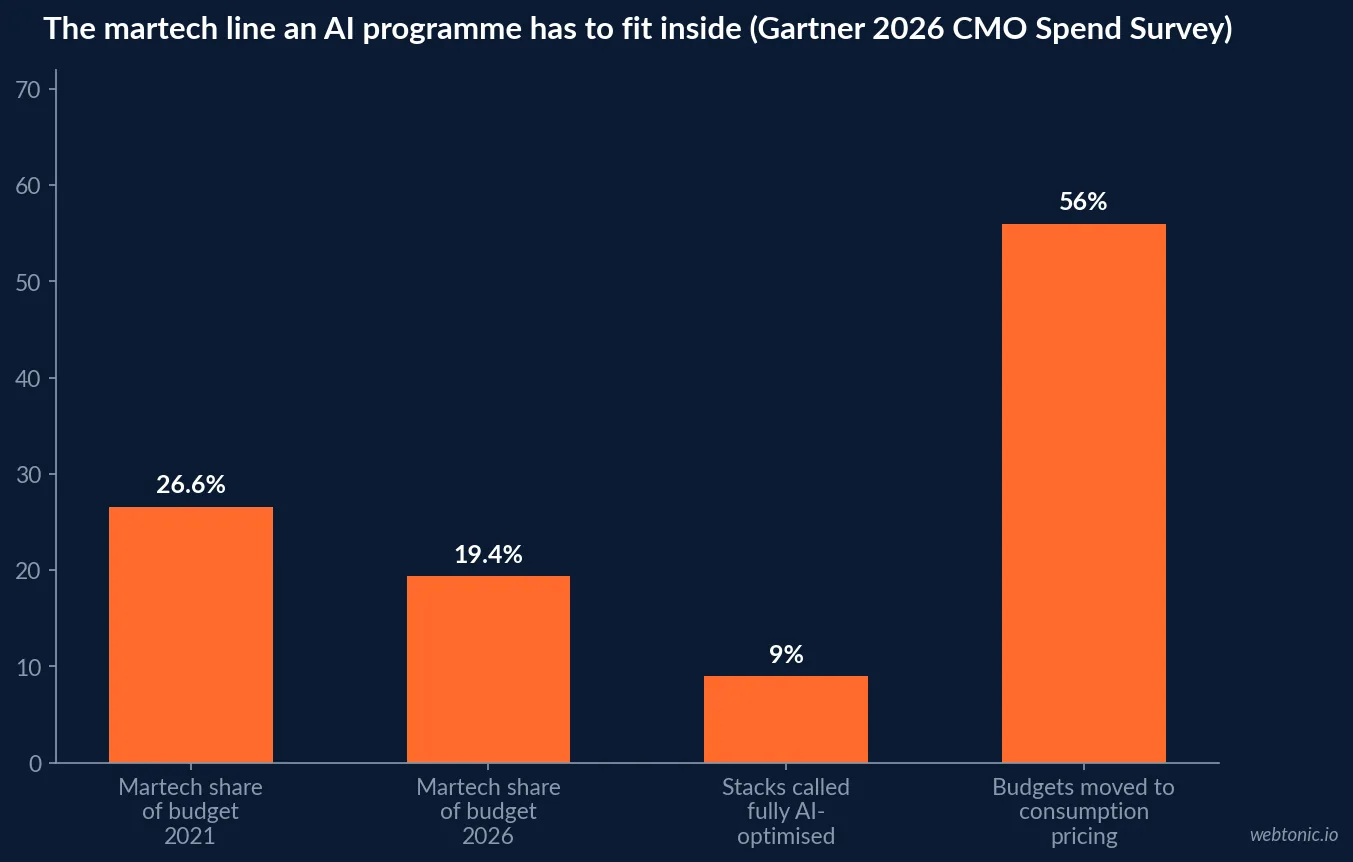
Gartner's 2026 CMO Spend Survey puts martech at 19.4% of marketing budget, a five-year low against 26.6% in 2021, with 62% planning to invest more, 56% of spend on consumption-based pricing against 9% cutting, 41% adding usage controls, 24% overhauling systems and only 9% describing their stack as fully AI-optimised.
Read those together and the picture is a smaller tooling budget being asked to carry a larger workload. Any AI plan that starts with a purchase is fighting the direction of the budget.
Nothing self-rates above five out of seven
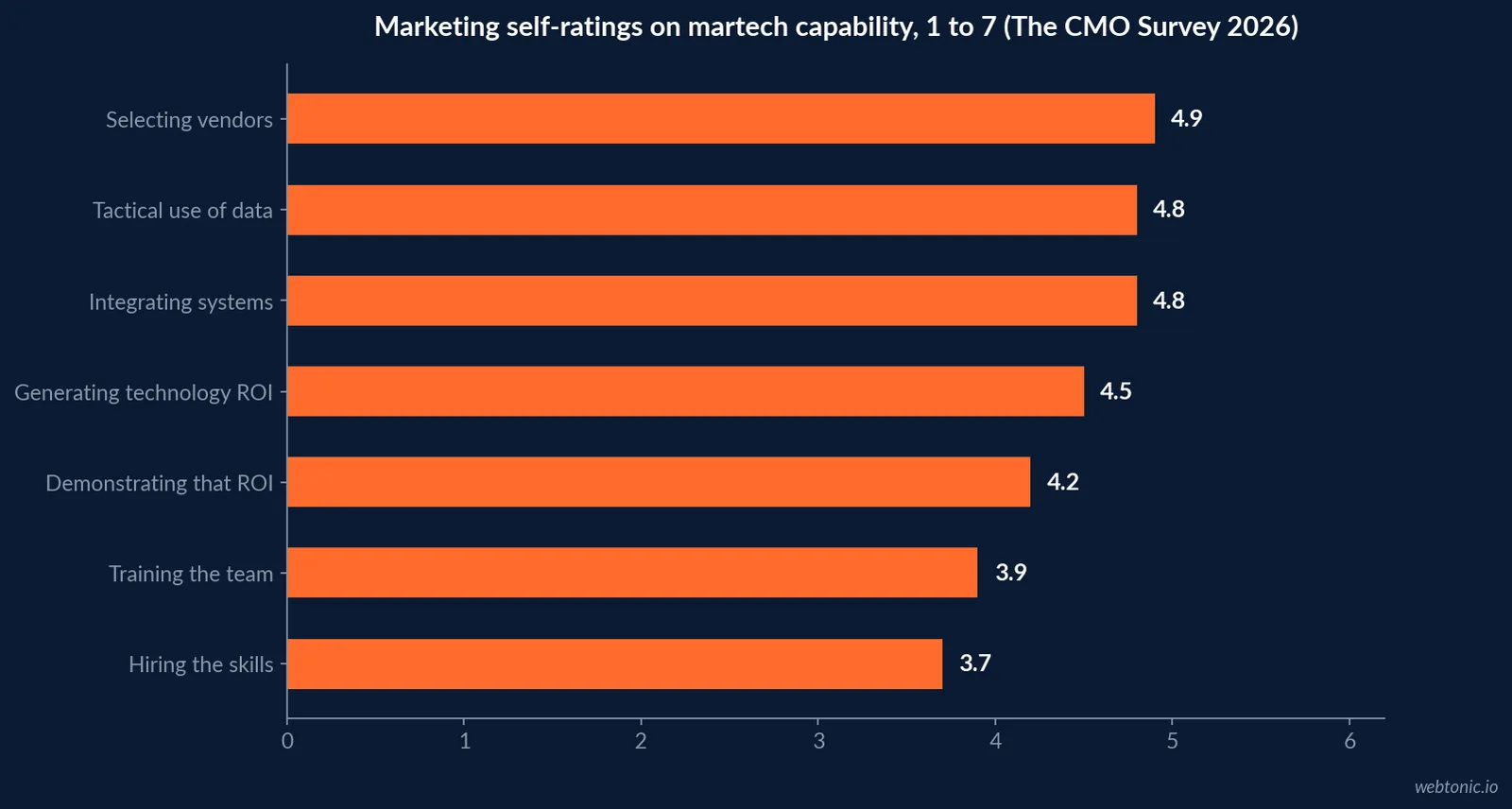
The CMO Survey 2026 asks marketers to rate their own martech capability from 1 to 7: vendor selection 4.9, tactical use of data 4.8, systems integration 4.8, generating technology ROI 4.5, demonstrating that ROI 4.2, training 3.9 and hiring 3.7. The ratings are flat against 2024.
This is the single most useful number in an AI readiness conversation. Generative capability is being layered onto a base that scores below 5 on every dimension that implementation depends on.
| Martech capability | Self-rating (1-7) | What it limits |
|---|---|---|
| Selecting vendors | 4.9 | Which AI tools get bought |
| Tactical use of data | 4.8 | Whether outputs are usable |
| Integrating systems | 4.8 | Whether automation actually connects |
| Generating technology ROI | 4.5 | Whether spend earns its keep |
| Demonstrating that ROI | 4.2 | Whether the budget survives review |
| Training the team | 3.9 | Whether adoption sticks |
| Hiring the skills | 3.7 | Whether you can staff it internally |
Consumption pricing rewrites the AI business case
With 56% of martech spend on consumption pricing and 41% of CMOs adding usage controls, the cost of an AI use case is no longer a licence - it is a function of how much you use it. A successful pilot therefore creates an unbudgeted invoice unless the cap exists first.
The practical rule is boring and effective: no rollout without a usage ceiling, an alert at 70% of it, and a named person who owns the overage decision.
Adoption is real, but concentrated
The CMO Survey reports AI covering 24.2% of marketing activities, up from 13.1%, and generative AI at 22.4% against 7.0% - a 220% rise - with 55.9% projected within three years and 41.5% working on generative engine optimisation. Use cases rank content generation 73.9%, personalisation 65.4%, marketing automation 48.9%, data analysis 46.3% and audience targeting 45.2%.
HubSpot's State of Marketing adds 80% using AI for content, 75% for media production and 61% calling this the biggest disruption in marketing in twenty years. One case is standardised; the rest are pilots.
Tool sprawl has a measurable cause
The CMO Survey ranks barriers as AI knowledge and skill gaps 35.7%, resourcing 22.3%, data architecture 19.1%, team bandwidth 14.1% and talent availability 13.1% - while training fell to 3.8% of marketing spend from 5.8% and headcount growth was down 50% year on year.
When skills are short and headcount is frozen, tools get bought as substitutes for capability. That is how a stack accumulates overlapping licences nobody has been trained to use, and it is why the next dollar belongs to training.
RSW/US's 2026 New Year Outlook makes the same point from the delivery side: roughly 61% of external agencies used generative AI in 2025 against 17% of in-house agencies, and 60% of client firms now hold some in-house agency capability. Practice travels faster than licences do.
| Adoption barrier | Share of marketers | The tooling temptation | The better move |
|---|---|---|---|
| Knowledge and skill gaps | 35.7% | Buy a tool with defaults | Fund training above 3.8% of spend |
| Resourcing | 22.3% | Automate everything at once | Standardise one use case |
| Data architecture | 19.1% | Add a connector | Consolidate sources first |
| Team bandwidth | 14.1% | Add another seat | Retire a tool in exchange |
| Talent availability | 13.1% | Buy a managed service | Rent senior judgement short term |
Governance is where AI output turns into slop
The Content Marketing Institute's 2026 B2B research finds 97% of organisations with a content strategy, effectiveness improved significantly for 13% and somewhat for 48%, flat for 30%, and challenges ranked prompting action 40%, resources 39%, measurement 33%, quality 28%, differentiation 24% and buyer journey 23%. Only 52% of pacesetters call their governance mature.
High usage plus immature governance is a volume problem waiting to become a brand problem. Documenting inputs, a review step and an owner for one use case beats adding a second tool.
Measure the stack, not the licences
Four numbers make a tooling review honest: share of activities using AI against 24.2%, standardised use cases against content generation at 73.9%, martech share of budget against 19.4%, and consumption exposure against the 56% of spend now usage-priced. Each one forces a decision instead of a status update.
Our data intelligence team runs that review before any automation is scaled, for the simple reason that 4.8 out of 7 integration confidence does not survive contact with a rushed rollout.
| Tooling KPI | 2026 comparator | Cadence | Decision it forces |
|---|---|---|---|
| AI share of activities | 24.2%, up from 13.1% | Quarterly | Widen or narrow the pilot set |
| Standardised use cases | Content generation 73.9% | Monthly | Document it or retire it |
| Martech share of budget | 19.4% of budget | Quarterly | Cap, renegotiate or cut |
| Consumption exposure | 56% of spend usage-priced | Monthly | Set or lower the usage cap |
| Governance maturity | 52% of pacesetters | Quarterly | Name an owner per use case |
| AI search visibility | 41.5% now work on GEO | Monthly | Fund or ignore AI answers |
Smaller teams feel it differently
Constant Contact's Small Business Now report, Q1 2026 finds 68% of small businesses expecting budgets to rise, 74% expecting to spend more time on marketing and inflation as the top concern for 41%.
For a small team the AI question is time, not headcount. One standardised use case that removes hours from a weekly routine is worth more than a stack that promises transformation - the same logic we apply in our email marketing agency guide.
Where AI search sits in the stack
With 41.5% of marketers working on generative engine optimisation and 61% calling AI the biggest disruption in twenty years, visibility inside AI answers has become a reporting line rather than a curiosity. It is also measurable, which most AI claims are not.
Treat it like any paid or organic channel: a named owner, a monthly number, a decision attached. The approach we use for paid search transfers directly.
Sort the use cases by maturity, not by excitement
The adoption spread does most of the prioritisation for you. Content generation sits at 73.9% and is the only case above 70%; personalisation follows at 65.4%, automation at 48.9%, data analysis at 46.3% and audience targeting at 45.2%. HubSpot's 80% for content and 75% for media production point the same way.
Treating all five as equally ready is how a stack fills up with half-configured tools. Standardise the mature case, pilot one more with a measured outcome, and leave the rest documented as untested.
| Use case | 2026 adoption | Tooling implication | Next step |
|---|---|---|---|
| Content generation | 73.9% (80% per HubSpot) | Consolidate onto one tool | Document and standardise |
| Personalisation | 65.4% | Needs clean audience data | Pilot with a holdout |
| Marketing automation | 48.9% | Blocked by architecture for 19.1% | Consolidate sources first |
| Data analysis | 46.3% | Definitions must be frozen | Agree metrics, then automate |
| Audience targeting | 45.2% | Platform-side, not stack-side | Test before scaling spend |
| Generative engine optimisation | 41.5% now working on it | Reporting, not licences | Assign a monthly owner |
A tooling plan that survives a budget review
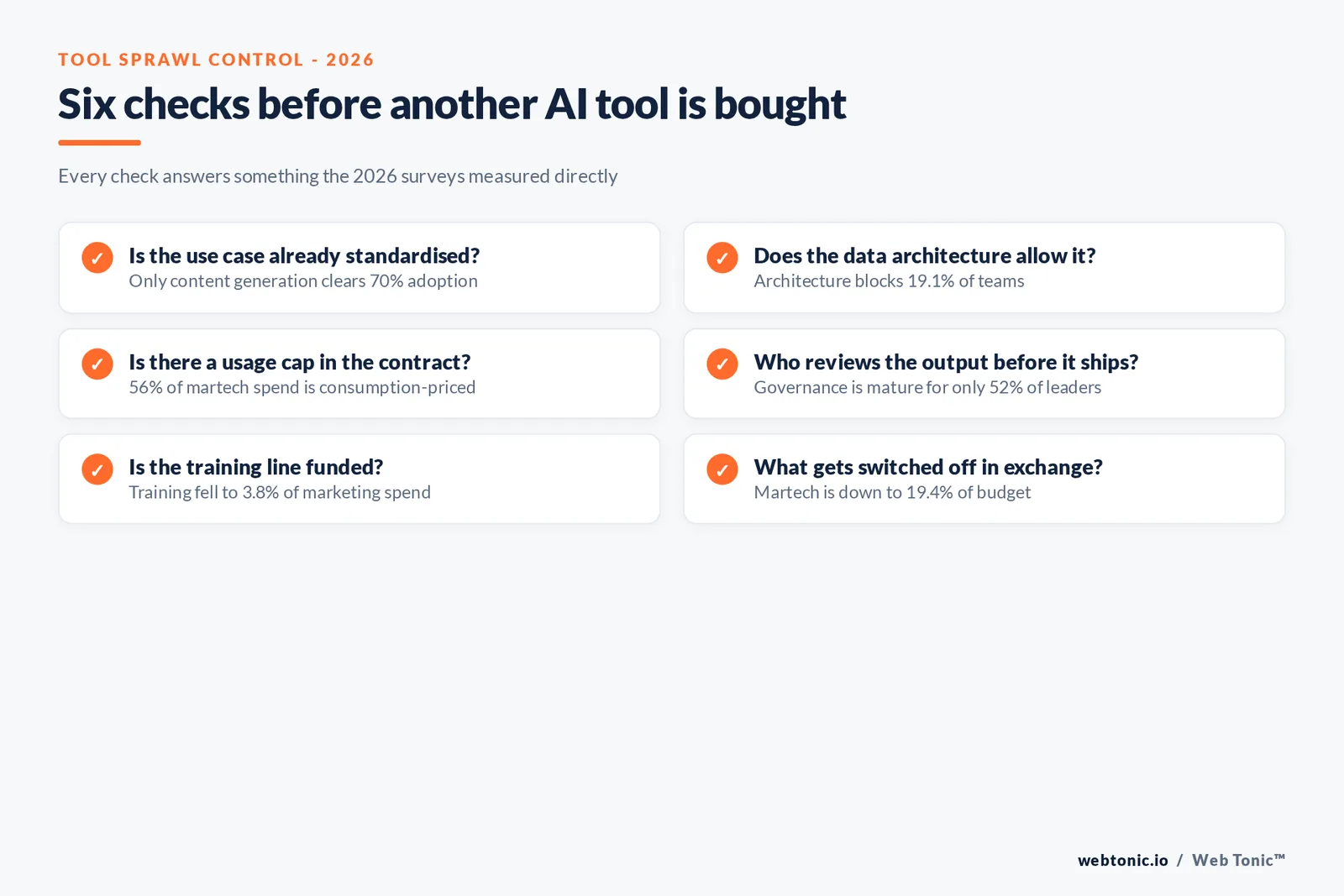
Cap consumption while 56% of martech spend is usage-priced. Retire one tool for every tool added while the line sits at 19.4%. Fund training above 3.8% of spend because skill gaps block 35.7% of teams. Document one use case while governance is mature for only 52%. Then revisit the projected 55.9% as an intention to be tested.
That is five decisions, all sourced. If you want them mapped onto your own stack, send us your current tool list and reporting pack.
Related reading
- Growth Consulting Statistics: Adoption and Tooling in 2026
- Marketing KPI Scorecard Statistics: Adoption and Tooling
- AI Marketing Advisory / AI Readiness — Tooling & Template Checklist
- Marketing Strategy Consulting services at Web Tonic
Frequently Asked Questions
Why is AI adoption stalling on tooling rather than ambition?
Because the stack it has to run on is being squeezed. Gartner's 2026 CMO Spend Survey puts martech at 19.4% of marketing budget, a five-year low against 26.6% in 2021, with only 9% of stacks described as fully AI-optimised. Meanwhile The CMO Survey's martech capability self-ratings top out at 4.9 out of 7 for vendor selection and 4.8 for systems integration - nothing scores above 5.
What does consumption-based martech pricing change?
It changes who controls the invoice. Gartner reports 56% of martech spend moving to consumption-based pricing against 9% cutting, with 41% of CMOs adding usage controls and 24% overhauling systems. Generative workloads scale with usage, so a successful pilot can produce an unbudgeted bill unless a cap is written into the contract before the rollout.
How much of marketing work is AI actually doing in 2026?
The CMO Survey 2026 reports AI covering 24.2% of marketing activities, up from 13.1% a year earlier, with generative AI at 22.4% against 7.0% - a 220% rise - and 55.9% projected within three years. Content generation leads use cases at 73.9%, then personalisation 65.4%, automation 48.9%, data analysis 46.3% and targeting 45.2%.
What stops AI output from becoming slop?
A review step with a named owner. The Content Marketing Institute's 2026 B2B research finds 97% of organisations have a content strategy but only 52% of top performers call their governance mature, with challenges ranked prompting action 40%, resources 39%, measurement 33%, quality 28% and differentiation 24%. High AI usage plus weak governance is how volume arrives faster than anyone can check it.
Should tooling or training get the next dollar?
Training, on the published evidence. The CMO Survey names AI knowledge and skill gaps as the top barrier for 35.7% of marketers while training spend fell to 3.8% of marketing spend from 5.8%, and the training capability self-rating sits at 3.9 out of 7. Another licence does not close a skill gap that the same survey says is the binding constraint.
Sources
Gartner 2026 CMO Spend Survey via Chief Marketer
The CMO Survey - Highlights and Insights Report 2026
HubSpot - State of Marketing
RSW/US - 2026 New Year Outlook Report
Content Marketing Institute - B2B Content Marketing Trends 2026
Constant Contact - Small Business Now Report, Q1 2026


