Table of contents
AI copywriting tools are software assistants that draft, rewrite and scale marketing copy from a prompt, a brief or a product feed. They are excellent first-draft engines and weak final editors — the value comes from the workflow you wrap around them.
Key Takeaways
- Entry paid plans for mainstream writing tools cluster between $12 and $59 per seat per month, with team tiers running well past $100 per month.
- Google's guidance is output-based, not tool-based: AI-assisted content ranks fine if it is helpful, and automation aimed purely at manipulating rankings violates spam policy.
- 7 of the 9 tools reviewed here ship a free tier or free trial, so a two-week bake-off costs nothing but your time.
- Budget 25-45 minutes of human editing per 1,000 AI-drafted words for facts, claims and brand voice — that edit pass is where quality is won.
- The highest-ROI use cases are repetitive and structured: product descriptions, ad variants, meta descriptions and email subject lines.
What AI copywriting tools actually do
Every tool in this category sits on top of a large language model and adds three things: templates, a brand-voice layer, and a place to store and reuse outputs. The underlying models predict text token by token from a prompt, a mechanic documented in OpenAI's text generation guide and first demonstrated at scale in the 2020 GPT-3 paper. That single fact explains both the strength and the failure mode: fluent prose, unreliable facts.
So the useful comparison is not "which tool writes best" — the base models are close. It is which tool fits the job you repeat every week.
| Job to be done | What the tool is good at | What still needs a human | Realistic time saved |
|---|---|---|---|
| Long-form blog drafts | Outlines, section drafts, transitions | Original data, examples, claims | 30-50% |
| Product descriptions | Bulk generation from attributes | Spec accuracy, compliance wording | 60-80% |
| Ad copy variants | 20+ headline and description options | Offer logic, legal claims | 50-70% |
| Email sequences | Structure, subject-line sets | Segmentation, personal proof | 40-60% |
| Social captions | Repurposing one asset into many | Timeliness, community tone | 50-65% |
| SEO briefs and meta tags | Meta description generator, entity coverage | Search intent judgement | 35-55% |
The 9 AI copywriting tools worth shortlisting
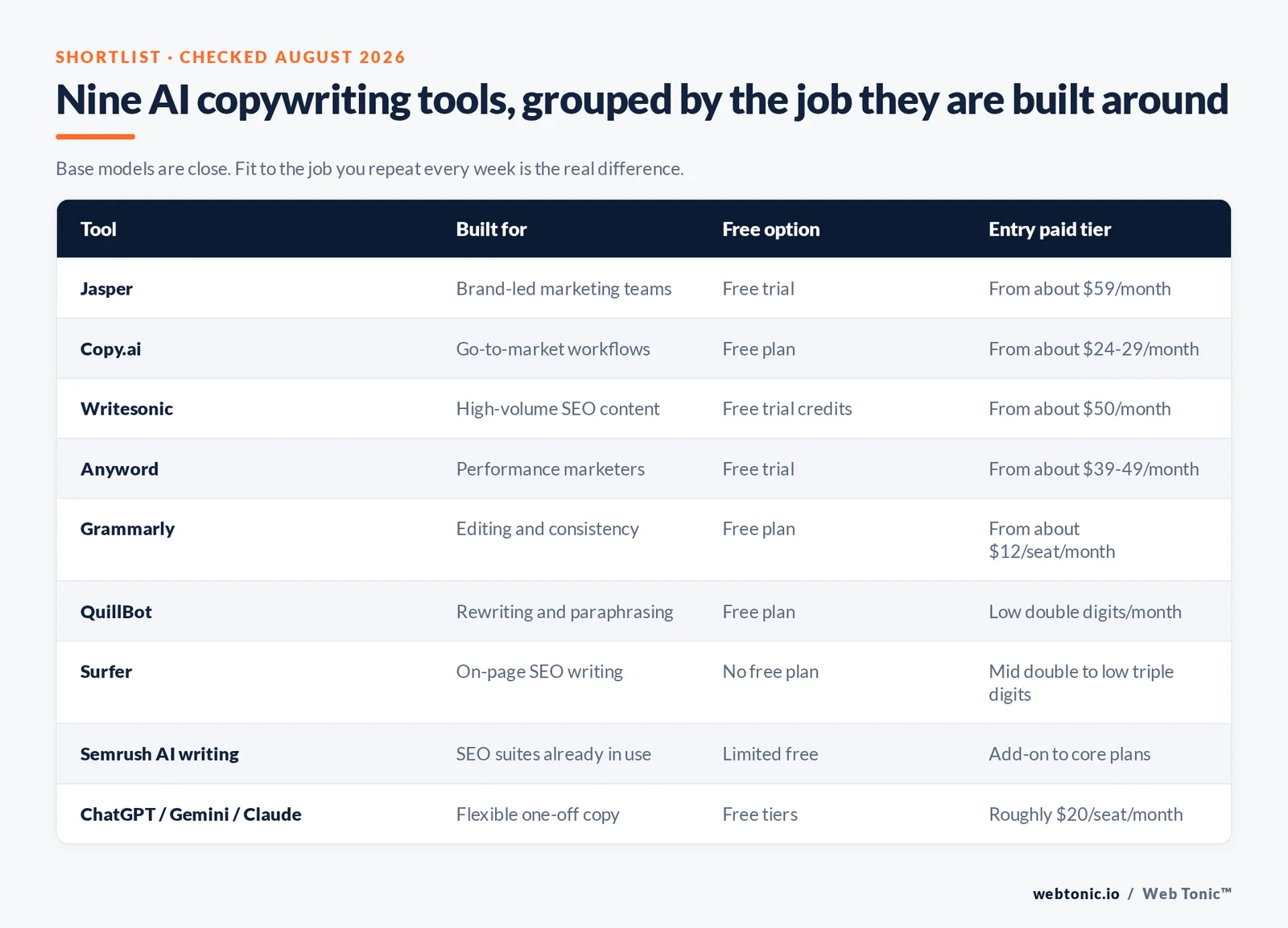
We grouped the market by the job each tool is built around rather than by a ranked league table, because "best copywriting tool" changes entirely depending on whether you publish 4 blog posts a month or 4,000 product descriptions a quarter.
| Tool | Built for | Standout feature | Free option | Entry paid tier (checked Aug 2026) |
|---|---|---|---|---|
| Jasper | Brand-led marketing teams | Brand voice training across campaigns | Free trial | From about $59/month |
| Copy.ai | Go-to-market workflows | Multi-step workflow automation | Free plan | From about $24-29/month |
| Writesonic | High-volume SEO content | Long form blog generation plus SEO checks | Free trial credits | From about $50/month |
| Anyword | Performance marketers | Predictive performance scores per variant | Free trial | From about $39-49/month |
| Grammarly | Editing and consistency | Real time rewrite and tone control | Free plan | From about $12/seat/month |
| QuillBot | Rewriting and paraphrasing | Paraphrase modes and summarizer | Free plan | Low double digits per month |
| Surfer | On-page SEO writing | Term coverage scoring inside the editor | No free plan | Mid double to low triple digits |
| Semrush AI writing | SEO suites already in use | Keyword data feeding the brief | Limited free | Add-on to core plans |
| General assistants (ChatGPT, Gemini, Claude) | Flexible one-off copy | Best raw reasoning, no templates | Free tiers | Roughly $20/seat/month |
Vendor pricing changes monthly — treat the column above as a directional benchmark and confirm on the vendor page before you buy. Broader adoption context sits in Statista's AI market overview.
Free vs paid: what the free plans really cap
Free tiers are genuinely useful for testing, but every one of them limits the thing that matters once you scale: words, seats or brand memory.
| Constraint | Typical free plan | Typical paid plan | When it forces the upgrade |
|---|---|---|---|
| Monthly word or credit cap | A few thousand words | Unlimited or 100k+ | Past 4 long-form pieces a month |
| Brand voice memory | None | Saved voice profiles | More than 2 writers on one brand |
| Seats | 1 | 3-20 included | Any review workflow |
| Integrations (CMS, docs, ads) | Rare | Standard | Publishing weekly at volume |
| Bulk generation | No | CSV or feed import | Above 50 product descriptions |
How to choose: 6 evaluation criteria that predict satisfaction
Run the same brief through every shortlisted tool and score it. A two-week bake-off with real briefs beats any review roundup, including this one.
| Criterion | Test to run | Weight | Red flag |
|---|---|---|---|
| Criterion 1 — Output quality | Same brief, 3 drafts, blind-rate them | 30% | Generic openers, repeated phrasing |
| Criterion 2 — Brand voice control | Feed 5 approved pages, ask for a 6th | 20% | Voice resets between sessions |
| Criterion 3 — Factual grounding | Ask for 5 stats with sources | 20% | Confident citations that do not exist |
| Criterion 4 — Workflow fit | Push one draft to your CMS | 15% | Copy-paste only, no API |
| Criterion 5 — Speed at volume | Generate 25 variants at once | 10% | Manual one-at-a-time prompts |
| Criterion 6 — Total cost | Seats x months x overage | 5% | Credit overages priced per word |
AI copy and SEO: what Google actually says
Google's position is about quality, not authorship. Its helpful content guidance and the search team's statement on AI-generated content make the rule plain: automation used primarily to manipulate rankings is spam, while AI-assisted content that demonstrably helps people is fine.
| Practice | Risk level | Why | Safer alternative |
|---|---|---|---|
| Publishing unedited drafts at scale | High | Scaled content abuse, thin pages | Fewer pages, edited and sourced |
| AI-generated stats without checks | High | Fabricated figures damage trust | Verify every number against a primary source |
| AI outlines and first drafts | Low | Human owns claims and structure | Keep an editor in the loop |
| Meta description generation | Low | Short, checkable, low claim risk | Review length and keyword fit |
| Bulk spinning of existing pages | High | Near-duplicate, no added value | Consolidate and genuinely improve |
If you want the mechanics of how those pages get discovered in the first place, Google's SEO starter guide is still the cleanest primer, and our growth marketing team treats it as the baseline for every content programme.
Legal and disclosure limits worth knowing
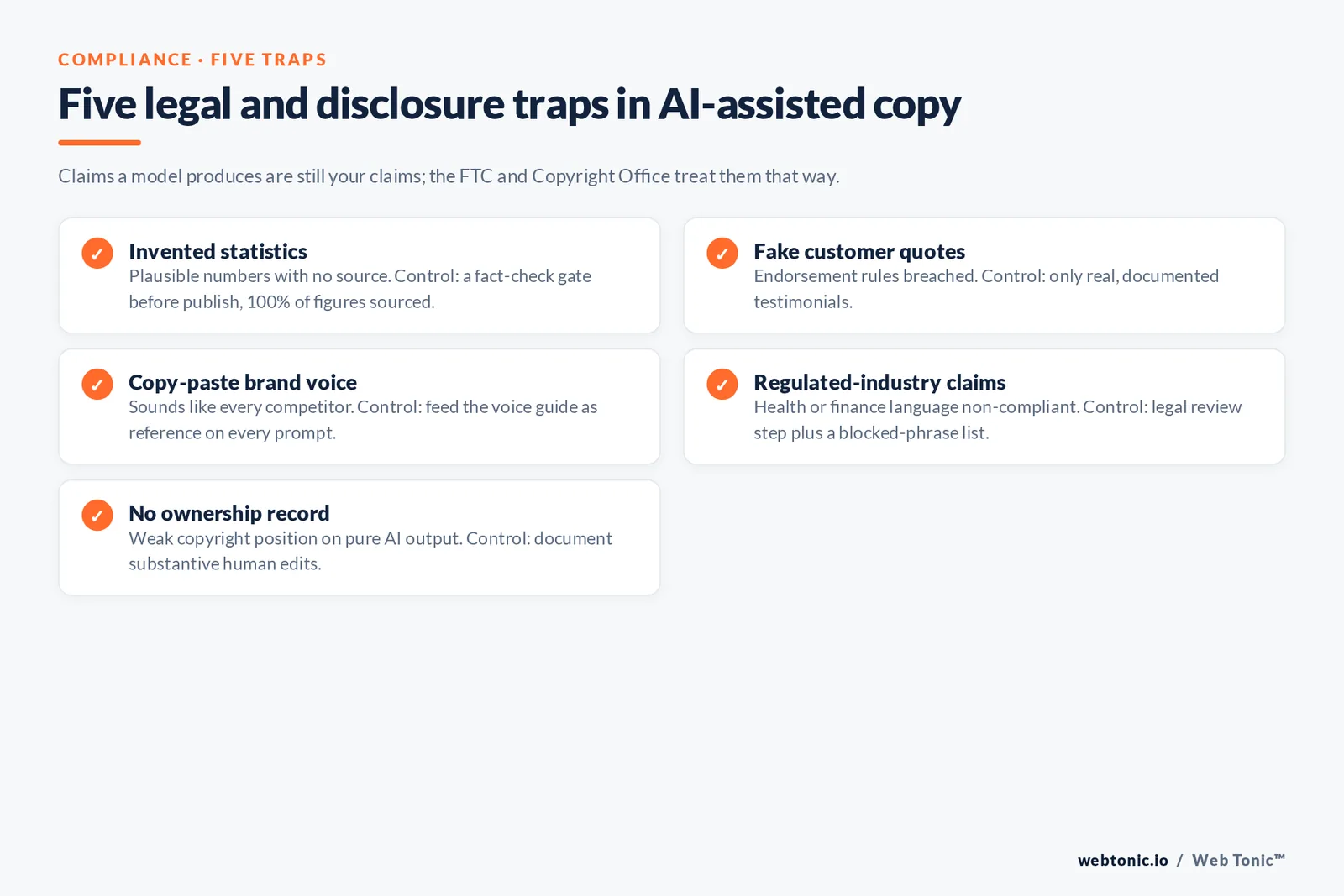
Two constraints trip teams up. First, advertising claims produced by a model are still your claims: the FTC's endorsement guidance applies to AI-assisted testimonials and reviews exactly as it does to human-written ones. Second, US copyright registration requires human authorship, a position set out in the Copyright Office's AI initiative materials.
| Trap | What goes wrong | Control that fixes it |
|---|---|---|
| Trap 1 — Invented statistics | Plausible numbers with no source | Fact-check gate before publish; 100% of figures sourced |
| Trap 2 — Fake customer quotes | Endorsement rules breached | Only real, documented testimonials |
| Trap 3 — Copy-paste brand voice | Sounds like every competitor | Voice guide fed as reference on every prompt |
| Trap 4 — Regulated-industry claims | Health or finance language non-compliant | Legal review step, blocked-phrase list |
| Trap 5 — No ownership record | Weak copyright position on pure AI output | Document substantive human edits |
A 5-step workflow that makes AI copy publishable
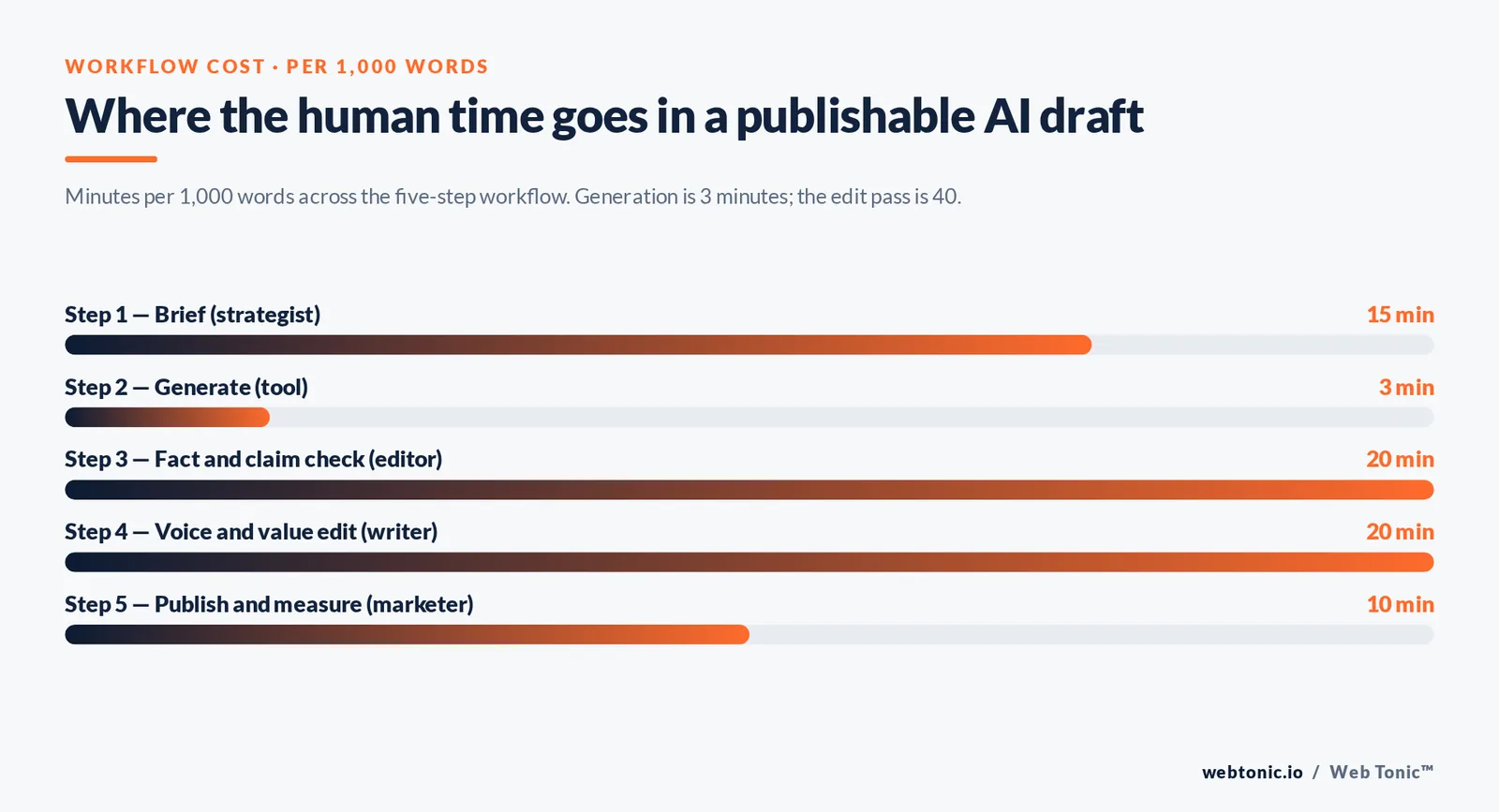
Tools do not fix process. This is the sequence we run for client content, and it is why the edit pass is budgeted, not improvised.
| Step | Action | Owner | Time per 1,000 words |
|---|---|---|---|
| Step 1 — Brief | Intent, audience, outline, must-cite sources | Strategist | 15 min |
| Step 2 — Generate | Draft sections with brand voice reference | Tool | 3 min |
| Step 3 — Fact and claim check | Verify every figure and link | Editor | 20 min |
| Step 4 — Voice and value edit | Add examples, cut filler, tighten openers | Writer | 20 min |
| Step 5 — Publish and measure | Ship, then track rankings and conversions | Marketer | 10 min |
Which tool by team type
Match the tool to the constraint you actually have — seats, volume or performance measurement.
| Team | Main constraint | Best-fit category | Monthly budget guide |
|---|---|---|---|
| Solo founder | Time and cash | General assistant plus free editor | $0-20 |
| Small in-house team (2-5) | Consistency | Brand-voice platform | $40-120 |
| Ecommerce (1,000+ SKUs) | Volume | Bulk product-description generation | $50-200 |
| Performance/paid team | Variant testing | Predictive scoring tool | $40-150 |
| SEO team | Term coverage | SEO writing editor | $90-300 |
| Agency | Multi-brand voices | Platform with workspaces plus API | $200+ |
Agencies usually need the API tier, because campaign copy has to flow into ad platforms and CMS templates without a human pasting it. That plumbing is what our performance creative and data intelligence teams build, and it is where the real savings appear.
Prompting patterns that lift output quality
The gap between mediocre and usable output is mostly prompt structure. These five patterns are worth standardising as saved templates.
| Pattern | Prompt shape | Why it works |
|---|---|---|
| Pattern 1 — Role plus constraint | "You are a B2B copywriter. Max 90 words. No adjectives stacked." | Cuts filler by roughly 1 in 4 words |
| Pattern 2 — Reference-first | Paste 3 approved examples, then ask for a 4th | Anchors voice without training |
| Pattern 3 — Structured input | Feed attributes as a table or JSON | Removes invented specs |
| Pattern 4 — Variant matrix | "10 headlines: 3 benefit, 3 curiosity, 4 objection" | Forces angle diversity for testing |
| Pattern 5 — Critic pass | "List 5 weaknesses in the draft, then rewrite" | Self-review beats one-shot output |
Feature and pricing matrix: brand voice, long form content, free plans
Marketers ask two questions about every AI copywriting tool: can it hold a brand voice, and what does the free plan really allow? This matrix answers both across the best copywriting tools in the market, with pricing read from each vendor's pricing page.
| Copywriting tool | Brand voice training | Long form content | SEO features | Free plan or free trial | Pricing signal |
|---|---|---|---|---|---|
| Jasper | Yes — brand voice consistency across campaigns | Long form blog posts | SEO add-on | Start free trial | Pricing: starter plan upward |
| Copy.ai | Yes — brand voice per workspace | Long form content workflows | Limited | Pricing free plan | Pricing: free plan, then paid tiers |
| Writesonic | Brand voice profiles | Long form blog generator | Content for search engines | Pricing free trial | Credit-based pricing |
| Anyword | Brand voice plus predictive scores | Marketing copy, some long form | Ad and landing focus | Free trial | Per-seat pricing |
| Grammarly | Tone and style guide | Editing, not generation | None | Free plan | Lowest per-seat pricing |
| QuillBot | Tone modes | Rewriting long documents | None | Free plan | Cheap annual pricing |
| Surfer | Guidelines only | Long form blog editor | Best-in-class term coverage | No free plan | Higher pricing tier |
| General AI assistants | Prompt-based voice only | Any length | Manual | Free tier | Flat seat pricing |
3 features separate a real copywriting tool from a chat window: saved brand voice, bulk generation, and a place where content lives after it is created. If a tool lacks all three, a free general assistant will do the same job for less.
What to generate with each tool: 12 high-value copy assets
These are the assets where AI copywriting tools help most, ranked by how reliably the output survives editing. Product descriptions, social media captions and a meta description generator are the fastest wins; brand storytelling is the slowest.
| Copy asset | Best tool type | Prompt input to provide | Edit effort |
|---|---|---|---|
| Product descriptions | Bulk generator with feed import | Attributes, audience, tone | Low |
| Social media captions | Template-based tool | Asset, platform, call to action | Low |
| Meta descriptions | Meta description generator | Target keyword, page promise | Low |
| Email subject lines | Variant generator | Offer, segment, past winners | Low |
| Google Ads headlines | Predictive scoring tool | Keyword, offer, character limit | Medium |
| Long form blog posts | Long form content editor | Outline, sources, brand voice | High |
| Landing page copy | Brand voice platform | Offer, objections, proof | High |
| Sales emails | Workflow tool | ICP, trigger, next step | Medium |
| Video and Reels scripts | General assistant | Hook, length, platform | Medium |
| Category and collection pages | SEO writing editor | Keyword cluster, internal links | Medium |
| Press and PR boilerplate | Brand voice platform | Facts, quotes, approvals | High |
| Brand storytelling | Human first, AI to polish | Founder interview transcript | Very high |
Writer's block is the underrated use case: a tool that produces 10 mediocre openers in 30 seconds gets a writer moving faster than a blank page ever will. High quality content still comes from the human pass that follows.
Cost comparison: AI tools vs freelancers vs agency
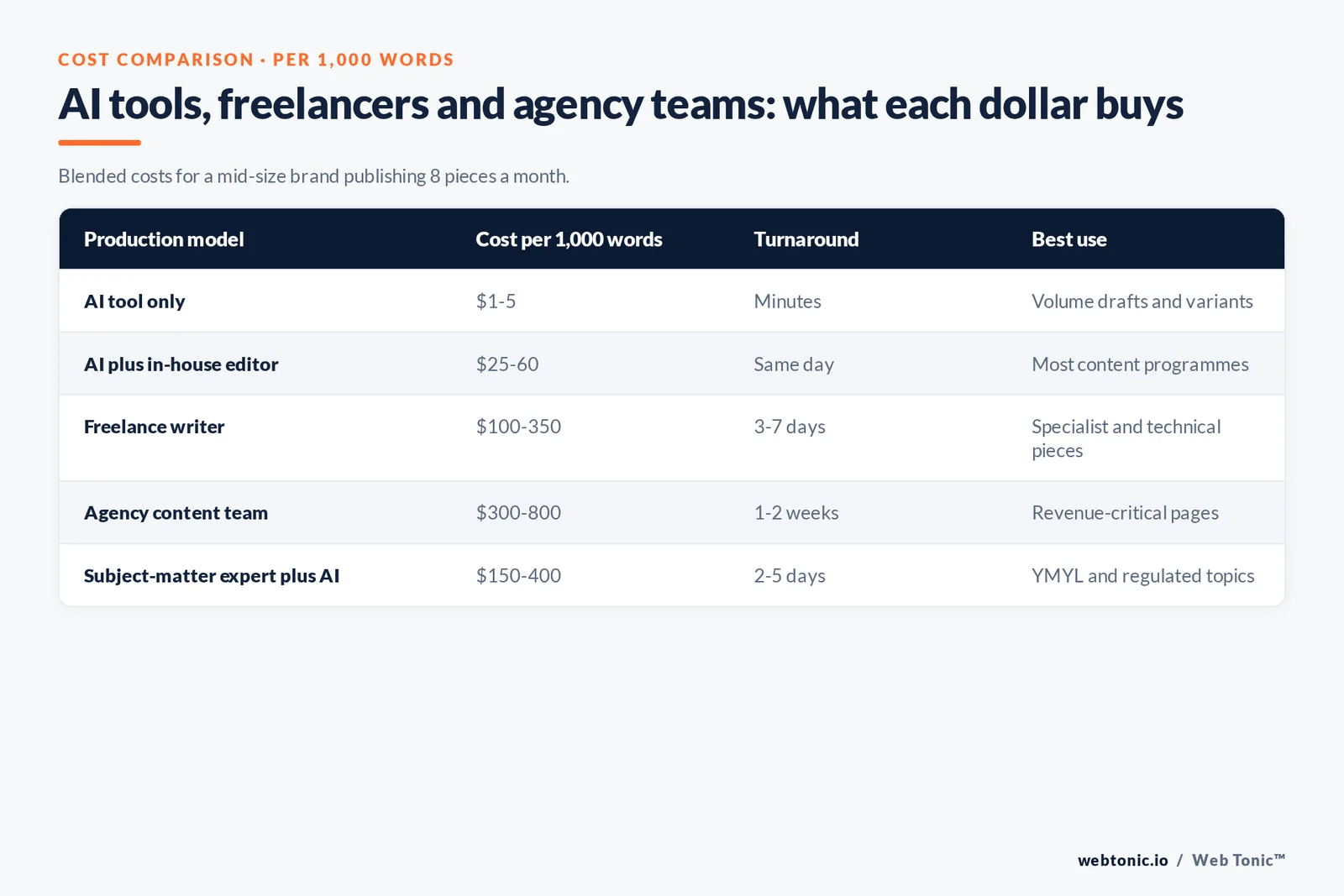
The honest framing is not "AI instead of writers" but "where does each dollar of copy production go". Blended costs for a mid-size brand publishing 8 pieces a month look like this.
| Production model | Typical cost per 1,000 words | Turnaround | Strategy included | Best use |
|---|---|---|---|---|
| AI tool only | $1-5 | Minutes | No | Volume drafts, variants |
| AI plus in-house editor | $25-60 | Same day | Partly | Most content programmes |
| Freelance writer | $100-350 | 3-7 days | Rarely | Specialist and technical pieces |
| Agency content team | $300-800 | 1-2 weeks | Yes | Revenue-critical pages |
| Subject-matter expert plus AI | $150-400 | 2-5 days | Partly | YMYL and regulated topics |
Rule 1: never route your top 10 revenue pages through the cheapest model. Rule 2: never hand-write the 300 product descriptions that a feed can generate in an afternoon. Mixing the two models is how content teams get both margin and quality, which is the operating logic behind our service stack.
How to measure whether AI copy is working
Word count is not an outcome. These are the five metrics that tell you whether the tool earned its subscription, tracked before and after adoption.
| Metric | How to measure | Healthy signal after 90 days | Warning signal |
|---|---|---|---|
| Publishing throughput | Pieces shipped per month | Up 40-100% at equal headcount | Volume up, engagement down |
| Editing ratio | Minutes edited per 1,000 words | Falling toward 25 min | Rising above 60 min |
| Organic entrances per piece | Analytics, 90-day cohort | Flat or up per piece | Down 30%+ per piece |
| Ad copy win rate | Share of AI variants beating control | 1 in 5 variants wins | No winners in 20 tests |
| Conversion rate on new pages | Goal completions per session | Within 10% of human-written pages | Consistently lower |
If throughput rises while organic entrances per piece collapse, you have a scaled-thin-content problem, not a tooling problem — cut volume and reinvest the hours in research.
FAQ
What are the best AI copywriting tools in 2026?
There is no single winner. For brand-led teams Jasper and Copy.ai lead on voice and workflow; for SEO volume Writesonic and Surfer-style editors fit better; for ad testing Anyword's predictive scores are the differentiator; and general assistants such as ChatGPT, Gemini and Claude cover one-off copy cheaply. Shortlist three, run the same brief through each and score the drafts.
Which AI copywriting tools are free?
Most vendors ship either a free plan or a free trial, including Copy.ai, Grammarly and QuillBot on free tiers, plus trial credits from Jasper, Writesonic and Anyword. Free plans typically cap you at a few thousand words a month, one seat and no saved brand voice, which is enough to evaluate but not to run a content programme.
Will Google penalise AI-written content?
Not for using AI. Google evaluates the page, not the tool: helpful, original, well-sourced content is eligible to rank, while content generated at scale primarily to game rankings is treated as spam. The practical safeguard is an editing and fact-checking pass before every publish.
How much do AI copywriting tools cost?
Entry paid tiers generally land between about $12 and $59 per seat per month, with team and API plans running from roughly $100 to several hundred per month. Watch credit overages, which are where high-volume ecommerce teams get surprised.
Can AI replace a copywriter?
No, and the economics explain why. AI compresses drafting time by 30-80% depending on the format, but strategy, original research, offer design and claim accuracy still need a human. Teams that cut editors saw quality drop; teams that redeployed writers into editing and research got the gain.
Sources
OpenAI text generation guide · Brown et al., Language Models are Few-Shot Learners (arXiv, 2020) · Google Search Central: creating helpful content; Google Search and AI-generated content; SEO starter guide · FTC Endorsement Guides FAQ · US Copyright Office AI initiative · Statista AI market overview · Vendor pricing pages: Jasper, Copy.ai, Writesonic, Anyword, Grammarly, Semrush (checked August 2026).