Table of contents
AgileSherpas has run the same marketer survey for nine years, and its 2026 edition shows a discipline with almost uniformly positive outcomes and almost flat adoption. Twenty-five percent of marketers currently practice Agile marketing, per 430 respondents across 24 countries, while the software side of Agile, tracked separately by Digital.ai, is dealing with its own AI-driven inflection point. Both datasets are compared here on their own terms.
Key Takeaways
- 25% of marketers currently practice Agile marketing, per AgileSherpas' 9th Annual State of Agile Marketing Report (430 respondents, 24 countries, Dec 2025-Feb 2026).
- 25% are past users, 27% have never used it, and 23% do not know what Agile marketing is.
- 47% of current Agile users describe themselves as only "somewhat Agile".
- Among current users, 76% work where more than half their marketing org is also Agile.
- Agile marketing teams are 3x more likely to have AI fully integrated: 39% versus 13% for non-Agile teams.
- In the full 2026 dataset, no non-Agile team reported full AI integration.
- 87% of Agile marketers report higher productivity; 77% report lower stress.
- 95% of Agile marketers call the experience very positive; the rest call it neutral.
- 98% of current Agile marketers rate their implementation successful, the 4th straight year in the high nineties.
- Agile marketers are 1.5x more likely to become true strategic partners to the business.
- 92% of all marketers, Agile and non-Agile alike, report collaboration challenges.
- 82% of marketers overall believe they create strategic value rather than just take orders; only 37% of non-Agile marketers say their team actively shapes strategy.
- Adoption has climbed from 37% of marketing teams using an Agile process in the 1st Annual Report (2018) to today's landscape.
- On the software side, Digital.ai's 18th State of Agile Report found AI tool adoption jump from 68% to 84% year over year.
- Only 49% of software organizations have AI governance guardrails in place.
- 76% of software organizations report increased ROI scrutiny on Agile investment.
Adoption has plateaued near one in four, not climbed toward the majority
AgileSherpas' 9th Annual State of Agile Marketing Report, surveying 430 marketers across North America, Latin America, Europe and Asia between December 2025 and February 2026, splits the market four ways: 25% currently practice Agile marketing, 25% used to and stopped, 27% have never used it, and 23% do not know what it is. Nine years into the discipline's own longitudinal study, roughly half the market still has not adopted, and a meaningful share has tried and walked away.
The report's own 2026 deep dive names the likely cause: 47% of current Agile users call themselves only "somewhat Agile," running individual practices like sprints or a Kanban board without building the full operating model. Partial adoption produces partial, harder-to- defend results, which slows the case for full commitment even inside teams that have already started.
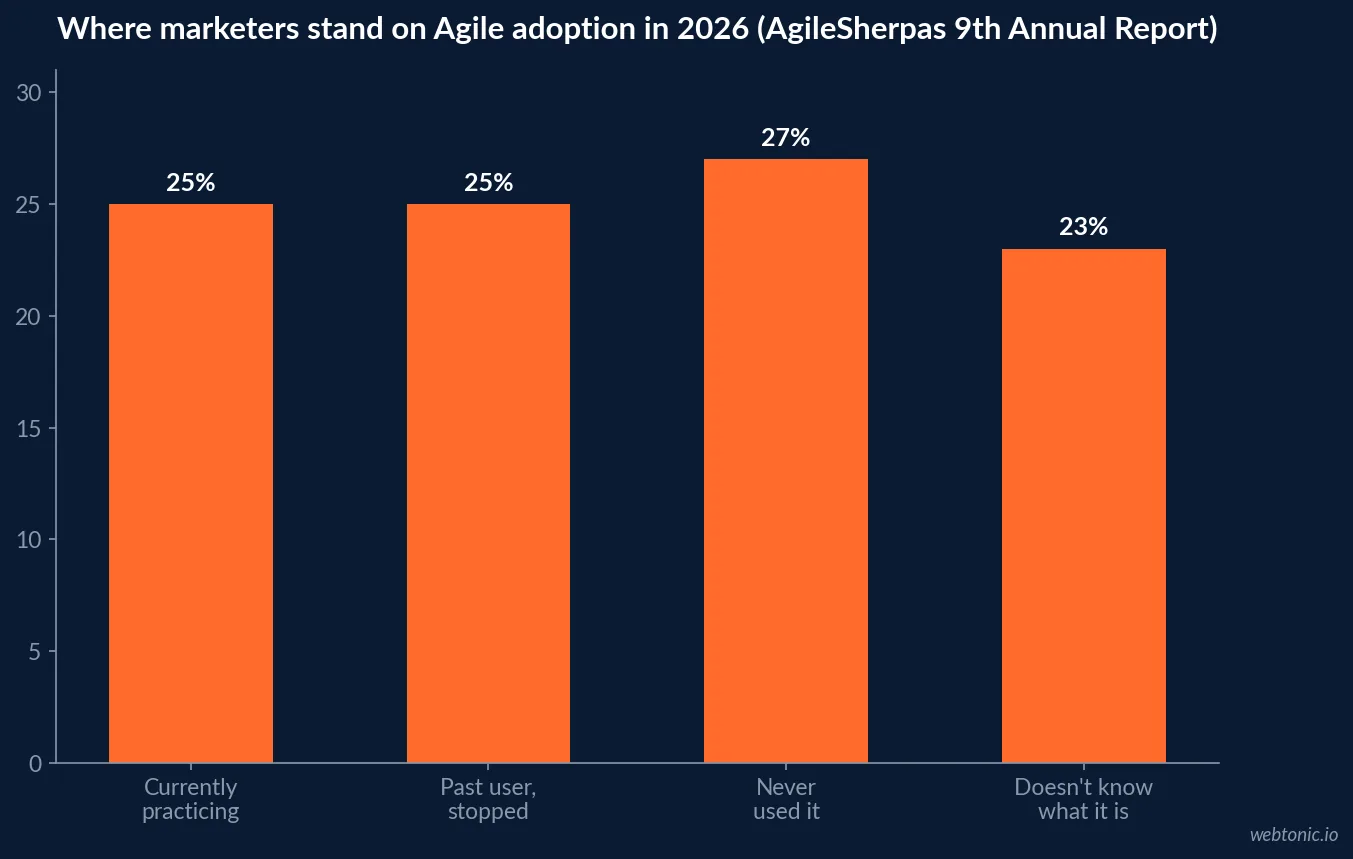
| Agile marketing status (2026) | Share of marketers | Source |
|---|---|---|
| Currently practicing | 25% | AgileSherpas 9th Annual Report |
| Past user, since stopped | 25% | AgileSherpas 9th Annual Report |
| Never used it | 27% | AgileSherpas 9th Annual Report |
| Does not know what it is | 23% | AgileSherpas 9th Annual Report |
| Of current users, self-rated only "somewhat Agile" | 47% | AgileSherpas 2026 deep dive |
| Marketing teams using an Agile process, 1st Annual Report (2018) | 37% | AgileSherpas |
Where Agile marketing pays off: AI, productivity and stress
The clearest 2026 finding is the AI gap. AgileSherpas found Agile marketing teams are three times more likely to have AI fully integrated into their processes than non-Agile teams, 39% versus 13%, and in the full 430-response dataset, not one non-Agile team reported full AI integration. On operational outcomes, 87% of Agile marketers report higher productivity and 77% report lower stress, and Agile marketers are 1.5x more likely to be seen as true strategic partners inside their organization rather than an execution team taking orders.
Experience data backs the operational numbers: 95% of Agile marketers describe the experience as very positive, with the remaining 5% calling it neutral rather than negative, and 98% of current Agile marketers rate their own implementation as successful, the fourth consecutive year that figure has landed in the high nineties.
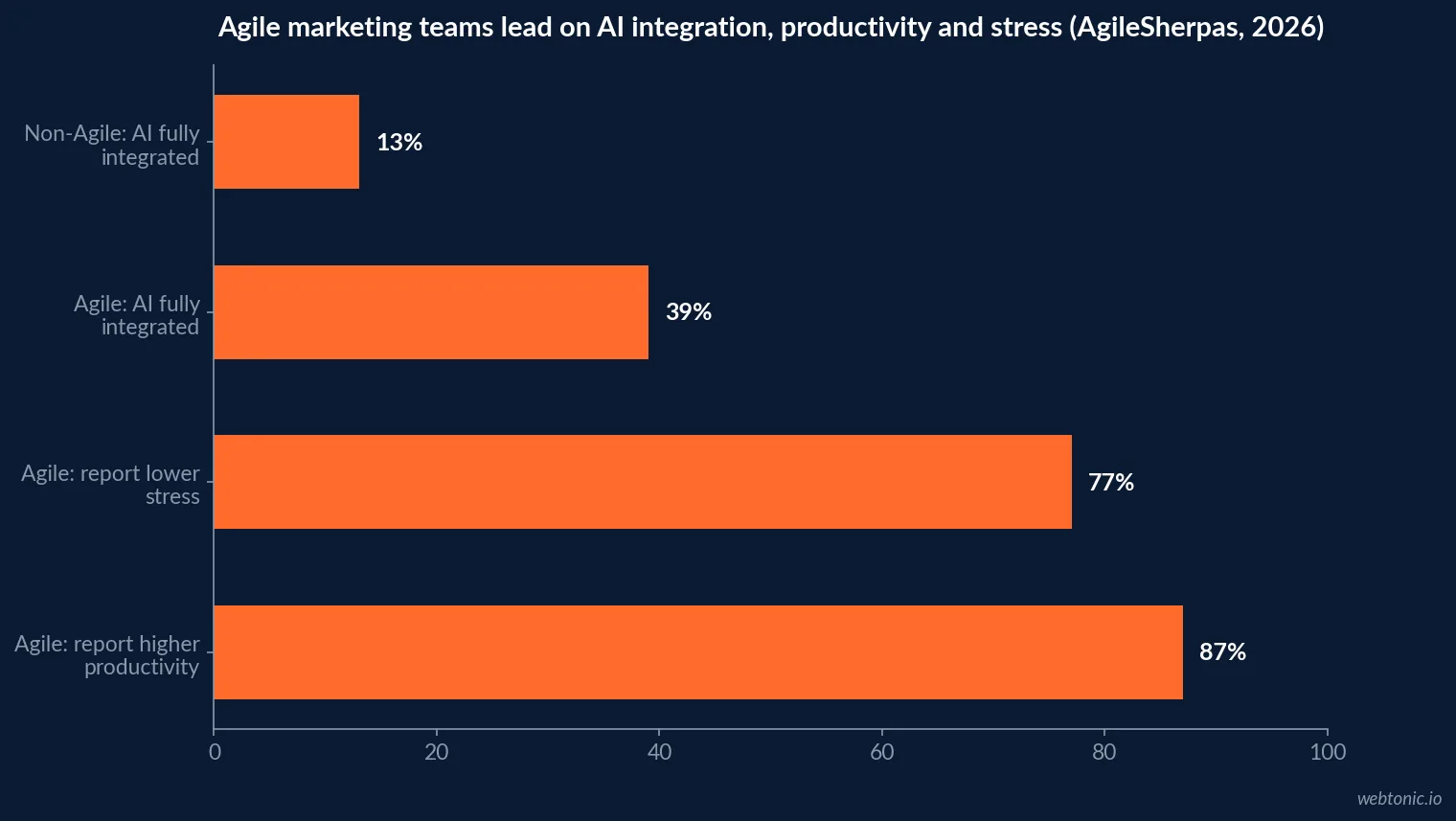
| Outcome metric (AgileSherpas, 2026) | Agile marketers | Non-Agile marketers |
|---|---|---|
| AI fully integrated into processes | 39% | 13% |
| Report higher productivity | 87% | Not separately reported |
| Report lower stress | 77% | Not separately reported |
| Rate implementation successful | 98% | Not applicable |
| Actively shape organizational strategy | Majority, per report framing | 37% |
The collaboration problem neither camp has solved
Agile marketing is not a fix for every organizational friction. 92% of all marketers, Agile and non-Agile alike, report collaboration challenges in AgileSherpas' 2026 data — nearly universal. What differs is the nature of the friction: Agile teams' collaboration problems tend to center on cross-functional handoffs at scale, while non-Agile teams' problems concentrate on basic prioritization and stakeholder alignment. 82% of marketers overall believe they create strategic value for the business rather than just executing requests, but only 37% of non-Agile marketers say their team actively helps set organizational strategy, against a clear majority of Agile marketers who say the same.
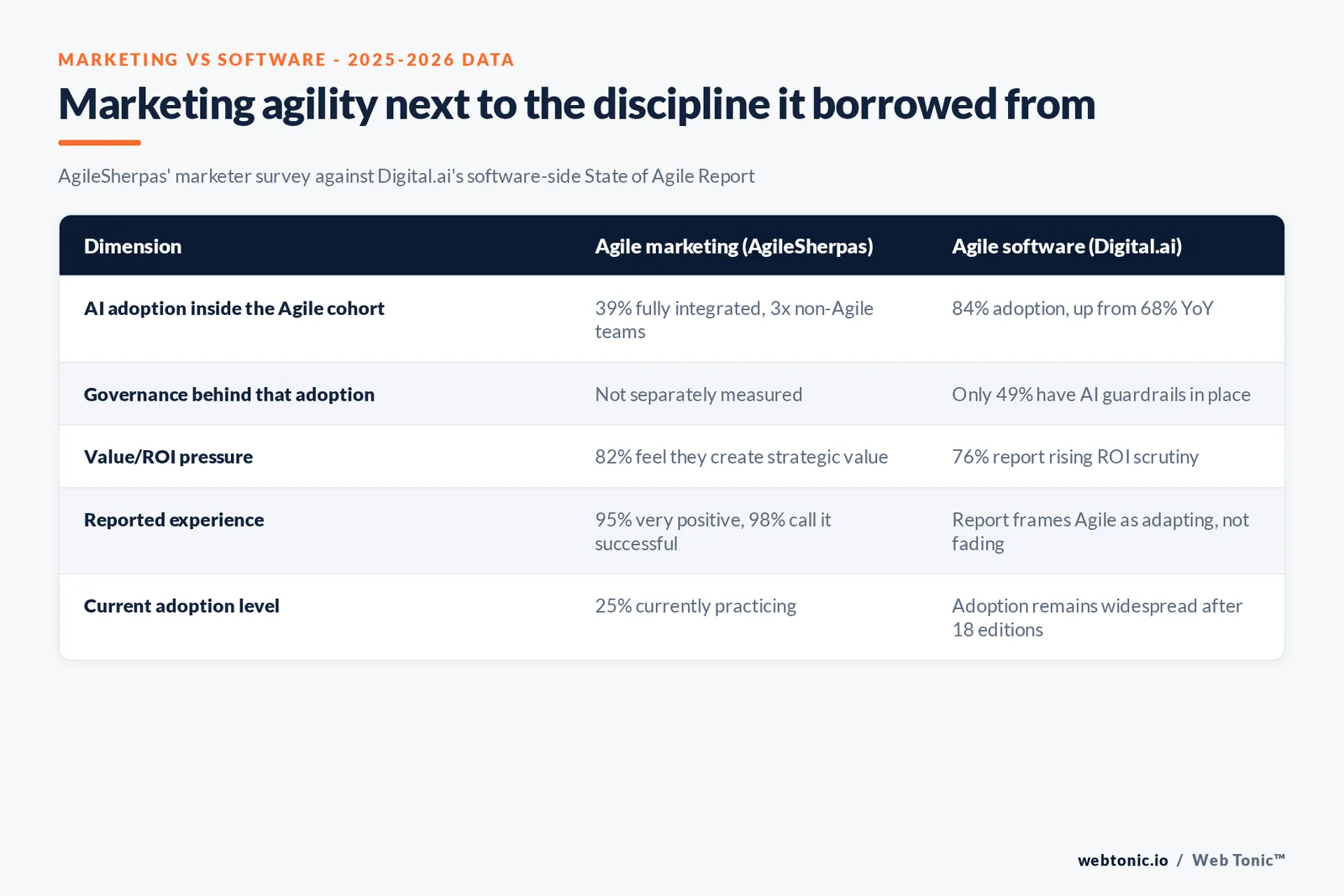
What marketing agility looks like next to the discipline it borrowed from
Marketing did not invent the Agile vocabulary, and comparing notes with the software side is instructive. Digital.ai's 18th annual State of Agile Report, the world's longest- running Agile benchmark, found AI tool adoption in software delivery jumped from 68% to 84% year over year, but only 49% of organizations have governance guardrails in place for that AI use, and 76% report increased scrutiny on the ROI of Agile investment generally. That is a strikingly similar shape to marketing's own 2026 data: fast AI adoption inside the Agile cohort, thinner governance behind it, and a rising bar for proving the investment was worth it.
The practical read for a CMO evaluating Agile marketing in 2026: the outcome data (productivity, stress, AI readiness, strategic standing) has been consistently strong for nine straight survey years, but the adoption data has not moved nearly as fast, and the reason both AgileSherpas and Digital.ai point to is the same one — partial, un-governed adoption dilutes results enough to keep the business case from closing itself.
| Dimension | Marketing agility (AgileSherpas 2026) | Software agility (Digital.ai 18th Report) |
|---|---|---|
| AI adoption inside Agile cohort | 39% fully integrated (3x non-Agile) | 84% adoption, up from 68% |
| Governance maturity | Not separately measured | Only 49% have AI guardrails |
| ROI/value scrutiny | 82% feel they create strategic value | 76% report rising ROI scrutiny |
| Reported experience | 95% very positive, 98% call implementation successful | Report frames Agile as adapting, not fading |
The framework fight has quietly ended in a tie
AgileSherpas' own 7th Annual State of Agile Marketing Report, surveying 381 marketers in early 2024, found that for the first time in the study's history, hybrid frameworks were not the single most popular choice: Kanban, Scrum and bespoke hybrids landed in a near-tie, with Lean close behind. That shift away from build-your-own hybrids toward known-quantity frameworks like Kanban and Scrum suggests marketers are borrowing more directly from software Agile as the discipline matures, rather than adapting it beyond recognition the way early adopters did.
The prior year's 8th Annual Report (2025 edition, also 430 marketers) adds a regulatory data point rarely raised in Agile-marketing coverage: despite the common assumption that Agile does not suit highly regulated environments, more than 9 in 10 fully Agile marketers said Agile ways of working made it easier, not harder, to meet regulatory requirements. That same 2025 edition found 66% of Agile marketers reporting lower stress and two-thirds of respondents saying their AI use had specifically enhanced their agility, a bidirectional relationship the 2026 data goes on to confirm at a larger scale.
| Historical AgileSherpas data point | Figure | Report edition |
|---|---|---|
| Frameworks tie for the first time (Kanban, Scrum, Hybrid) | No single most-popular framework | 7th Annual (2024, n=381) |
| Fully Agile marketers saying Agile eased regulatory compliance | >90% | 8th Annual (2025, n=430) |
| Agile marketers reporting lower stress | 66% | 8th Annual (2025, n=430) |
| Respondents saying AI use enhanced their agility | ~67% (two-thirds) | 8th Annual (2025, n=430) |
Agile marketers beat the general market on AI, not just non-Agile peers
CoSchedule's State of AI in Marketing 2025 report, based on 1,005 marketing professionals surveyed in December 2024, found 9 out of 10 marketers plan to ramp up AI integration in 2025, and most teams report productivity, output and quality all rising with AI while team size stays flat, evidence that AI is being absorbed as leverage rather than headcount replacement across the market broadly.
Set against AgileSherpas' 39% full-integration rate for Agile marketing teams, the CoSchedule data implies most of that market-wide AI ramp-up in 2025 is still landing well short of full integration for the typical team. Agile marketing's own deep dive found only 17% of respondents overall would call their AI rollout fully integrated, which lines up with CoSchedule's broader market picture and confirms the Agile cohort's 39% figure is a real gap, not a rounding difference.
| AI-in-marketing metric | Agile marketers (AgileSherpas) | Market-wide (CoSchedule 2025) |
|---|---|---|
| Full AI integration into processes | 39% | 17% overall rollout described as fully integrated |
| Planning to increase AI use | Not separately reported | 9 out of 10 marketers |
| Team size change from AI adoption | Not separately reported | Most report no change in team size |
| Outcome from AI adoption | 3x more likely to have it fully integrated | Productivity, output, quality all rising |
Where to start if adoption has stalled at "somewhat Agile"
The 47%-somewhat-Agile figure is the actionable number in this dataset. Teams already running a sprint calendar or a Kanban board are closer to the full operating model than teams starting from zero, and AgileSherpas' nine years of data consistently show the productivity, stress and strategic-standing gains cluster around fuller adoption, not partial practice. Our growth marketing team builds the operating cadence — sprint planning, backlog prioritization, retro cycles — around live campaign data rather than a generic framework rollout, and our performance creative team runs the testing velocity that makes an Agile marketing calendar worth keeping. If the AI adoption gap is the more urgent problem, our take on building a Google Ads strategy shows where AI-assisted workflows already save the most planning time.
Frequently Asked Questions
How many marketing teams actually use Agile in 2026?
AgileSherpas' 9th Annual State of Agile Marketing Report, surveying 430 marketers worldwide between December 2025 and February 2026, found 25% currently practice Agile marketing, another 25% used to and stopped, 27% have never used it, and 23% do not know what it is. That is a flatter adoption curve than the discipline's nine years of positive outcome data would predict.
If the results are this good, why has adoption stalled near 25%?
AgileSherpas' own deep-dive into the 2026 data flags a partial-adoption problem: 47% of current Agile users describe themselves as only 'somewhat Agile', running a sprint calendar or a Kanban board without building the full operating model. Lack of training has been the top-cited adoption barrier since the first report in 2018, and partial adoption produces partial results, which slows the case for going further.
Does Agile marketing actually help with AI adoption?
The 9th Annual Report's clearest 2026 finding is that it does: Agile marketing teams are three times more likely to have AI fully integrated into their processes than non-Agile teams, 39% versus 13%. In AgileSherpas' full dataset, no non-Agile team reported full AI integration at all.
How does marketing agility compare with agile software development?
Digital.ai's 18th State of Agile Report, the software side's own longest-running benchmark, found 76% of software organizations now face increased ROI scrutiny on Agile investment and AI tool adoption jumped from 68% to 84% year over year, but only 49% have governance guardrails in place for that AI use. Marketing's 2026 data shows a similar AI acceleration with a similar governance lag, just measured on a smaller, more recently agile function.
Is a positive experience with Agile marketing typical, or rare?
Typical, per nine straight years of AgileSherpas data. In the 2026 report, 95% of marketers applying Agile ways of working describe the experience as very positive, with the other 5% calling it neutral. Ninety-eight percent of current Agile marketers separately rate their implementation as successful, the fourth consecutive year that figure has landed in the high nineties.
Sources
AgileSherpas - 9th Annual State of Agile Marketing Report (2026)
AgileSherpas - State of Agile Marketing Report (report hub)
AgileSherpas - The 2026 State of Agile Marketing: a deep dive
AgileSherpas - State of Agile Marketing Reports resource hub
Digital.ai - 18th State of Agile Report press release
Digital.ai - 18th State of Agile Report
CoSchedule - State of AI in Marketing 2025
AgileSherpas - 7th Annual State of Agile Marketing Report (2024)
AgileSherpas - 8th Annual State of Agile Marketing Report (2025, full PDF)