Table of contents

Agentic commerce statistics for 2026 fall into four evidence classes that get quoted as if they were one number: platform telemetry, vendor-reported program data, consumer surveys and analyst forecasts. Shopify's own telemetry shows AI-referred orders up nearly 13x year over year, while forecasts for the category range from USD 20.6 billion to USD 5 trillion - a 240x spread driven by definitions, not disagreement about direction.
Key Takeaways
- Shopify's AI-referred orders grew nearly 13x year over year in Q1 2026.
- Shopify's AI-referred traffic grew about 8x over the same period.
- Adobe measured a 393% jump in AI-referred US retail traffic in Q1 2026.
- ChatGPT reached 900 million weekly active users in February 2026.
- AI-referred shoppers now convert 42% better than non-AI traffic.
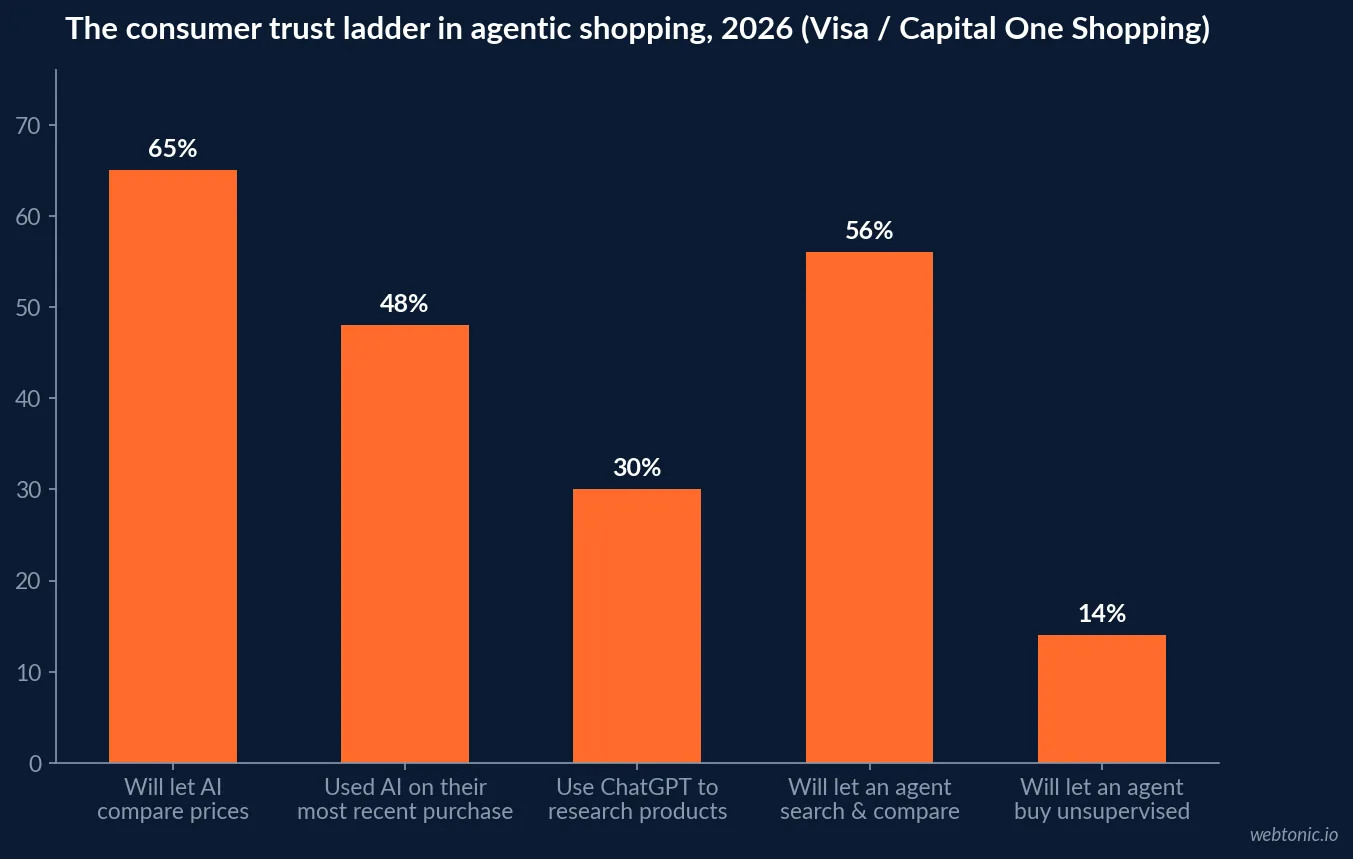
- 56% of consumers will let an agent search and compare products.
- Fewer than 40% will let an agent touch payment credentials.
- Just 14% would let an agent buy something unsupervised.
- 65% would let AI compare prices on their behalf.
- 48% of shoppers used AI in their most recent purchase research.
- 30% already use ChatGPT to research products before buying.
- Agent-mediated transactions are about 0.4% of global ecommerce by count.
- That volume grew roughly 380% year over year from a small base.
- Five competing protocols now govern agent-to-merchant transactions.
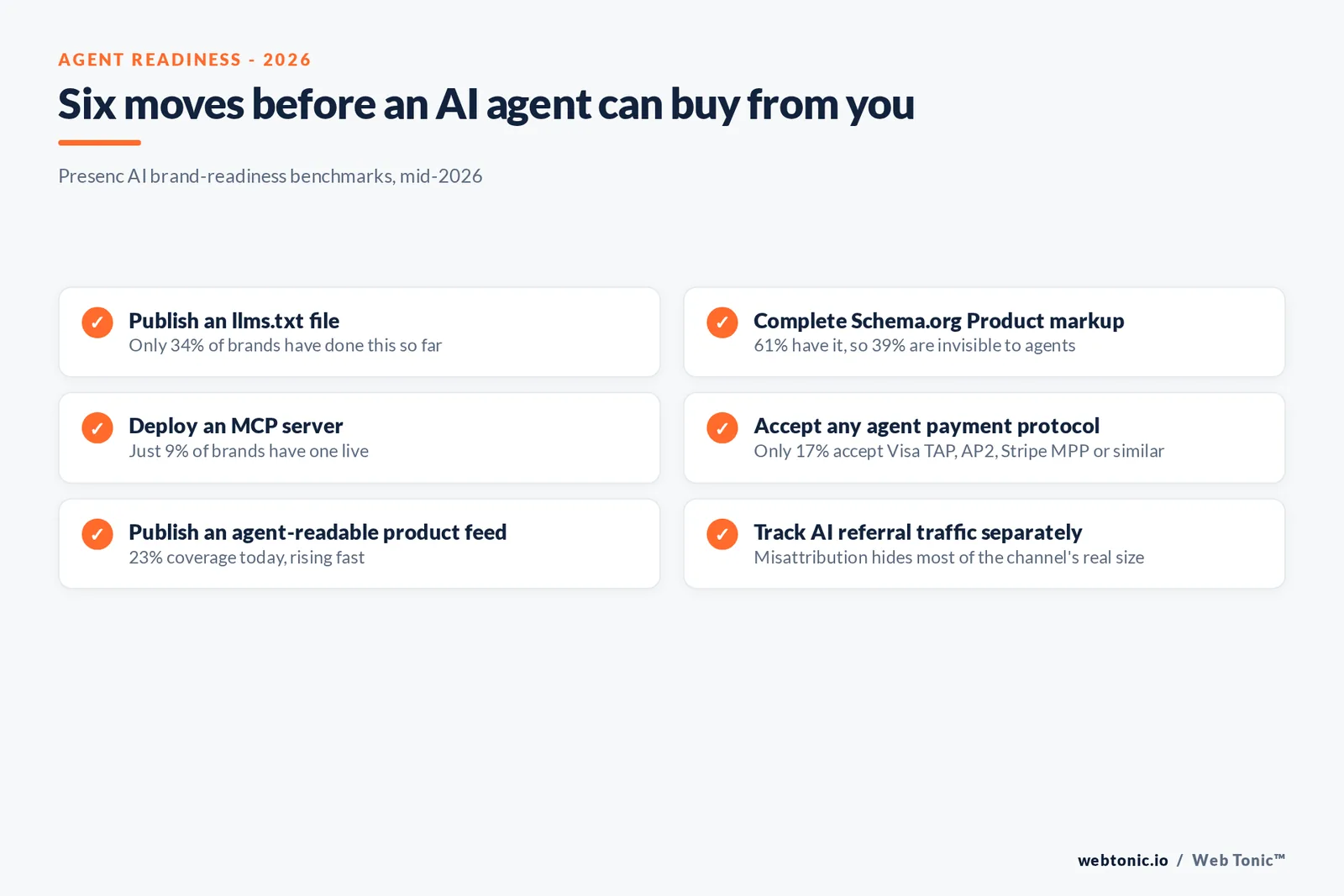
- Only 17% of brands accept any agent payment protocol today.
- 61% of brands have completed Schema.org product markup.
- Just 34% publish an llms.txt file and only 9% run an MCP server.
- 83% of brands are not agent-payment-ready on any major protocol.
Four kinds of evidence, one buzzword
Most agentic-commerce statistics circulating in 2026 sit in one of four buckets: counted platform telemetry, vendor-reported program data, self-reported consumer surveys, and analyst forecasts. Digital Applied's mid-2026 review sorts the available figures by how firmly they are sourced, which is the discipline most coverage skips - printing an 8x traffic figure next to a USD 5 trillion forecast as though they measured the same thing.
The order below runs from hardest evidence to softest: platform telemetry first, vendor program data second, forecasts third, and consumer trust data as the honest counterweight to all of it.
Platform telemetry: the hardest number available
Shopify's own enterprise blog reports that AI-referred traffic to its merchants grew roughly 8x year over year in Q1 2026, with AI-referred orders up nearly 13x over the same period - counted events on real sessions, not a panel estimate. Because orders outpaced traffic, the per-session conversion rate on AI-referred sessions actually improved. Elogic Commerce reports a directionally identical pattern from Adobe's separate dataset: AI referral traffic to US retail sites grew 393% year over year in Q1 2026, with March alone up 269%.
The clearest commercial-quality signal is the reversal in conversion. A year earlier, AI-referred shoppers converted worse than regular traffic; in 2026, Elogic reports they now convert 42% better on revenue per visit, time on site and engagement.
| Metric | 2026 figure | What it actually measures | Source |
|---|---|---|---|
| Shopify AI-referred orders | Up nearly 13x YoY, Q1 2026 | Counted orders from AI-powered referral sessions | Shopify enterprise blog |
| Shopify AI-referred traffic | Up about 8x YoY, Q1 2026 | Counted sessions from AI surfaces | Shopify enterprise blog |
| Adobe AI-referred US retail traffic | +393% YoY, Q1 2026 | Independent platform telemetry | Adobe Digital Insights via Elogic |
| ChatGPT weekly active users | 900 million, Feb 2026 | Platform scale, not shopping-specific | OpenAI via Elogic Commerce |
| AI-referred shopper conversion vs. non-AI | +42% better | Revenue per visit, time on site, engagement | Elogic Commerce 2026 |
The consumer trust ceiling
Consumer willingness, not model quality, is the near-term limit on agentic commerce. Visa's 2026 Global Digital Shopping Index, fielded across 5,241 consumers, 1,185 merchants and 150 acquirers in the US, Brazil and the UAE, finds that more than half (56%) will let an agent search and compare products, but fewer than 40% will let one touch their payment credentials. Visa also reports that 48% of online shoppers used AI as part of researching their most recent purchase.
Separately reported figures widen the same gap: willingness to let AI compare prices sits at 65% against just 14% for letting it place an order unsupervised, a 51-point gap. Capital One Shopping's 2026 report adds that 76% of consumers want AI-powered shopping assistants and 30% already use ChatGPT to research products before buying, so interest in discovery is well ahead of trust in autonomous transaction.
| Task delegated to an AI agent | Share willing, 2026 | Source |
|---|---|---|
| Search and compare products | 56% | Visa Global Digital Shopping Index |
| Compare prices specifically | 65% | Secondary-sourced consumer data |
| Research products before buying (ChatGPT) | 30% | Capital One Shopping |
| Used AI in most recent purchase research | 48% | Visa Global Digital Shopping Index |
| Let an agent touch payment credentials | Under 40% | Visa Global Digital Shopping Index |
| Let an agent buy something unsupervised | 14% | Secondary-sourced consumer data |
Why the forecasts disagree by 240x
The forecasts circulating in mid-2026 range from about USD 20.6 billion for US AI-platform retail ecommerce this year to USD 5 trillion globally by 2030. Divide those and the spread is roughly 243x. Almost none of that gap is disagreement about how fast AI shopping will grow - it is disagreement about what counts as an agentic transaction. eMarketer's smaller figure counts autonomous checkout in one country for one year; the largest forecasts (McKinsey-class estimates cited across the category) count AI-orchestrated revenue including influenced purchases, globally, through 2030, and typically exclude services and B2B marketplaces.
Read every headline forecast with that question first: is this counting a transaction the agent executed, or a purchase it merely helped along?
The protocol layer: five standards, no clear winner
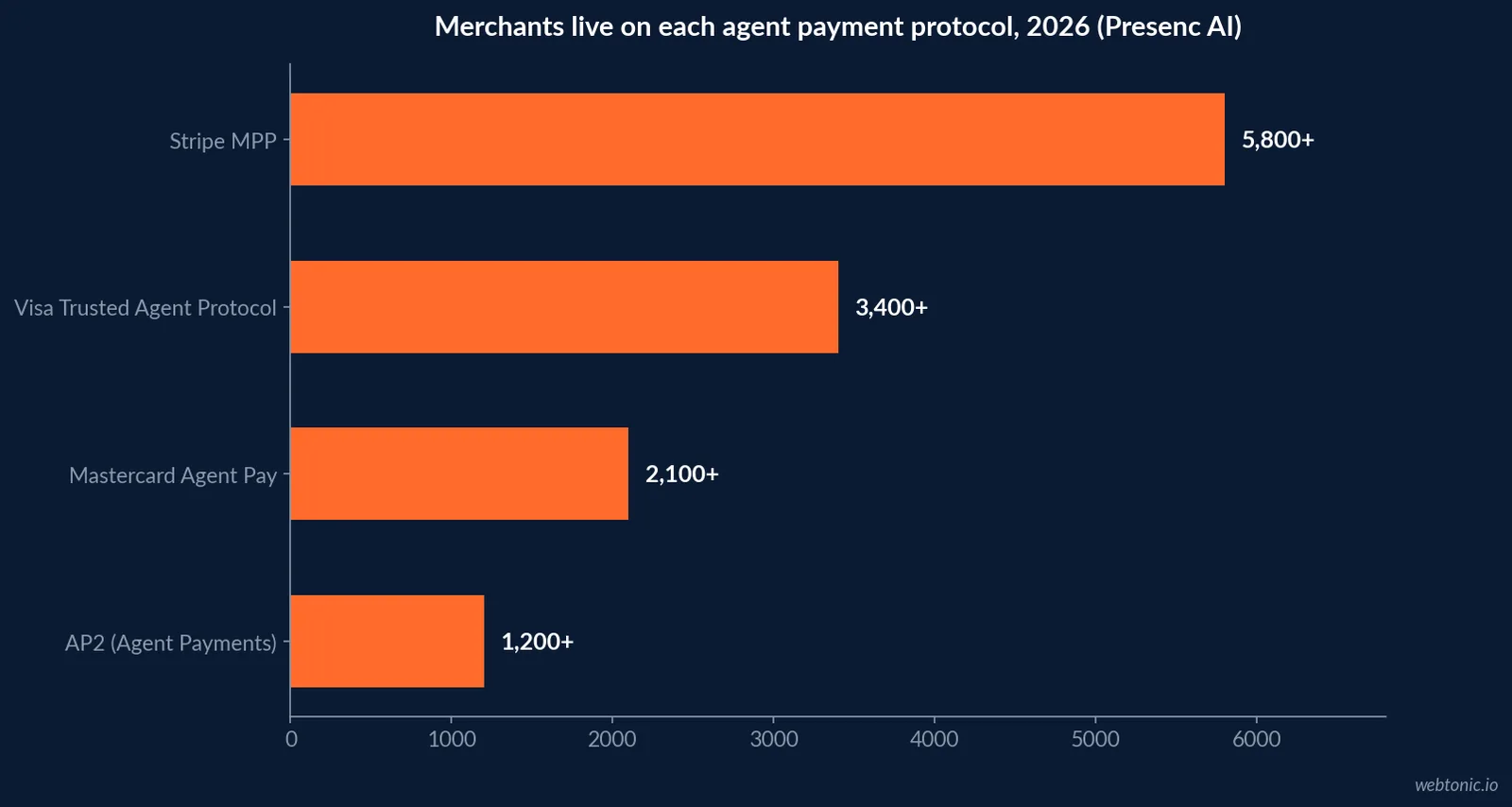
Discovery may happen inside an AI interface, but in 2026 checkout has settled into merchant-controlled environments reached through one of five competing protocols: OpenAI's Agentic Commerce Protocol (ACP), Google's Universal Commerce Protocol (UCP) and Agent Payments Protocol (AP2), Visa's Trusted Agent Protocol, and Mastercard's Agent Pay. Presenc AI's adoption benchmarks put Stripe's Merchant Payment Protocol ahead on raw merchant count at 5,800+ merchants, with Visa Trusted Agent Protocol at 3,400+, Mastercard Agent Pay at 2,100+, and AP2 at 1,200+. The crypto-native x402 protocol leads on endpoint count at 11,000+, a different unit entirely.
No protocol has won. Most brands preparing for agent-payment readiness should plan to support more than one rather than betting on a single winner emerging in 2026.
| Protocol | Merchant / endpoint adoption, 2026 | Issuer or wallet coverage |
|---|---|---|
| Stripe MPP | 5,800+ merchants | Stripe ecosystem |
| Visa Trusted Agent Protocol (TAP) | 3,400+ merchants | 14 issuers in pilot |
| Mastercard Agent Pay | 2,100+ merchants | 11 issuers in pilot |
| AP2 (Agent Payments) | 1,200+ merchants | Multi-issuer |
| x402 | 11,000+ endpoints | Native crypto wallets |
The brand-readiness gap
Presenc AI's mid-2026 benchmarks describe the largest brand-readiness gap of any recent marketing infrastructure transition, ahead of the mobile shift of 2010-2014 and the HTTPS shift of 2017-2018. 61% of brands have completed Schema.org product markup, but only 34% publish an llms.txt file, just 9% have deployed an MCP server, and a mere 17% accept any agent payment protocol at all. Across every brand measured, 83% are not yet agent-payment-ready on any major protocol.
B2B SaaS is the exception, not the rule: 18% have deployed MCP servers, 27% accept at least one agent payment protocol, and 8% have an x402 endpoint live. CPG, pharma and traditional retail are described as mostly absent from agentic infrastructure as of mid-2026.
| Brand capability | Share of brands ready, 2026 | Gap to close |
|---|---|---|
| Schema.org Product markup complete | 61% | 39% not machine-readable at all |
| llms.txt published | 34% | 66% invisible to LLM-native discovery |
| Agent-readable product feed | 23% | 77% still need feed work |
| Agent payment protocol acceptance (any) | 17% | 83% cannot settle an agent-initiated sale |
| MCP server deployed | 9% | 91% have no direct agent data channel |
| x402 endpoint deployed | 4% | 96% absent from crypto-native rails |
Why every forecast table needs a scope column
Any table comparing agentic-commerce forecasts is only useful with a scope column attached, because the headline numbers alone imply a false comparability. Reading the methodology notes behind each figure is the only way to know whether "agentic commerce" means a single-country, one-year checkout figure or a multi-year, global, influenced-purchase estimate.
| Forecast | Scope | Figure | What it counts |
|---|---|---|---|
| US AI-platform retail ecommerce, 2026 | One country, one year | ~USD 20.6 billion | Autonomous checkout only, US retail |
| Global agent-mediated transactions, Q2 2026 | Global, current snapshot | ~0.4% of ecommerce by transaction count | Agent-initiated purchases only |
| Global AI-orchestrated commerce, by 2030 | Global, multi-year, cumulative framing | USD 3-5 trillion | Includes influenced purchases; excludes services and B2B marketplaces |
Category concentration: B2B SaaS is years ahead
Agent-readiness adoption is not spread evenly across industries. Presenc AI's category breakdown shows B2B SaaS leading on every readiness measure it tracks: 18% have deployed MCP servers, 27% accept at least one agent payment protocol, and 8% have an x402 endpoint live - each multiple times the cross-category average. Developer tools sit in the very-early-adopter tier alongside B2B SaaS, consumer ecommerce is catching up quickly through 2026, and CPG, pharma and traditional retail are described as mostly absent from agentic infrastructure as of mid-2026.
| Category | MCP servers deployed | Any agent payment protocol | x402 endpoint live |
|---|---|---|---|
| B2B SaaS | 18% | 27% | 8% |
| Developer tools | Very-early-adopter tier | Very-early-adopter tier | Above-average |
| Consumer ecommerce | Catching up quickly | Rising through 2026 | Below B2B SaaS |
| CPG, pharma, traditional retail | Mostly absent | Mostly absent | Mostly absent |
Where agent volume actually concentrates
Agent-mediated transactions remain small in absolute terms - roughly 0.4% of global ecommerce by transaction count and 0.2% by value in Q2 2026 - but growing about 380% year over year from that base. The volume concentrates in developer tools, B2B SaaS and certain consumer subscription categories, which tracks with where machine-readable product data and API-first commerce were already the norm before agents arrived.
Our data and analytics practice treats AI referral traffic as a channel that needs its own attribution logic from day one, because standard analytics setups routinely misclassify it as direct or unattributed - understating the channel's real size long before the volume becomes hard to ignore.
What marketers should actually do with these numbers
Three actions outrank everything else in 2026. First, audit whether AI referral traffic is already appearing in your analytics stack, and how much of it might be hidden inside direct or unattributed traffic. Second, treat structured product data - Schema.org markup, an llms.txt file, a clean agent-readable feed - as prerequisite infrastructure rather than a future project, since it is the one investment every protocol assumes is already done. Third, decide whether your business needs agent discoverability only, or full agent-ready transaction capability, before committing engineering time to a specific payment protocol.
Our growth marketing practice treats this the same way it treats any new channel: measure before optimizing, and do not let a five-year forecast substitute for this quarter's actual traffic mix. If paid search or social still carries most of your acquisition, our breakdown of what paid search actually costs is a useful budget anchor while agent-referred volume is still single digits of total traffic for most brands.
The honest scorecard for 2026
Agentic commerce is real and growing fast by percentage, small in absolute share, unevenly trusted by consumers for anything beyond discovery, and running years ahead of most brands' technical readiness to transact through it. None of those four facts contradicts the others - they describe different layers of the same transition, and treating any single number as the whole picture is the fastest way to either overreact or dismiss it entirely.
If you want a second opinion on where your own AI-referral traffic already sits, talk to us before committing budget to a specific protocol.
Frequently Asked Questions
What is agentic commerce?
Agentic commerce is when an AI agent researches, compares and, increasingly, purchases products on a person's behalf rather than a human clicking through a search result or an ad. The shopper states an intent, the agent handles discovery and comparison, and checkout either happens inside the assistant or hands off to a merchant-controlled page. In 2026 the handoff model is winning: five protocols now govern discovery-to-checkout, and most transactions still close on the merchant's own site rather than inside the chat window.
How big is agentic commerce right now?
It depends entirely on what is being counted. Presenc AI puts agent-initiated purchases at roughly 0.4% of global ecommerce by transaction count and 0.2% by value in Q2 2026, growing about 380% year over year from a small base. Meanwhile Shopify's own telemetry shows AI-referred orders up nearly 13x year over year, because that figure measures referral-channel growth, not the agent's total share of checkout. Both numbers are correct and neither answers 'how big' on its own.
Why do agentic commerce forecasts vary so much?
The widely cited range runs from about USD 20.6 billion for US AI-platform retail ecommerce in one year to USD 5 trillion globally by 2030, a spread of roughly 240x. Almost none of that gap is disagreement about growth speed. eMarketer's smaller figure counts autonomous checkout in one country for one year; the largest forecasts count AI-influenced revenue globally through 2030, including purchases an agent merely assisted with rather than executed. Ask what counts as an agentic transaction before repeating either number.
Will consumers actually let an AI agent buy things unsupervised?
Not yet, and that gap is the real ceiling on growth. Visa's 2026 Global Digital Shopping Index finds 56% of consumers will let an agent search and compare products, but fewer than 40% will let one touch payment credentials. Separately reported figures put willingness to let AI compare prices at 65% against just 14% for letting it place an order without supervision - a 51-point gap. Discovery trust arrived years before transaction trust, and merchants should plan around that sequencing rather than against it.
What should a brand do first to prepare for AI shopping agents?
Fix machine readability before chasing a payment protocol. Presenc AI's mid-2026 brand-readiness benchmarks show 61% of brands have completed Schema.org product markup but only 34% publish an llms.txt file, just 9% run an MCP server and a mere 17% accept any agent payment protocol at all. Structured, agent-readable product data is the prerequisite every protocol assumes is already in place, so it is also the cheapest fix available before a single dollar of agent-mediated revenue shows up in analytics.
Sources
Digital Applied - Agentic Commerce by the Numbers, mid-2026
Elogic Commerce - ChatGPT Commerce & Agentic Shopping Statistics 2026
Visa Acceptance - 2026 Global Digital Shopping Index, Agentic Edition
Capital One Shopping - AI Shopping Statistics 2026 Report
Presenc AI - Agentic Commerce Adoption Benchmarks 2026
Aimerce - The AI Commerce Report, September 2026
kn8 - Agentic Commerce Statistics 2026