Table of contents
Affiliate and partnership marketing is not one channel with one commission rate - it is a different economic model in every vertical, and the honest budget question is which model and which disclosure law applies before a single dollar of commission is committed. This page prices the channel from network, association and regulator sources rather than a single blended average.
Key Takeaways
- 66% of affiliate publishers reported revenue growth in the IAB Australia 2026 review.
- 72% of advertisers grew their publisher count in the same 2026 study.
- 42% of advertisers increased affiliate investment year over year.
- 69% of B2B SaaS leaders are raising partnership investment, PartnerStack/Wynter found.
- Zero respondents reported decreasing partnership investment in that same survey.
- PartnerStack's network has moved USD 2.7 billion in all-time GMV.
- Transaction volume on that network grew 52% year on year.
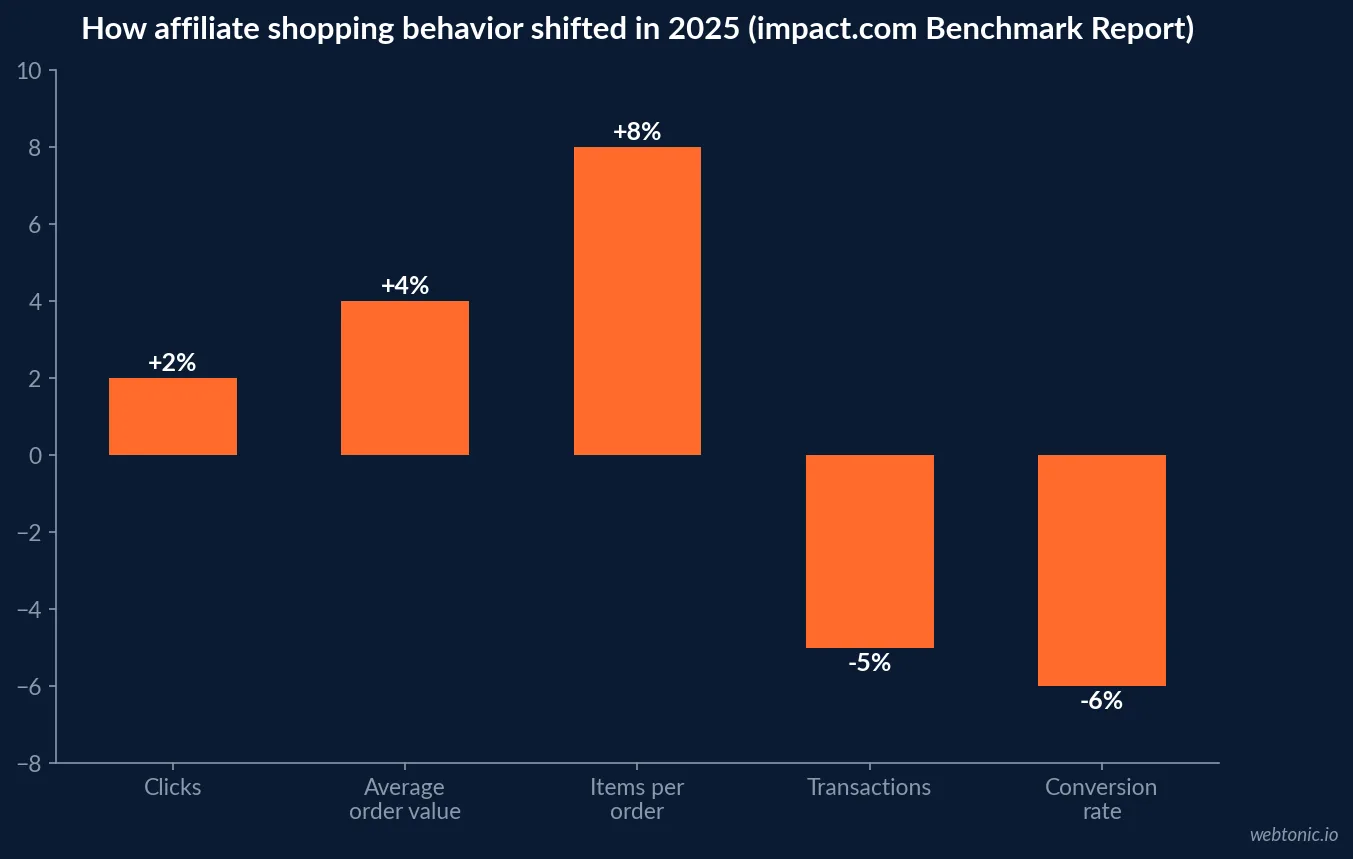
- Clicks rose 2% year over year on impact.com's tracked retail brands in 2025.
- Transactions fell 5% and conversion rate fell 6% over that same period.
- Average order value rose 4%, from USD 118 to USD 123.
- Items per order rose 8% as shoppers consolidated purchases.
- 650 director-level marketers were surveyed for Awin's Forrester-commissioned study.
- Thumbtack pros set their own lead price rather than paying a fixed commission.
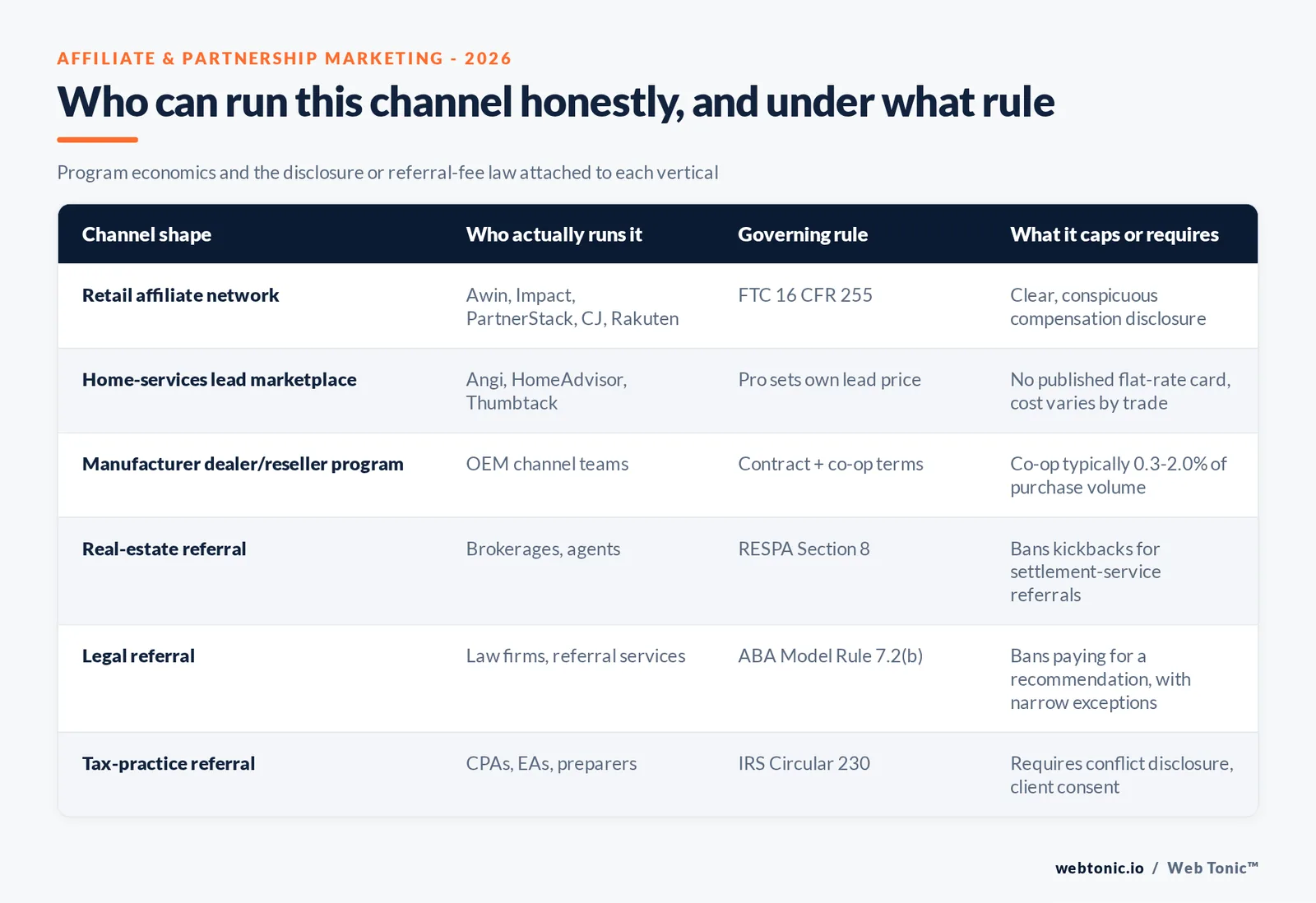
- FTC 16 CFR 255 requires clear, conspicuous disclosure of any paid connection.
- RESPA Section 8 bans kickbacks on federally related mortgage settlement services.
- ABA Model Rule 7.2(b) bars paying for a legal-services recommendation in most cases.
- IRS Circular 230 requires conflict disclosure before a referral fee is accepted.
- Manufacturer co-op funds typically run 0.3% to 2.0% of dealer purchase volume.
Why one blended commission number is the wrong question
Affiliate and partnership marketing spans a retail cost-per-sale network, a B2B SaaS partner ecosystem, a home-services lead marketplace and a manufacturer dealer program, and each prices itself differently. impact.com's 2025 Industry Benchmark Report, tracking more than 2,300 North American retail brands across the full calendar year, found clicks up 2% year over year while transactions fell 5% and conversion rate fell 6% - shoppers clicked more affiliate links and bought in fewer, larger baskets, with average order value up 4% (USD 118 to USD 123) and items per order up 8%.
None of that is a commission rate. It is a demand signal, and the first budgeting mistake most teams make is pricing the channel off a rate card before checking whether the channel's own volume is even moving in their category.
| Channel shape | Who runs the program | How it is priced | What is published |
|---|---|---|---|
| Retail affiliate network | Awin, Impact, PartnerStack, CJ, Rakuten | Cost per sale, category rate | Network-side benchmarks, not a public rate card |
| B2B SaaS partner ecosystem | PartnerStack-hosted programs | Recurring or one-time commission | USD 2.7B all-time GMV, 52% YoY volume growth |
| Home-services lead marketplace | Angi, HomeAdvisor, Thumbtack | Flat fee per lead, pro-set | No public flat-rate card; varies by trade and market |
| Manufacturer dealer/reseller program | OEM channel teams | Co-op fund, percent of spend | 0.3-2.0% of purchase volume, NAW 2025 study |
| Realtor / property-manager partnership | Local trade referral networks | Informal referral, no fee if compliant | Governed by RESPA Section 8, not a network |
What confidence in the channel actually looks like right now
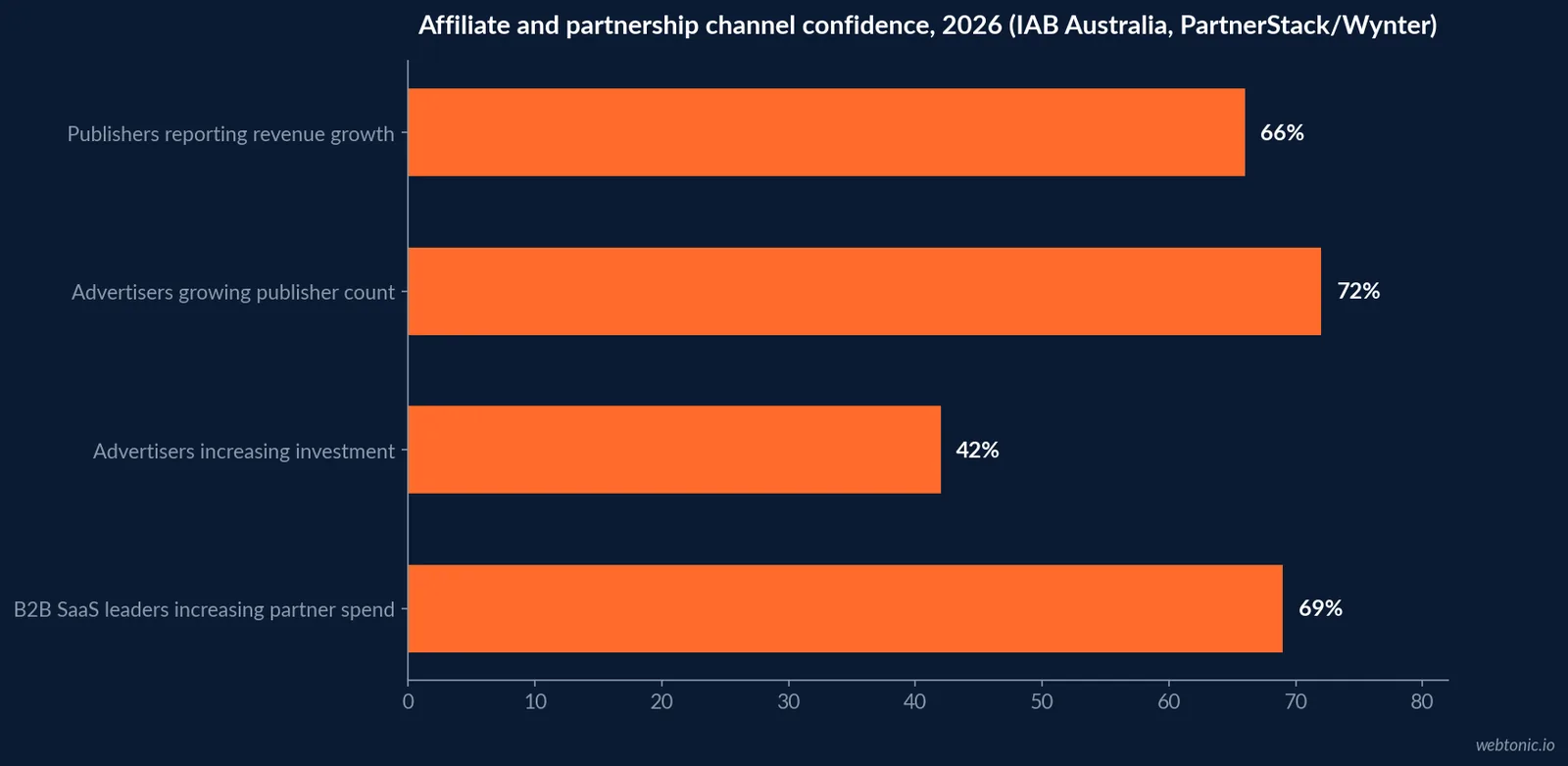
The IAB Australia Affiliate and Partnership Marketing State of the Nation Report 2026, surveying 66 advertisers and agencies and 57 publishers, found 66% of publishers reporting revenue growth from the channel and 72% of advertisers growing their publisher count, alongside 42% of advertisers increasing investment year over year. On the B2B side, PartnerStack and Wynter's State of Partnerships in GTM 2026 report found 69% of B2B SaaS leaders raising partnership investment heading into next year, with zero respondents reporting a decrease.
That is sentiment converging from two very different survey populations - Australian retail affiliate stakeholders and North American B2B SaaS leaders - which is a stronger signal than either figure alone, though the two are not the same market and should not be quoted interchangeably.
What the PartnerStack network shows in raw volume
PartnerStack's own 2026 network report puts its all-time gross merchandise value at USD 2.7 billion, driven by a 52% year-over-year surge in transaction volume. That is one network, not the category, but it is the largest B2B-specific partnership figure published with a stated method rather than modeled from a survey.
Awin's Forrester-commissioned opportunity snapshot, based on 650 director-level-and-above marketing decision-makers surveyed between August 2023 and January 2024, documents why brands invest in the channel - reach, incremental customer acquisition, cost efficiency - without publishing a blended commission figure, because none exists across its category mix.
| Program metric (2025-2026) | Figure | Source | What it actually measures |
|---|---|---|---|
| Publisher revenue growth | 66% | IAB Australia 2026 | Publisher-reported outcome, not a rate |
| Advertiser publisher-count growth | 72% | IAB Australia 2026 | Program expansion, not payout size |
| Advertiser investment growth | 42% | IAB Australia 2026 | Budget direction, not amount |
| B2B SaaS leaders raising partner spend | 69% | PartnerStack/Wynter GTM 2026 | Sentiment across SaaS-only respondents |
| All-time network GMV | USD 2.7B | PartnerStack 2026 Network Report | One network's volume, not category size |
| YoY transaction volume growth | 52% | PartnerStack 2026 Network Report | Same network, order count not dollars |
Local-services trades: the honest version of this channel
Roofing, HVAC, plumbing and pest control businesses rarely run a retail-style cost-per-sale affiliate program, because there is no digital "add to cart" moment for a roof replacement. The equivalent channel is a lead marketplace. Per Thumbtack's own help documentation, pros set their own lead price inside the platform rather than paying a network-published flat rate, which means "what does Angi or Thumbtack cost" has no single honest answer - it is set per trade, per market, per pro.
The second real channel for these trades is the manufacturer dealer or certified-installer program - a distributor-style partnership, not a link-based affiliate program - covered in depth on our companion page on manufacturing and industrial digital marketing. Selling either of these as a standard affiliate commission misrepresents how the channel actually pays.
The federal disclosure floor: FTC 16 CFR Part 255
Every affiliate or partnership relationship in the United States sits under one baseline rule regardless of industry: the FTC's Endorsement Guides, 16 CFR Part 255. They require that a "material connection" between an endorser and a brand - which includes an affiliate commission - be disclosed clearly and conspicuously, in a placement and language an average consumer would actually notice before clicking through, not buried in an about page or a footer.
That single rule is why a compliant affiliate program never depends on hiding the commission - the commission is legal, the concealment is not.
| Vertical | Extra rule on top of FTC 255 | What it restricts | Citation |
|---|---|---|---|
| Real estate | RESPA Section 8 | Kickbacks for settlement-service referrals | 12 CFR 1024.14 |
| Legal services | ABA Model Rule 7.2(b) | Paying for a client recommendation | americanbar.org / law.cornell.edu |
| Tax preparation | IRS Circular 230 | Undisclosed referral-fee conflicts | irs.gov |
| General consumer marketing | FTC 16 CFR 255 | Undisclosed material connections | ecfr.gov |
| Manufacturer channel programs | Contract + co-op terms, not FTC | Spend rules on co-op funds | NAW 2025 study |
Real estate, legal and tax: where a commission can become a violation
In real estate, RESPA Section 8, codified at 12 CFR 1024.14, prohibits paying or accepting a kickback for referring business tied to a federally related mortgage settlement service - a standard affiliate commission structure applied to a mortgage or title referral can be the violation itself, not just a disclosure gap.
In law, ABA Model Rule 7.2(b) generally bars a lawyer from paying anything of value for recommending their services, with narrow exceptions for reciprocal referral agreements and not-for-profit lawyer referral services. In tax preparation, IRS Circular 230 requires a practitioner to identify a conflict of interest - including a referral-fee arrangement - and obtain informed client consent before it proceeds.
Fraud and attribution: the cost nobody puts on the invoice
None of the growth and confidence figures above net out fraud. Affiliate networks manage this internally through click validation and payout holds, and the discipline varies by network maturity - newer or lower-oversight programs carry materially more invalid-traffic risk than the established networks named above. Budgeting for the channel without a fraud-review line, whichever network is used, understates the true cost of the commission actually paid out.
Attribution is the second hidden cost: last-click, cookie-based crediting means a publisher who merely repeated a brand's own paid-search ad can still collect commission on a sale the brand would have made anyway. That is a program-design problem, not a fraud problem, and it is the reason serious advertisers audit publisher mix at least quarterly rather than trusting the network dashboard by default.
Building the program budget line by line
A defensible affiliate or partnership budget separates four lines: the network platform fee, the commission itself (category-specific, never a single blended percentage), a fraud/compliance review allocation, and disclosure/legal review for any regulated vertical above. Skipping the third and fourth lines is how programs end up with a commission bill that looks efficient on the dashboard and a compliance exposure that shows up later.
For a B2B partner program specifically, model it against PartnerStack's published USD 2.7 billion GMV and 52% transaction growth as a category-level reference point, not a guarantee - a new program does not inherit an established network's volume on day one.
How this differs from a paid-media budget
Affiliate and partnership spend is performance-contingent by design - the commission is paid on the outcome, not the impression - which is exactly why it gets mis-sold as "free" marketing. It is not free: the platform fee, the fraud review and the legal/disclosure review above are fixed costs regardless of sales volume. If you are comparing this channel against paid search spend, compare total program cost, not just the commission line.
What to check before signing a program agreement
Confirm which network or platform actually runs the program, get the category-specific commission range in writing rather than a blended average, confirm the disclosure language required under FTC 16 CFR 255, and - for real estate, legal or tax clients - have counsel confirm the arrangement does not cross RESPA Section 8, ABA Model Rule 7.2(b) or IRS Circular 230 before the first payout is made. Talk to us if you want that review done before launch, or see how our growth marketing practice structures partner programs end to end.
Frequently Asked Questions
Is affiliate and partnership marketing still growing in 2026?
By publisher and advertiser sentiment, yes. The IAB Australia Affiliate and Partnership Marketing State of the Nation Report 2026, based on 66 advertisers/agencies and 57 publishers, found 66% of publishers reporting increased revenue from the channel and 72% of advertisers growing the number of publishers they work with. But impact.com's 2025 Industry Benchmark Report, analyzing more than 2,300 North American retail brands across the full year, found transactions down 5% and conversion rate down 6% even as clicks rose 2% - growth in confidence has not yet meant growth in raw volume.
What does a typical commission or payout actually look like?
There is no single number, because networks price by category, not by channel. What is published: Awin's Forrester-commissioned survey of 650 director-level-and-above marketing decision-makers documents why brands invest in the channel, and PartnerStack's own network data shows USD 2.7 billion in all-time GMV with transaction volume up 52% year on year through its GTM 2026 report with Wynter - both are volume and confidence figures, not a commission-rate index. Treat any single quoted commission percentage as category-specific until you see the network's own rate card.
Do local-services businesses (roofing, HVAC, plumbing, pest control) have a real affiliate channel?
Not the retail-network kind. For those trades, the honest equivalent is a lead marketplace (Angi, HomeAdvisor, Thumbtack) where, per Thumbtack's own help documentation, the contractor sets their own lead price rather than a network publishing a flat commission, plus manufacturer-dealer and certified-installer programs and realtor or property-manager referral partnerships. None of that is a cost-per-sale affiliate link, and marketing that promises one for these trades is marketing the wrong channel.
What has to be disclosed, and to whom?
The FTC's 16 CFR Part 255 Endorsement Guides require that any material connection between an endorser and a brand - including an affiliate commission - be disclosed clearly and conspicuously, in a way an average consumer would notice it, not buried in a bio or an about page. That rule applies regardless of the network used and regardless of whether the endorser calls themselves an affiliate, a partner or a creator.
Which industries face an extra referral-fee law on top of the FTC rule?
Three matter most for Web Tonic clients. Real estate: RESPA Section 8, enforced at 12 CFR 1024.14, bans kickbacks tied to a federally related mortgage settlement service. Legal: ABA Model Rule 7.2(b) generally bars a lawyer from paying anything of value for a client recommendation, with narrow carve-outs for not-for-profit referral services. Tax preparation: IRS Circular 230 requires practitioners to identify and disclose a conflict of interest, including a referral-fee relationship, before the engagement proceeds.
Sources
impact.com - Affiliate Benchmark 2025 Industry Report
IAB Australia - Affiliate and Partnership Marketing State of the Nation Report 2026
PartnerStack / Wynter - The State of Partnerships in GTM 2026
PartnerStack - 2026 Network Report
Awin / Forrester Consulting - Affiliate Investment Opportunity Snapshot
Thumbtack Help - How lead pricing works for pros
eCFR - 16 CFR Part 255, FTC Endorsement Guides
Federal Reserve - 12 CFR 1024.14, RESPA Section 8 kickback prohibition
Cornell Law - ABA Model Rule 7.2, referral-fee restrictions
IRS - Circular 230 professional obligations guidance
NAW / Alexander Group - Manufacturer-Dealer Partner Program Study 2025