Table of contents
Ad tech budgets are not shrinking next year - they are being reshuffled. Total U.S. ad spend growth was revised upward twice in 2026, from 9.5% to 12.3%, while the martech share of the marketing budget fell to a five-year low. Both things are true at once, and the gap between them is where next year's planning decisions actually get made.
Key Takeaways
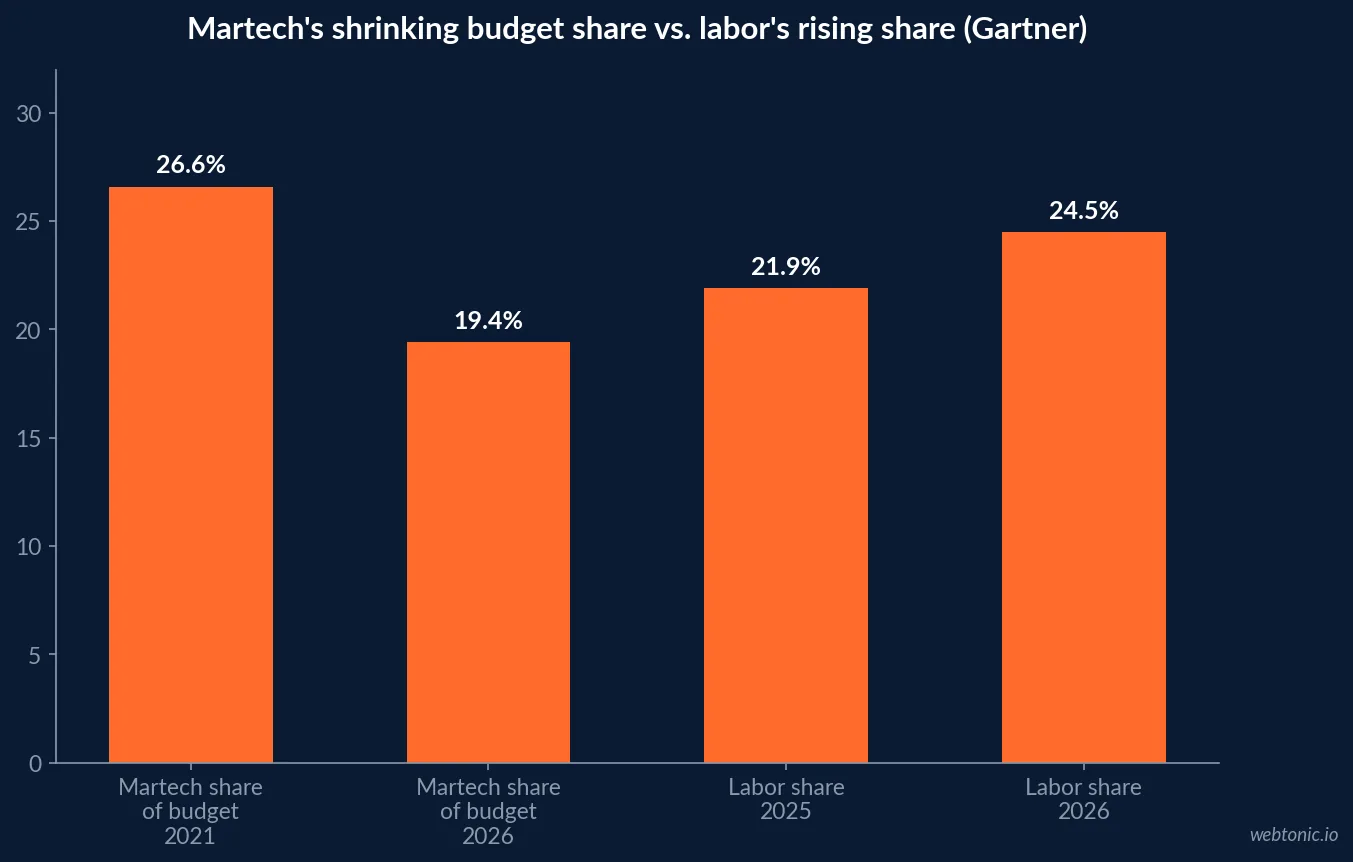
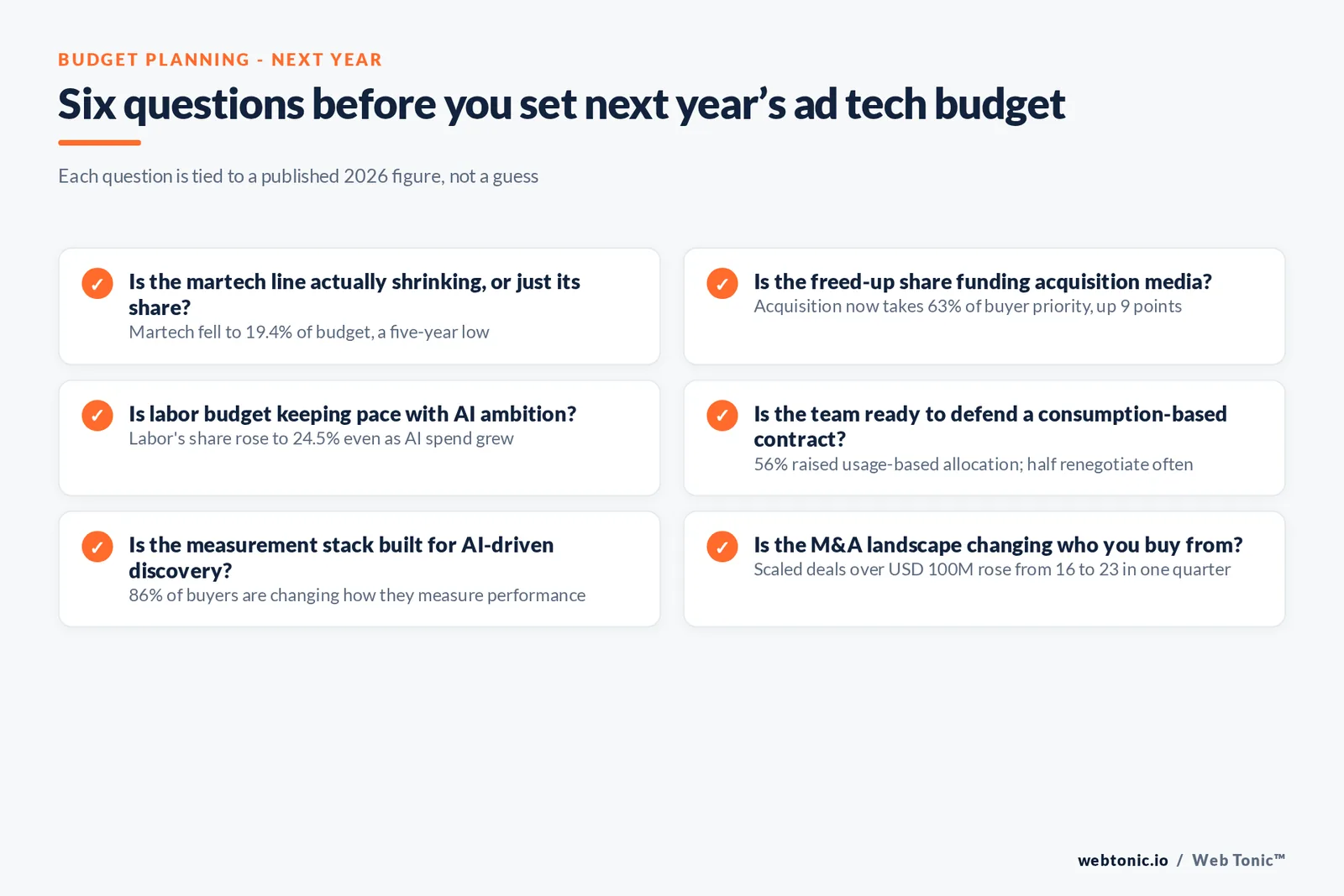
- Martech now takes 19.4% of the marketing budget, down from 26.6% in 2021 (Gartner).
- That is a five-year low, even as 62% of CMOs plan to spend more on martech.
- IAB raised its 2026 U.S. ad spend forecast to 12.3% growth, up from 9.5% in January.
- The global adtech market itself is valued at USD 869.23 billion in 2026, up from USD 791.95 billion in 2025.
- Customer acquisition jumped to 63% of buyer priorities, up nine points since January.
- Awareness and conversion spend now take 62.6% of media budgets (Gartner).
- Loyalty and retention spend fell 29% since 2024 and sits under 15% of media spend.
- Labor's share of the marketing budget rose to 24.5%, up from 21.9% a year earlier.
- CMOs allocate a mean 15.3% of their budget to AI, rising to 21.3% among AI-mature teams.
- Only 30% of CMOs call their AI processes mature or fully optimized.
- 56% of teams increased consumption-based martech allocation in the past year; 9% decreased it.
- Optimizing content for AI-generated answers is the top 2026 focus area, at 76% of buyers.
- 86% of buyers are changing how they measure media performance because of AI tools and agents.
- Ad tech and martech M&A totaled 102 deals in Q2 2026, per LUMA Partners.
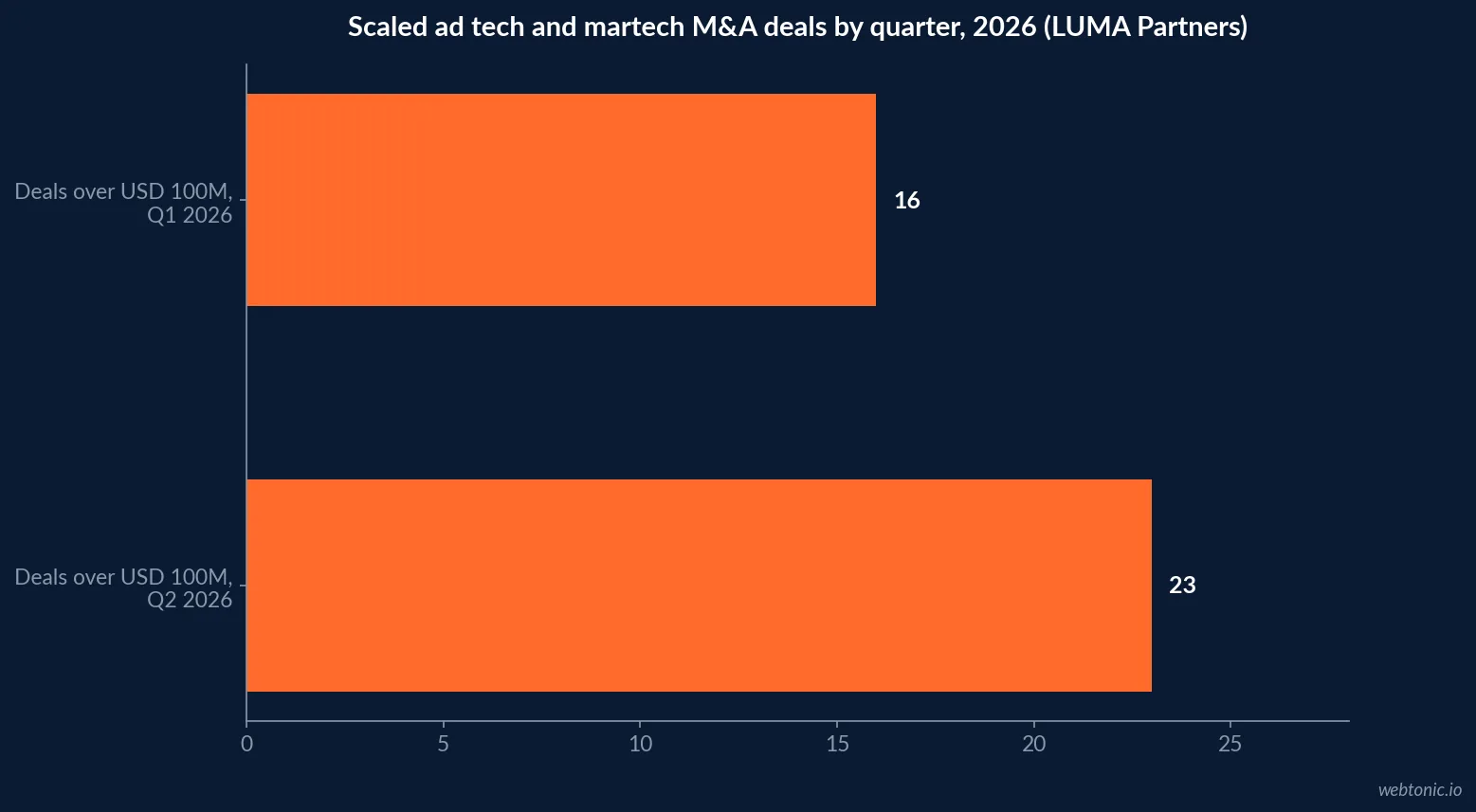
- Deals over USD 100 million rose to 23, up from 16 in Q1 2026.
- Fox's acquisition of Roku was valued at USD 22 billion; Publicis paid USD 2.1 billion for LiveRamp.
- Liftoff's June 2026 IPO was the first pure-play ad tech listing since May 2025.
The headline paradox: less martech, more ad spend
Two 2026 studies describe what looks like a contradiction until you separate the line items. Gartner's 2026 CMO Spend Survey, based on 401 CMOs, found the mean share of marketing budget allocated to martech fell to 19.4%, a five-year low down from 26.6% in 2021. Meanwhile IAB's September 2026 Outlook Study update raised the full-year U.S. ad spend growth forecast to 12.3%, up 2.8 percentage points from its January projection of 9.5%. The martech line is shrinking as a share of a budget that is itself growing faster than expected - which means the dollar amount spent on tooling can still rise even as its percentage falls.
| Budget metric (2026) | Figure | Comparison point | Source |
|---|---|---|---|
| Martech share of marketing budget | 19.4% | Down from 26.6% in 2021 | Gartner CMO Spend Survey |
| CMOs planning to increase martech spend | 62% | Of 401 respondents | Gartner |
| 2026 U.S. ad spend growth forecast (Sept.) | 12.3% | Up from 9.5% in January | IAB Outlook Study |
| Global adtech market size | USD 869.23B | Up from USD 791.95B in 2025 | The Business Research Company |
Where the freed-up share is actually going
The budget line that gained the most is media itself, and specifically acquisition media. Gartner's own reporting on the same survey found awareness and conversion activities now account for 62.6% of media spending, with digital media representing more than two-thirds of total media investment. Loyalty and retention spend has fallen 29% since 2024 and now sits under 15% of total media spend. IAB's September update tells the same story from the buyer's side: customer acquisition jumped nine points since January to 63% of stated investment goals, while brand equity rose six points to 43%.
| Media investment priority | 2026 figure | Change vs. earlier 2026 | Source |
|---|---|---|---|
| Customer acquisition (buyer priority) | 63% | +9 points since January | IAB Outlook Study |
| Brand equity (buyer priority) | 43% | +6 points since January | IAB |
| Repeat purchases (buyer priority) | 24% | Roughly flat | IAB |
| Awareness + conversion (share of media budget) | 62.6% | — | Gartner CMO Spend Survey |
| Loyalty + retention (share of media budget) | <15% | Down 29% since 2024 | Gartner |
AI is the line item everyone is negotiating around
Every recent buyer survey shows AI reshaping how budgets get justified, not just how campaigns get built. IAB found 76% of buyers now list optimizing content for AI-generated answers as an area of increased focus for 2026, followed by 72% for AI/LLM models specifically. Adapting to AI-driven search is the single most cited media investment challenge, at 44% of buyers, with concern about low-quality "AI slop" content close behind at 38%. On the measurement side, 86% of buyers report they are already changing, or expect to change, how they measure media performance because of conversational AI tools and AI agents within the next twelve months.
| AI-related budget signal, 2026 | Figure | Source |
|---|---|---|
| Buyers prioritizing AI-answer optimization | 76% | IAB Outlook Study |
| Buyers prioritizing AI/LLM models specifically | 72% | IAB |
| Buyers citing AI-driven search as top challenge | 44% | IAB |
| CMOs' mean AI share of marketing budget | 15.3% | Gartner CMO Spend Survey |
| AI share among AI-mature organizations | 21.3% | Gartner |
| Buyers changing measurement due to AI | 86% | IAB |
Labor is rising, not falling, alongside AI spend
A common budgeting assumption is that AI tooling should eventually shrink headcount costs. The 2026 data runs the other way for now: labor's share of the marketing budget climbed from 21.9% in 2025 to 24.5% in 2026, according to Gartner's survey, even as CMOs increased AI allocation. Only 30% of CMOs called their organization's AI processes mature or fully optimized; the other 70% cited immature processes as the reason they still need to fund people alongside tools. A lack of internal AI expertise was the most frequently cited barrier, named by 38% of marketing leaders as a primary constraint.
Consumption-based pricing is rewriting the martech contract
Part of why martech's percentage share keeps falling is a genuine pricing shift underneath it. Gartner's survey found 56% of respondents increased how much of their martech budget they allocate to consumption-based (usage-based) pricing in the past year; only 9% decreased it. But the model carries administrative weight: half of organizations using consumption-based solutions report continually renegotiating contracts to avoid unexpected cost spikes, and 41% have built or are building real-time spend controls specifically to manage it.
| Consumption-based martech signal | Figure | Source |
|---|---|---|
| Teams that increased usage-based allocation | 56% | Gartner CMO Spend Survey |
| Teams that decreased it | 9% | Gartner |
| Orgs continually renegotiating contracts to avoid spikes | ~50% | Gartner |
| Orgs building real-time spend controls | 41% | Gartner |
| Orgs overhauling systems specifically to reduce usage | 24% | Gartner |
Where the M&A dollars are moving
Deal activity confirms the same reallocation story at the corporate level. LUMA Partners' Q2 2026 Market Report tracked 102 total ad tech and martech transactions, down 16% year over year but essentially flat sequentially. Scaled deals above USD 100 million strengthened to 23, up from 16 in Q1 2026. The quarter's largest transactions leaned toward data, identity and distribution rather than pure ad-serving technology: Fox's USD 22 billion acquisition of Roku, Publicis' USD 2.1 billion acquisition of LiveRamp, and Walmart's USD 1.4 billion acquisition of Vibe. Liftoff completed its IPO in June 2026 - the first pure-play ad tech public offering since MNTN's listing in May 2025.
| M&A metric, Q2 2026 | Figure | Notable transaction | Source |
|---|---|---|---|
| Total ad tech + martech deals | 102 | — | LUMA Partners |
| Deals over USD 100 million | 23 | Up from 16 in Q1 2026 | LUMA Partners |
| Largest media/distribution deal | USD 22B | Fox acquires Roku | LUMA Partners |
| Largest identity/data deal | USD 2.1B | Publicis acquires LiveRamp | LUMA Partners |
| Retail media deal | USD 1.4B | Walmart acquires Vibe | LUMA Partners |
Building next year's plan around this data
The practical read for anyone building a 2027 ad tech budget: expect the total media pool to keep growing (IAB's own forecast moved up twice within a single year), expect martech's percentage share to keep compressing as consumption-based pricing spreads, and expect a measurement line item to grow no matter what format you buy, since the majority of buyers are already rebuilding how they attribute performance around AI-driven discovery. Our data and analytics practice builds that kind of measurement plan before the budget gets finalized, our growth marketing team handles the acquisition-media allocation shift directly, and our guide to what paid search actually costs in 2026 is a useful companion number for the acquisition-media side of this same budget.
One more caution before the budget is final
A separate Gartner consumer survey, cited in the same reporting cycle, found 49% of U.S. consumers believe generative AI has made content quality worse - a figure that rises to 57% among Gen Z and millennial respondents. That skepticism matters for a 2027 budget because it cuts against the assumption that AI-generated volume alone buys attention: a media plan that pours the freed-up martech share into more AI-produced content without a quality gate risks spending into an audience that already distrusts the output. The safer read of this year's numbers is that the budget shift toward acquisition media and AI tooling has to be paired with the same media quality discipline covered in our companion piece on performance creative work, not treated as a free pass to cut oversight along with the martech line.
Frequently Asked Questions
Are companies cutting their ad tech budgets next year?
No - they are reallocating within them. Gartner's 2026 CMO Spend Survey found martech's share of the marketing budget fell to 19.4%, a five-year low down from 26.6% in 2021, even as 62% of the 401 CMOs surveyed said they planned to invest more in marketing technology. The dollars are moving toward consumption-based pricing and paid media, not disappearing.
Why is martech's share of the budget shrinking while ad spend is growing?
Two separate forces are pulling in different directions. IAB raised its 2026 U.S. ad spend forecast to 12.3% growth in September, up from 9.5% in January, because performance channels are absorbing more dollars. At the same time Gartner found awareness and conversion activities now take 62.6% of media spending, with loyalty and retention down 29% since 2024 - so the growth is concentrating in acquisition media, and martech tooling is being asked to do more with a proportionally smaller line item.
Is AI actually reducing headcount costs in ad tech budgets?
The opposite, so far. Gartner's survey found labor's share of the marketing budget rose from 21.9% in 2025 to 24.5% in 2026, even as CMOs allocate a mean 15.3% of budget to AI initiatives. Only 30% of CMOs described their organization's AI processes as mature or fully optimized; the rest are still funding the people needed to make AI tools work before any labor savings show up.
Where is ad tech M&A money going in 2026?
Toward data and identity, and toward fewer but larger deals. LUMA Partners tracked 102 total ad tech and martech transactions in Q2 2026, roughly flat sequentially, but scaled deals over USD 100 million rose to 23 from 16 in Q1. Publicis' USD 2.1 billion acquisition of LiveRamp and Fox's USD 22 billion acquisition of Roku were among the quarter's largest, both squarely in data and distribution rather than pure ad-serving technology.
What should a budget plan for next year assume about ad tech spend?
Assume the total pool keeps growing (IAB's own forecast moved up twice in 2026) but that martech's share of it keeps shrinking as a proportion, that pricing models shift toward consumption-based billing 56% of surveyed teams increased that allocation in the past year, and that measurement line items grow regardless of format, since 86% of buyers are already changing how they measure performance because of AI tools and agents.
Sources
Chief Marketer - Gartner CMO Spend Survey, 2026
MarTech - Gartner finds CMOs spending more on digital and acquisition
IAB - 2026 Outlook Study: September Update
IAB - 2026 Outlook Study: September Update (full report PDF)
The Business Research Company - AdTech Global Market Report 2026
LUMA Partners - Q2 2026 Market Report