Table of contents
Ad fraud is projected to cost advertisers more than USD 172 billion a year by 2028, and current estimates already put annual losses near USD 250 billion - roughly USD 1 of every USD 3 spent in the most exposed channels. The rate varies sharply by channel: paid search fraud runs 14% to 22% of clicks, affiliate traffic runs closer to 17%, and some verticals see bot traffic above 50%.
Key Takeaways
- Ad fraud losses are forecast to exceed USD 172 billion a year by 2028.
- Current global losses are estimated near USD 250 billion a year.
- 22% of global digital ad spend was lost to ad fraud on a 2026 read.
- Roughly USD 1 of every USD 3 spent in exposed channels is lost to fraud.
- 20% of digital traffic is estimated to be non-human.
- Paid search click fraud averages 14% of clicks, ranging 14% to 22%.
- Bots are responsible for about 24% of all paid search clicks.
- Bot networks alone drive nearly 40% of click fraud.
- 270 million Facebook accounts are estimated to be bots or fakes.
- 95 million Instagram accounts are estimated to be bots or fakes.
- Scam ads made up about 10% of Meta's 2024 ad revenue.
- 4% to 5% of Meta's monthly active users are estimated fake.
- 17% of affiliate traffic has been proven fake.
- Cookie stuffing affects 5% to 10% of affiliate transactions.
- Affiliate fraud is estimated to cost advertisers USD 3.4 billion.
- 80% of travel-advertiser traffic is estimated to be bots.
- 43% of fintech ad budgets are lost to fraudulent clicks.
- The fraud detection software market is forecast to reach USD 80 billion by 2031.
| Ad fraud metric (2025-2026) | Published figure | Source |
|---|---|---|
| Ad fraud losses by 2028 | USD 172 billion a year | TrafficGuard |
| Current estimated global losses | USD 250 billion a year | TrafficGuard |
| Share of global digital ad spend lost | 22% | TrafficGuard |
| Non-human share of digital traffic | 20% | TrafficGuard |
| Average paid search click fraud rate | 14% (range 14-22%) | TrafficGuard |
| Affiliate traffic that is fake | 17% | TrafficGuard |
How big is the ad fraud problem right now
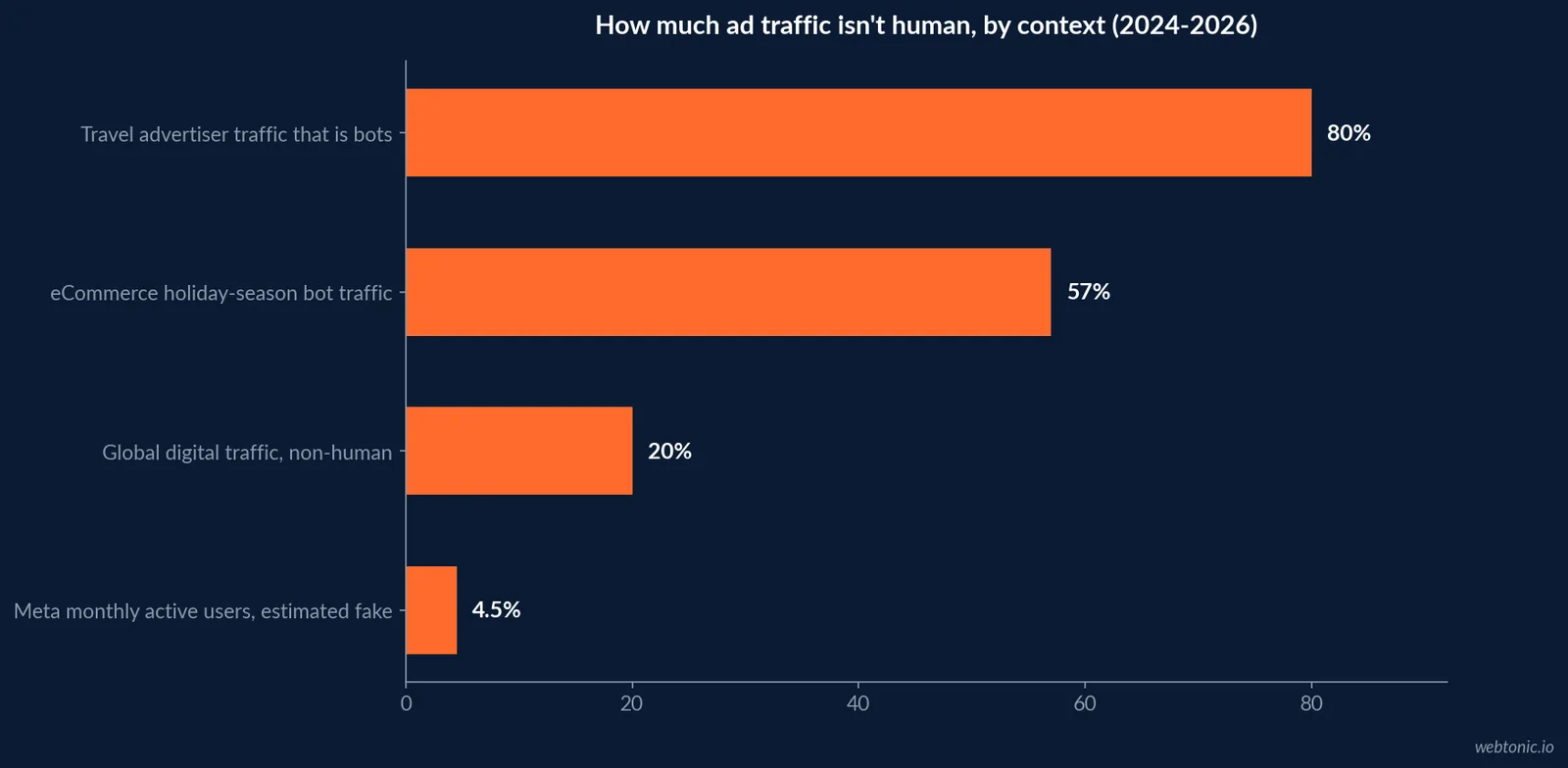
The headline number marketers usually hear is the 2028 forecast: TrafficGuard's 2026 click fraud statistics page puts global ad fraud losses on track to pass USD 172 billion a year by 2028. That figure sits on top of a current-year estimate of roughly USD 250 billion in annual losses, with 22% of global digital ad spend already lost to fraud and 20% of digital traffic classified as non-human.
Put in the context of overall spend, Statista's advertising market data puts total worldwide ad spend at almost USD 832 billion in 2025. A USD 250 billion fraud estimate against that total is not a rounding error - it is close to a third of the market, though the two figures use different measurement methods and shouldn't be read as a single clean ratio.
Click fraud and invalid traffic in paid search
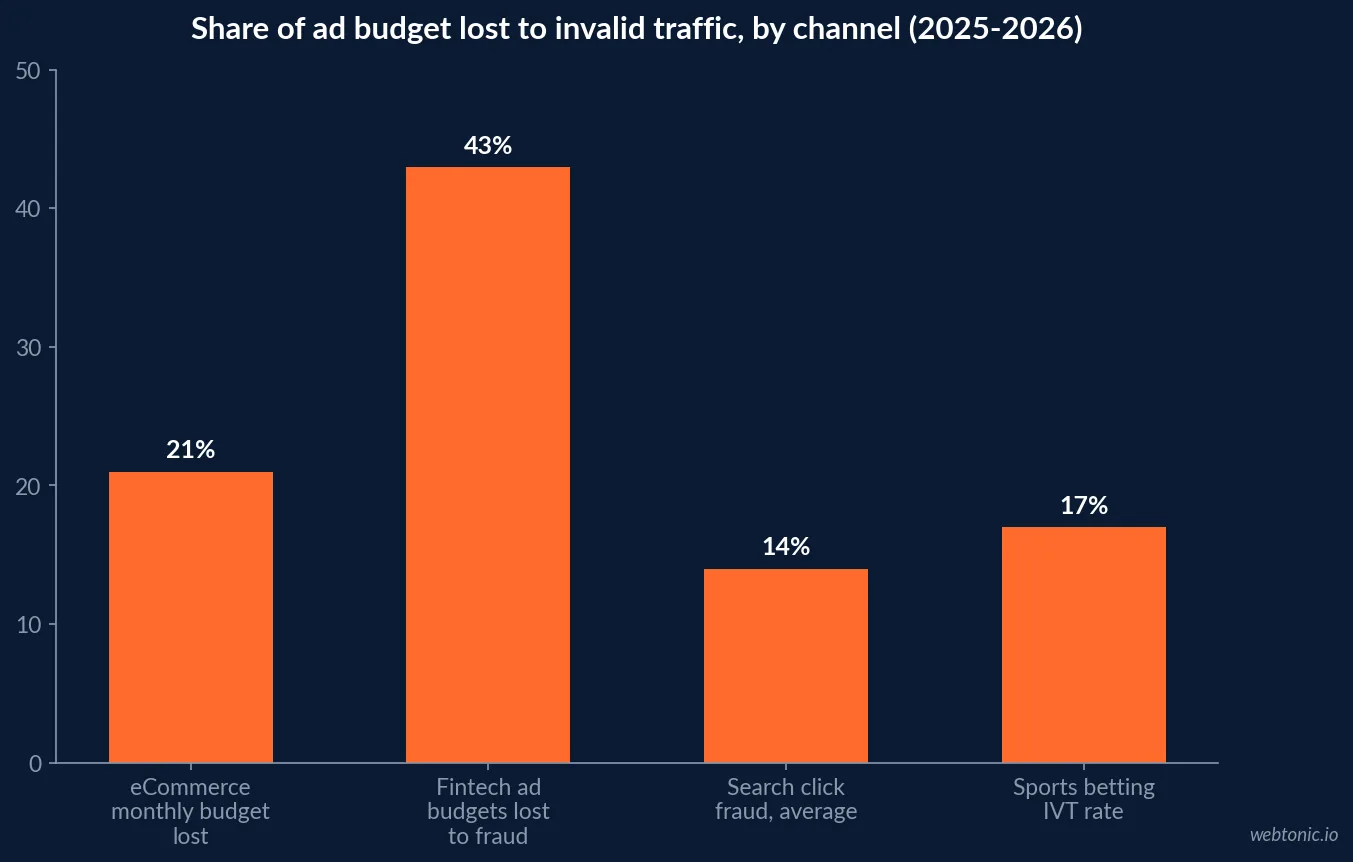
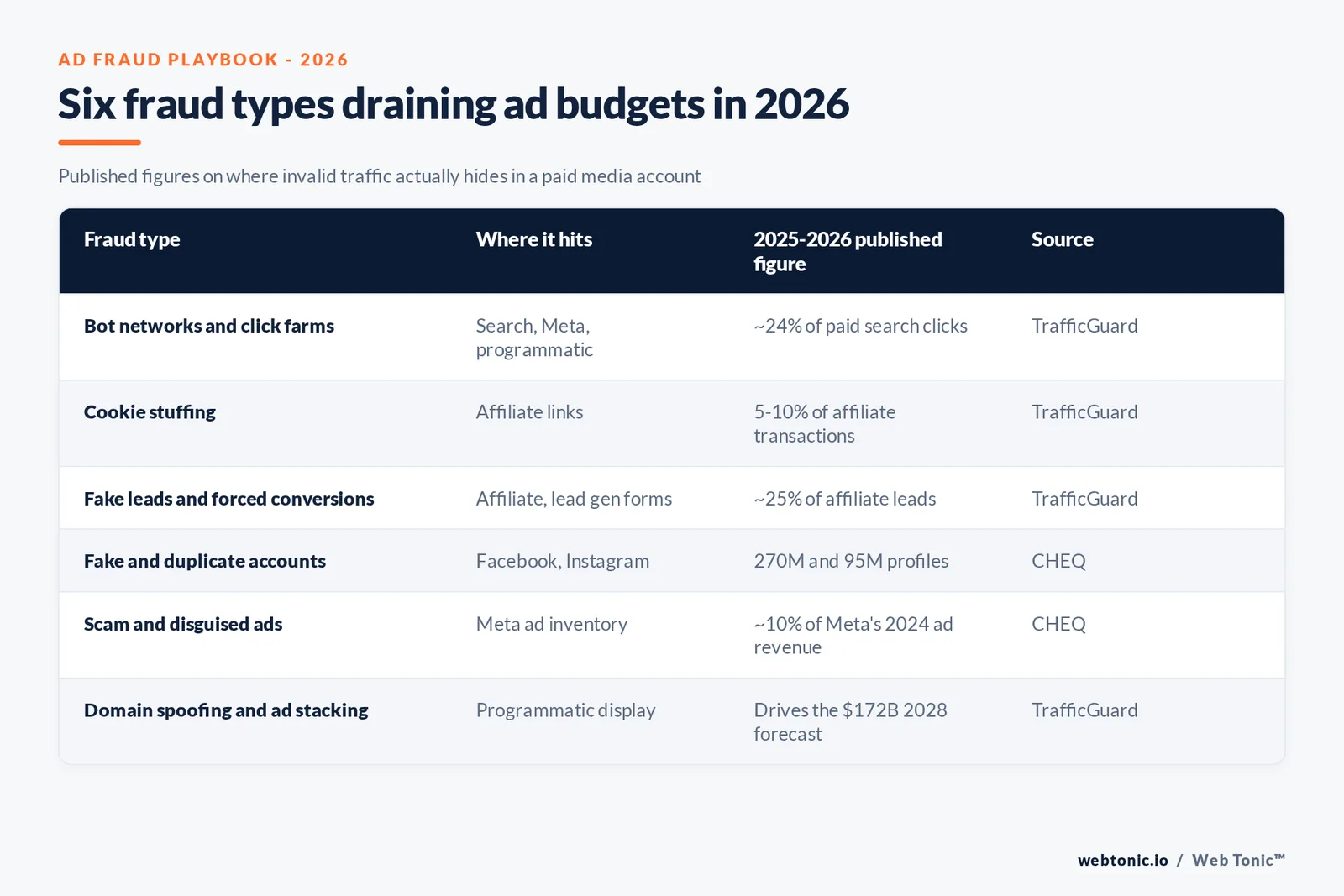
Search is where most marketers first encounter the term. TrafficGuard's compiled 2026 figures show an average of 14% of all clicks on paid search campaigns coming from non-genuine sources, with bots responsible for approximately 24% of clicks overall. Click fraud rates range between 14% and 22% depending on industry and geography, and bot networks drive nearly 40% of the fraud that does occur.
CHEQ's invalid traffic breakdown, based on ClickCease data, separately found an average fraudulent-click rate of 14% as of 2020, with some industries such as photography, locksmithing and plumbing seeing over 70% invalid clicks, and law, finance and e-commerce holding around 30%. Across the board, roughly 90% of paid search campaigns are affected in some capacity.
| Search click fraud signal | Published figure | Source |
|---|---|---|
| Average invalid click rate, paid search | 14% | TrafficGuard / CHEQ |
| Range by industry and geography | 14%-22% | TrafficGuard |
| Share of clicks driven by bots | ~24% | TrafficGuard |
| Share of click fraud from bot networks | ~40% | TrafficGuard |
| High-risk local-service verticals | over 70% invalid clicks | CHEQ |
| Law, finance, e-commerce verticals | ~30% invalid clicks | CHEQ |
Bot traffic and fake accounts on social platforms
Social fraud looks less like a rogue click and more like a fake audience. CHEQ's research into bots on Facebook and Instagram estimates 270 million Facebook accounts and 95 million Instagram accounts are bots or fake profiles, and finds that roughly 4% of ad clicks and impressions on Facebook are effectively wasted on non-genuine audiences.
TrafficGuard's channel-level data adds that scam ads accounted for around 10% of Meta's 2024 ad revenue, and that 4% to 5% of Meta's monthly active users are estimated to be fake accounts. None of this shows up as a broken link - it shows up as inflated reach and engagement that never converts.
Affiliate marketing's fraud problem
Affiliate fraud is harder to see because the attribution model itself can be gamed. TrafficGuard's 2026 data finds 17% of affiliate traffic has been proven fake, cookie-stuffing schemes affecting 5% to 10% of affiliate transactions, and an estimated 25% of affiliate-generated leads potentially fake - together costing advertisers an estimated USD 3.4 billion.
That number has grown quickly. 99firms' affiliate marketing statistics, citing CHEQ, put 2020 affiliate fraud losses at USD 1.4 billion - meaning the estimated cost has more than doubled in roughly five years as affiliate spend itself grew.
| Affiliate fraud signal | Published figure | Source |
|---|---|---|
| Affiliate traffic proven fake | 17% | TrafficGuard |
| Transactions affected by cookie stuffing | 5%-10% | TrafficGuard |
| Affiliate leads that may be fake | up to 25% | TrafficGuard |
| Estimated cost of affiliate fraud, current | USD 3.4 billion | TrafficGuard |
| Estimated cost of affiliate fraud, 2020 | USD 1.4 billion | CHEQ via 99firms |
Ad fraud by industry: where exposure concentrates
Fraud is not evenly distributed. TrafficGuard's industry breakdown, drawing on multiple named sources, shows a mid-sized e-commerce store losing an average of 21% of its monthly budget to invalid traffic, with 57% of e-commerce holiday-season traffic estimated to be bots (citing Nasdaq data). Sports betting carries an estimated USD 10.5 billion of at-risk digital ad spend and a published invalid-traffic rate near 17%. Fintech loses an estimated 43% of ad budgets to fraudulent clicks, and travel advertisers see bot traffic near 80%, largely from automated price-scraping.
| Industry | Published exposure figure | Source (via TrafficGuard) |
|---|---|---|
| Mid-sized e-commerce | 21% of monthly budget lost | TrafficGuard |
| e-Commerce, holiday season | 57% of traffic is bots | Nasdaq |
| Sports betting | USD 10.5B at-risk spend / ~17% IVT | Statista / PMW |
| Fintech | 43% of ad budgets lost to fraud | mFilterIt |
| Travel | ~80% of traffic is bots | Imperva |
Why fraud detection is becoming its own line item
The response to these numbers is a fast-growing detection market. MarketsandMarkets' fraud detection and prevention market report projects the broader fraud detection and prevention (FDP) market to grow from USD 35.71 billion in 2026 to USD 80.01 billion by 2031, a 17.5% CAGR - a market that increasingly includes ad-specific invalid traffic tools sold alongside banking and identity fraud products.
For a paid media team, that growth is a signal, not a solution: budget for monitoring is being treated as part of the media plan, not an optional add-on, in the same way Google Ads budgets now routinely fold in a tooling line.
Why the published estimates disagree
Every number above comes from a different measurement method - some track clicks, some track sessions, some track ad revenue exposed to scam creatives, and some model losses forward to 2028. That is why "the" ad fraud rate does not exist as a single figure; a search campaign, a Meta campaign and an affiliate program each need their own baseline before a number becomes actionable.
The practical takeaway is to benchmark your own invalid-traffic rate against the range for your channel and industry above, rather than importing a single average from a different vertical.
| Where estimates diverge | What it measures | Why it moves |
|---|---|---|
| Click-level fraud (14-24%) | Individual paid search clicks | Bot sophistication, geography |
| Revenue-level fraud (~10% of Meta ad revenue) | Ad spend touching scam creatives | Platform enforcement cycles |
| Account-level fraud (270M/95M profiles) | Fake or bot accounts on a platform | Platform-reported cleanup waves |
| Forward-looking losses (USD 172B by 2028) | Total global fraud trajectory | Ad spend growth, new fraud tactics |
Warning signs a campaign is exposed
Across every channel above, the same signals recur: unexplained spikes in clicks or impressions without a matching lift in conversions, unusually high click-through rates from a narrow set of placements, repeat clicks from the same source, and a rising cost per acquisition that outpaces any change in bidding. Affiliate programs add their own tell - commission claims that spike right after a cookie window resets.
None of these on their own proves fraud, but two or three together on the same campaign is worth a manual audit before the next budget increase.
What this means for how you plan a budget
If 14% to 22% of search clicks and 17% of affiliate traffic can be non-genuine, then a media plan that doesn't reserve room for monitoring is quietly overstating its own expected return. Building a fraud-adjusted CPA into the plan - rather than discovering the gap in a quarterly review - is the difference between a budget that holds up and one that needs a mid-quarter correction. Our data and analytics team builds that adjustment into campaign forecasts before the first dollar is spent, and if you want a second read on an account that already looks off, talk to us.
How this compares to a year ago
The direction of travel across every source above is the same: fraud estimates keep rising even as detection spend rises with them. TrafficGuard's own framing is that losses are "projected to exceed" USD 172 billion by 2028 precisely because current-year losses, near USD 250 billion by some measures, are still climbing faster than most fraud-prevention budgets. That is the argument for treating an invalid-traffic audit as a recurring line item on a media plan rather than a one-time cleanup project.
Frequently Asked Questions
What percentage of ad clicks are fraudulent?
It depends heavily on the channel. TrafficGuard's 2026 data puts the paid search average at around 14% of clicks from non-genuine sources, with a 14% to 22% range depending on industry and geography, and bots alone responsible for close to 24% of all clicks. Affiliate traffic runs higher still, with roughly 17% flagged as fake. There is no single honest number - the range is the finding.
How much money does ad fraud cost advertisers each year?
TrafficGuard estimates current global losses at around USD 250 billion, with digital ad fraud losses projected to exceed USD 172 billion annually by 2028 on their own. Roughly USD 1 of every USD 3 spent on digital marketing budgets is estimated to be lost to fraud in exposed channels, and 22% of global digital ad spend was lost to ad fraud on their current-year read.
Which industries see the highest ad fraud rates?
Travel and sports betting stand out. Imperva's bot data, cited by TrafficGuard, puts bot traffic at around 80% for travel advertisers, largely from price-scraping bots. Fintech loses an estimated 43% of ad budgets to fraudulent clicks according to mFilterIt, and sports betting carries a published invalid-traffic rate of about 17% alongside an estimated USD 10.5 billion of at-risk digital ad spend.
Is fraud worse on Facebook and Instagram than on search?
It shows up differently rather than uniformly worse. CHEQ estimates 270 million Facebook accounts and 95 million Instagram accounts are bots or fakes, with scam ads accounting for around 10% of Meta's 2024 ad revenue and 4% to 5% of monthly active users estimated fake. Search fraud is more about clicks; social fraud is more about the audience quality behind the click.
Does affiliate marketing have a fraud problem too?
Yes, and it is one of the least monitored. TrafficGuard puts fake affiliate traffic at around 17%, cookie-stuffing schemes affecting 5% to 10% of transactions, and as much as 25% of affiliate-generated leads potentially fake, at an estimated cost of USD 3.4 billion. CHEQ's earlier estimate put 2020 affiliate fraud losses at USD 1.4 billion, so the number has grown, not shrunk.
Sources
TrafficGuard - Click Fraud Statistics 2026
CHEQ - What Is Invalid Traffic (IVT)?
CHEQ - How to Protect Your Ads From Bots on Facebook
99firms - Affiliate Marketing Stats and Emerging Trends
MarketsandMarkets - Fraud Detection and Prevention Market Report
Statista - Advertising Worldwide, Statistics and Facts
Imperva - 2026 Bad Bot Report