Table of contents
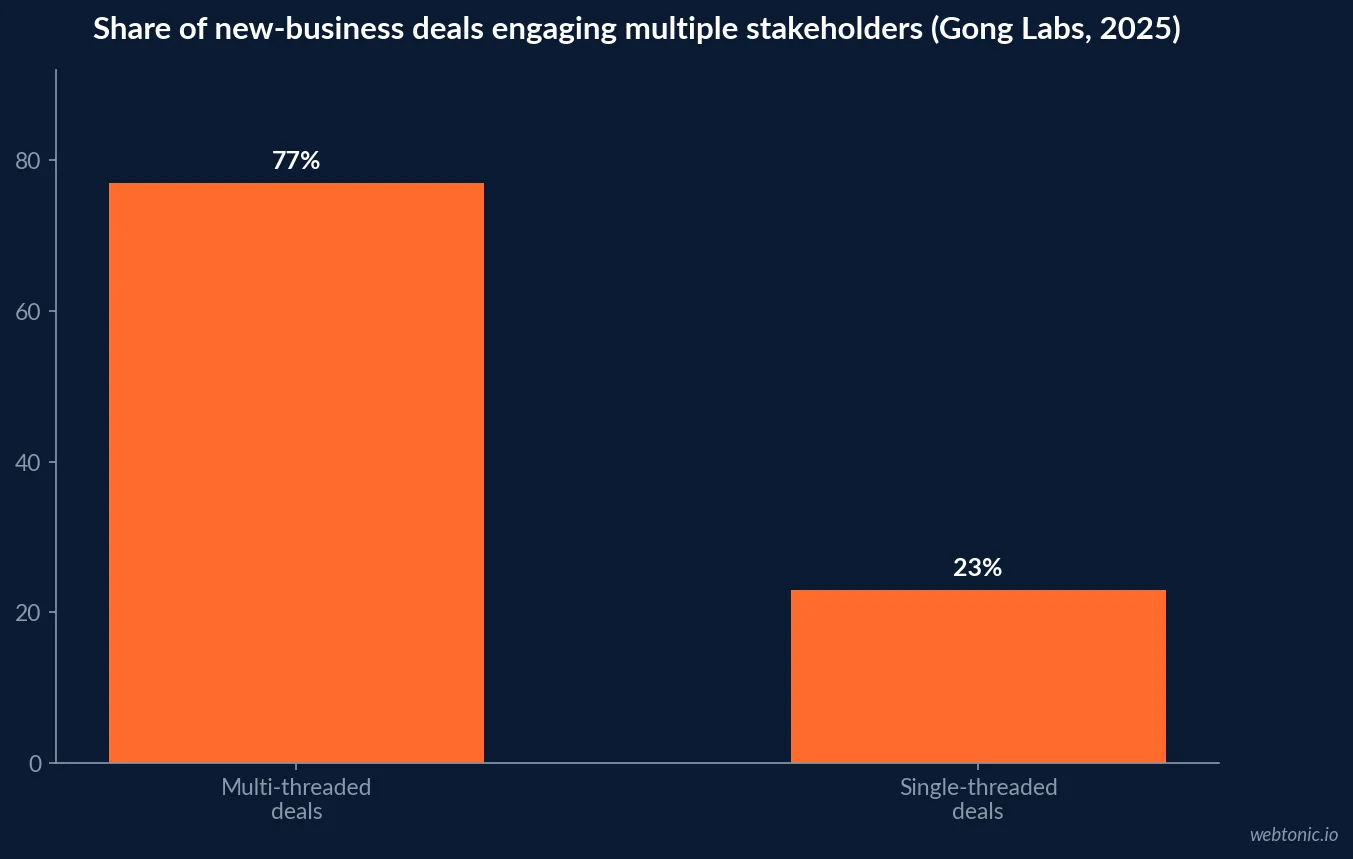
Account-based selling treats the buying group as the unit of the deal, not the lead. Gong Labs' analysis of 1.8 million new-business opportunities closed in 2024 found that deals engaging multiple stakeholders close at meaningfully higher rates than single-threaded ones, and separate research from Forrester and LinkedIn shows the same pattern in deal size and buying-group structure. This page pulls the published win-rate, deal-size and pipeline-velocity numbers together in one place.
Key Takeaways
- 77% of new-business deals are multithreaded, per Gong Labs' 2025 analysis of 1.8 million opportunities closed in 2024.
- Multithreading lifts win rate by 130% in deals over USD 50,000.
- Closed-won deals carry 67% more buyer contacts than closed-lost deals.
- Strategic enterprise deals average 17 buyer contacts on the winning side.
- Closed-won deals include 6.7 selling-team members by the end of discovery and scoping.
- AI-assisted stakeholder briefing cuts average deal duration by 26%, per Gong Labs.
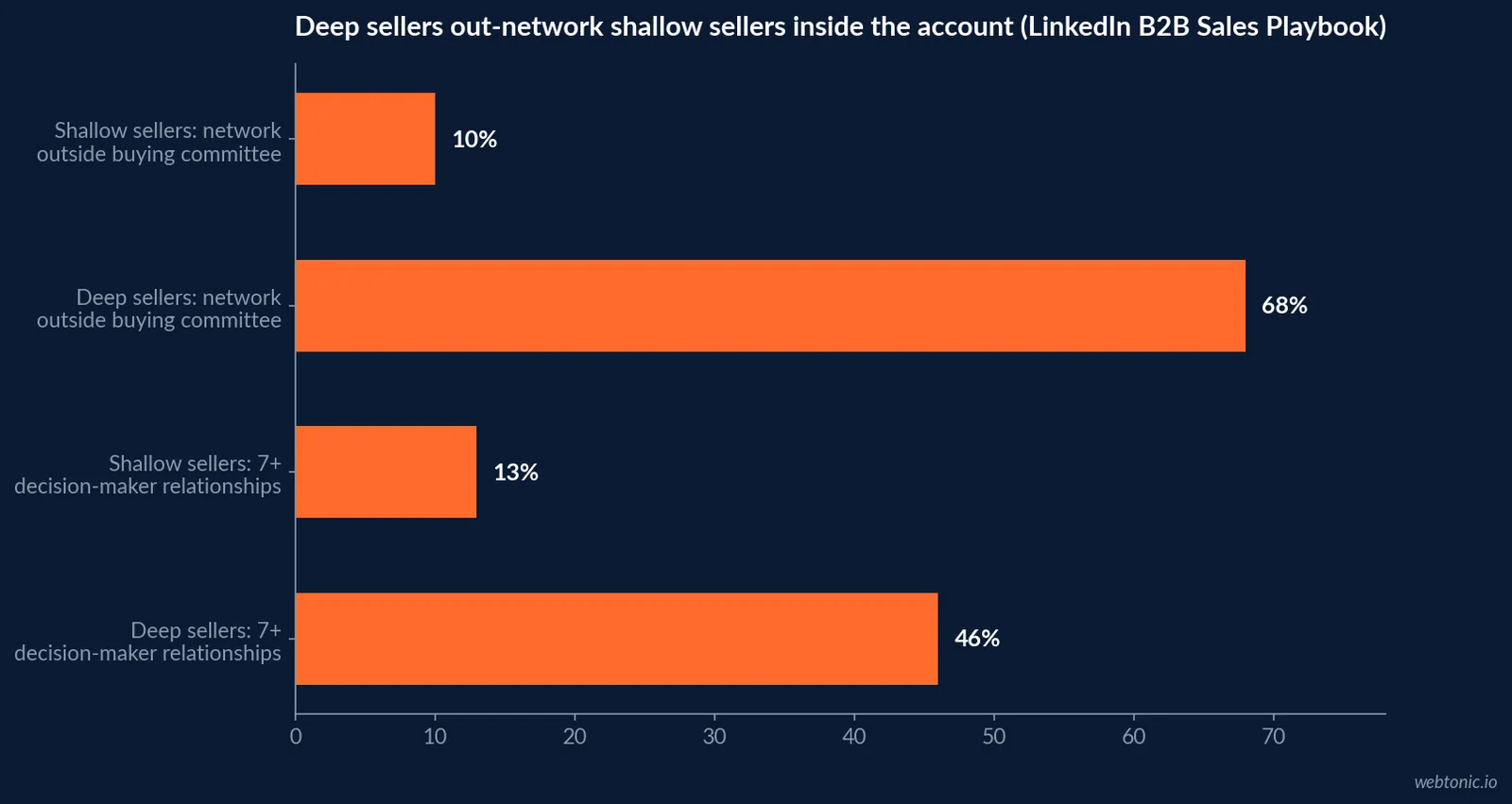
- 46% of "deep sellers" hold relationships with 7 or more decision-makers in an account, against 13% of shallow sellers.
- 68% of deep sellers say connecting with people outside the formal buying committee moves deals forward, against 10% of shallow sellers.
- Hidden allies outside the committee shorten the path to close by an average of 17%.
- Buying decisions generally involve up to 11 people, per LinkedIn's Sales Leader Compass research.
- Nearly three in four sellers report the number of buyers on a deal has grown over the last two years.
- North American ABM accounts most often report an 11% to 20% deal-size lift.
- European ABM accounts most often report a 21% to 50% deal-size lift.
- Asia Pacific ABM accounts most often report a 51% to 100% deal-size lift.
- The median SDR carries a base-to-variable pay split of 68:32 on OTE of USD 80,000.
- 60% of SDRs hit quota, the lowest share the Bridge Group has recorded since 2018.
- Median SDR ramp time has fallen to 3.0 months, the fastest on record.
- Median average selling price across sampled B2B companies is USD 50,000.
What "account-based" changes about who is actually in the deal
The evidence base for account-based selling is not survey opinion, it is deal telemetry. Gong Labs analyzed 1.8 million new-business opportunities closed in 2024 and found that 77% are already multithreaded in some form, but the deals that actually close carry roughly twice the buyer contacts of the ones that do not. The gap between "technically multithreaded" and "sufficiently multithreaded" is where account-based selling lives.
That gap widens with deal size. Large strategic enterprise deals in the same Gong Labs dataset average 17 buyer contacts on the winning side, roughly double the contact count of a typical multithreaded opportunity, which is the practical definition of an account, not a lead.
| Metric (2024-2025 data) | Figure | Source | What it measures |
|---|---|---|---|
| Deals that are multithreaded | 77% | Gong Labs | Share of 1.8M new-business opportunities |
| Win-rate lift from multithreading, deals >USD 50K | +130% | Gong Labs | Closed-won vs closed-lost |
| Contact-count gap, closed-won vs closed-lost | +67% | Gong Labs | Team selling guide |
| Buyer contacts on won strategic enterprise deals | 17 | Gong Labs | Average per deal |
| Selling-team members on closed-won deals by scoping | 6.7 | Gong Labs | Average per deal |
| Deal duration change from AI stakeholder briefing | -26% | Gong Labs | AI Briefer feature |
Deep sellers versus shallow sellers
LinkedIn's B2B Sales Playbook research splits sellers into "deep" and "shallow" groups by how many relationships they hold inside a target account, and the gap is stark: 46% of deep sellers hold relationships with 7 or more decision-makers in an account, against just 13% of shallow sellers. Deep sellers are also far more willing to work the edges of the account: 68% strongly agree that connecting with people outside the formal buying committee helps move a deal forward, against 10% of shallow sellers, and LinkedIn's data attributes an average 17% faster path to close to those "hidden ally" relationships.
The buying group itself keeps growing. LinkedIn's Sales Leader Compass research puts a typical buying decision at up to 11 people, and nearly three-quarters of sellers report that the number of buyers involved has increased over the last two years, which is the structural reason single-threaded prospecting keeps losing ground.
| Seller behavior | Deep sellers | Shallow sellers | Source |
|---|---|---|---|
| Relationships with 7+ decision-makers in-account | 46% | 13% | LinkedIn B2B Sales Playbook |
| Strongly agree outside-committee contacts help | 68% | 10% | LinkedIn B2B Sales Playbook |
| Faster path to close via hidden allies | 17% faster | n/a | LinkedIn B2B Sales Playbook |
| Buying decisions involving up to 11 people | Reported by sellers broadly | - | LinkedIn Sales Leader Compass |
Deal size: what account-based motions are worth
Forrester's 2024 regional data on account-based marketing accounts found the deal-size lift clusters differently by geography. Globally, roughly one-third of respondents reported an 11% to 20% uplift and just under a third reported 21% to 50%. By region, North America most often landed in the 11% to 20% band, Europe most often landed in the 21% to 50% band, and Asia Pacific most often reported the largest lift, 51% to 100%.
Read this as a targeting signal, not a universal multiplier: the accounts that get the account-based treatment already skew larger and more strategic, so some of the lift is selection, not technique. What is consistent across regions is the direction, not the size, of the effect.
| Region (Forrester, 2024) | Most common deal-size uplift band | Read |
|---|---|---|
| North America | 11% to 20% | Smaller, steadier lift on a mature ABM base |
| Europe | 21% to 50% | Larger lift on accounts with less prior coverage |
| Asia Pacific | 51% to 100% | Largest lift, smallest base of comparable accounts |
| Global (all respondents) | ~1/3 report 11-20%, ~1/3 report 21-50% | Two dominant bands, not one number |
Pipeline velocity: the sales-development layer underneath the account
Account-based selling still runs on a sales-development engine, and that engine's own benchmarks have moved. The Bridge Group's 2025 SDR Models, Motions & Metrics report, its 10th edition and drawn from 351 B2B companies (83% B2B SaaS, median revenue USD 47M), found median SDR on-target earnings flat at USD 80,000 on a 68:32 base-to-variable split, quota attainment down to 60% of reps, the lowest the study has recorded since 2018, and median ramp time at a series-low 3.0 months. Median average selling price across the sample sits at USD 50,000.
A shorter ramp with lower quota attainment is not a contradiction: it means new reps get productive faster on activity, but converting that activity into an account-based win still depends on whether they are taught to build a buying group instead of chasing a single lead.
| Sales-development benchmark (2025) | Figure | Source |
|---|---|---|
| Median SDR on-target earnings | USD 80,000 | Bridge Group |
| Base-to-variable pay split | 68:32 | Bridge Group |
| Reps at quota | 60% (series low) | Bridge Group |
| Median ramp time | 3.0 months (series low) | Bridge Group |
| Median average selling price | USD 50,000 | Bridge Group |
Alignment is the precondition, and most teams still lack it
Account-based selling assumes sales and marketing are working the same account list, and the 2026 data says most are not. Sagefrog's 2026 B2B Marketing Mix Report, its 19th annual edition drawn from nearly 500 B2B marketers, found only 35% of organizations report full sales and marketing alignment, and the same report ties that alignment directly to outperformance in lead quality, conversion rates and revenue growth. Sixty-five percent of organizations, in other words, are running an account-based motion on one side of the house without a matching one on the other.
Sagefrog's separate 2026 outsourcing data shows how B2B teams are trying to close that gap without new headcount: hybrid outsourcing models, mixing internal owners with external execution, rose to 46% of respondents in 2026, up from 36% the year before, with limited internal bandwidth cited by 42% as the top driver, ahead of cost or expertise.
| Sales-marketing alignment (Sagefrog 2026 B2B Marketing Mix Report) | Figure |
|---|---|
| Organizations reporting full alignment | 35% |
| Organizations using a hybrid in-house/agency model | 46% (up from 36% in 2025) |
| Citing limited internal bandwidth as the top outsourcing driver | 42% (up from 37% in 2025) |
| Reporting outsourced support helped meet business objectives | 76% |
Where the AI layer is actually changing outcomes
The one place account-based selling has a directly measured AI effect, rather than a sentiment survey about AI, is deal orchestration. Gong Labs found that teams using its AI stakeholder-briefing feature saw a 26% decrease in average deal duration, tied specifically to reducing the friction of briefing internal stakeholders and handing deals between reps as the buying group grows. That is a pipeline-velocity effect, not a win-rate effect, and the two should be tracked separately.
Our growth marketing practice and data and analytics practice build the account and contact-level instrumentation that makes a multithreading metric like this measurable in the first place, rather than a one-off study finding.
How to read these numbers together
None of these studies measure the exact same population: Gong Labs measures deals inside its own customer base, Forrester surveys B2B marketers about ABM programs, LinkedIn surveys sellers using Sales Navigator, and the Bridge Group surveys SDR leaders directly. Treat the direction as the signal — more stakeholders, engaged earlier, correlates with bigger and faster wins across every one of these independently run studies — and treat any single percentage as a description of that source's population, not a universal constant for your pipeline.
The practical takeaway is to instrument your own buying-group size and contact count per deal stage, then compare your own multithreaded-versus-single-threaded win rate the way Gong Labs compares its aggregate one. That comparison, run on your own CRM data, is worth more than any published percentage. For the paid-acquisition side of filling that pipeline, see our breakdown of what Google Ads actually costs and how it compares with the account lists you are already targeting.
Frequently Asked Questions
What is account-based selling, in measurable terms?
It is a sales motion built around the buying group rather than a single contact. Gong Labs' analysis of 1.8 million new-business deals closed in 2024 found 77% already involve multiple stakeholders, and deals that close successfully carry roughly twice the buyer contacts of deals that do not. The measurable version of account-based selling is simply: how many of the right people are engaged, and how early.
How much does multithreading actually move win rate?
Gong Labs reports a 130% win-rate lift from multithreading in deals over USD 50,000, and its separate guide on team selling found closed-won deals carry 67% more contacts than closed-lost deals. Both figures come from the same research team analyzing live CRM and call data, not a self-reported survey.
Does account-based selling change deal size?
Forrester's 2024 regional data on account-based marketing accounts found deal-size increases cluster differently by region: North America most often reported an 11% to 20% lift, Europe most often reported 21% to 50%, and Asia Pacific most often reported 51% to 100%. Roughly a third of respondents globally landed in each of the two lower bands.
How many stakeholders does a real buying group involve?
LinkedIn's Sales Leader Compass research puts the number at up to 11 people in a typical buying decision, and Gong Labs measured an average of 17 buyer contacts on won strategic enterprise deals specifically, which are larger and more contested than the typical opportunity.
What is the fastest way to tell if a rep is account-based selling or just prospecting a lead?
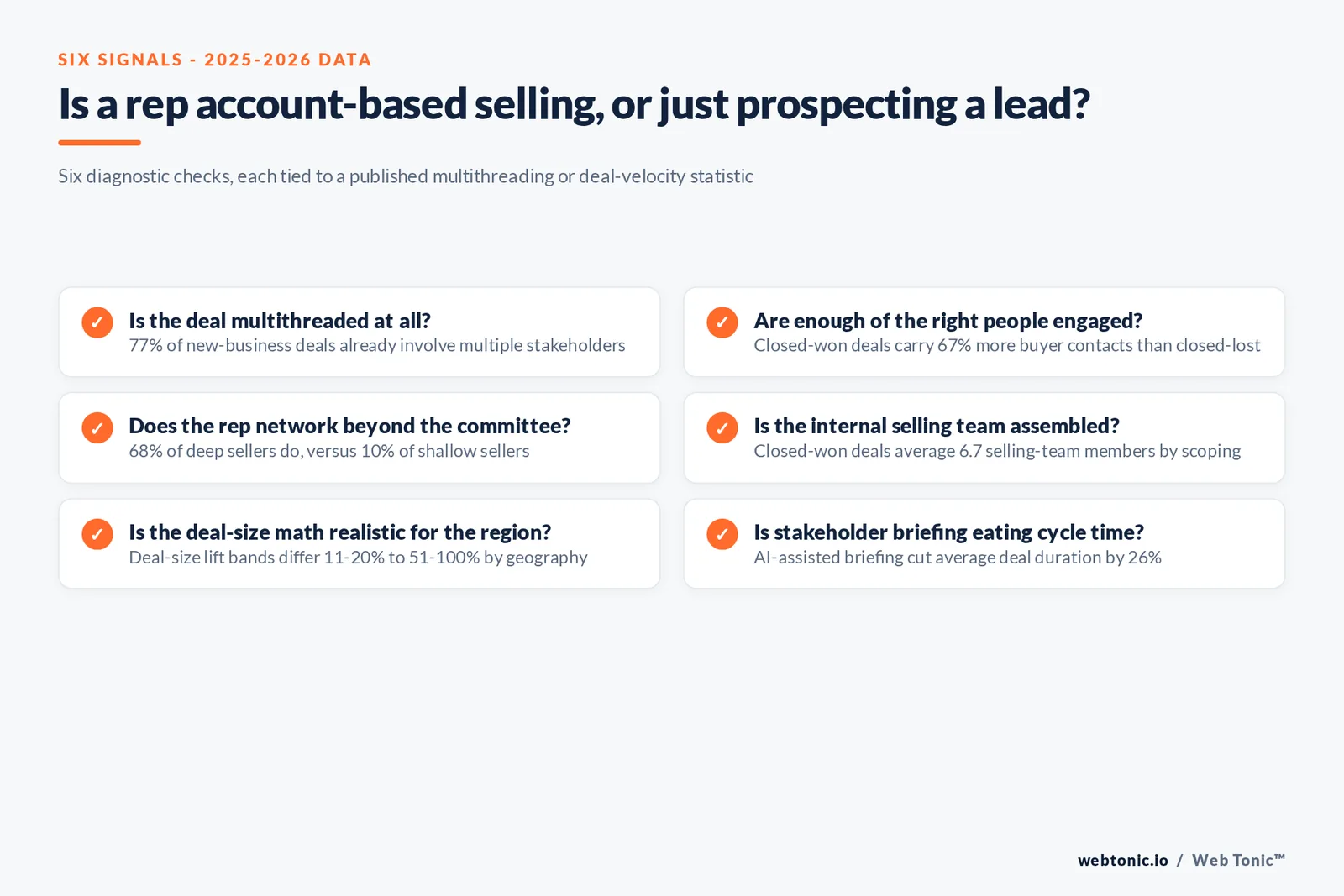
Count the internal and external people on the deal. Gong Labs found closed-won deals include an average of 6.7 members of the selling team by the time discovery and scoping wrap up, and LinkedIn's data shows 68% of 'deep sellers' strongly agree that engaging people outside the formal buying committee moves deals forward, against 10% of shallow sellers. A single-threaded rep working a single-threaded deal is not practicing account-based selling regardless of what the CRM field says.
Sources
Gong Labs - Data shows top reps don't just sell, they orchestrate (2025)
Gong Labs - The best sales insights of 2025
LinkedIn Sales Navigator - B2B Sales Playbook
LinkedIn - Multithreading in sales: why it matters and how to do it well
LinkedIn Sales Leader Compass - AI-powered sales best practices report
Forrester - Account-based marketing results in larger average deal sizes across regions (2024)
The Bridge Group - 2025 SDR Models, Motions & Metrics Report
Sagefrog - 8 insights from the 2026 B2B Marketing Mix Report
Sagefrog - 2026 B2B Marketing Mix Report