



Table of contents
Account-based marketing (ABM) flips the traditional B2B funnel on its head — instead of casting a wide net and hoping the right leads fall in, it focuses every marketing and sales resource on a shortlist of high-value target accounts. The result: 76% of marketers report higher ROI from ABM than any other marketing approach, and top-performing programs deliver an average 7:1 return on investment.
Key Takeaways
- 71% of B2B organizations now implement an ABM strategy, up from 67% in 2023 — and an additional 23% plan to adopt it within 12 months.
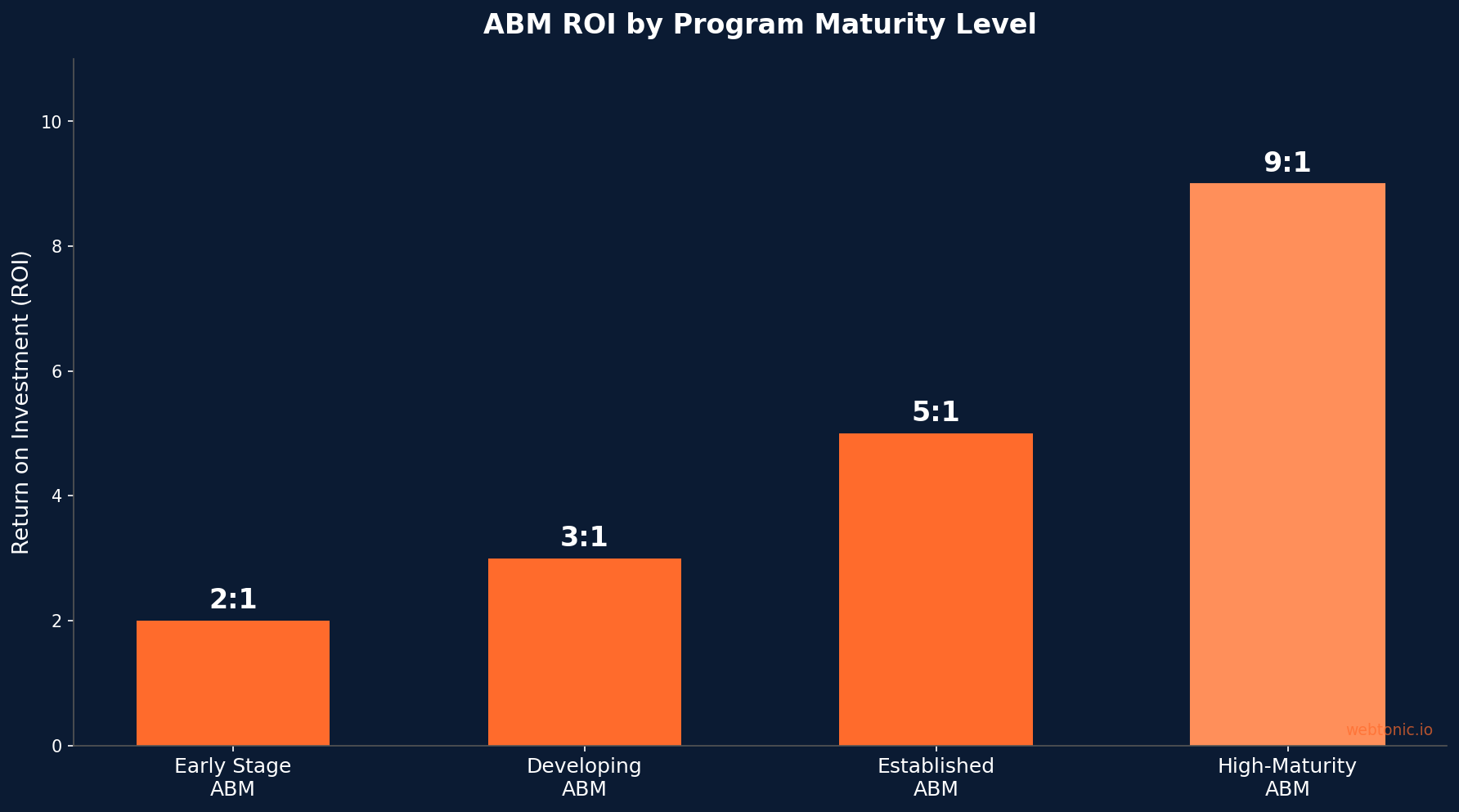
- High-maturity ABM programs achieve 5–9× ROI on average, compared to 3:1 for programs still in early stages.
- ABM shortens the B2B sales cycle by 20–30% because marketing and sales teams pursue the same accounts with personalized, multi-channel campaigns.
- The ideal customer profile (ICP) and target account list are the foundation — every ABM strategy fails without disciplined account selection based on intent data and firmographics.
- ABM platforms like Demandbase and 6sense start at $50K–$80K annually for mid-market contracts, with enterprise deployments exceeding $200K — but the pipeline lift justifies the investment for accounts worth six or seven figures.
What Is Account-Based Marketing (ABM)?
Account-based marketing is a focused B2B growth strategy where marketing and sales teams collaborate to create personalized buying experiences for a defined set of high-value target accounts. Unlike traditional lead generation — which measures success by the volume of marketing-qualified leads (MQLs) — ABM measures success by the quality of engagement and pipeline created with specific accounts. If your team is evaluating a full-funnel overhaul, our growth marketing services page covers how ABM fits alongside paid and organic channels.
The approach works because B2B buying committees are growing larger. The average enterprise deal now involves 6–10 decision makers, each consuming their own content and forming independent opinions before a vendor even gets a meeting. ABM ensures your content, ads, and outreach reach every stakeholder inside the accounts that matter most.
Three tiers define how companies practice ABM today:
- 1:1 ABM (Strategic) — Fully customized campaigns for individual accounts. Best for enterprise deals worth $500K+ with long sales cycles.
- 1:Few ABM (Cluster) — Personalized campaigns for small groups of 5–15 accounts sharing similar challenges. Balances personalization with scale.
- 1:Many ABM (Programmatic) — Technology-driven campaigns targeting hundreds or thousands of accounts using intent data and automation. Best for mid-market pipeline generation.
ABM vs. Traditional Lead Generation
The core difference between account-based marketing and traditional demand generation is the direction of the funnel. Traditional marketing starts broad and narrows — ABM starts narrow and expands influence within each target account. Here is how they compare across the key dimensions that matter for B2B revenue teams:
| Dimension | Traditional Lead Gen | Account-Based Marketing |
|---|---|---|
| Targeting | Broad audience, demographic filters | Named target accounts, firmographic + intent signals |
| Success metric | MQL volume, cost per lead | Account engagement score, pipeline per account |
| Sales alignment | Handoff at MQL stage | Continuous collaboration from day one |
| Content approach | Generic assets for wide distribution | Personalized content mapped to buying committee roles |
| Average ROI | 2–3× typical | 5–9× for mature programs |
| Sales cycle impact | Standard cycle length | 20–30% shorter with aligned ABM campaigns |
| Deal size | Variable, many small deals | 171% larger average contract value |
Building Your ABM Strategy: A Step-by-Step Framework
A successful account-based marketing strategy follows a structured approach that aligns sales and marketing teams around shared revenue goals. The framework below synthesizes best practices from the leading ABM strategy frameworks used by B2B organizations:
Step 1: Define Your Ideal Customer Profile (ICP)
Your ABM strategy lives or dies by the quality of your ideal customer profile. Analyze your best existing customers — look at firmographics (industry, company size, revenue), technographics (tech stack), and behavioral signals (content consumption, product usage). The ICP should describe the account-level characteristics that predict a high lifetime value and strong product-market fit.
Step 2: Build and Tier Your Target Account List
Using your ICP, build a target account list and assign each account to a tier. Tier 1 accounts (top 10–25) receive fully custom 1:1 campaigns. Tier 2 accounts (25–100) get cluster campaigns with industry-specific personalization. Tier 3 accounts (100–1,000+) are reached through programmatic ABM using intent data and marketing automation.
Step 3: Map the Buying Committee
For each Tier 1 and Tier 2 account, identify the key decision makers, influencers, and champions by role. In a typical enterprise deal, this means mapping the economic buyer (CFO/VP), the technical evaluator, the end-user champion, and the legal/procurement gatekeeper. Intent data tools surface which individuals at a target account are actively researching your category.
Step 4: Create Personalized Content and Campaigns
Develop content mapped to each stage of the buyer journey and each persona in the buying committee. For Tier 1 accounts, this means custom landing pages, personalized video messages, and account-specific case studies. For Tier 2 and Tier 3, create industry-vertical playbooks, ROI calculators, and targeted ad sequences using platforms like Demandbase or 6sense.
Step 5: Execute Multi-Channel ABM Campaigns
ABM campaigns work best when they surround the target account across multiple channels simultaneously — LinkedIn advertising, personalized email sequences, direct mail, targeted display ads, and sales outreach all coordinated around the same messaging and timing. The goal is to create the impression that your brand is everywhere the buying committee looks.
Step 6: Measure Account Engagement, Not Just Leads
Traditional funnel metrics like MQLs don't capture ABM's value. Instead, measure account engagement scores (how many stakeholders at an account are interacting with your content), pipeline velocity (time from first touch to opportunity), and account-level revenue influenced by ABM campaigns. 47% of ABM practitioners cite proving ROI and attribution as their top challenge — solve this by aligning your ABM platform with your CRM from day one.
ABM Benchmarks and ROI Statistics
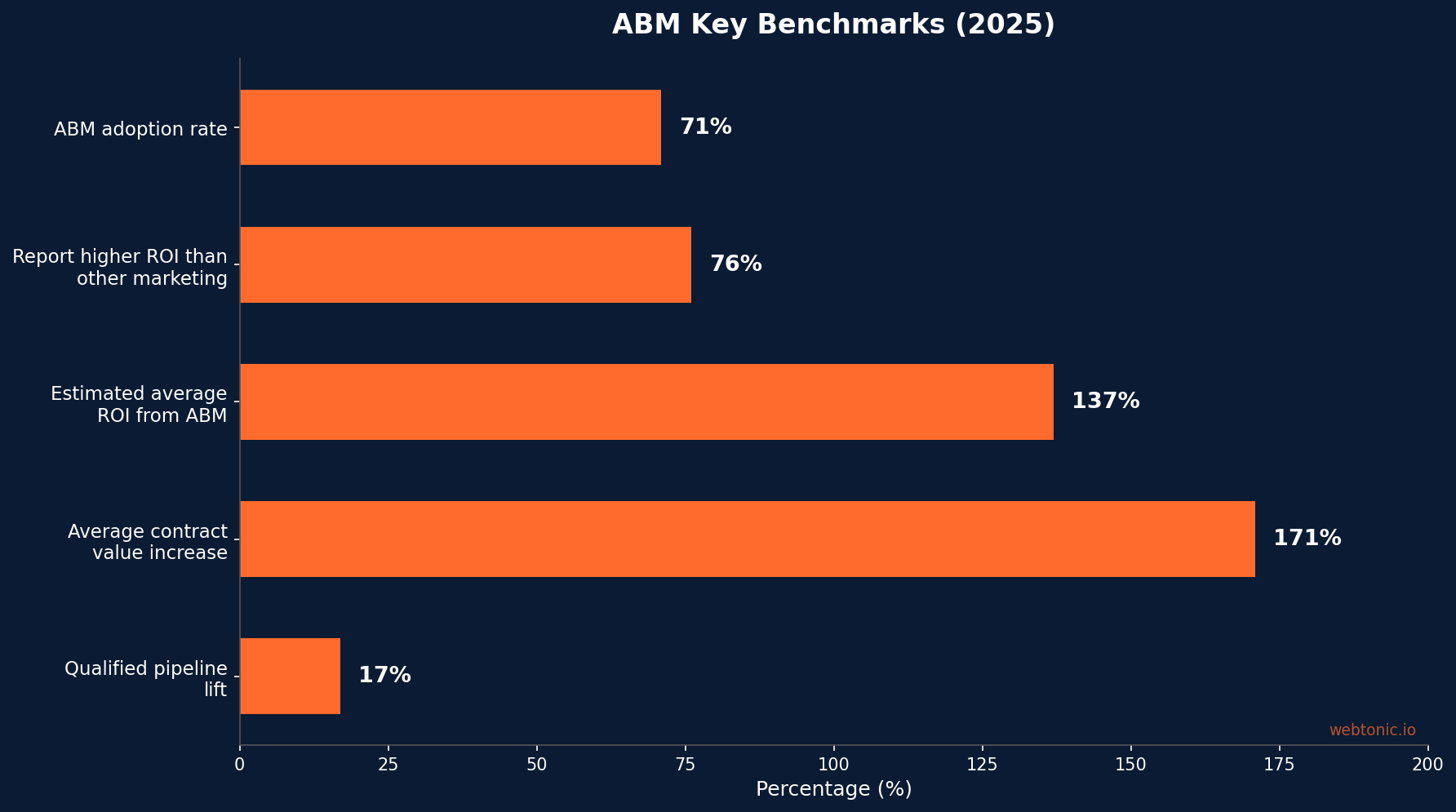
The data consistently shows that account-based marketing outperforms every other B2B marketing approach when executed well. Here are the latest ABM benchmarks from industry surveys:
| ABM Metric | Benchmark | Source |
|---|---|---|
| ABM adoption rate | 71% of B2B organizations | DemandGen Report, 2025 |
| ABM ROI vs. other marketing | 76% report higher ROI than any other approach | ITSMA / ABM Leadership Alliance |
| Top-performing ABM ROI | 7:1 average return | TOPO, 2024 |
| High-maturity ABM ROI | 5–9× return on investment | Revenue Memo / industry aggregate |
| Estimated average ROI | 137% return | Outcomes Rocket, 2025 |
| Pipeline lift | 17% qualified-pipeline increase | The Starr Conspiracy / Forrester |
| Average contract value lift | 171% larger deal size | ABM Leadership Alliance |
| Sales cycle reduction | 20–30% shorter | Directive Consulting |
Top ABM Platforms and Tools
The ABM technology landscape has consolidated around several enterprise platforms that handle intent data, account identification, campaign orchestration, and measurement. Choosing the right ABM platform depends on your team size, budget, and whether you prioritize predictive analytics or multi-channel activation.
- Demandbase — The most established ABM platform with a native B2B demand-side platform (DSP) for programmatic display advertising. Best for organizations with defined target account lists that need multi-channel campaign orchestration. Mid-market contracts start at $50K–$80K annually.
- 6sense — Known for its predictive analytics and AI-powered buying-stage predictions. 6sense identifies anonymous website visitors at the account level and scores their intent signals across the web. Enterprise deployments can exceed $200K–$250K annually.
- HubSpot ABM — An accessible entry point for mid-market companies already using HubSpot's CRM. Includes target account dashboards, company scoring, and ABM reporting. Available in Marketing Hub Enterprise (~$3,600/month).
- Terminus (now Demandbase) — Acquired by Demandbase in 2024, Terminus brought strong multi-channel advertising and account-based analytics capabilities into the Demandbase ecosystem.
- RollWorks — A mid-market ABM platform focused on account-based advertising and retargeting. Pricing starts around $975/month, making it the most accessible dedicated ABM platform for growing B2B companies.
Common ABM Mistakes and How to Avoid Them
Even experienced B2B marketing and sales teams make predictable ABM mistakes. The most common pitfalls — and their solutions — fall into three categories:
- Targeting too many accounts — The temptation to add hundreds of accounts to your ABM program dilutes personalization and overwhelms your sales team. Start with 25–50 Tier 1 and Tier 2 accounts and expand only after you prove pipeline impact.
- Skipping sales and marketing alignment — ABM cannot work in a silo. If your marketing team runs ABM campaigns without coordinating with sales on account priorities, messaging, and follow-up timing, the buying committee receives a disjointed experience. Run joint account planning sessions quarterly.
- Measuring ABM like demand gen — Tracking MQL volume for ABM programs is like measuring a basketball player by their batting average. ABM success metrics are account engagement depth, pipeline velocity, and revenue per target account — not lead count.
- Ignoring intent data — Launching ABM campaigns without intent signals means guessing which accounts are actively in-market. Strong digital marketing services integrate intent data at every stage. Use first-party website data, third-party intent providers (Bombora, G2, TrustRadius), and engagement scoring to prioritize the accounts most likely to convert right now.
- Underinvesting in content personalization — Sending the same white paper to every account is not ABM. At minimum, personalize content by industry vertical and buying stage. For Tier 1 accounts, create custom assets that reference the account's specific business challenges and competitive landscape.
How to Align Sales and Marketing Teams for ABM
The alignment between sales and marketing teams is what separates ABM programs that deliver 7× ROI from those that stall at 2×. True alignment requires shared goals, shared data, and shared accountability — not just a handshake between department heads.
Start with a joint account scoring model that both teams agree on. Define what constitutes a sales-ready account versus one that needs more marketing engagement. Use intent data and engagement scores — not just arbitrary thresholds — to trigger the handoff from marketing-led nurture to sales-led outreach.
Build a shared ABM dashboard visible to both teams that tracks account engagement, pipeline created, and revenue influenced. When sales and marketing teams look at different dashboards with different metrics, misalignment is inevitable. The best ABM organizations use a single source of truth — typically their ABM platform integrated with CRM — to keep both teams focused on the same target accounts and the same revenue targets.
Schedule weekly or biweekly account review meetings where marketing shares engagement data and sales shares deal intelligence. These sessions are where both teams decide which accounts to pursue harder, which to deprioritize, and what personalized content to create next. According to The Starr Conspiracy's 2025 ABM benchmarks, organizations with strong sales-marketing alignment achieve 38% higher win rates on ABM-targeted accounts.

Account-Based Experience (ABX): The Evolution Beyond ABM
Account-based experience (ABX) represents the next evolution of account-based marketing. While ABM focuses primarily on marketing and sales, ABX extends the account-centric approach to the entire customer lifecycle — from initial awareness through onboarding, expansion, and renewal.
ABX recognizes that the buying experience does not end when a deal closes. Customer success teams use the same account intelligence and personalization principles to reduce churn, identify upsell opportunities, and turn customers into advocates. This full-lifecycle approach is why high-maturity ABM organizations report an estimated average ROI of 137% — they capture value beyond the initial sale.
The technology infrastructure for ABX builds on ABM platforms but adds customer health scoring, product usage data integration, and expansion playbooks. Companies like Demandbase and 6sense are evolving their platforms to support this broader vision, integrating customer success signals alongside the marketing and sales intent data that drives traditional ABM campaigns.

Multi-Channel ABM Campaign Playbook
A high-performing account-based marketing ABM campaign requires orchestrating multiple channels into a unified experience for each target account. The most effective ABM campaigns combine 5–7 touchpoints per buying-committee member across email, LinkedIn, display advertising, direct mail, and personalized website experiences — all coordinated around the same account-level insights.
Here is how to structure a multi-channel ABM campaign from launch to close:
- Week 1–2: Intent data activation — Use intent data from Bombora, G2, or your ABM platform to identify which high-value target accounts are actively researching your category. Prioritize accounts showing multiple intent signals across different topics related to your solution. This is where account-based marketing strategies separate from spray-and-pray demand generation.
- Week 2–4: Personalized content delivery — Deploy personalized landing pages, industry-specific case studies, and custom email sequences to the key account decision makers identified in your buying committee map. Every ABM campaign should include content tailored to at least three distinct personas within the target account.
- Week 3–6: Sales and marketing coordination — Your sales and marketing teams should be meeting weekly to review account engagement scores and adjust the ABM strategy based on which stakeholders are responding. The most successful account-based marketing programs have sales reps and marketers jointly planning each target account's next-best-action.
- Week 4–8: Account-based experience expansion — Extend the personalized experience beyond initial outreach. The account-based experience approach means every touchpoint — website visits, event invitations, support interactions — reflects what you know about that specific account. This is the evolution from basic ABM to true ABX.
Top-performing ABM strategies layer multiple campaign types simultaneously: 1:1 ABM campaigns for your top 10 target accounts with fully custom content, 1:few ABM campaigns for 25–50 accounts grouped by industry or pain point, and programmatic ABM campaigns using intent data and automation for your broader target account list. This tiered approach ensures every account receives the right level of personalization based on its revenue potential and buying stage.
Building Your ABM Technology Stack
The right technology stack is what separates scalable account-based marketing programs from manual efforts that stall at 20–30 target accounts. A complete ABM technology stack includes four layers:
- Account identification and intent data — Platforms like 6sense, Demandbase, and Bombora that identify which accounts match your ideal customer profile and which are actively in-market. Intent data is the fuel that powers every downstream ABM strategy.
- Orchestration and campaign execution — Tools that coordinate personalized campaigns across channels, including your marketing automation platform (HubSpot, Marketo, Pardot), your ABM campaign orchestration layer, and your CRM (Salesforce, HubSpot CRM). The key is ensuring all these tools share a unified view of each target account.
- Personalization and content — Dynamic content tools, personalized landing page platforms, and content management systems that serve account-specific experiences at scale. Without personalized content created specifically for your ABM campaigns, the technology stack delivers generic experiences that undermine the entire approach.
- Measurement and attribution — ABM-specific analytics that measure account engagement, pipeline influence, and revenue attribution at the account level — not the lead level. Success in account-based marketing is measured by how deeply your sales and marketing teams engage the buying committee at each target account.
Getting Started with ABM: First Steps
If your organization hasn't yet adopted an account-based marketing strategy, the best way to start is with a focused pilot program. Select 10–15 target accounts that match your ideal customer profile, assign a dedicated team of one marketer and one sales rep, and run a 90-day ABM campaign using your existing marketing automation and CRM tools. You don't need an enterprise ABM platform to validate the approach — a spreadsheet tracking account engagement, a personalized email sequence, and targeted LinkedIn campaigns are enough to prove the business case for account-based marketing. Once your pilot delivers measurable pipeline results, you'll have the data to justify investing in a full ABM technology stack and scaling your account-based marketing program across your entire target account list.
Related reading
- Where HVAC Account Based Marketing Budgets Are Going This Year
- Solar Account-Based Marketing Budget Allocation Benchmarks
- Most Plumbing Firms Still Miss the Target: Account-Based Marketing Data
- Marketing Strategy Consulting services at Web Tonic
FAQ
What is the difference between ABM and demand generation?
Demand generation casts a wide net to generate as many leads as possible, then qualifies them down to potential buyers. Account-based marketing inverts this approach — it identifies specific high-value target accounts first, then creates personalized campaigns to engage the buying committee within those accounts. ABM typically delivers 171% larger deal sizes and 20–30% shorter sales cycles than traditional demand gen.
How much does account-based marketing cost?
ABM costs vary widely depending on the tier of execution and technology stack. A lean ABM program using existing CRM and marketing automation tools can start at $2,000–$5,000 per month in content and advertising spend. Mid-market ABM platforms like RollWorks start around $975/month, while enterprise platforms like Demandbase and 6sense run $50K–$250K annually. The total investment typically ranges from $50,000 to $500,000 per year depending on program maturity.
How many target accounts should an ABM program have?
The right number depends on your tier structure and team capacity. Most successful ABM programs start with 10–25 Tier 1 accounts (fully custom 1:1 campaigns), 25–100 Tier 2 accounts (cluster campaigns), and 100–1,000 Tier 3 accounts (programmatic ABM). Starting with too many accounts is the most common ABM mistake — focus beats scale in the first 6–12 months.
What metrics should I use to measure ABM success?
The core ABM metrics are account engagement score (how deeply stakeholders interact with your content), pipeline velocity (time from first touch to closed deal), pipeline influenced by ABM campaigns, average contract value, and win rate on ABM-targeted accounts versus non-ABM accounts. Avoid relying on traditional metrics like MQL volume or cost per lead — they don't capture ABM's value.
Can small companies use account-based marketing?
Yes. Small B2B companies with high-value deals ($10K+ annual contract value) are well-suited for ABM. Start with a lean ABM framework — use your CRM to identify 10–20 ideal accounts, create targeted LinkedIn campaigns, and coordinate personalized email outreach between marketing and sales. You don't need an enterprise ABM platform to practice effective account-based marketing. For more strategic frameworks, browse our marketing blog or explore our data intelligence services.
Sources
thestarrconspiracy.com/insights/benchmarks/account-based-marketing-benchmarks-2025
outcomesrocket.com/insights/state-of-account-based-marketing-2025-insights-roi-and-the-rise-of-ai
thestarrconspiracy.com/insights/frameworks/abm-strategy-frameworks
directiveconsulting.com/blog/building-a-modern-account-based-marketing-strategy-for-2026
optif.ai/guides/account-based-marketing
revenuememo.com/p/account-based-marketing-statistics
improvado.io/blog/6sense-vs-demandbase
theb2bstack.com/p/abm-20-playbook-how-the-best-b2b


