



Table of contents

Key Takeaways
- Specialized SaaS design agencies bring frameworks and best practices developed across hundreds of software products, reducing trial-and-error costs for your team
- Design-led companies consistently outperform competitors in revenue growth and shareholder returns, making UX investment a business decision tied directly to business goals
- Subscription-based agency models now offer flexibility comparable to hiring contractors while delivering agency-level expertise in product strategy and design process
- First impressions form in milliseconds, making professional SaaS UX design critical for trial conversion and competitive differentiation among SaaS brands
- Delaying design investment creates compounding technical and experiential debt that costs significantly more to address later—early investment delivers substantial cost savings
- Matching agency specialization to your vertical and stage increases the probability of successful outcomes
- Working with a specialized design partner may accelerate your path to product-market fit and sustainable growth through proper user testing and usability testing
What Are SaaS Design Agencies?
SaaS design agencies specialize in creating user interfaces and experiences for software-as-a-service products. They're not general web design firms. The difference matters: subscription software involves complex data flows, multi-user permissions, continuous iteration, and onboarding sequences that can make or break customer retention.
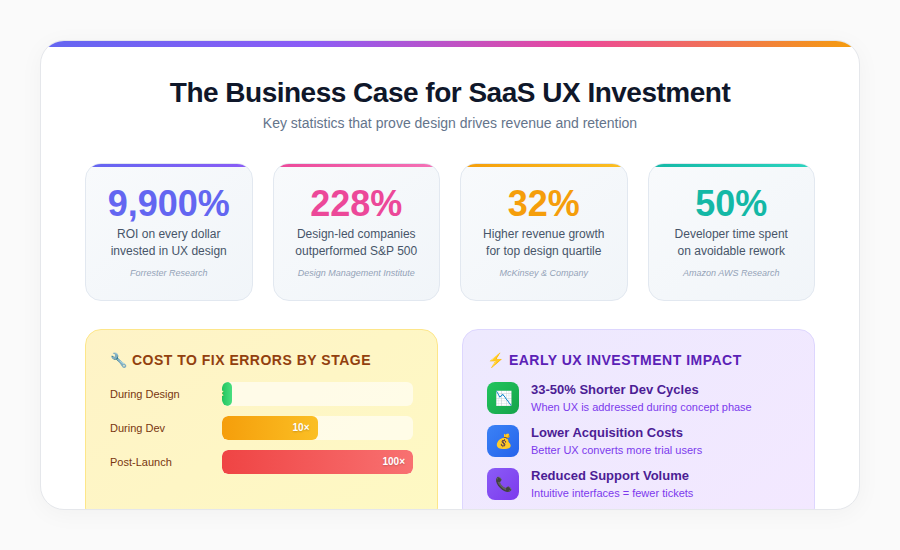
Why does this distinction matter? SaaS products get used daily or weekly. Users navigate dashboards, manage workflows, and make decisions based on what the interface shows them. According to McKinsey's Business Value of Design research, companies in the top quartile for design performance achieved 32% higher revenue growth and 56% higher total returns to shareholders compared to industry counterparts over a five-year period.
For mid-market and enterprise software companies, specialized SaaS UX design translates directly to reduced churn, faster user activation, and improved lifetime customer value. These agencies have frameworks already built from hundreds of software products. Your team won't need to reinvent solutions that experienced UX designers solved years ago.
Top 12 SaaS Design Agencies for 2026
The right design partner depends on your company's stage, budget, and specific challenges. Whether you need help with product strategy, brand strategy, or end-to-end UI/UX execution, this list covers firms with real expertise in software interface design across various specializations.
Agency Comparison Overview
| Agency | Headquarters | Specialization | Best For | Min. Project Size |
|---|---|---|---|---|
| Clay | San Francisco, USA | Enterprise UX + Branding | Funded startups, enterprise buyers | $50,000+ |
| Eleken | Kyiv, Ukraine | SaaS Product UI/UX | Startups needing dedicated designers | $5,000/month |
| Ramotion | San Francisco, USA | Brand + Product Design | Mid-market seeking premium positioning | $25,000+ |
| Superside | Distributed (Global) | Scalable Design Services | High-volume marketing and product teams | $5,000/month |
| Halo Lab | Estonia | SaaS Website Design | Companies prioritizing visual storytelling | $10,000+ |
| UX Studio | Budapest, Hungary | Research-Driven Design | Healthcare and fintech verticals | $15,000+ |
| UITOP | Ukraine | B2B SaaS Platforms | Complex enterprise software | $12,000+ |
| Pony Studio | UK/Remote | Fast Product Design | Early-stage startups | $15,000+ |
| Cieden | Ukraine/Switzerland | AI and Data Products | Companies building ML-powered tools | $20,000+ |
| StanVision | Bulgaria | Conversion-Focused Design | SaaS companies optimizing growth | $15,000+ |
| Momentum Design Lab | USA | Enterprise Software | Organizations simplifying complex workflows | $25,000+ |
| Adam Fard UX Studio | Germany | AI and Fintech Products | Companies integrating AI into UX | $10,000+ |
Detailed Agency Profiles
Clay helped Earnin secure over $100 million in additional venture funding after redesigning their app. That result explains why funded SaaS startups seek them out. Based in San Francisco, they combine product UX with visual identity development at a level few agencies match. Coinbase, Uber, and SendGrid all worked with Clay during early growth stages. Their design process integrates brand strategy with product strategy from day one. The catch? Minimum projects start at $50,000, and most engagements run significantly higher.
Eleken runs on a subscription model (a dedicated designer for a flat monthly fee) that mirrors how SaaS companies price their own products. They've designed over 100 SaaS applications across healthcare, fintech, geospatial, and AI. Their team of UX designers conducts user testing and usability testing as standard practice. The three-day trial before commitment is unusual in the agency world. Worth taking advantage of.
Ramotion has over a decade with enterprise clients like Salesforce, Xero, and Mozilla. Visual identity paired with functional UX execution is their core strength. Their design process encompasses both graphic design and interaction design, making them ideal if you need a polished interface and a cohesive brand identity built simultaneously.
Need landing pages, product UI, and marketing design assets without negotiating separate projects? Superside operates on a subscription-based creative-as-a-service model with a global team across multiple time zones. Their project management systems handle everything from SaaS UX design to marketing collateral. Figma, Snowflake, and Amazon Web Services use them for exactly this reason.
Halo Lab delivers premium quality at Eastern European rates. Grammarly and GitLab in the portfolio. Visual storytelling and brand-forward website design with attention to motion design and micro-interactions that make SaaS brands memorable.
UX Studio leads with research. Ten years of SaaS work, based in Budapest, with deep specialization in healthcare and fintech where regulatory compliance actually matters. Their user testing and usability testing protocols follow best practices from Nielsen Norman Group. Their agile design process moves fast while maintaining rigour.
103 B2B SaaS products and counting. That's UITOP. CRM, ERP, supply chain software. Complex data visualization is the specialty. They understand how digital transformation projects require interfaces that simplify rather than overwhelm.
Pony Studio moves quickly. Over 150 projects completed with an emphasis on speed and brand coherence rather than massive redesigns. Fintech, AI, and health sectors dominate their client list. Their streamlined design process helps SaaS startups ship faster.
Cieden makes AI products feel intuitive. Building machine learning-powered SaaS tools? Worried about users understanding black-box recommendations? They've solved that problem before. Their UX designers specialize in making complex technology accessible.
StanVision obsesses over conversion. 24 Awwwards. Their Primer project drove a 12x traffic increase and 4.5x more sign-ups. Numbers like that demonstrate how good SaaS UX design directly impacts business goals.
Momentum Design Lab targets one thing: complex enterprise workflows that confuse users. Dashboards. Systems. Tangled processes. They simplify. Organizations going through digital transformation often need this kind of specialized help.
Adam Fard UX Studio blends UX design with AI development capabilities. Fintech and SaaS platforms where AI integration needs careful UX treatment to maintain trust. Not every agency can handle both disciplines. Their design process includes extensive user testing to validate AI-driven features.
Evaluating SaaS Design Agency Fit
Specialized SaaS agencies bring pre-built frameworks for common patterns like onboarding, dashboards, and permissions. They've seen what works across industries and can spot problems your internal team might miss. Subscription models offer flexibility that project-based pricing doesn't. And their SaaS tools and processes for rapid prototyping have been refined over hundreds of engagements.
Pros of working with a specialized design partner:
- Pre-built best practices for SaaS-specific patterns
- Experienced UX designers who understand software business goals
- Established user testing and usability testing methodologies
- Faster iteration through refined project management processes
- Fresh perspective on problems your team sees daily
Cons to consider:
- Premium agencies charge $100-200 per hour or $5,000-20,000 monthly
- Remote collaboration requires solid communication processes on both sides
- Deep product context takes time to transfer, even with experienced teams
- Some agencies excel at graphic design but can't help with implementation, creating handoff friction with developers

One detail rarely mentioned in agency comparisons: most SaaS design firms won't touch projects under $10,000. The economics don't work for them. SaaS startups with smaller budgets should look at Eleken's subscription model or consider productized design services like DesignJoy as an alternative entry point.
Common Misconceptions About SaaS Design
Misconception 1: Beautiful Design Automatically Means Good UX
Aesthetics matter, but they don't drive SaaS success alone. Baymard Institute research found that average e-commerce sites can increase conversion rates by 35% through checkout redesigns. Not by making checkout prettier. By reducing form fields and clarifying user flows. The same applies to SaaS: clear information architecture, intuitive navigation, and logical workflows beat visual polish every time. Graphic design skills matter, but understanding user behaviour matters more.
Misconception 2: You Need a Full Redesign to See Results
Many SaaS companies assume they need comprehensive overhauls when targeted fixes would deliver faster ROI. A confusing onboarding sequence. A cluttered dashboard. Unclear calls-to-action. Fixing these specific friction points produces measurable improvements within weeks, not months. The best agencies recommend focused interventions before proposing ground-up rebuilds. This approach delivers cost savings while still moving toward business goals.
Misconception 3: In-House Teams Can Match Agency Expertise Without Specialized Training
Internal designers often have strong foundational skills but limited exposure to the breadth of SaaS-specific challenges. Agencies encounter these problems across hundreds of projects. Forrester research cited by User Interviews found that companies investing in user experience see lower customer acquisition costs, reduced support costs, and increased retention. Achieving these benefits consistently requires specialized knowledge that takes years to develop through user testing and iteration.
Why First Impressions Determine SaaS Success
Users judge digital products fast. About 50 milliseconds fast. That's how long it takes to form an opinion about whether to stay or leave a website.
For SaaS products in crowded markets, this snap judgment influences trial sign-ups, demo requests, and paid conversions. The financial impact compounds over time. According to Maze research citing Forrester, every dollar invested in UX design yields approximately $100 in return (a 9,900% ROI). This return comes through multiple channels: customer loyalty, operational efficiency, and reduced support costs. Design-led companies outperformed the S&P 500 by 228% over ten years according to Design Management Institute tracking.
The stakes for SaaS brands are even higher. Users who encounter confusing interfaces during free trials rarely convert. Support tickets spike when workflows are unclear. And churn increases when competitors offer more intuitive alternatives. Top SaaS companies treat design as central to product strategy, not an afterthought.
The Hidden Cost of Delaying Design Investment
Many SaaS companies treat design as late-stage polish rather than foundational capability. Bad idea. This approach creates technical and experiential debt that compounds.
Research compiled by User Interviews from Amazon AWS found that developers spend 50% of their time on avoidable rework. Organizations that invest in UX during the concept phase reduce product development cycles by 33 to 50% according to the Interaction Design Foundation. Fixing an error after development costs 100 times more than addressing it during the design process.
What does delayed design investment actually look like? Engineering builds new features that users can't figure out how to access. Support fields the same questions about confusing interfaces over and over. Sales struggles to show product value during demos because the interface gets in the way. These costs accumulate invisibly but hit growth hard. The cost savings from early design investment far outweigh the initial expense.
Companies undergoing digital transformation often discover this too late. Integrating proper SaaS UX design from the beginning makes the difference between adoption and abandonment.
Real-World Examples and Case Studies
Prism Mobile Banking Platform
Clay partnered with Prism (a mobile bill pay app for American consumers) to revamp their payment experience. The six-week project started with customer feedback analysis and support case data. The team identified that 34% of users abandoned the payment flow at the confirmation screen. After redesigning that single screen and simplifying the preceding steps, abandonment dropped to 12%. Prism was later acquired by Handle Financial, with the improved metrics cited during due diligence. This demonstrates how focused usability testing and iteration outperform comprehensive redesigns.
Enterprise Learning Management System
Eleken restructured the interface for NWORX, an enterprise LMS provider. The core problem: the design reflected internal product logic instead of user goals. Managers needed three clicks to reach daily tasks. After the redesign, that dropped to one. Support tickets fell 40% across key workflows within 60 days. Enterprise software has to serve daily users, not just the purchasing committee that signed the contract. The project management approach focused on user testing at every stage.
Flatfile Series B Positioning
Ramotion helped data infrastructure company Flatfile prepare for funding rounds. The four-month engagement unified product and brand strategy to communicate technical capability to both users and investors. Their design process addressed visual identity, marketing design, and product UI simultaneously. Flatfile raised $50 million after the comprehensive redesign. The lead investor specifically mentioned the product's UX clarity as a factor in the decision.
Frequently Asked Questions
How much does it cost to hire a SaaS design agency?
$15,000 to $150,000 for project work. $5,000 to $20,000 monthly for subscriptions. The best fit depends on whether you need a long-term design partner or targeted project work.
How long does a typical SaaS UI/UX design project take?
Scope determines timeline. UX audits take two to four weeks. Complete product redesigns span three to six months including research, wireframing, visual design, and developer handoff. Marketing websites fall in the six to twelve week range. Subscription models offer ongoing support without fixed timelines.
Should I hire an agency or build an in-house design team?
It depends on stage and volume. Agencies excel when you need rapid expertise, lack design leadership, or face a specific project with defined deliverables. In-house makes sense when design is continuous, high-volume, and you can attract senior UX designers. Many SaaS companies use hybrid approaches: internal designers for daily work, agency partnerships for specialized projects or overflow. The hybrid model has become the default for Series B and later companies, with agencies handling major redesigns or new product launches while internal SaaS teams maintain and iterate on existing features. One pattern that works well: bring an agency in for the initial design system and brand strategy, then hire internally to extend it.
What should I look for in a SaaS design agency portfolio?
Evidence of actual SaaS work. Pricing pages. Dashboard designs. Onboarding flows. Complex data interfaces. Generic portfolios featuring restaurant websites or e-commerce stores signal irrelevant expertise. Case studies should describe challenges, design process details, and measurable results tied to business goals. Not just visual samples. Client testimonials from SaaS companies at your stage matter.
How do I measure ROI on design agency investment?
Track metrics connecting design to business outcomes: trial-to-paid conversion rates, time-to-value for new users, support ticket volume related to UI confusion, feature adoption rates, customer satisfaction scores. Establish baselines before design work begins. Measure changes after implementation. Good agencies help define success metrics upfront and conduct user testing to validate improvements.
Web Tonic works across SEO, paid search and paid social, and you can book a consultation to talk through your own plan.


