



Table of contents
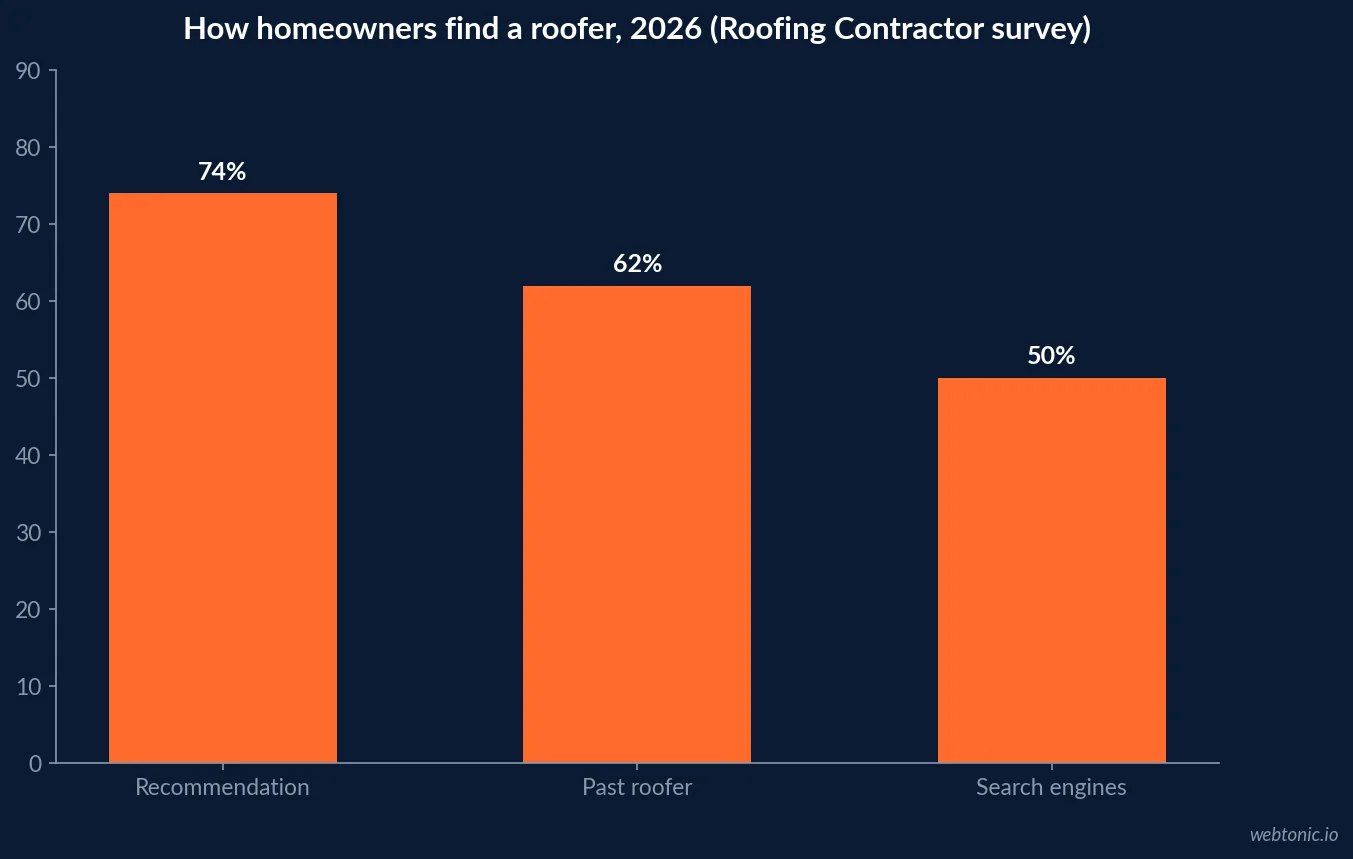
Homeowners say they find roofers through referrals (74%) and search engines (50%), while roofers say they spend on social media (70%), Google Ads (49%) and print (41%) - that mismatch is the only sourced inbound vs outbound comparison we found. It compares channel use, not return on spend, and this page treats it that way.
Key Takeaways
- 74% of homeowners follow a recommendation from a neighbour, friend or family member (Roofing Contractor, 2026).
- 62% would contact a roofer they have worked with before; exactly half use search engines.
- 70% of contractors advertise on social media and 49% rely on Google Ads.
- Only 17% use local television and 15% radio; 11% use AI search services for leads.
- Census CBP 2023 counts 25,519 roofing contractor establishments.
- 80.3% had fewer than 10 employees; only 216 had 100 or more.
- Google allows bulk profile verification at 10 or more locations.
- 65% of homeowners are more likely to call a roofer who shows pricing online.
- 47% of consumers won't use a business with fewer than 20 reviews (BrightLocal 2026, cross-industry).
- Google held 86.1% of US search share in August 2026 (Statcounter).
Who counts as an enterprise roofer
Roofing is a small-firm trade. The Census Bureau's County Business Patterns 2023 file lists 25,519 roofing contractor establishments with 215,242 employees. 16,661 had fewer than five employees, 80.3% had fewer than 10, and just 216 had 100 or more.
Enterprise SEO in roofing therefore means a narrow group: multi-branch regional contractors, franchise systems and private-equity-backed platforms assembling several local brands. Their problem is not ranking one website; it is keeping dozens of branch profiles, city pages and review streams consistent without tripping Google's spam policies.
| Employee size (CBP 2023) | Roofing establishments | Share of 25,519 | SEO reality |
|---|---|---|---|
| Under 5 | 16,661 | 65.3% | Owner-run, one profile |
| 5 to 9 | 3,826 | 15.0% | Single site, local pack focus |
| 10 to 19 | 2,566 | 10.1% | May run a second branch |
| 20 to 49 | 1,715 | 6.7% | Regional, several service areas |
| 50 to 99 | 533 | 2.1% | Multi-branch, needs governance |
| 100 or more | 216 | 0.8% | Enterprise: networks and platforms |
Inbound: how homeowners say they find a roofer
Roofing Contractor's 2026 homeowner survey, fielded in summer 2025 by myClearInsights Hub Research, the research arm of its parent company BNP Media, found 74% follow a recommendation from a neighbour, friend or family member, 62% would call a roofer they have used before, and 50% use internet search engines. Home services websites and social media each drew about a quarter of responses.
Respondents skew older and affluent: a mean age of 58, more than half with household income of USD 150,000 or more, and 93% living in single-family homes. Read the results as the voice of the homeowner who replaces a roof, not of every household.
Outbound: where roofers say they advertise
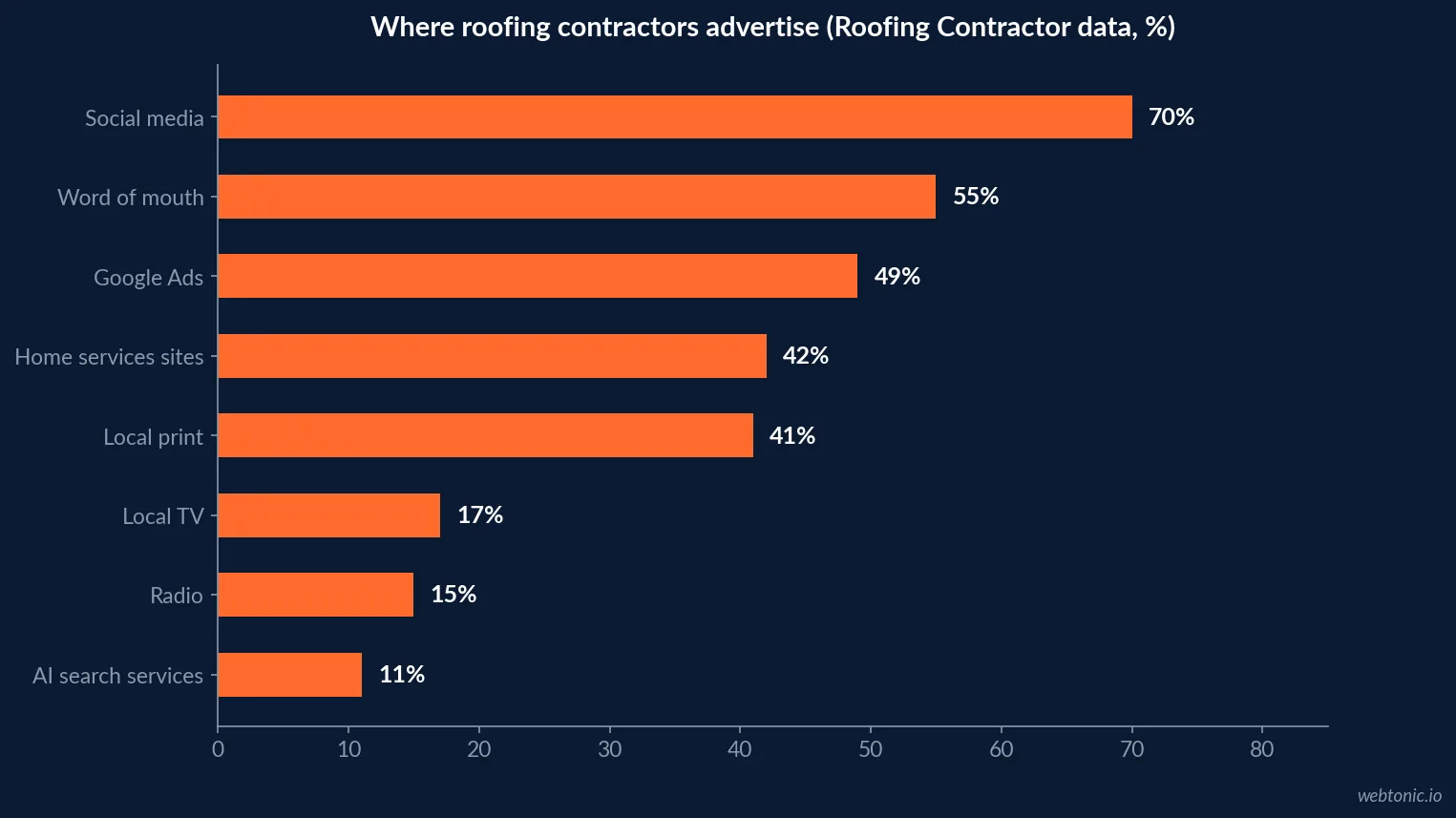
The same article sets the homeowner answers beside Roofing Contractor's contractor survey data. About 70% of contractors advertise on social media, 55% rely on word-of-mouth referrals, 49% rely on Google Ads to generate calls, 42% use home services websites and 41% use local print. Local television (17%) and radio (15%) trail, and for the first time 11% said they use AI search services for leads.
| Channel | Homeowners who use it to find a roofer | Contractors who use it | Inbound or outbound |
|---|---|---|---|
| Recommendations and word of mouth | 74% | 55% | Inbound (referral) |
| Past roofer | 62% | Not asked | Inbound (repeat) |
| Internet search engines | 50% | 49% via Google Ads | Inbound (search) |
| Home services websites | About a quarter | 42% | Inbound (directory) |
| Social media | About a quarter | 70% | Mixed |
| Local print, TV, radio | Not reported | 41%, 17%, 15% | Outbound |
What the comparison does and does not show
The data shows a channel mismatch: roofers put social media first, while homeowners put referrals, repeat relationships and search first. It does not show cost per lead, close rate or return by channel, and the two samples are different surveys. We found no published organic click-through rate, cost per lead or conversion rate for roofing, and we do not estimate one. What the numbers support is a direction - make the inbound paths homeowners already use (reviews that referrals check, branch profiles that searches surface, pages that answer pricing questions) work first.
What homeowners check once they find you
The survey shows the inbound path does not end at the click. About 62% called online reviews very or extremely important, and more than 91% of contractors feature customer reviews on their own sites. 65% of homeowners are more likely to call a roofer with pricing on the website, down from 78% a year earlier; 37% of contractors list starting prices or ranges and 33% list none. 66% of homeowners gather three quotes, and 56% expect to hear back within one to two days, with 39% expecting a same-day reply.
| Homeowner expectation (2026) | Share | Contractor practice | SEO implication |
|---|---|---|---|
| Reviews very or extremely important | About 62% | 91%+ feature reviews on site | Branch-level review volume |
| More likely to call if pricing shown | 65% | 37% show starting prices | Pricing pages per service |
| Pricing made no difference | 34% | 33% show no pricing | Not a universal lever |
| Gather three quotes | 66% | Most don't charge to assess | Comparison-ready pages |
| Expect contact within 1-2 days | 56% | Response speed varies | Local pack calls need fast pickup |
Review thresholds at branch level
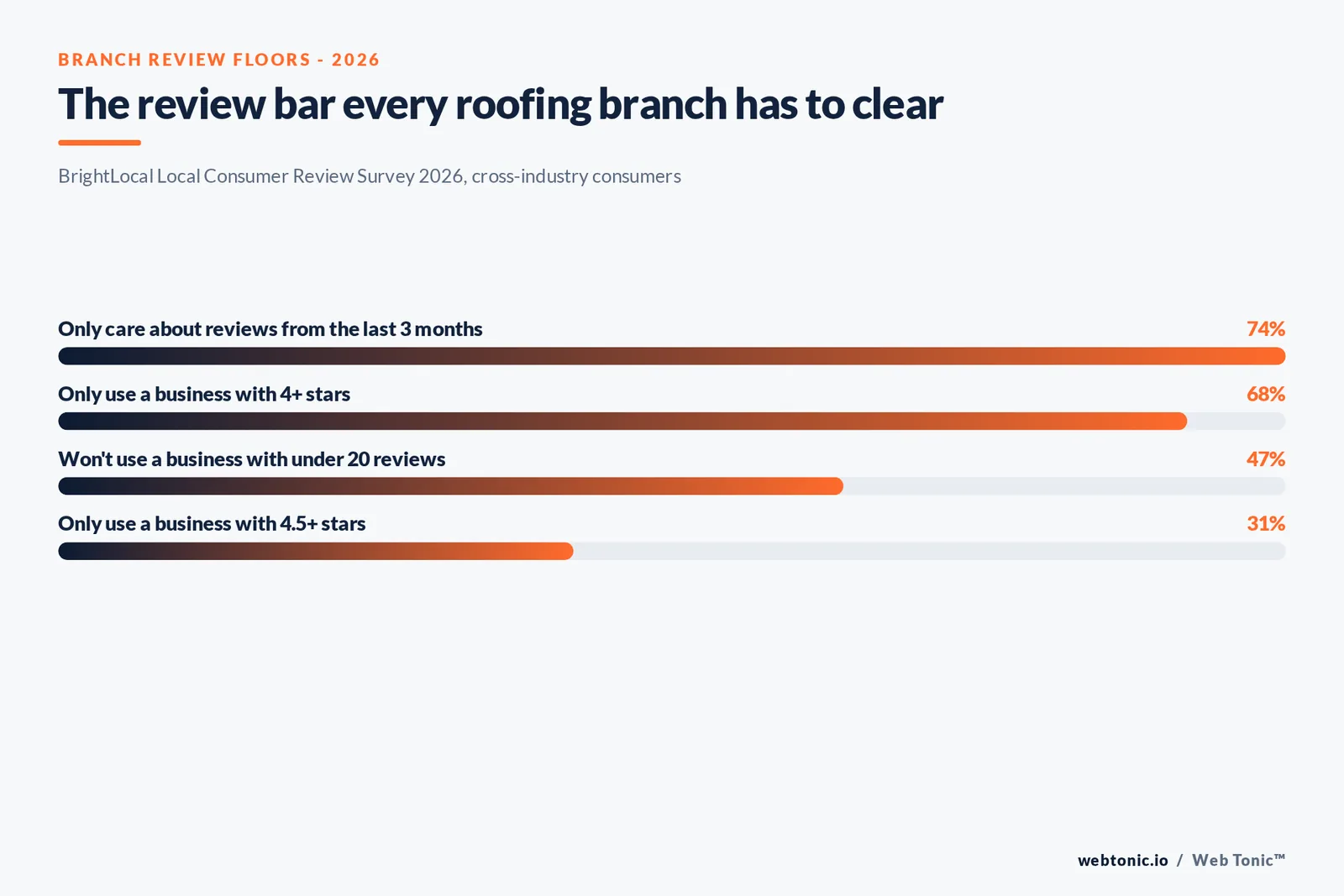
For a network, reviews have to be earned per location. BrightLocal's 2026 Local Consumer Review Survey, a cross-industry consumer study, found 47% won't use a business with fewer than 20 reviews, 74% only care about reviews from the last three months, and 68% will only use a business with four or more stars, up from 55% in 2025. Google's share of review use dipped from 83% in 2025 to 71%.
A network with 30 branches and 600 reviews on the head-office profile can still have ten branches below the 20-review line. That is where most enterprise roofing review programmes leak.
Google Business Profile rules for roofing networks
Google lets owners with 10 or more locations of the same business verify profiles in bulk by spreadsheet; agencies with more than one business in an account cannot, and duplicate, suspended or disabled profiles do not count toward the 10, and the route is not open to service-area businesses. Google's business representation guidelines say service-area businesses should have one profile for the central office or location with a designated service area, and that a virtual office - a rented address the business does not operate from - is not eligible.
For roofers, that means one profile per staffed branch, each with its own service area. A profile per city served, on mailbox addresses, is a suspension risk rather than an SEO tactic.
City pages without doorway abuse
Google's spam policies define doorway abuse as sites or pages created to rank for specific, similar queries that lead users to less useful intermediate pages, with examples that include multiple domain names or pages targeted at specific regions or cities that funnel users to one page. A roofing network's city pages pass that test when each carries local substance: the branch serving it, completed jobs, local permit or code notes, crews and reviews tied to that area.
Mark each branch up with structured data. Schema.org includes a dedicated RoofingContractor type under HomeAndConstructionBusiness, which lets each branch page declare its own address, phone number, hours and area served.
| Enterprise task | Rule or threshold | Source | Failure mode |
|---|---|---|---|
| Bulk verification | 10+ locations of the same business | Google Business Profile Help | Agency accounts can't bulk verify |
| Service-area profiles | One per central office or location | Google business guidelines | Virtual offices are ineligible |
| City landing pages | Must not be doorways | Google spam policies | Swapped place names |
| Branch markup | RoofingContractor type | Schema.org | One markup block for every branch |
| Search engine priority | Google 86.1% US share | Statcounter, August 2026 | Over-investing in minor engines |
Is the industry ready to run SEO at scale?
Enterprise SEO depends on systems - job data, reviews and branch information flowing into pages and profiles. Roofing Contractor's 2026 State of the Roofing Industry report found contractors make most use of enterprise or accounting software (67%), estimating software (63%) and cloud computing (61%), and that 40% use artificial intelligence, up from 29% in 2024. 78% expect sales volumes to rise in 2026 and 89% over three years. The sample was 69% residential, 22% commercial and 9% mixed.
Those systems are where branch-level proof lives. A network that already logs completed jobs by address in its estimating or accounting stack can feed city pages with real projects instead of templated copy. The report does not measure SEO adoption, so treat this as readiness, not performance.
| Contractor technology or outlook (2026 report) | Share | Prior figure | Use for enterprise SEO |
|---|---|---|---|
| Enterprise or accounting software | 67% | Not reported | Source of branch and job data |
| Estimating software | 63% | Not reported | Project records for city pages |
| Cloud computing | 61% | Not reported | Shared data across branches |
| Use artificial intelligence | 40% | 29% in 2024 | Drafting, review replies, QA |
| Expect higher sales in 2026 | 78% | 89% over three years | Capacity to add locations |
Search results are clicking less
Inbound search is also changing shape. Pew Research Center found that in March 2025, 18% of Google searches in its panel of 900 US adults produced an AI summary, and users clicked a traditional result on 8% of those visits versus 15% without one. Google still dominates discovery, with Statcounter putting it at 86.1% of US search share in August 2026. Local pack profiles, which answer on the results page, carry more of the load when fewer searchers click through.
Where to start
Audit branch profiles against the guidelines, set a per-branch review floor, rebuild city pages around local proof, and mark up every branch. Our enterprise SEO statistics give the cross-industry picture, our roofing CTV advertising statistics cover the outbound side, and our growth marketing team can map both - or contact us.
Frequently Asked Questions
Is inbound or outbound marketing better for roofing companies?
The only side-by-side data we found is Roofing Contractor's 2026 surveys, and it compares channels rather than measuring return. Homeowners said they find roofers through recommendations (74%), past roofers (62%) and search engines (50%). Contractors said they use social media (70%), word of mouth (55%), Google Ads (49%) and local print (41%), with local TV at 17% and radio at 15%. The gap suggests inbound channels match how homeowners search; it does not prove one channel pays better.
How many roofing companies are large enough for enterprise SEO?
Very few. Census County Business Patterns 2023 lists 25,519 roofing contractor establishments with 215,242 employees. 80.3% had fewer than 10 employees and only 216 had 100 or more. Enterprise SEO applies to multi-branch networks, franchises and private-equity platforms, not the typical roofer.
Can a roofing network create a page for every city it serves?
Only if each page is genuinely useful. Google's spam policies list doorway abuse, including having multiple pages targeted at specific regions or cities that funnel users to one page, as a violation. City pages need real local substance - the branch, crews, projects, permits and reviews for that area - rather than swapped place names.
How should a roofing company with many branches manage Google Business Profiles?
Google lets businesses with 10 or more locations of the same business verify profiles in bulk, but not service-area businesses, so most roofing branches verify one by one. Its guidelines say service-area businesses should have one profile for the central office or location, with a designated service area, and that virtual offices are not eligible. So a profile per staffed branch, not per city served.
How important are reviews for roofers?
In Roofing Contractor's 2026 homeowner survey, about 62% said online reviews were very or extremely important. BrightLocal's 2026 Local Consumer Review Survey, which is cross-industry, found 47% of consumers will not use a business with fewer than 20 reviews and 74% only care about reviews from the last three months.
Sources
Roofing Contractor - The homeowner's roofing journey in 2026
Roofing Contractor - 2026 State of the Roofing Industry report
US Census Bureau - County Business Patterns datasets
BrightLocal - Local Consumer Review Survey 2026
Google Business Profile Help - Verify profiles in bulk
Google - Guidelines for representing your business
Google Search Central - Spam policies
Schema.org - RoofingContractor
Pew Research Center - AI summaries and clicks
Statcounter - US search engine market share


