



Table of contents

For a plumbing company, international SEO almost never means ranking abroad; it means serving the 21.7% of US residents aged 5 and over who speak another language at home, and the bilingual market across the Canadian border. No study measures plumbing-specific multilingual traffic, so this page sizes the demand from government language data and Google's own rules.
Key Takeaways
- 78.3% of US residents aged 5+ speak only English at home (Census, 2018-2022).
- Spanish is 61.1% of non-English home languages in the US.
- Chinese follows at 5.1% and Tagalog at 2.5%.
- 61.0% of Spanish speakers also speak English very well, so roughly four in ten do not.
- 22.0% of Canadians have French as first official language (2021 Census).
- 18.0% of Canadians are English-French bilingual.
- 76% of online shoppers prefer product information in their own language (CSA Research, 2020).
- 40% will never buy from websites in other languages.
- Mr. Rooter Plumbing lists 363+ franchise locations across the US and Canada.
- Ferguson's Canada segment sold USD 1,493 million in fiscal 2025, against USD 30,762 million in total.
- Google held 85.3% of Canadian search in September 2026 (Statcounter).
- No plumbing hreflang or multilingual CTR benchmark exists.
What international SEO means for a plumber
Plumbing is a radius business. Nobody in Lisbon books a drain clearance in Phoenix, so the export playbook of country folders and foreign link building does not apply to most firms. What does apply are three narrower jobs: pages in the languages your own customers speak, a correct English and French setup for firms working in Canada, and clean country handling for the small number of franchise and distribution brands that run sites on both sides of the border.
Google defines the two cases plainly in its multi-regional and multilingual guidance: a multilingual website is any website that offers content in more than one language, and its own example is a Canadian business with English and French versions. A multi-regional site explicitly targets users in different countries. Most plumbing companies are the first case only.
| Plumbing scenario | Google's category | Typical setup | Who it fits |
|---|---|---|---|
| Spanish pages for local residents | Multilingual | /es/ folder on the main domain | US metros with large Spanish-speaking populations |
| English and French for Quebec work | Multilingual | /fr/ folder, French version of comparable quality | Firms with a Quebec address or Quebec clients |
| US and Canadian franchise territories | Multi-regional | Country folders or separate domains | Franchise systems such as Mr. Rooter |
| Distributor selling into two countries | Multi-regional and multilingual | Country plus language versions | Supply houses with a Canadian segment |
| Single-language local contractor | Neither | One site, local pages | Most independent plumbers |
How many of your customers speak another language
The US Census Bureau reported in December 2023, using 2018-2022 American Community Survey estimates, that 78.3% of the population aged 5 and older spoke only English at home, down from 78.7% in 2013-2017. Among people speaking another language, Spanish accounted for 61.1%, Chinese for 5.1% and Tagalog for 2.5%.
That is the demand pool behind a Spanish plumbing page. It is national, so treat it as a starting point and pull your own county or metro from the Census tables before deciding which language earns a page.
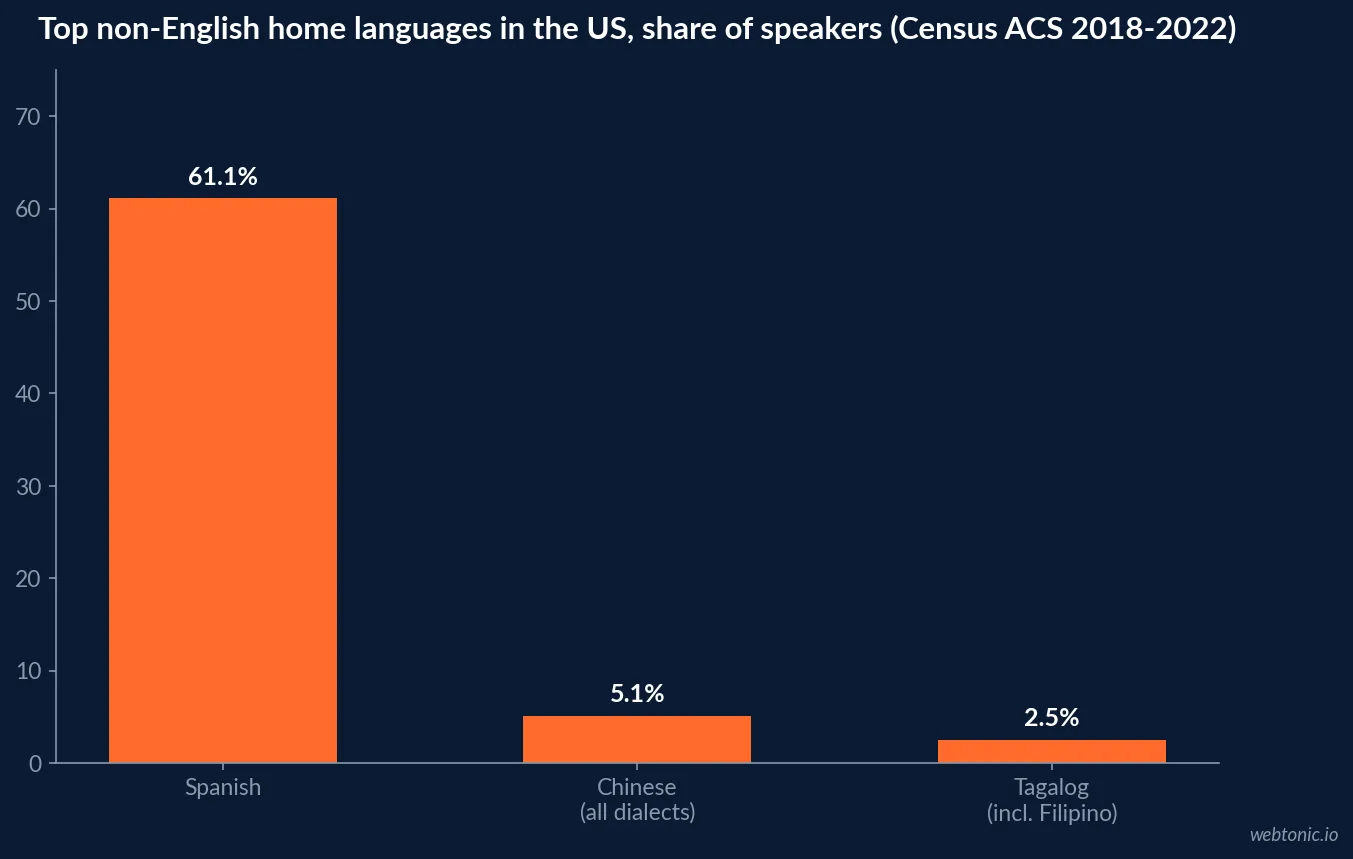
| US home language measure (ACS 2018-2022) | Share | What it means for a plumbing site |
|---|---|---|
| Speak only English at home | 78.3% | The main site still carries most demand |
| Speak a language other than English | 21.7% | The pool for second-language pages |
| Spanish, share of non-English speakers | 61.1% | First language to add in most US markets |
| Chinese, all dialects | 5.1% | Worth testing in specific metros |
| Tagalog including Filipino | 2.5% | Niche, local decision |
| Spanish speakers who speak English very well | 61.0% | About four in ten may prefer Spanish for an emergency call |
Why language matters in an emergency call
The Census release adds a detail that matters for a burst pipe at 2 a.m.: 61.0% of Spanish speakers spoke English very well, and the share falls with age, to 41.6% of Spanish speakers aged 65 and older. Older homeowners own a large slice of the housing that needs repiping and water heater work, and they are the group least comfortable describing a problem in English.
CSA Research's 2020 "Can't Read, Won't Buy" survey of 8,709 consumers in 29 countries found 76% prefer to buy products with information in their own language and 40% will never buy from websites in other languages. That study covers online shopping, not trades, so read it as a direction of preference rather than a plumbing conversion rate.
Canada: the bilingual market next door
Canadian Heritage, citing the 2021 Census, reports that 22.0% of Canadians have French as their first official language, 76.1% English, and 18.0% are English-French bilingual, up from 17.5% in 2011. Bilingualism among English-mother-tongue residents outside Quebec is only 7.4%, which is why a French page matters for reaching francophone homeowners rather than being a courtesy.
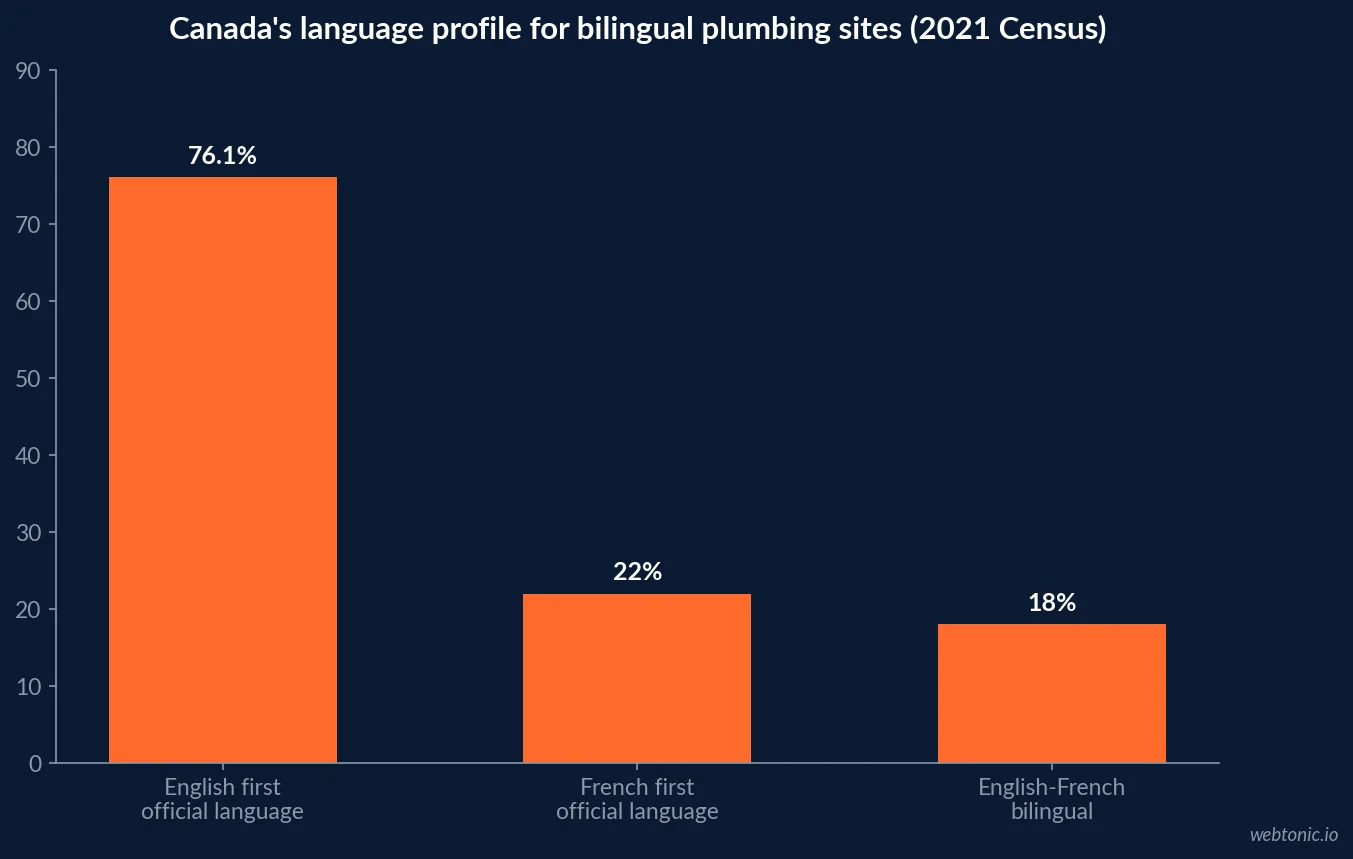
| Canadian language measure (2021 Census) | Value | Implication for plumbing sites |
|---|---|---|
| French as first official language | 22.0% | French pages reach more than one in five Canadians |
| English as first official language | 76.1% | English remains the larger market outside Quebec |
| English-French bilingual | 18.0% | Bilingual users can be served by either version |
| Bilingualism, English mother tongue, rest of Canada | 7.4% | Few anglophones can read French pages |
| Bilingualism, French mother tongue, Quebec | 42.8% | Most Quebec francophones prefer French |
Quebec's French rule for plumbing websites
For firms with a Quebec address, a French site is a legal requirement, not an SEO choice. Educaloi's summary of the Charter of the French Language states that you must have a French version of your website if your business has an address in Quebec and you offer your products or services to Quebecers, and that other language versions are allowed as long as a French version is available. Quote requests and booking forms count as part of that experience.
The practical result is that a Quebec plumbing site is multilingual by default, and Google's hreflang rules decide whether the right version appears for each searcher.
Franchise and supply brands that cross the border
A few plumbing brands genuinely operate in two countries. Mr. Rooter Plumbing describes itself as operating through independently owned franchise locations across the United States and Canada and lists 363+ franchise locations. On the distribution side, Ferguson's fiscal 2025 results show Canada net sales of USD 1,493 million against total net sales of USD 30,762 million, so Canada is roughly 5% of the business.
Those are the operators that need true multi-regional SEO: country versions, local currency and correct locale signals. An independent contractor does not.
| Cross-border plumbing operator | Published figure | Year | International SEO need |
|---|---|---|---|
| Mr. Rooter Plumbing (franchise) | 363+ franchise locations, US and Canada | 2026 brand page | US and Canadian locator pages, French where required |
| Ferguson, Canada segment | USD 1,493 million net sales | Fiscal 2025 | Canadian catalogue and locale signals |
| Ferguson, total | USD 30,762 million net sales | Fiscal 2025 | US remains about 95% of revenue |
| Ferguson, Canada Q4 growth | +4.8% net sales | Q4 fiscal 2025 | Small but growing Canadian demand |
Google's rules that decide which version ranks
Google recommends using different URLs for each language version of a page rather than cookies or browser
settings, and using hreflang annotations to connect them. Its localized versions documentation lists three equivalent methods (HTML, HTTP headers and
sitemaps), says annotations must point to each other or they are ignored, and suggests an
x-default fallback for unmatched languages. Google also warns against automatically redirecting
users from one language version to another based on a guess about their language.
| Google rule | What it says | Plumbing implication |
|---|---|---|
| Separate URLs per language | Recommended over cookies or browser settings | /es/ and /fr/ folders, not a JavaScript toggle |
| hreflang methods | HTML, HTTP headers or sitemap, all equivalent | Pick one; most CMS plugins use HTML |
| Bidirectional links | Tags that do not point to each other are ignored | Every Spanish page must link back to the English one |
| x-default | Fallback for unmatched languages | Point it at the main English page |
| No forced redirects | Do not redirect on a language guess | Let callers switch language themselves |
Search share on both sides of the border
The engine mix is simple for this trade. Statcounter put Google at 85.3% of Canadian search in September 2026, with Bing at 10.06%, and Google held 86.1% of US search in August 2026. A plumbing site optimised for Google in English, Spanish and French covers the large majority of searches in both countries; there is no Baidu or Naver problem to solve.
Sizing the translation job
Translation volume is measured in words, and Weglot's pricing page shows the arithmetic: 20 pages at about 500 words into 2 extra languages equals 20,000 translated words. A plumber's Spanish build is usually smaller, because only service and emergency pages earn the effort. Its list prices start at USD 170 a year for 10,000 words in one language and USD 320 a year for 50,000 words across three, as shown in September 2026. Machine output still needs a fluent reviewer for terms like backflow, sewer line and water heater.
The market is also mostly small firms: Census business data for 2022 counts 107,004 plumbing and HVAC contractor firms, with 89.9% employing fewer than 20 people, per the Statistics of US Businesses tables. That is the budget reality a language plan has to fit.
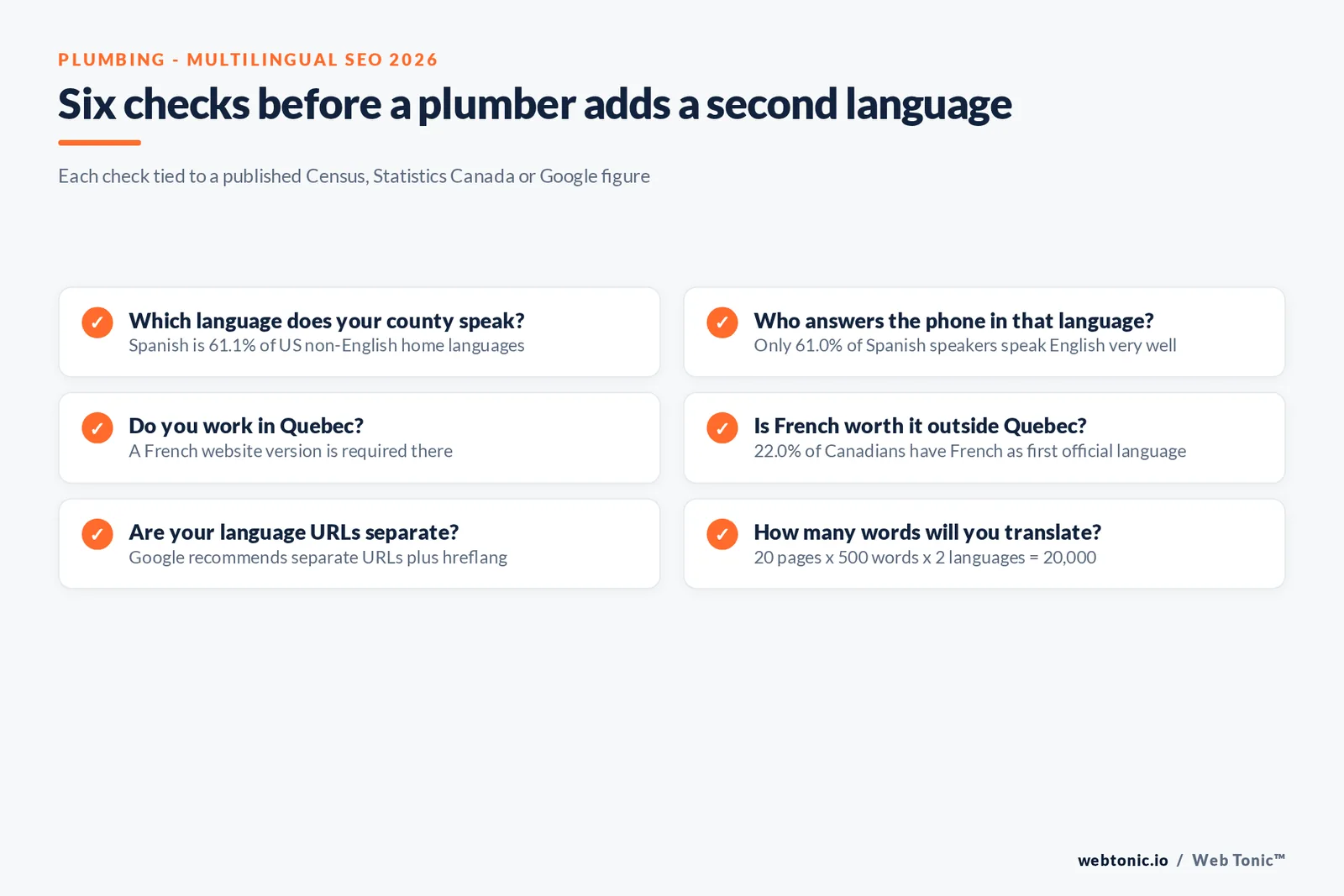
A practical order of work
- Check your county's language mix before choosing a language; the national 21.7% is an average.
- Translate emergency and top service pages first, not the blog.
- Use folders and hreflang per Google's guidance, with an x-default to English.
- Staff the phone: a Spanish page that reaches an English-only dispatcher wastes the click.
- In Quebec, build French first and keep it of comparable quality to English.
- Measure in Search Console by page, because no industry benchmark exists to compare against.
For the wider technical picture on multi-location trade sites, see our plumbing enterprise SEO data and the cross-industry enterprise SEO overview.
What the data cannot tell you
No public source reports how many plumbing websites use hreflang, what share of plumbing traffic arrives in Spanish or French, or how multilingual pages convert for trades. The figures above describe the people and the rules, not plumbing performance. Treat your own call tracking and Search Console language data as the benchmark, and our data and analytics team or growth marketing team can set that measurement up. Talk to us before translating the whole site.
Frequently Asked Questions
Does a local plumber need international SEO at all?
Usually not in the export sense. A plumber serves a radius, so the relevant version of international SEO is multilingual SEO for residents inside that radius, plus English and French pages for firms working in Canada. The US Census Bureau's 2018-2022 survey found 78.3% of residents aged 5 and over speak only English at home, which leaves roughly one in five households where another language is spoken.
Which language should a US plumbing site add first?
In most US markets, Spanish. Spanish accounts for 61.1% of people who speak a language other than English at home, far ahead of Chinese at 5.1% and Tagalog at 2.5%, according to the Census Bureau. Check the language mix for your own county before committing, because the national average hides large local differences.
Do plumbing companies in Quebec need a French website?
Yes. Educaloi, summarising Quebec's Charter of the French Language, states that a business must have a French version of its website if it has an address in Quebec and offers products or services to Quebecers. An English version can sit alongside it as long as the French version is of comparable quality.
Is there a benchmark for plumbing hreflang adoption or multilingual click-through rates?
No. No published study reports hreflang adoption, multilingual click-through rates or international traffic share for plumbing websites. Anyone quoting one is inventing it. The defensible inputs are language demographics, Google's documentation and your own Search Console data after launch.
How much content does a second-language plumbing site involve?
Weglot's own pricing page gives the arithmetic: 20 pages of about 500 words translated into 2 extra languages comes to 20,000 translated words. A typical plumbing site with 15 service pages and 10 city pages translated into Spanish lands in a similar range, which is why most firms start with service pages only.
Sources
US Census Bureau - Language spoken at home, ACS 2018-2022 (Dec 2023)
Canadian Heritage - Statistics on official languages (2021 Census)
Google Search Central - Managing multi-regional and multilingual sites
Google Search Central - Localized versions of your pages
CSA Research - Can't Read, Won't Buy B2C (2020)
Educaloi - Language laws and doing business in Quebec
Mr. Rooter Plumbing - Brand page
Ferguson - Fiscal 2025 fourth quarter and year-end results
Weglot - Pricing (Sep 2026)
Statcounter - Search engine market share, Canada (Sep 2026)
US Census Bureau - Statistics of US Businesses 2022


