



Table of contents
Yes, but only a handful of plumbing enterprise SEO statistics are worth analyzing, because no public study measures organic rankings, click-through or lead cost for plumbing brands. The useful data describes who is big enough to need enterprise SEO, what Google allows a branch network to publish, and how many searches still end in a click.
Key Takeaways
- 107,004 plumbing, heating and air-conditioning firms operated in the US in 2022.
- 89.9% of those firms had fewer than 20 employees.
- Only 215 firms had 500 or more employees, running 1,932 establishments.
- Google bulk verification starts at 10 locations of the same business.
- Crawl budget guidance targets sites with 1 million+ pages, or 10,000+ changing daily.
- 58.5% of US Google searches ended with no click in 2024 (SparkToro and Datos).
- 8% of visits clicked a result when an AI summary appeared, versus 15% without (Pew, 2025).
- Google held 86.1% of US search engine share in August 2026 (Statcounter).
- No public study reports a plumbing-specific organic CTR, rank share or lead cost.
Which Plumbing Enterprise SEO Numbers Hold Up
Before analyzing anything, sort the figures by whether an issuer with a stated method stands behind them. The table below keeps only those that do; the right-hand column says what each one can and cannot tell a plumbing brand.
| Figure | Value | Issuer and year | Worth analyzing for |
|---|---|---|---|
| Plumbing, heating and AC firms | 107,004 | Census SUSB 2022 | Sizing the enterprise segment |
| Firms under 20 employees | 89.9% | Census SUSB 2022 | Why most tactics are single-location |
| Firms with 500+ employees | 215 (1,932 establishments) | Census SUSB 2022 | Who needs branch-level SEO |
| Bulk verification threshold | 10+ locations | Google Business Profile Help | Profile management at scale |
| US zero-click searches | 58.5% | SparkToro / Datos 2024 | Ceiling on organic traffic |
| Plumbing organic CTR by position | Not published | No issuer | Nothing - do not quote one |
How Big Is the Enterprise Segment in Plumbing?
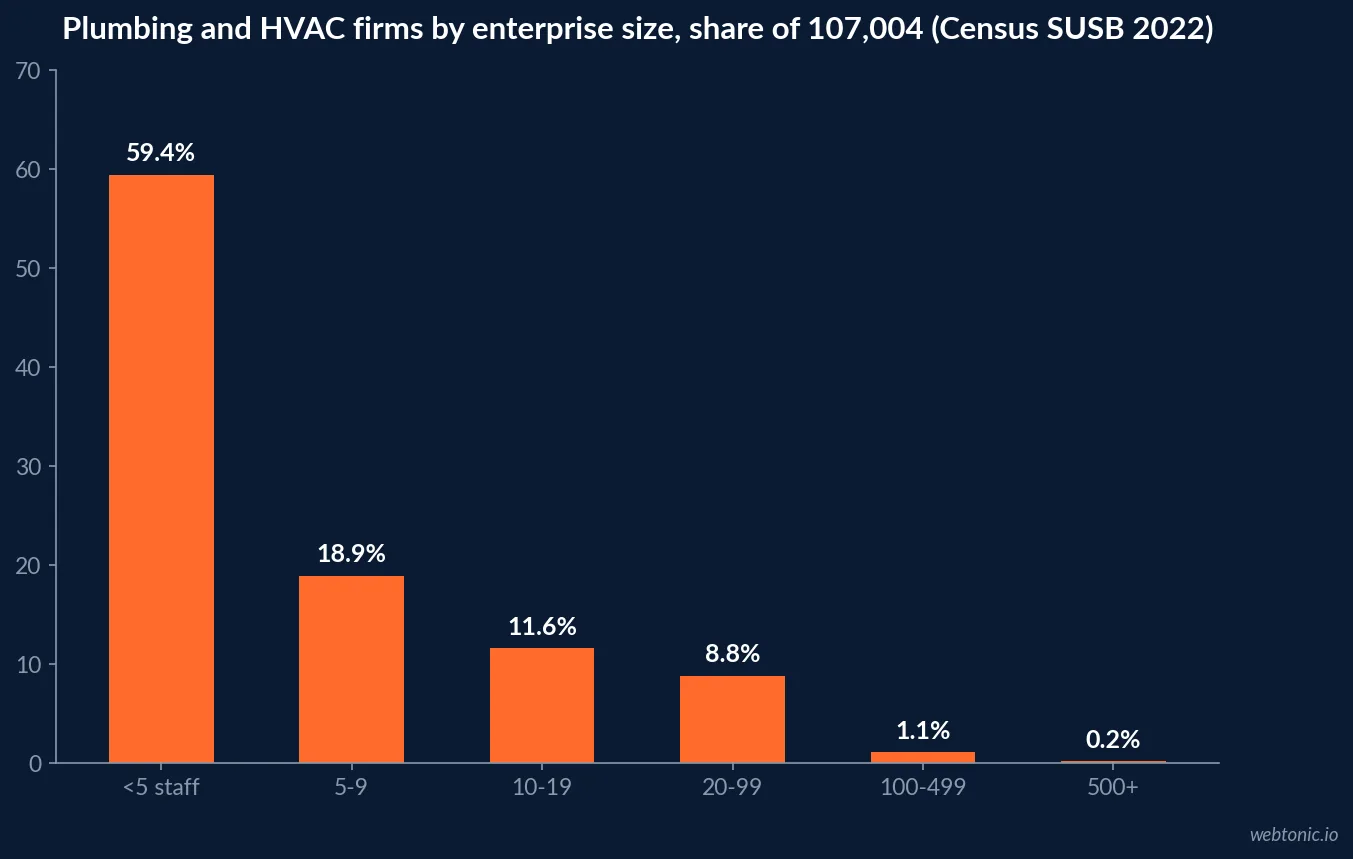
The Census Bureau's 2022 Statistics of U.S. Businesses group plumbers with heating and air-conditioning contractors under NAICS 238220, so every figure here covers the combined trade. Of 107,004 firms operating 109,601 establishments, 63,588 had fewer than five employees. A firm with one location is doing local SEO, not enterprise SEO, whatever its tool stack is called.
| Enterprise size | Firms | Establishments | Share of firms |
|---|---|---|---|
| Under 5 employees | 63,588 | 63,588 | 59.4% |
| 5-9 employees | 20,175 | 20,183 | 18.9% |
| 10-19 employees | 12,459 | 12,468 | 11.6% |
| 20-99 employees | 9,415 | 9,741 | 8.8% |
| 100-499 employees | 1,152 | 1,689 | 1.1% |
| 500+ employees | 215 | 1,932 | 0.2% |
The pattern is the point: below 100 employees, firms and establishments are almost the same number. Only at the top does one firm run many sites - the 215 largest firms average about 9 establishments each. Those networks, together with franchise systems, are where branch rankings become a portfolio problem.
What a Plumbing Branch Network Looks Like Online
Franchise systems add a second layer the Census firm count does not show. Mr. Rooter Plumbing, for example, describes itself as part of Neighborly and operating "through a network of independently owned and operated franchise locations across the United States and Canada". Each franchisee is its own firm in Census terms, yet the brand shares one domain, one set of location templates and one reputation in search. That is the practical definition of enterprise SEO in this trade: a brand-level site plus dozens or hundreds of branch pages and profiles.
For the single-location view of the same channel, see our plumbing SEO statistics and plumbing local SEO statistics; the cross-industry view lives in our enterprise SEO statistics hub.
Google's Rules for Branch Profiles
Most plumbers are service-area businesses: they travel to the customer. Google's Business Profile guidelines say such a business "should have one profile for the central office or location with a designated service area", and that a company with different locations, "with separate service areas and separate staff at each location", is allowed one profile for each location. A virtual office or an unstaffed address is not eligible. For a network, this rule, not a ranking factor, sets how many map listings it can hold.
Scale then changes the workflow. Google's bulk verification help page applies to 10 or more locations of the same business, and adds that duplicate, suspended or disabled profiles do not count towards the 10-profile minimum. Agencies holding more than one business in one account cannot bulk verify.
| Branch situation | What Google allows | Source |
|---|---|---|
| No storefront, one dispatch office | One service-area profile | Business Profile guidelines |
| Several branches, separate staff and areas | One profile per branch | Business Profile guidelines |
| Rented mailbox or virtual office | Not eligible | Business Profile guidelines |
| 10+ locations of one brand | Bulk verification | Bulk verification help |
| Fewer than 10 locations | Verify individually | Bulk verification delays help |
City Pages and the Doorway Policy
The most common enterprise plumbing tactic, one landing page per town, runs straight into Google's spam policies. Doorway abuse includes "having multiple domain names or pages targeted at specific regions or cities that funnel users to one page" and "creating substantially similar pages that are closer to search results than a clearly defined, browseable hierarchy". The numbers worth tracking are therefore not how many city pages exist, but how many carry branch-specific facts: staff, address or area served, hours and local job examples.
Pages that exist only to rank tend to earn nothing anyway. Ahrefs' 2023 study of about 14 billion pages found 96.55% of pages got zero traffic from Google and 1.94% received one to ten visits a month. That is a cross-web figure, not a plumbing one, but it is a reminder that page count is not reach.
When Crawl Budget Enters the Picture
Google's crawl budget guide is explicit about its audience: large sites with 1 million+ unique pages whose content changes about weekly, medium or larger sites with 10,000+ unique pages changing daily, and sites with many URLs stuck as discovered but not indexed. A plumbing brand with a few hundred branch and service pages sits far below both thresholds, so crawl budget is rarely its bottleneck; duplicated templates and thin pages are the likelier cause of pages not being indexed.
Zero-Click Search and AI Summaries
Every branch-ranking statistic has to be read against how many searches produce a click at all. SparkToro's 2024 zero-click study, built on Datos panel data, found 58.5% of US Google searches resulted in zero clicks, and that only 360 of every 1,000 US searches sent a click to the open web.
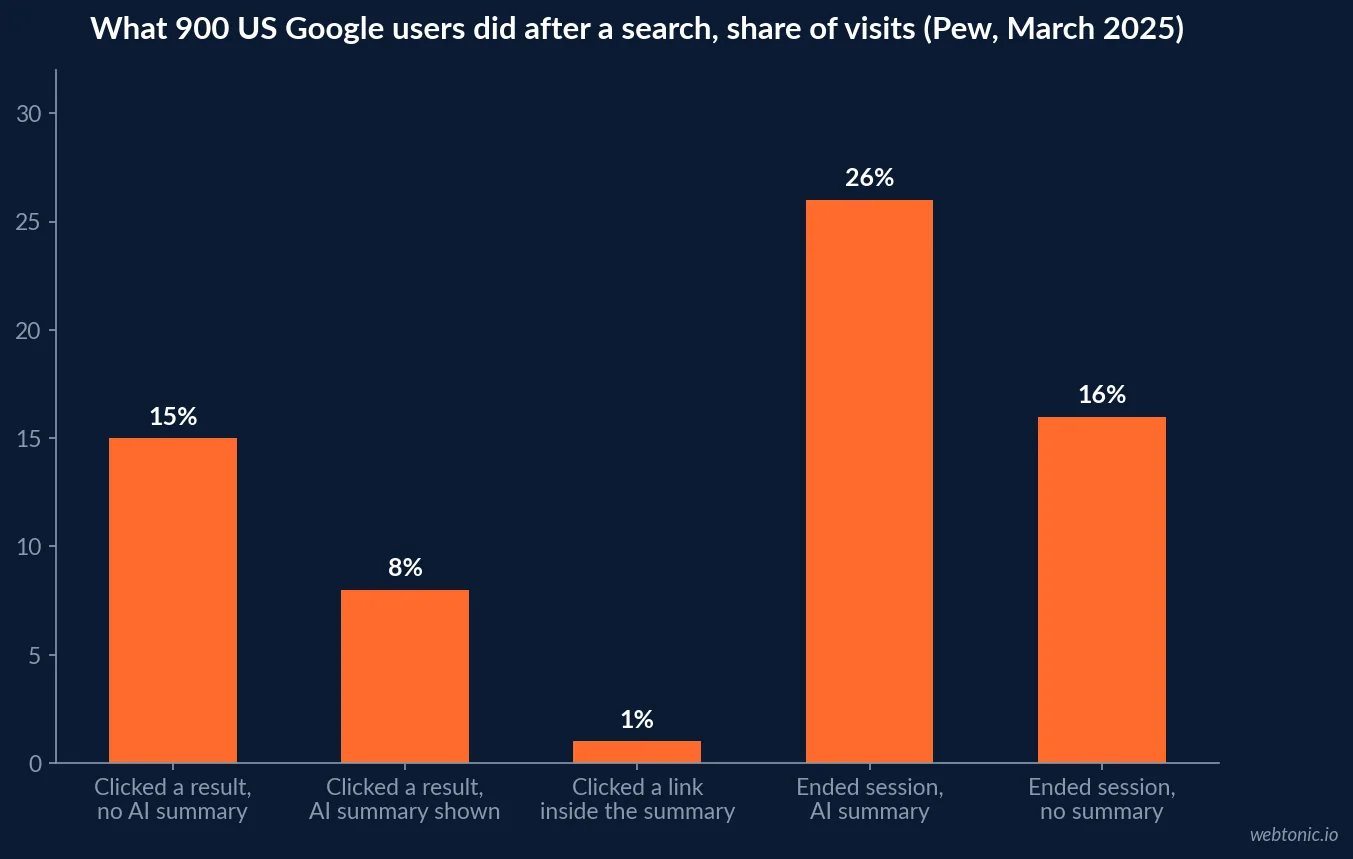
Pew Research's July 2025 analysis of 900 US adults' browsing in March 2025 adds the AI layer. Users who saw an AI summary clicked a traditional result in 8% of visits, against 15% of visits without one, and clicked a link inside the summary in just 1% of visits. Sessions ended on 26% of pages with a summary versus 16% without.
| Study | Sample and period | Headline figure | Plumbing-specific? |
|---|---|---|---|
| SparkToro / Datos | US and EU clickstream panels, 2024 | 58.5% US zero-click | No |
| Pew Research Center | 900 US adults, March 2025 | 8% vs 15% result clicks | No |
| Ahrefs | 300,000 keywords, December 2025 | 58% lower top-result CTR with AI Overviews | No |
| Statcounter | US search engine share, August 2026 | Google 86.1%, Bing 8.92% | No |
Ahrefs' 2026 update measured a 58% lower average click-through rate for the top-ranking page on keywords with an AI Overview, up from 34.5% in its April 2025 study. The study covers informational keywords; urgent "plumber near me" searches are local and commercial, so the effect on them is not measured here.
Which Search Engines Matter for a Plumbing Brand
Google's dominance makes its documentation the rulebook. Statcounter put Google at 86.1% of US search engine share in August 2026, Bing at 8.92%, Yahoo at 2.74% and DuckDuckGo at 1.7%. A branch network tracking rankings in more than one engine should weight its reporting accordingly rather than averaging them.
Organic search was already the largest trackable channel before AI summaries: BrightEdge's 2019 Channel Share report put organic at 53.3% of trackable traffic across its clients. That figure is seven years old and cross-industry, so treat it as history, not a current plumbing share.
Reporting Branch Rankings at Scale
Search Console is the only free first-party source of branch-level query data, and its limits shape any enterprise dashboard. Google's Search Console export help says performance data through the API is limited to 50K rows of data per day per type per property. The API usage limits page adds a per-site quota of 1,200 queries per minute and 2,000 URL inspections a day per site. A network with hundreds of branch pages should pull data per page folder or per property rather than one site-wide export. Our data intelligence team builds that kind of branch roll-up.
| Branch metric | Where it comes from | Limit or caveat |
|---|---|---|
| Impressions and clicks per branch page | Search Console API | 50K rows per day per type |
| Index status of branch pages | URL Inspection API | 2,000 inspections per day per site |
| Profile calls and direction requests | Business Profile performance | Per profile, not per page |
| Structured data validity | LocalBusiness markup | One entity per location page |
| Share of queries with AI summaries | Manual or tool sampling | No official Google report |
Best Practices for Multi-Branch Plumbing SEO
- Start from the Census size band: 89.9% of firms have under 20 staff, so confirm the business really runs several staffed branches before buying enterprise tooling.
- Match profiles to real branches: one service-area profile per staffed location, bulk-verified once the network passes 10 locations.
- Write branch pages from branch facts, not swapped town names, to stay clear of doorway abuse.
- Mark up each location with LocalBusiness structured data, including departments where a branch has its own hours or phone number.
- Report clicks against zero-click reality: with 58.5% of US searches ending without a click, flat traffic can hide stable visibility.
- Pull Search Console by API per folder so no branch drops out of the 50K-row daily cap.
Plumbing Versus All Industries
Every click and visibility figure on this page is cross-industry; the only plumbing-specific data is structural. That asymmetry is itself the answer to the headline question. Plumbing enterprise SEO statistics are worth analyzing when they describe the market and the rules, and not worth analyzing when they claim a plumbing click-through rate or ranking share, because no issuer with a stated method has published one. Paid channels are different: our plumbing CTV advertising statistics cover a channel where vendors do publish spend data.
Frequently Asked Questions
Are plumbing enterprise SEO statistics worth analyzing?
Some are and most are not. No public study publishes an organic click-through rate, ranking share or lead cost for plumbing brands specifically, so any page quoting one is guessing. What is worth analyzing is the market structure from the Census Bureau, Google's own rules for multi-location profiles and pages, and cross-industry click studies from Pew Research, SparkToro and Ahrefs, each labelled with its year and sample.
How many plumbing companies are large enough to need enterprise SEO?
Very few. The Census Bureau's 2022 Statistics of U.S. Businesses count 107,004 plumbing, heating and air-conditioning firms; 96,222 of them, or 89.9%, have fewer than 20 employees. Only 215 firms have 500 or more employees, and together they operate 1,932 establishments. Those networks, plus franchise systems, are the real audience for enterprise SEO.
Can a plumbing company create one page per city it serves?
It can create pages for places it genuinely serves, but Google's spam policies list 'having multiple domain names or pages targeted at specific regions or cities that funnel users to one page' as doorway abuse. A defensible city or branch page carries information unique to that branch: its staff, address or service area, hours and work done there.
How many Google Business Profiles can a multi-branch plumber have?
Google's guidelines allow one service-area profile for a business without a storefront, and one profile per location when separate locations have separate service areas and separate staff. Networks with 10 or more locations of the same business can use bulk verification in the Business Profile Manager.
Does AI in search change the value of ranking a branch page?
The published data points to fewer clicks per search. Pew Research found users clicked a traditional result in 8% of visits when an AI summary appeared versus 15% without one (March 2025, 900 US adults), and Ahrefs found a 58% lower top-result click-through rate alongside AI Overviews in December 2025 data. Neither study is plumbing-specific.
Want branch-level reporting built on first-party data instead of borrowed benchmarks? Talk to Web Tonic.
Sources
U.S. Census Bureau - 2022 SUSB annual tables (NAICS 238220)
Google - Business Profile guidelines
Google - Verify Business Profiles in bulk
Google Search Central - Spam policies (doorway abuse)
Google - Crawl budget management
SparkToro - 2024 Zero-Click Search Study
Pew Research Center - AI summaries and clicks, 2025
Ahrefs - AI Overviews reduce clicks (2026 update)
Ahrefs - Search traffic study, 2023
Statcounter - US search engine market share
BrightEdge - 2019 Channel Share report
Mr. Rooter Plumbing - brand entity page


