



Table of contents
Nobody has published evidence that native advertising works, or fails, for pest control. No native network, trade body or benchmark vendor reports pest control native ad results. What the public record does hold is enough to run an honest test: LocaliQ pest benchmarks for search, display and social, Rollins' own advertising spend, and NPMA data on how homeowners find and keep exterminators.
Key Takeaways
- No study publishes a native ad CTR, CPL or conversion rate for pest control in 2026.
- Pest and rodent control search leads cost USD 39.25 in LocaliQ's 2021 edition.
- Display leads for the same category cost USD 66.69, at a 0.09% CTR.
- Social leads cost USD 70.11 at a 1.51% CTR.
- Rollins spent USD 128.5 million on advertising in 2025, per its 10-K.
- US structural pest control revenue reached USD 13.416 billion in 2025 (+6%).
- Recurring plans made up 85.4% of residential pest revenue in 2025.
- Only 24% of millennials use search as their main way to find a pest pro.
Pest control native advertising: what is and is not measured
Before asking whether native works, separate the numbers that exist from the ones that get repeated without a source. Every row below is either published by a named issuer or marked as missing.
| Question | Public answer | Issuer | Year |
|---|---|---|---|
| Native CTR for pest control | Not published | No issuer | - |
| Native cost per lead for pest control | Not published | No issuer | - |
| Pest display cost per lead | USD 66.69 | LocaliQ (vendor) | 2021 edition |
| Pest search cost per lead | USD 39.25 | LocaliQ (vendor) | 2021 edition |
| Largest US pest firm's ad spend | USD 128.5 million | Rollins 10-K | 2025 |
| US pest control service revenue | USD 13.416 billion | NPMA / Specialty Consultants | 2025 |
The closest proxy: pest display versus search
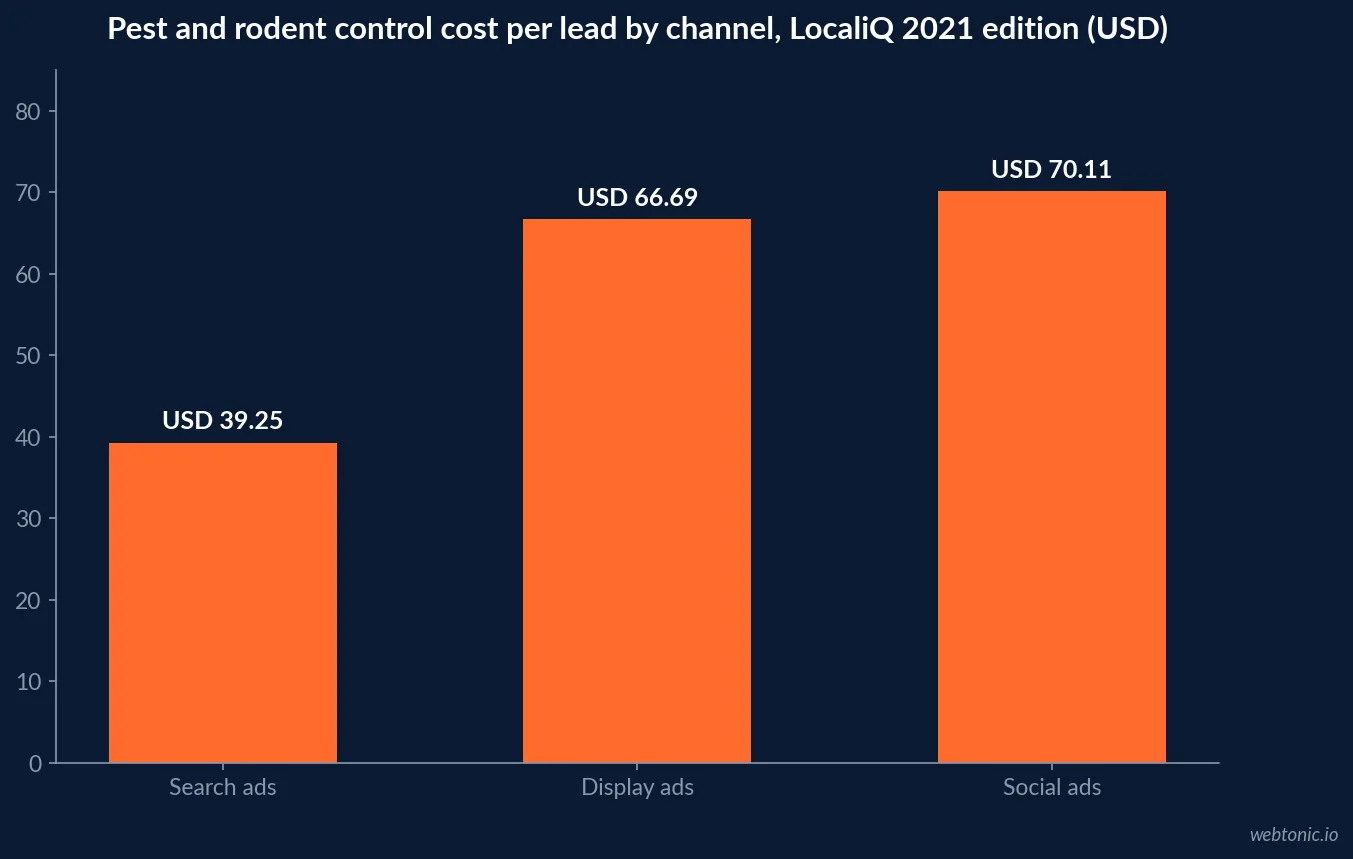
Native ads and display ads share a buying model: both interrupt someone who is reading, not searching. That makes display the nearest published comparator. LocaliQ's home services advertising benchmarks (vendor data, published in its 2021 edition and not refreshed for pest in the 2025 search study) list pest and rodent control at USD 39.25 per lead on search with a 4.31% click-through rate and USD 6.55 per click, against USD 66.69 per lead on display at a 0.09% click-through rate. Social ads ran USD 70.11 per lead.
Read the gap plainly: in that dataset a pest lead from an interruption channel cost about 1.7 times a search lead. Native has no pest benchmark of its own, so it starts from the display side of that gap and has to earn its way down.
| Pest and rodent control, LocaliQ 2021 ed. | Search | Display | Social |
|---|---|---|---|
| Cost per lead | USD 39.25 | USD 66.69 | USD 70.11 |
| Click-through rate | 4.31% | 0.09% | 1.51% |
| Cost per click | USD 6.55 | USD 5.42 | USD 1.23 |
| Average monthly spend | USD 1,250 | USD 300 | USD 350 |
Why the newer search data does not settle it
LocaliQ's 2025 home services search study (3,211 US campaigns, April 2024 to March 2025) dropped pest control as a named subcategory. It reports a home services median of USD 90.92 per lead, a 7.85 dollar click and a 7.33% conversion rate, and says cost per lead rose for 69% of home services businesses. Those are paid-search figures for the whole category. They tell a pest owner that search got dearer; they say nothing about native.
What the largest pest company spends on advertising
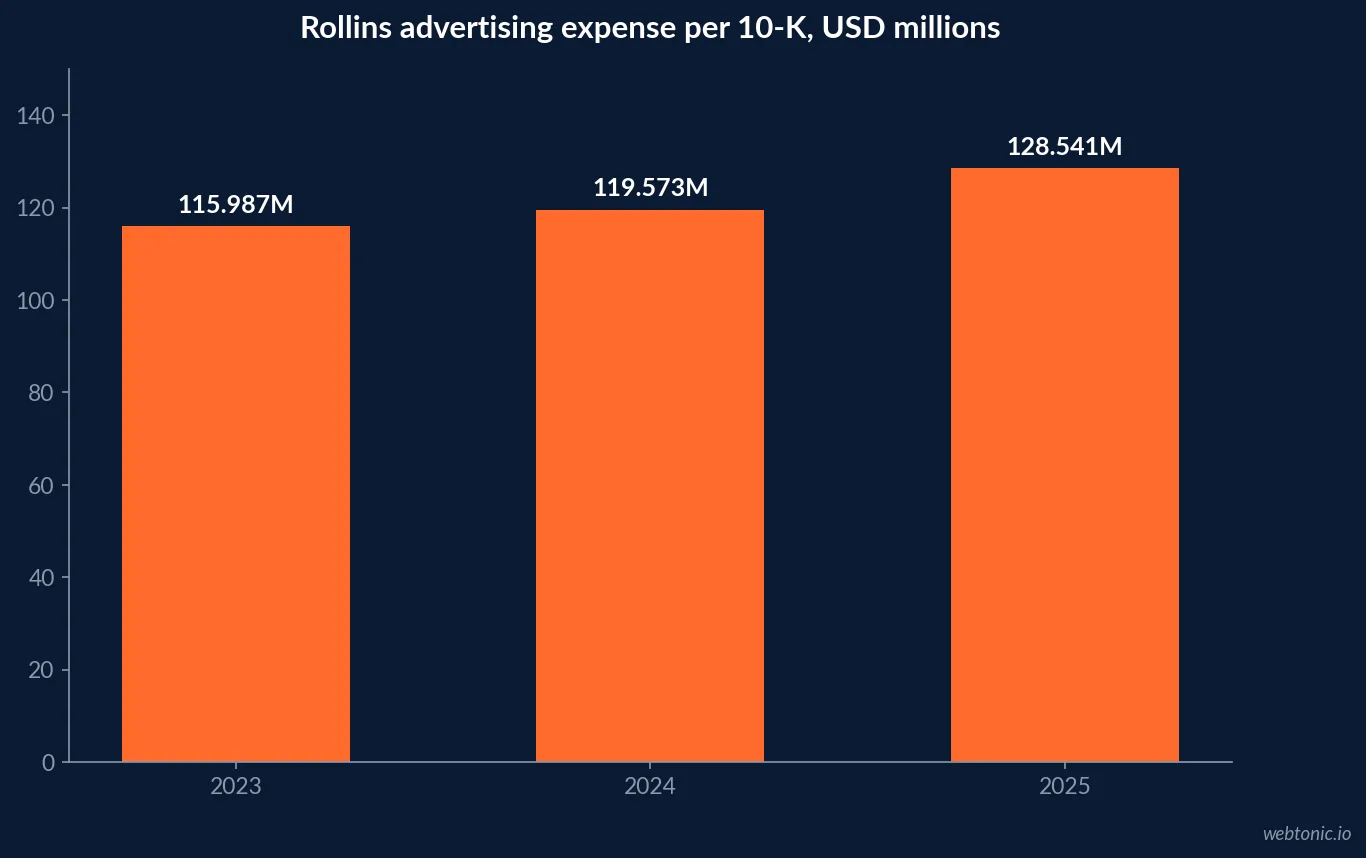
Rollins, parent of Orkin, gives the only audited view of pest advertising at scale. Its 2025 Form 10-K reports advertising costs of USD 128,541 thousand in 2025, against USD 119,573 thousand in 2024 and USD 115,987 thousand in 2023, charged to sales, general and administrative expense as incurred. Total revenues were USD 3,761,050 thousand, so advertising ran at roughly 3.4% of revenue (our calculation). The filing also lists "a decline in the effectiveness of our marketing (including digital marketing) efforts" as a risk factor.
The 10-K does not say how much of that went to native, search or television. It is a ceiling for context, not a channel mix to copy.
| Rollins, per 2025 10-K | 2023 | 2024 | 2025 |
|---|---|---|---|
| Advertising costs | USD 116.0M | USD 119.6M | USD 128.5M |
| Total revenues | USD 3,073.3M | USD 3,388.7M | USD 3,761.1M |
| Advertising as share of revenue (calc.) | 3.8% | 3.5% | 3.4% |
Growth came from several directions in 2025: organic revenue growth of 6.9% with acquisitions adding 4.1%, residential pest revenue up about 10%, commercial up about 11% and termite and ancillary services up about 14%, per the same filing. None of those lines is attributed to a specific ad channel.
The market a native campaign would be selling into
The NPMA 2025 industry report (26th edition, 800 owners and managers surveyed by Specialty Consultants) puts US structural pest control revenue at USD 13.416 billion in 2025, up 6% from USD 12.654 billion. There were 16,565 firms, 81.4% of them running one or two locations, serving nearly 13.29 million residential customers. Recurring revenue was 85.4% of residential revenue, up from 85.2%.
That last number is the one that matters for native. A channel that wins a quarterly plan earns its cost back over years, which changes how much a pest firm can afford per lead.
| NPMA 2025 figure | Value | What it means for a native test |
|---|---|---|
| Industry service revenue | USD 13.416 billion (+6%) | Growing category, room for new demand |
| Pest control firms | 16,565 | Most compete locally |
| Firms with one or two locations | 81.4% | Small budgets, tight test windows |
| Residential customers | ~13.29 million | Large, repeat audience |
| Recurring share of residential revenue | 85.4% | Value a lead on plan lifetime |
| Firms constrained by technician shortage | 36.8% | Demand may outrun capacity |
Where pest customers actually come from
NPMA's 2026 Sales Operations Survey, conducted in April 2026, reports that "digital channels, referrals, and word of mouth rank as the top lead generation channels industry-wide", and that technicians and owners generate most sales. It does not split "digital" into search, social or native.
Generational research from the Professional Pest Management Alliance, summarised in NPMA's PestWorld magazine (January-February 2026), shows 33% of Gen Zers and 24% of millennials turn to search engines as their primary method for finding pest control services; Gen Z's second method, recommendations from friends and family, sits at 19%. Among regular pest control users, 76% of millennials keep ongoing service relationships, and over 50% of millennials and Gen Zers are interested in smart-device pest monitoring.
Put together: most younger homeowners do not start with search. That is the gap native is designed to fill, but no dataset yet shows native filling it profitably for pest firms.
| Discovery signal | Figure | Source |
|---|---|---|
| Gen Z using search as primary discovery | 33% | PPMA via NPMA, 2026 |
| Millennials using search as primary discovery | 24% | PPMA via NPMA, 2026 |
| Gen Z relying mainly on friends and family | 19% | PPMA via NPMA, 2026 |
| Millennial users with ongoing service plans | 76% | PPMA via NPMA, 2026 |
| Top lead channels named by firms | Digital, referrals, word of mouth | NPMA survey, Apr 2026 |
What native networks offer a pest advertiser
The IAB Native Advertising Playbook 2.0 (May 2019) groups native into in-feed or in-content ads, content recommendation widgets and branded content. For a pest firm that usually means a seasonal article such as "signs of termites in spring" placed below news stories. Scale is not the issue: Taboola says its Realize platform reaches over 600 million daily active users across publishers such as NBC News and Yahoo. Reach is the vendor's claim; local relevance is the buyer's job, since a pest firm only serves a few ZIP codes.
Computing whether native can work for your firm
OpenAdLibrary, a native-ad spy-tool vendor, states that "there is no trustworthy universal conversion rate benchmark for native ads" and recommends a breakeven rate: cost per click divided by allowable cost per acquisition. Applied to pest control with the LocaliQ display lead cost of USD 66.69 as the allowable cost, a USD 0.50 native click needs a 0.75% conversion rate to break even and a USD 1.00 click needs 1.50%. Those are our calculations, not observed pest results.
| Native CPC (scenario) | Allowable CPL | Breakeven conversion rate |
|---|---|---|
| USD 0.30 | USD 66.69 | 0.45% |
| USD 0.50 | USD 66.69 | 0.75% |
| USD 1.00 | USD 66.69 | 1.50% |
| USD 0.50 | USD 39.25 (search parity) | 1.27% |
Label rules that shape pest native copy
Two rule sets hit pest advertorials. First, the FTC native advertising guide says a native ad is deceptive if it is not readily identifiable as advertising, and that the label must be clear before the consumer clicks. Second, federal pesticide labeling rules at 40 CFR 156.10 list "claims as to the safety of the pesticide or its ingredients, including statements such as 'safe,' 'nonpoisonous,' 'noninjurious,' 'harmless' or 'nontoxic to humans and pets'" among false or misleading statements. The regulation governs labeling, but an advertorial built on "pet-safe" language carries the same risk.
A fair native test for an exterminator
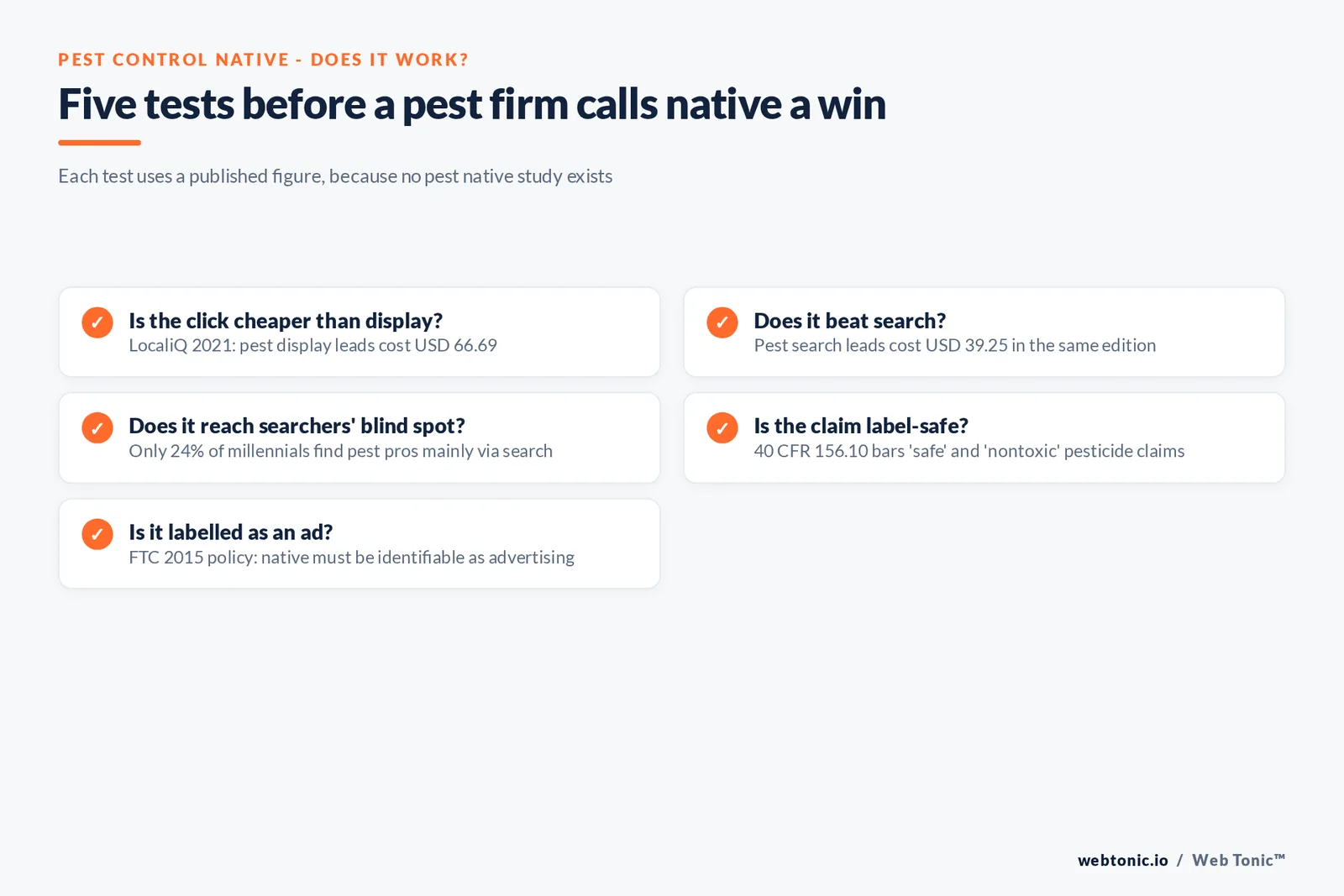
- Set the bar at USD 66.69 per lead or your own display cost, whichever is lower.
- Count booked inspections, not clicks: a 0.09% display CTR shows clicks are scarce.
- Value recurring plans: they are 85.4% of residential revenue industry-wide.
- Target the season when termite, ant and mosquito content is timely.
- Strip safety claims from the creative and label it "Sponsored".
So, does native work for pest control?
The honest answer for 2026 is that it is unproven either way. Interruption channels cost more per pest lead than search in the only public pest benchmark, and the largest operator does not disclose its channel mix. Native earns a place when it reaches homeowners who never search, and only a tracked test with a breakeven rate can show whether it does that for your service area.
For the cross-industry picture see our native advertising statistics. Pest organic search data sits in our pest control enterprise SEO statistics and pest control international SEO statistics. Our data intelligence team can set up the tracking a fair test needs.
Frequently Asked Questions
Does native advertising work for pest control companies?
No published study answers it. No network, association or vendor reports native ad click-through, cost per lead or conversion rates for pest control. The closest public data is LocaliQ's 2021-edition pest benchmarks, where display leads cost USD 66.69 against USD 39.25 for search, so native has to prove it beats display before it can compete with search.
How much do large pest control companies spend on advertising?
Rollins, the largest listed US pest control company, reported advertising costs of USD 128.5 million in 2025, up from USD 119.6 million in 2024 and USD 116.0 million in 2023, on total revenues of about USD 3.76 billion. Its 10-K does not split that spend by channel, so the native share is unknown.
How do homeowners find a pest control company?
Research from the Professional Pest Management Alliance cited by NPMA in January 2026 found 33% of Gen Z and 24% of millennials use search engines as their primary way to find pest control services, with recommendations from friends and family at 19% for Gen Z. Native ads reach people who are not searching yet.
Can a pest control native ad say a treatment is safe for pets?
Be careful. Federal pesticide labeling rules at 40 CFR 156.10 treat claims such as 'safe', 'nontoxic to humans and pets' or 'harmless' as false or misleading on pesticide labeling. An advertorial that repeats those phrases invites the same problem, and the FTC also requires the ad to be clearly labelled as an ad.
What should a pest company measure in a native test?
Measure cost per booked inspection and the share of recurring plans, not clicks. NPMA reports that recurring revenue was 85.4% of residential pest revenue in 2025, so a lead that converts to a quarterly plan is worth several one-off jobs. Compute a breakeven conversion rate from your click cost and allowable cost per lead before you spend.
Sources
LocaliQ, Home Services Advertising Benchmarks (2021 edition)
LocaliQ, Home Services Search Advertising Benchmarks 2025
Rollins, Inc., Form 10-K for 2025
NPMA, US pest control industry grows 6% in 2025
NPMA, 2026 Pest Control Industry Sales Operations Survey
NPMA PestWorld, The New Generation of Homeowners (2026)
IAB, Native Advertising Playbook 2.0
Taboola, Q4 and full year 2025 results
OpenAdLibrary, Native Ads Conversion Rate Benchmarks
FTC, Native Advertising: A Guide for Businesses
eCFR, 40 CFR Part 156 Subpart A


