Table of contents
Fitness is one of the few local-service industries where the app itself is a product people keep using, so the metric to watch is retention, not installs alone. Below: the membership base, what operators disclose about their apps, the store signals Apple and Google publish, and what to track.
Key Takeaways
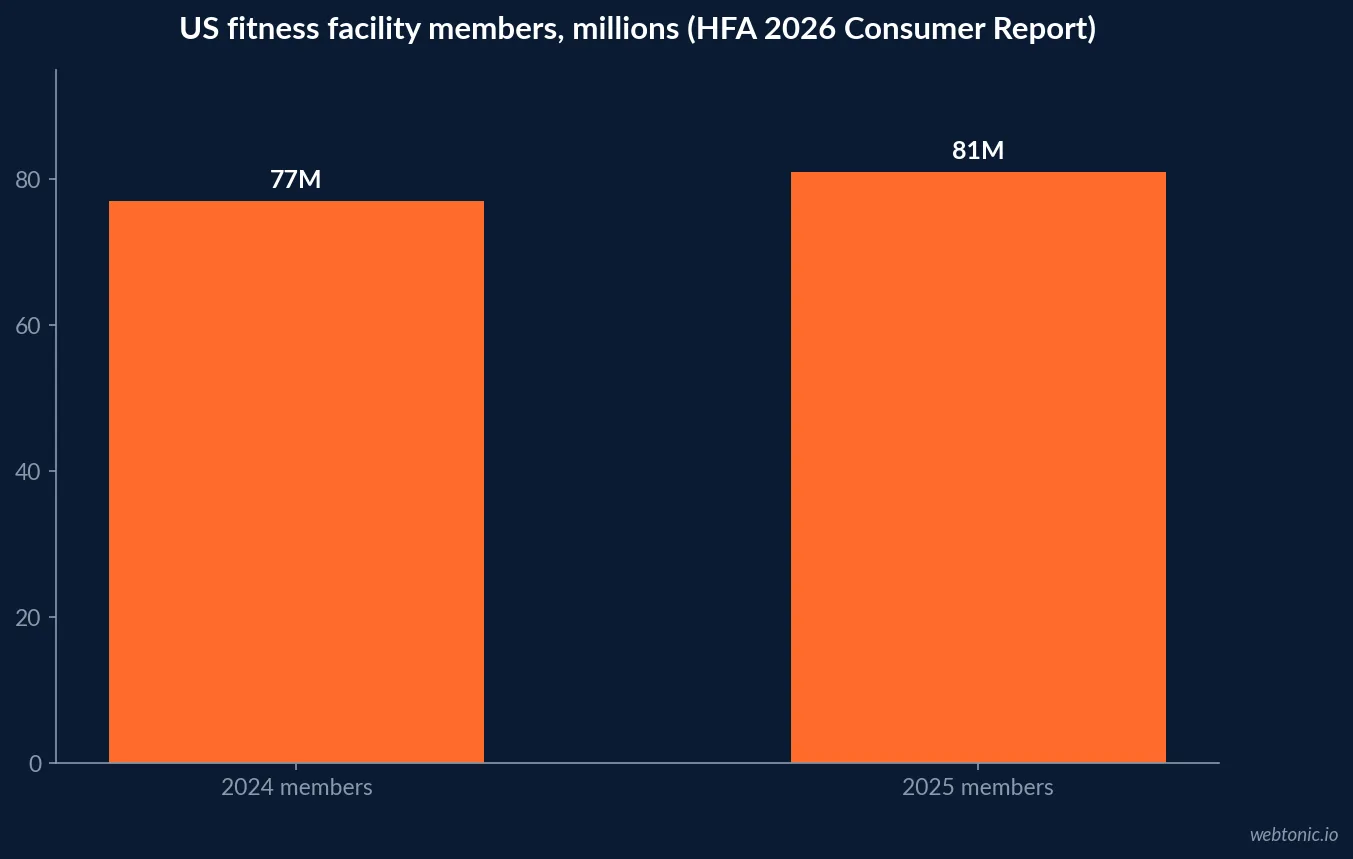
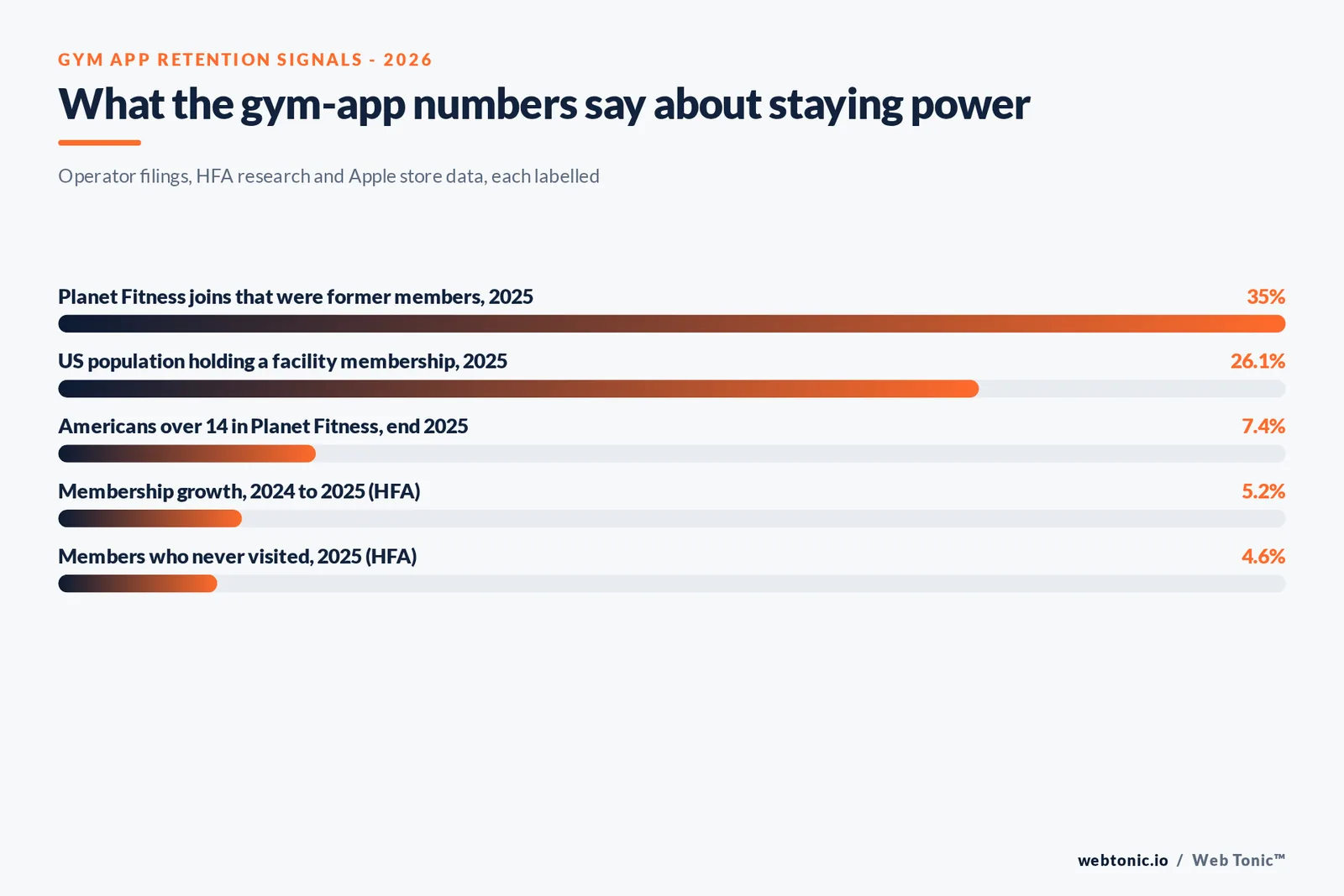
- 81 million Americans held a fitness membership in 2025, up 5.2% (HFA).
- 26.1% of the US population were facility members in 2025.
- Only 4.6% of members never used their membership, a record low.
- About 35% of Planet Fitness joins in 2025 were former members.
- Planet Fitness ended 2025 with about 20.8 million members and 2,896 clubs.
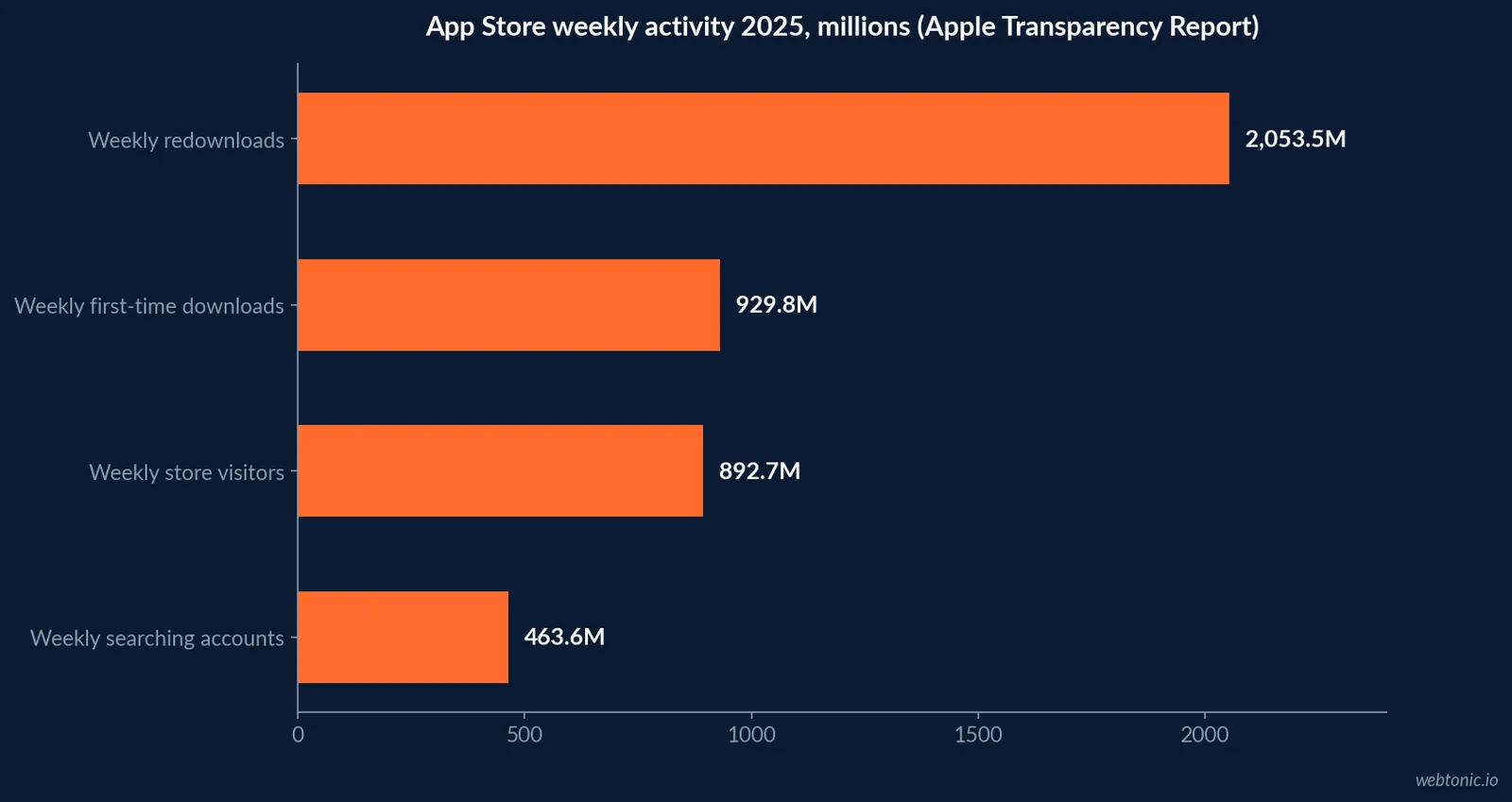
- 2,053,461,208 app redownloads happened weekly on the App Store in 2025 (Apple).
- Apple allows up to 70 custom product pages per app.
- Google Play experiments report 1-day retention for each listing version.
The membership base fitness apps are built on
The Health & Fitness Association's 2026 US Consumer Report finds 81 million Americans belonged to a gym, studio or other facility in 2025, a 5.2% increase on 2024, with more than 100 million engaging as members or non-member users and nearly 7 billion visits. The share of members who did not use their membership at all fell from around 10% to 4.6%.
The HFA also counts 55,000+ commercial fitness facilities in the US. That is the unusual part for ASO: a large, habitual audience that already expects to manage bookings, classes and check-ins on a phone.
| Membership fact | Figure | Year | Source |
|---|---|---|---|
| US facility members | 81 million | 2025 | HFA |
| Growth on the prior year | 5.2% | 2025 | HFA |
| Members plus non-member users | 100 million+ | 2025 | HFA |
| Facility visits | Nearly 7 billion | 2025 | HFA |
| Members who never visited | 4.6% | 2025 | HFA |
| Commercial fitness facilities | 55,000+ | Current page | HFA |
What operators disclose about their apps
Public operators are the only reliable source on fitness app scale, because they report it to shareholders. The Planet Fitness 2025 annual report says the company ended 2025 with about 20.8 million members and 2,896 clubs, that members completed more than 650 million workouts in clubs, and that about 7.4% of Americans over 14 belonged. It states that its mobile app remains a top download in the health and fitness category, without giving a download count, and that about 35% of joins were former members.
Note what is missing: no install totals, no store conversion rates, no rank history. Any page that quotes a gym chain's app conversion rate is quoting something the company did not publish.
| Planet Fitness disclosure (2025 annual report) | Figure | Relevance to app marketers |
|---|---|---|
| Members at year end | About 20.8 million | Installed-base ceiling for a branded app |
| Clubs globally | 2,896 | Local pages and check-in points |
| Member workouts in clubs | 650 million+ | Frequency the app can support |
| Share of Americans over 14 | About 7.4% | Brand search demand in the store |
| Joins from former members | About 35% | Win-back is a core app use case |
| App position | A top download in health and fitness | No count or rank disclosed |
The store signals that approximate retention
Apple's 2025 Transparency Report gives weekly averages across all apps: 929,754,061 first-time downloads, 2,053,461,208 redownloads, 892,670,823 visitors and 463,575,966 searching accounts. Redownloads outnumber first-time downloads more than two to one: much store activity comes from people returning to apps they have used before, which is exactly the lapsed-member behaviour a gym app should serve.
For a single app, the store-native retention readout is on Google Play: store listing experiments report acquisition and 1-day retention for each version of a listing. A screenshot that wins installs but loses day-one users is not a winner for a membership app.
Retention metrics to track, stage by stage
No public benchmark exists for fitness app retention that we could verify, so the table below lists what to measure and where the number lives rather than what it should be. Read the stages in order: a drop at day one usually points back to the listing promising something the first session does not deliver, while a drop at the habit stage is a product and programming question that no screenshot will fix. Keep the store metrics and the membership metrics in one weekly report so the two teams argue from the same numbers, and split every line by acquisition source, because members arriving from a join email behave differently from strangers arriving from a generic workout search.
| Stage | Metric | Where it is reported | Why it matters for a gym app |
|---|---|---|---|
| Discovery | Impressions and product page views | App Store Connect / Play Console | Brand and class searches |
| Conversion | Page view to first download | App Store Connect / Play Console | Creative and caption tests |
| Day one | 1-day retention by listing version | Play store listing experiments | Catches misleading creative |
| Activation | First class booked or check-in | Gym software or app analytics | Install becomes a visit |
| Habit | Weekly active members | App analytics | Mirrors the 4.6% non-use trend |
| Win-back | Rejoins through the app | Membership system | Planet Fitness: 35% of joins |
Cross-industry conversion context, labelled
AppTweak's 2025 benchmarks put the US App Store average conversion rate at 8.56% and Google Play at 16.15%, across all categories. For paid search on the App Store, MobileAction's 2026 Apple Ads benchmark measured a 8.08% tap-through rate and 65.82% conversion rate for search results ads in 2025, across its client base. Neither publishes a Health & Fitness figure on the pages we opened, so we do not give one.
Testing capacity on each store
Apple's product page optimization tests up to three alternate treatments of icon, screenshots and previews, with a duration estimate against a 90-day window. Custom product pages allow up to 70 additional versions of a product page, each with its own URL. A gym brand can map these to programs: strength, group classes, beginners, family plans.
| Tool | Store | Limit | Best fitness use |
|---|---|---|---|
| Product page optimization | App Store | Up to 3 treatments | Icon and first screenshot |
| Custom product pages | App Store | Up to 70 pages | One page per program or audience |
| Store listing experiments | Google Play | A/B tests on graphics and text | Creative with 1-day retention check |
| Localized experiments | Google Play | Per-language tests | Multi-country chains |
Chains, franchisees and independents need different apps
The ASO job depends on who owns the listing. A national chain runs one branded app, so every club's members search the same brand name and the listing competes on the brand term plus a handful of generic workout and class searches. A franchisee inside that system usually cannot publish its own app at all; its work is local pages and the club profile inside the brand app. An independent gym or studio typically uses a white-label app supplied by its booking software, which often ships under the gym's name but on the vendor's template and release schedule.
That last case is common and easy to overlook. If the software vendor controls screenshots and release notes, the gym controls very little of its own store page, and the practical ASO lever becomes getting members to search the exact app name from emails and front-desk signage.
| Operator type | Who publishes the app | Main store search | Main ASO lever |
|---|---|---|---|
| National chain | The brand | Brand name | Screenshots, tests, custom product pages |
| Franchisee in a chain | The franchisor | Brand name | Club profile inside the brand app |
| Independent gym or studio | Often the booking software vendor | Exact gym name | Name, icon and member prompts |
| Connected-fitness brand | The brand | Brand plus workout terms | Subscription value in first screens |
How much of the store runs through search
Apple Ads says more than 850 million people visit the App Store every week and that almost 65% of downloads happen directly after a search. For a gym brand, most of that search is navigational: members typing the club name. That is why brand-term defence, in both organic listing text and paid search results ads, tends to come before any generic workout keyword work. Apple's own weekly visitor count in the Transparency Report, 892,670,823, sits above the marketing floor of 850 million.
Health data rules that affect fitness listings
Google Play's Health apps declaration lists Activity and Fitness apps that monitor workouts, heart rate or body composition as a declared health feature, and every published app must complete the form. Apple's guideline 1.4.1 says apps must disclose data and methodology to support accuracy claims about health measurements. Listing copy that promises measurement accuracy needs that support.
Where iOS and Android audiences split
Statcounter puts US mobile share at 60.68% iOS and 39.29% Android in August 2026. With nearly two in five US devices on Android, a chain that runs tests only on the App Store is optimizing blind for a large part of its members, and Play's retention readout is the easier one to get.
A retention-first ASO checklist for gym apps
- Win the brand search first: most installs for a club app come from members.
- Test creative on Play and keep only versions that hold 1-day retention.
- Build custom product pages per program and link them from class and join emails.
- Show booking and check-in in the first screenshots, not generic workout stock.
- Make rejoining a first-class flow: win-back drives a large share of joins.
- Report store metrics next to visits, not downloads on their own.
For all-industry store data, see our app store optimization statistics. For another channel view, read our fitness CTV advertising data, and for measurement help see our data intelligence services or contact us.
Frequently Asked Questions
Which metrics matter most for a gym or studio app?
Track the store funnel and what happens after it. On the store side that means impressions, product page views, first-time downloads and page-view-to-install conversion, which App Store Connect and the Play Console report. After the install, track activation, workouts or check-ins logged, and retention by week. Google's store listing experiments report acquisition and 1-day retention for each listing version, which is the closest store-native retention signal.
Do fitness brands really have large apps?
Yes, unlike most local-service industries. Planet Fitness's 2025 annual report says its mobile app remains a top download in the health and fitness category, for a system of about 20.8 million members and 2,896 clubs. Connected-fitness and studio brands also run subscription apps. Independent gyms usually rely on a white-label booking app from their software provider instead.
Is there a published conversion rate for fitness apps?
We found no primary source that publishes a Health & Fitness conversion rate we could open and verify. The cross-industry figures are AppTweak's 2025 US averages of 8.56% on the App Store and 16.15% on Google Play, and MobileAction's 65.82% Apple Ads search-results conversion rate for 2025. We do not state a fitness benchmark we could not source.
How does membership data relate to app retention?
It sets the ceiling. The HFA reports 81 million US members in 2025 and says the share of members who never used their membership fell to 4.6%, an all-time low. Planet Fitness reports that about 35% of its 2025 joins were former members. An app that makes returning easy works with that behaviour; the data shows the pattern alongside app use, not that apps cause it.
What store tests should a fitness app run first?
Start with icon and first-screenshot tests. Apple's product page optimization tests up to three alternate treatments against the original, and Google Play's store listing experiments A/B test graphics and localized text for free. Then build custom product pages for distinct audiences, such as strength, classes or beginners; Apple allows up to 70.
Sources
HFA - 2026 US Health & Fitness Consumer Report release
Health & Fitness Association - US industry economic impact
Planet Fitness - 2025 Annual Report
Apple - App Store Transparency Report 2025
Google Play Console - Store listing experiments
Apple - Product page optimization
Apple - Custom product pages
Apple - App Review Guidelines
Google Play - Health apps declaration
AppTweak - App conversion rate by category 2025
MobileAction - Apple Ads 2026 benchmark report
Statcounter - US mobile OS share