



Table of contents
No published study gives a dental cost per lead for native advertising, so a dental native budget has to be built from two things that are published: the networks' own budget rules and the lead costs dentists already pay in search and on Meta. Taboola's Realize help centre sets the floor at USD 50 a day or 10 times the CPA goal, and the 2026 dental search median sits at USD 72.97 a lead. Everything below is sized from those anchors, with every cross-industry figure labelled as such.
Key Takeaways
- Realize recommends a daily budget of 10 times the CPA goal or at least USD 50.
- Google's Demand Gen guidance asks for at least USD 100 a day on Maximize conversions.
- Dental search leads cost a median USD 72.97 in 2026 (WordStream).
- Dental search clicks cost USD 8.00, against USD 5.42 for all industries.
- Dental search converts at 10.67%, above the 8.18% all-industry median.
- Dental Facebook lead campaigns cost USD 76.71 a lead, the highest of 15 industries in 2025.
- Dental Facebook lead clicks cost USD 9.78, with a 1.05% click-through rate.
- Health is native's largest vertical at 24,472 live creatives in July 2026 (OpenAdLibrary).
- Taboola carries 11,982 of those health creatives.
- Taboola reported USD 713.5 million ex-TAC gross profit for 2025.
- US internet ad revenue reached USD 294.6 billion in 2025; IAB does not break out native.
- No dental native CPL, CTR or conversion rate is published anywhere we could find.
Why there is no dental native benchmark to copy
Native networks report to investors in aggregate. Taboola's full-year 2025 results give revenue, ex-TAC gross profit and advertiser counts, not results by vertical, and the IAB/PwC Internet Advertising Revenue Report for 2025 splits US revenue into search, social, video, commerce media and programmatic without a native line at all. Vendor case studies exist, but none we could verify publishes a dental cost per lead with a stated sample.
That gap matters for a budget. A practice owner who reads a "native CPL" in a pitch deck is almost always reading a blended network figure or a single advertiser's result. The honest planning method is to borrow the floors the networks themselves publish and to compare the test against dental costs that are measured, which for now means search and Meta lead campaigns.
| Budget input | Published figure | Who publishes it | Dental-specific? |
|---|---|---|---|
| Native daily budget rule | 10x CPA goal or at least USD 50 | Taboola Realize help centre | No - network rule |
| Demand Gen daily minimum (Maximize conversions) | USD 100 | Google Ads Help | No - platform rule |
| Demand Gen with target CPA | At least 10x the tCPA | Google Ads Help | No - platform rule |
| Search cost per lead, 2026 | USD 72.97 | WordStream by LocaliQ | Yes - dentists |
| Facebook lead-campaign cost per lead, 2025 | USD 76.71 | WordStream by LocaliQ | Yes - dentists |
| Native cost per lead | Not published | - | No source exists |
The floor the networks set
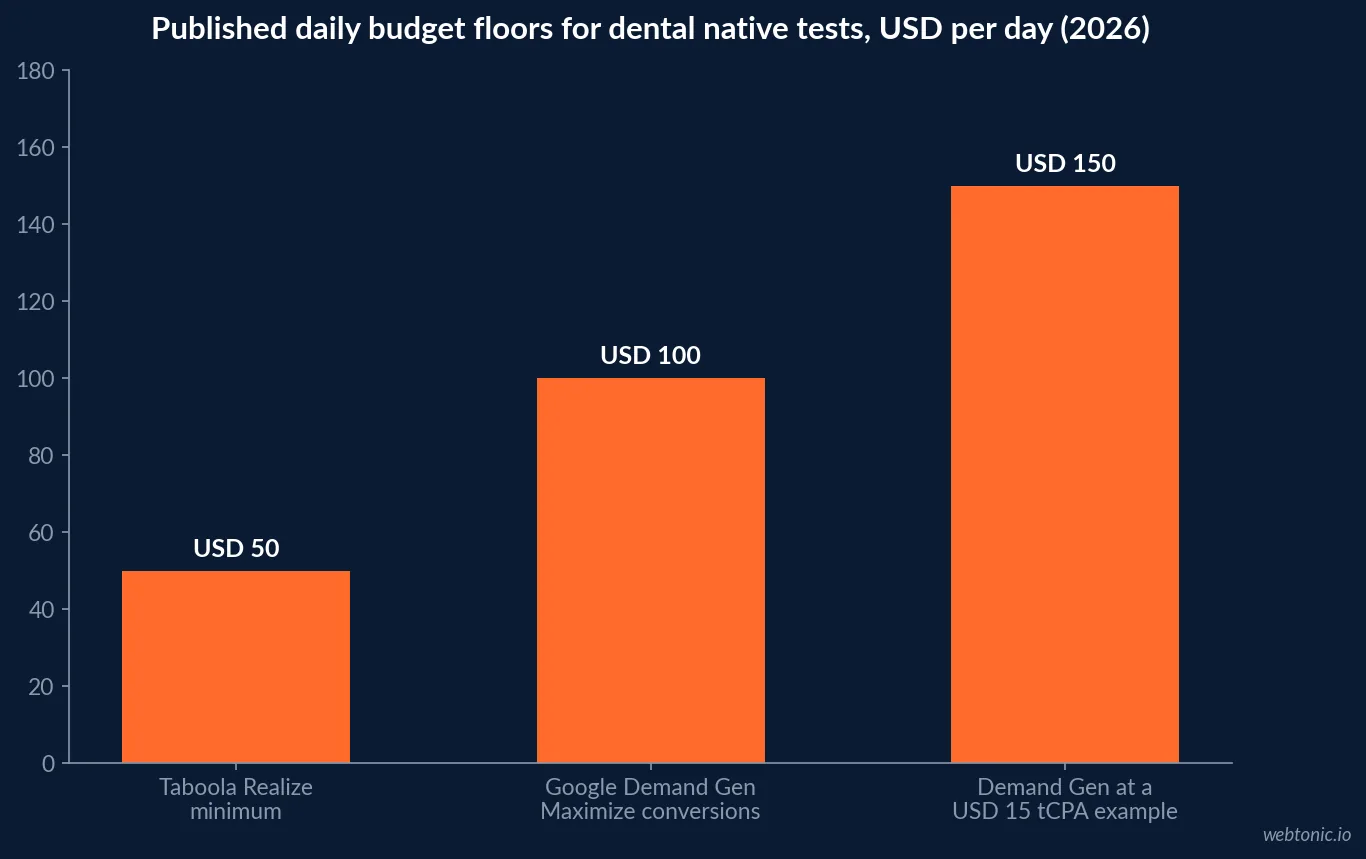
Taboola's Realize budget and pacing article is specific: the recommended daily budget per campaign is 10 times your CPA goal, or at least USD 50, so the algorithm gathers enough data to reach about ten conversions a day. Google's Demand Gen troubleshooting page, the closest comparator format on Google's side, uses the same multiple: a daily budget of at least 10 times the target CPA, with its own example of a USD 15 tCPA requiring USD 150 a day, and a minimum of USD 100 a day for Maximize conversions.
Both rules exist for the same reason. Automated bidding needs conversion volume, and a budget below the multiple starves it. For a dental practice that is the first budgeting decision: the CPA goal you choose sets the spend, not the other way round.
What dentists already pay for a lead elsewhere
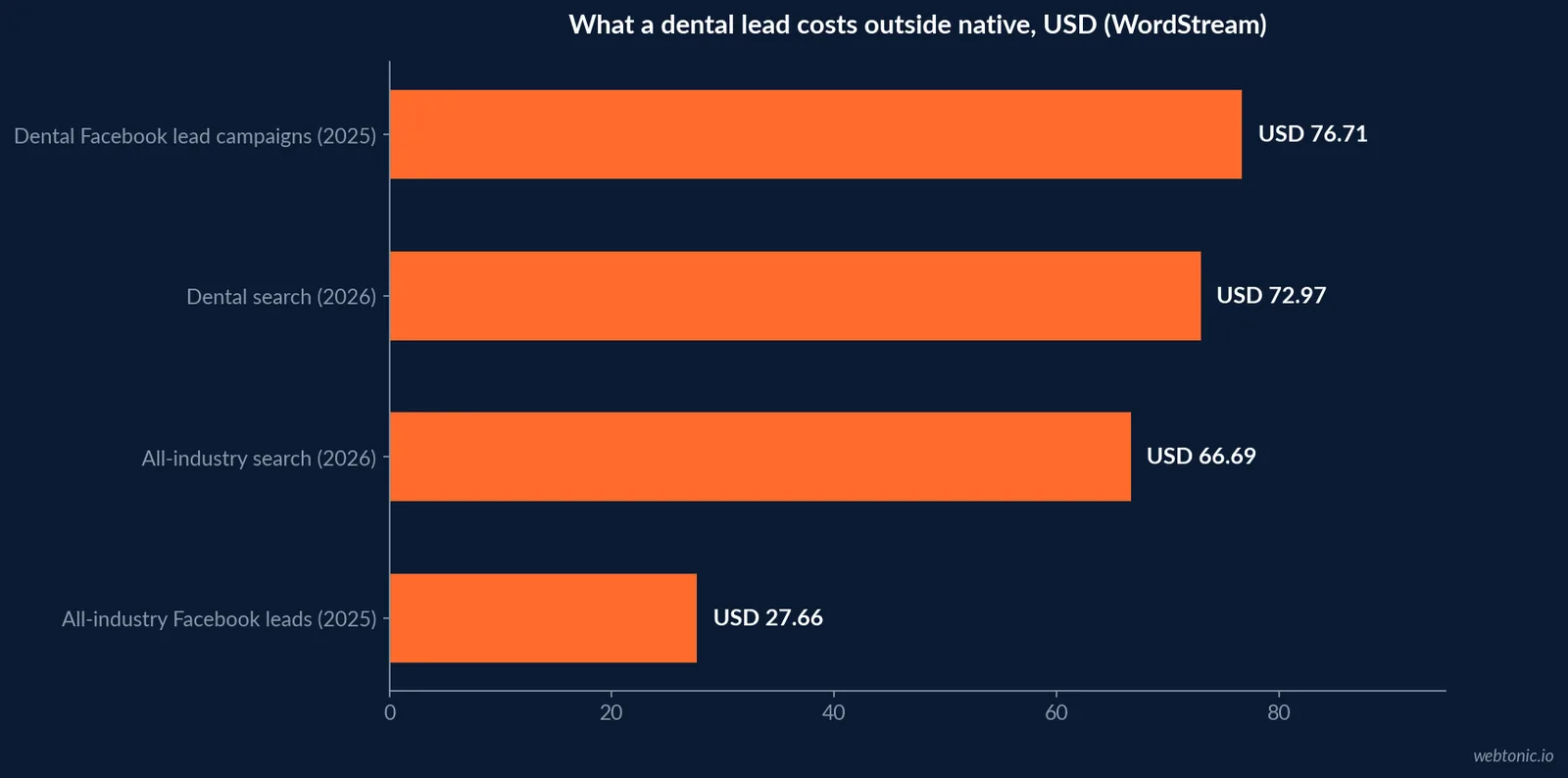
WordStream's 2026 Google Ads benchmarks, built from more than 13,000 search campaigns run between April 2025 and March 2026 and reported as medians, place Dentists and Dental Services at a 5.66% click-through rate, USD 8.00 per click, a 10.67% conversion rate and USD 72.97 per lead. The all-industry medians are 6.64%, USD 5.42, 8.18% and USD 66.69.
On Meta the picture is harsher. WordStream's 2025 Facebook ads benchmarks (more than 1,000 campaigns) put dental lead campaigns at a 1.05% click-through rate, USD 9.78 a click, a 6.38% conversion rate and USD 76.71 a lead - the highest cost per lead of the 15 industries in the lead-campaign table, where the all-industry figure is USD 27.66.
| Metric (median) | Dental search, 2026 | All-industry search, 2026 | Dental Facebook leads, 2025 | All-industry Facebook leads, 2025 |
|---|---|---|---|---|
| Click-through rate | 5.66% | 6.64% | 1.05% | 2.59% |
| Cost per click | USD 8.00 | USD 5.42 | USD 9.78 | USD 1.92 |
| Conversion rate | 10.67% | 8.18% | 6.38% | 7.72% |
| Cost per lead | USD 72.97 | USD 66.69 | USD 76.71 | USD 27.66 |
Turning the floors into budget ranges
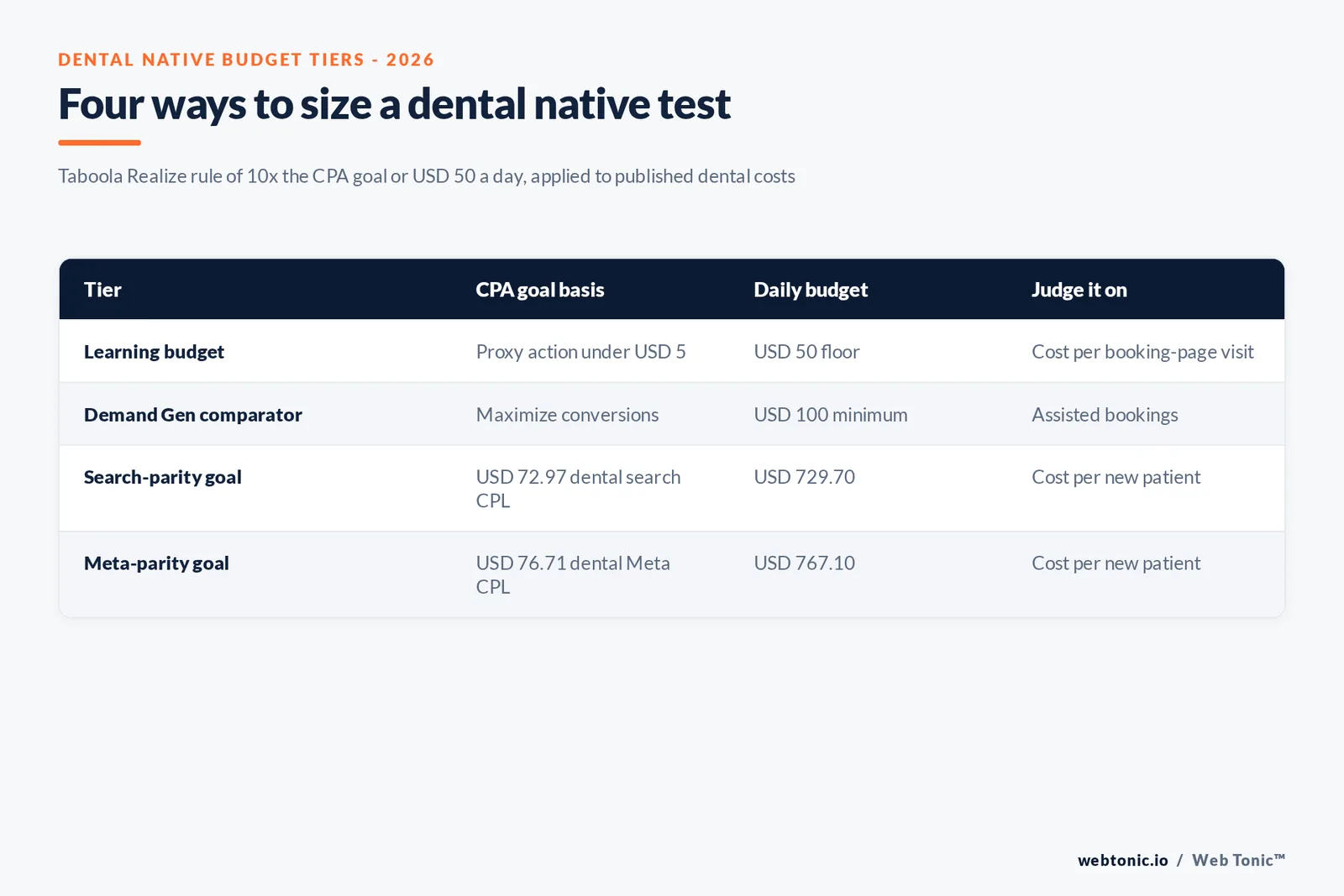
The table below is arithmetic, not a benchmark. It multiplies the Realize rule by three CPA goals a practice might set: a click-led test, the dental search median and the dental Meta median. It shows why a conversion-optimised native campaign at search-level lead costs is a large daily commitment for a single office, and why many tests begin on a lower-funnel proxy such as a booking-page visit.
| CPA goal the practice sets | Basis for the goal | Realize rule: 10x goal | Monthly at 30 days |
|---|---|---|---|
| USD 5 (proxy action) | Below the USD 50 floor | USD 50 a day (floor applies) | USD 1,500 |
| USD 72.97 | Dental search median, 2026 | USD 729.70 a day | USD 21,891 |
| USD 76.71 | Dental Facebook leads median, 2025 | USD 767.10 a day | USD 23,013 |
Read the second and third rows as a ceiling on what full conversion optimisation would demand, not as a recommendation. Practices that cannot fund that line should not set a lead-level goal on native; they should buy a learning budget with a fixed end date and judge it on cost per booking-page visit and assisted conversions.
Where the native money actually goes
OpenAdLibrary, a native-ad spy-tool vendor reporting on its own index of live native creatives, reports in its August 2026 health benchmark that health is native's largest vertical with 24,472 live creatives in its July 2026 index of more than 725,000 ads across 49 networks, ahead of finance at 24,068 and insurance at 22,427. Nearly half the classified health creatives, 11,982, run on Taboola.
The same study files "oral and dental adjacent" offers - red-light gum therapy and dental alternatives - under a "reliably aggressive" corner of the vertical. That is the company a dental practice keeps in a native feed, and it is a creative-quality and compliance problem as much as a budget one.
| Native index figure (OpenAdLibrary, July 2026) | Value | What it tells a dental buyer |
|---|---|---|
| Live health creatives | 24,472 | Health is the most crowded native vertical |
| Live finance creatives | 24,068 | Close second competitor for the same inventory |
| Live insurance creatives | 22,427 | Third vertical bidding on similar readers |
| Health creatives on Taboola | 11,982 | Nearly half the vertical sits on one network |
| Networks in the index | 49 | Inventory quality varies widely by network |
The size of the networks you are buying from
Budgets land with a small number of companies. Taboola's 2025 results show USD 1,912 million of revenue and USD 713.5 million of ex-TAC gross profit, up 6.9%, and about 2,200 Scaled Advertisers in the fourth quarter (Taboola's term for advertisers above USD 100,000 of cumulative gross spend). Teads, which merged with Outbrain in February 2025, reported USD 529.7 million of ex-TAC gross profit for 2025, up 124% mainly because of the acquisition.
A single-location practice spending USD 1,500 a month is a very small account on either network. Expect self-serve tooling, not a managed team, and plan the creative and landing page yourself.
Disclosure rules that shape the budget
The FTC's native advertising guide for businesses (December 2015) says it is deceptive to mislead consumers about the commercial nature of content and lists labels it considers likely to be understood - "Ad", "Advertisement", "Paid Advertisement", "Sponsored Advertising Content" - while warning against "Promoted" or "Promoted Stories". The Endorsement Guides at 16 CFR Part 255 add disclosure of material connections for any patient story or reviewer the ad uses.
The ADA marketing and advertising guidance quotes the Code directly: "Although any dentist may advertise, no dentist shall advertise or solicit patients in any form of communication in a manner that is false or misleading in any material respect." Budget for legal review of the advertorial, because a sponsored article about implants is held to the same standard as any other ad.
How to split a dental budget around a native test
- Keep search funded first. It is the only channel with a measured dental lead cost.
- Pick the CPA goal before the budget. The 10x rule turns that goal into daily spend.
- Test elective treatments, not emergencies. Aligners, implants and whitening suit discovery reading.
- Set a stop rule. A fixed end date and a cost-per-visit ceiling, written down before launch.
- Label it plainly. "Sponsored" or "Ad" per the FTC list; avoid "Promoted Stories".
- Measure assisted conversions. Native rarely gets last-click credit; judge it on assisted bookings.
For the cross-industry picture of the channel, see our native advertising statistics; for the search side of a dental budget, our dental Google Ads statistics go deeper.
Native against the wider 2025 ad market
US internet advertising revenue reached USD 294.6 billion in 2025, up 13.9%, per IAB and PwC. Search held the largest share at 38.8% (USD 114.2 billion, up 11.0%) and social media reached USD 117.7 billion. Native is not reported as a separate format in that report, so any "native share of budget" figure you see quoted comes from a different definition or a forecast.
| US internet ad revenue line, 2025 (IAB/PwC) | Value | Growth |
|---|---|---|
| Total internet advertising | USD 294.6 billion | +13.9% |
| Search | USD 114.2 billion (38.8% share) | +11.0% |
| Social media | USD 117.7 billion | +32.6% |
| Native | Not broken out | - |
What we could not verify
We found no primary source for a dental native click-through rate, a dental share of native spend or a dental native cost per patient. Agency round-ups quoting such figures do not name a sample, so they are left out. When those numbers appear, they should be read against the measured search and Meta figures above. Practices running organic content at scale can compare our dental enterprise SEO statistics.
Frequently Asked Questions
How much should a dental practice budget for a native advertising test?
Start from the network's own rule rather than a guess. Taboola's Realize help centre recommends a daily campaign budget of 10 times your CPA goal, or at least USD 50. If a practice plans against the USD 72.97 median search cost per lead WordStream reports for dentists in 2026, ten times that goal is roughly USD 730 a day, which is why most single-location practices test native with a lower CPA goal or a click objective first.
Is there a published cost per lead for dental native ads?
No. Neither Taboola, Teads, IAB nor any association publishes a dental native-ad cost per lead, click-through rate or conversion rate. The figures on this page that carry a dental label come from paid search and Meta lead campaigns; the native figures are cross-industry and labelled that way.
How does a native budget compare with Google and Meta for dentists?
WordStream's 2026 search benchmarks put the dental median at USD 8.00 a click and USD 72.97 a lead, and its 2025 Facebook report puts dental lead campaigns at USD 9.78 a click and USD 76.71 a lead, the highest of the 15 industries it measured. Native has no matching dental benchmark, so it should be budgeted as a test with its own cost goal, not as a cheaper substitute.
What does the ADA say about advertising in sponsored content?
The ADA Code states that although any dentist may advertise, no dentist shall advertise or solicit patients in a manner that is false or misleading in any material respect. Combined with the FTC's 2015 native advertising guidance, that means a sponsored article about implants or aligners must read as an ad and carry claims the practice can support.
Should native replace search in a dental budget?
Nothing in the published data supports that. Search still held 38.8% of US internet ad revenue in 2025 per IAB and PwC, and it captures patients who are already looking. Native is better treated as a discovery line for elective treatments, funded from a separate test budget with a stop rule.
Sources
Taboola Realize - Setting your budget and pacing
Google Ads Help - Demand Gen troubleshooting
WordStream - Google Ads benchmarks 2026
WordStream - Facebook ads benchmarks 2025
OpenAdLibrary - Health advertising benchmarks 2026
Taboola - Q4 and full year 2025 results
IAB/PwC - Internet Advertising Revenue Report FY2025
FTC - Native advertising: a guide for businesses
eCFR - 16 CFR Part 255 Endorsement Guides
ADA - Marketing and advertising


