Table of contents
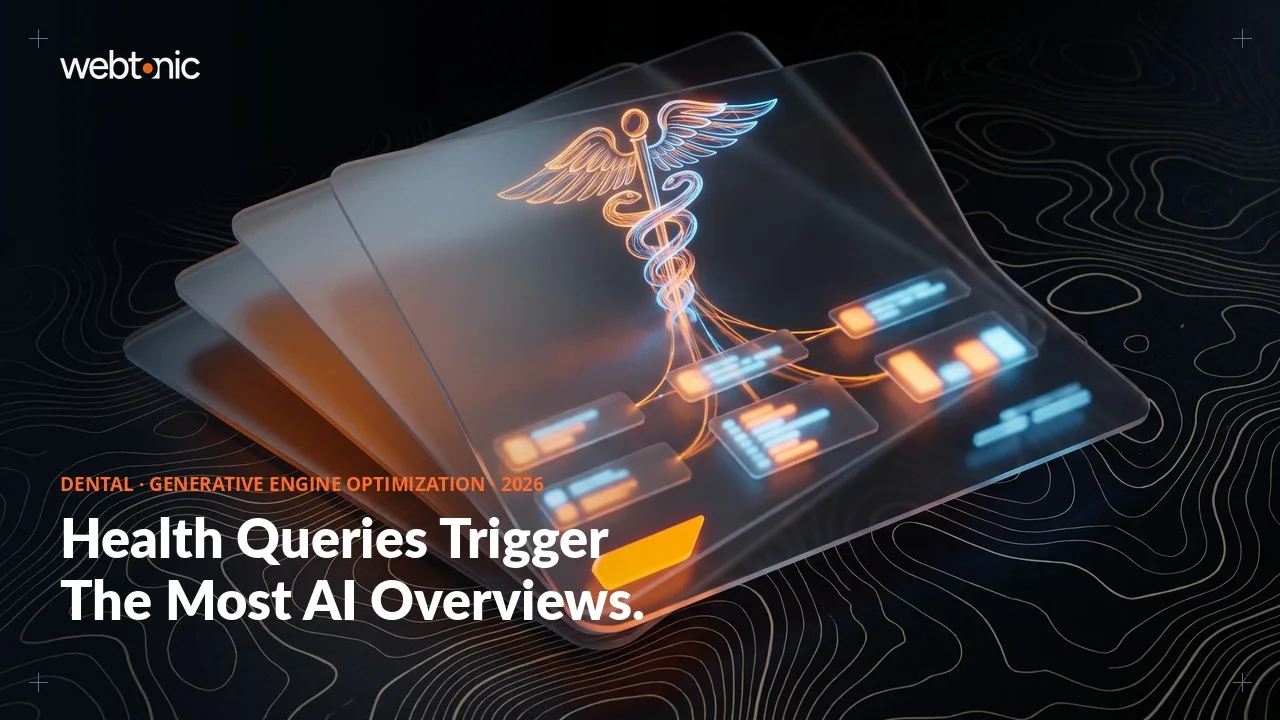
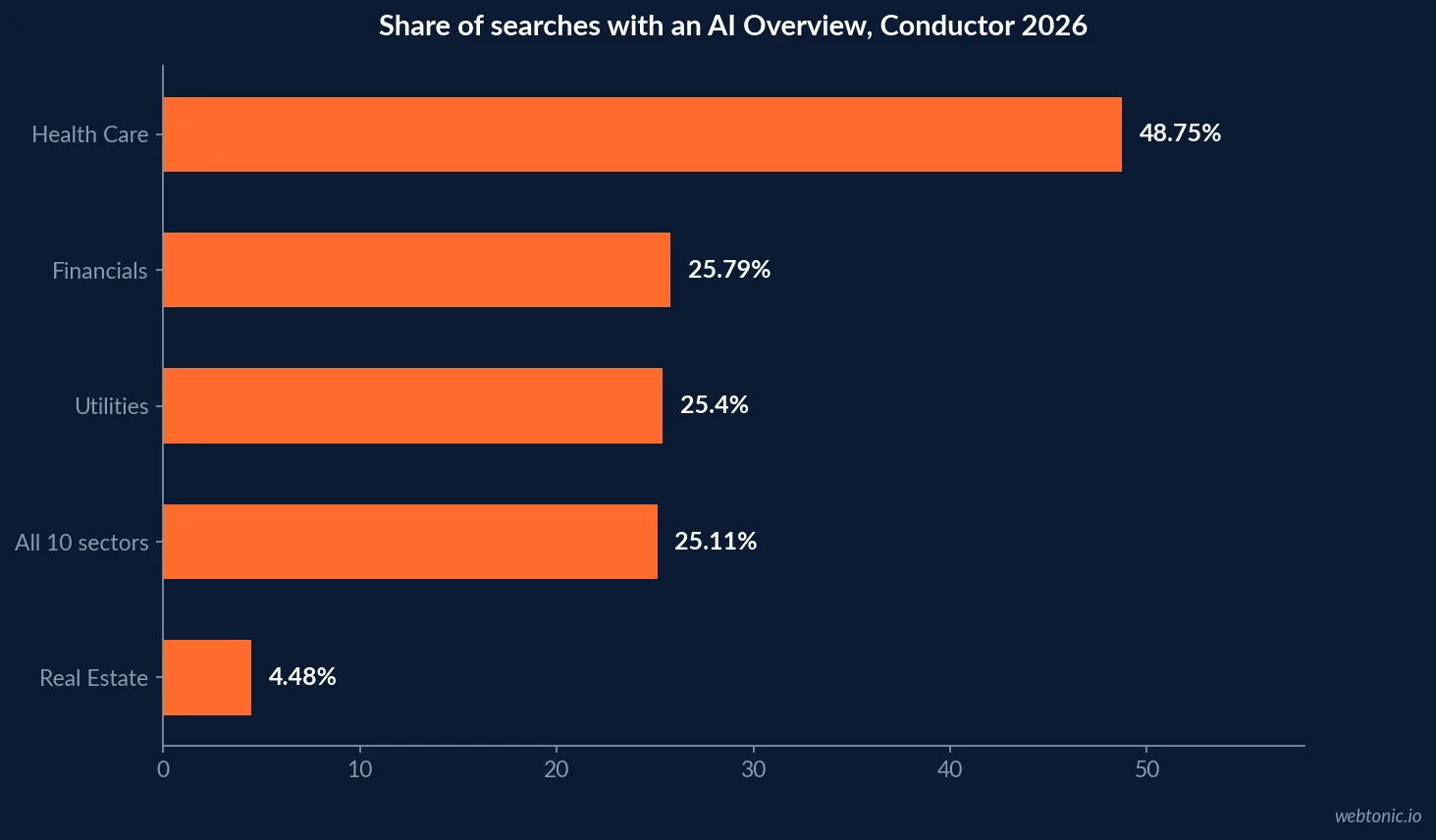
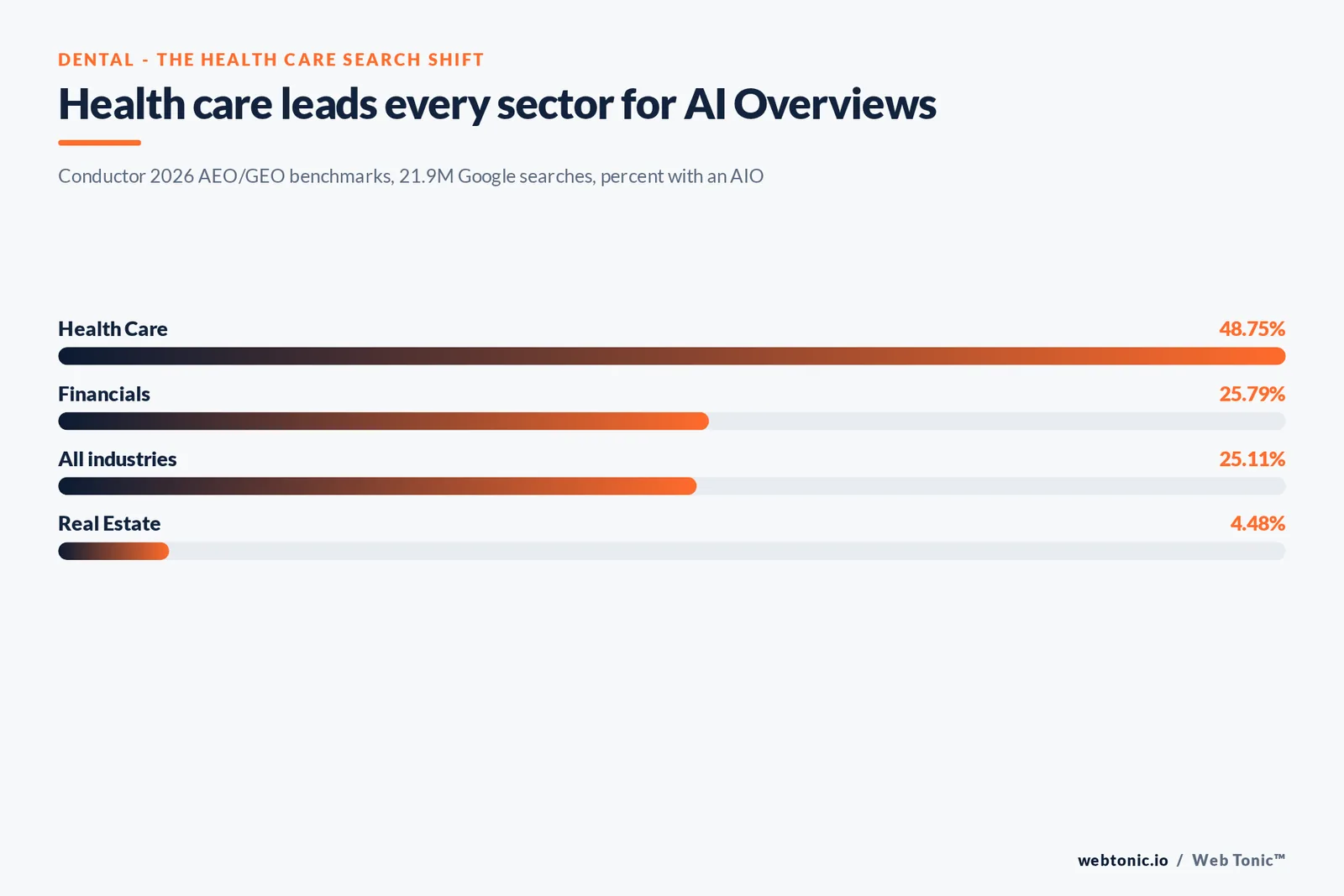
This 2026 annual report is a compilation, not a dental survey: it gathers named 2025-2026 studies and uses the health care sector wherever no dental cut exists. The headline finding comes from Conductor: health care searches trigger Google AI Overviews more than any other sector, at 48.75%.
Key Takeaways
- Health care led all ten sectors with 48.75% of searches showing an AI Overview, against 25.11% across 21.9M searches (Conductor 2026).
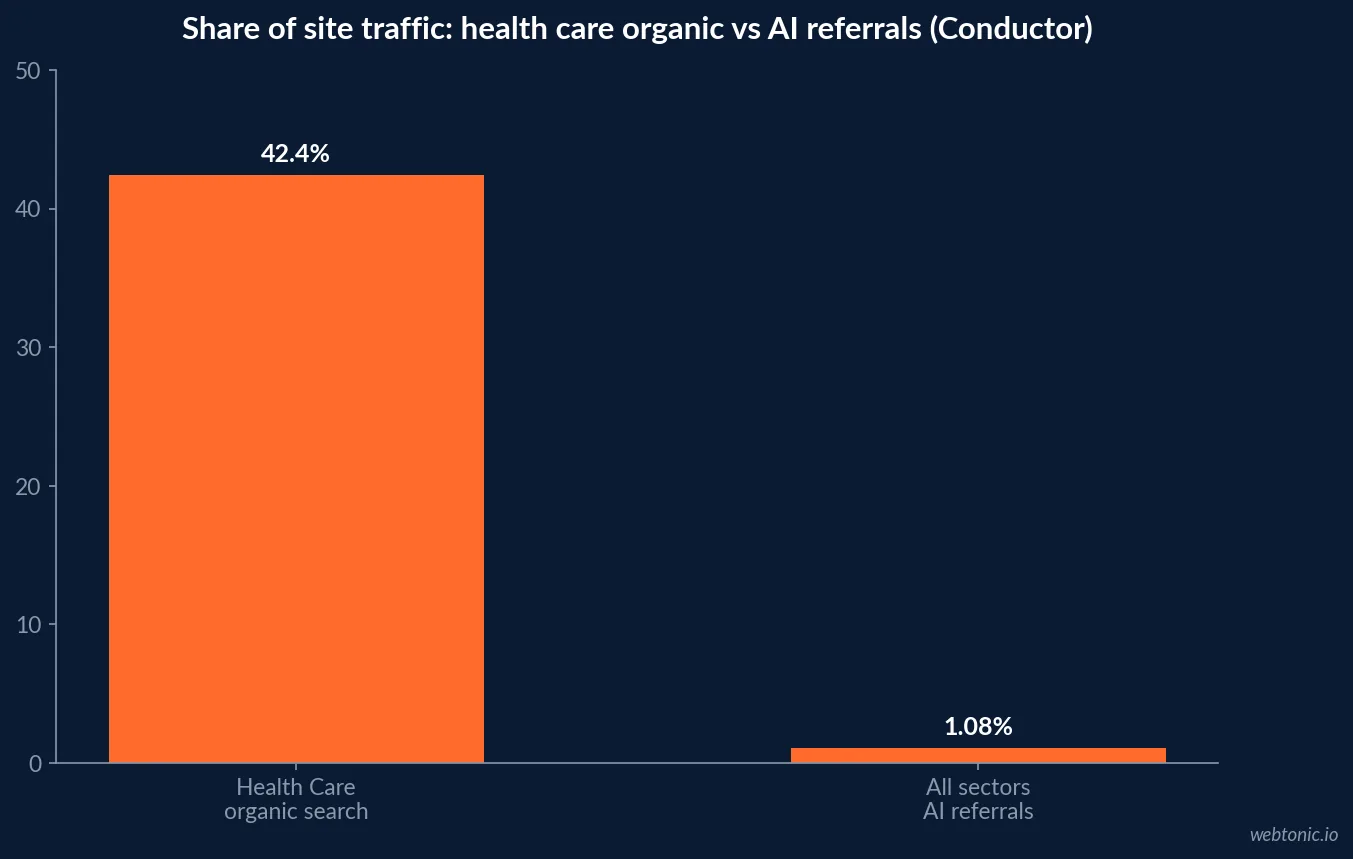
- Organic search supplied 42.4% of Health Care website traffic; AI referrals were 1.08% of traffic across all sectors.
- ChatGPT generated 87.4% of AI referral traffic in Conductor's data.
- Google says AI Overviews have over 2.5 billion monthly active users (I/O 2026).
- AIO presence grew from roughly 30% to 48% of tracked queries in a year (BrightEdge).
- Only about 17% of AIO-cited sources also rank in the organic top 10.
- No study publishes a dental AI-citation share, GEO cost per patient or AEO click-through rate.
The 2026 report card at a glance
Each row names its issuer and scope. "Health care" means the sector cut; there is no dental row in any of these datasets, and the right-hand column says so.
| Indicator | Latest value | Scope | Dental cut? |
|---|---|---|---|
| Searches showing an AI Overview | 48.75% | Health Care sector, Conductor 2026 | No |
| Website traffic from organic search | 42.4% | Health Care sector, Conductor | No |
| Website traffic from AI referrals | 1.08% | Ten sectors, Conductor | No |
| AI Overviews monthly users | Over 2.5 billion | Global, Google I/O 2026 | No |
| Google searches ending without a click | 68.01% | US, Jan-Apr 2026, SparkToro | No |
| Consumers using AI for local recommendations | 45% | US, all categories, BrightLocal 2026 | No |
Why health care tops the AI Overview chart
Conductor analysed 21.9M Google searches; 5.5M generated an AIO result, or 25.11%. The Health Care industry received the highest share at 48.75%, followed by Financials (25.79%) and Utilities (25.4%), while Real Estate sat at the bottom with 4.48%. Conductor's reading is that AIOs appear more often for YMYL ("your money or your life") categories and complex queries. Dental questions about pain, procedures and costs fall squarely in that pattern, which is why the health care figure is the closest proxy a practice can use.
Who the AI cites when patients ask health questions
Conductor lists the top five Health Care domains by AI citation market share as mayoclinic.org, clevelandclinic.org, healthline.com, goodrx.com and webmd.com, and the top brand mentions as Mayo Clinic, Cleveland Clinic, Pfizer, Labcorp and Baptist Health. A local dental office will rarely displace those on "what causes tooth sensitivity". Its realistic AI targets are local and practice-specific questions, such as emergency hours, accepted insurance or a named procedure in a named city.
| Rank | Health Care domain by AI citation share | Health Care brand by AI mention share |
|---|---|---|
| 1 | mayoclinic.org | Mayo Clinic |
| 2 | clevelandclinic.org | Cleveland Clinic |
| 3 | healthline.com | Pfizer |
| 4 | goodrx.com | Labcorp |
| 5 | webmd.com | Baptist Health |
Traffic: organic still dwarfs AI referrals
The same Conductor study measured where visits actually come from across 1,215 enterprise domains. AI referrals made up 1.08% of all website traffic, about one in a hundred visits, and grew roughly 1% month over month on average. Health Care's growth rate slowed between May and September 2025 (-0.34 points), while organic search remained a key pillar at 42.4% of Health Care traffic. ChatGPT produced 87.4% of AI referrals across the ten sectors. For a dental site, the implication is arithmetic: the organic channel is roughly forty times larger than AI referrals in this sector benchmark.
AI Overviews reach more searchers every year
At Google I/O 2026, Sundar Pichai said "AI Overviews now has over 2.5 billion monthly active users." BrightEdge tracked AIO presence growing from roughly 30% to 48% of tracked queries over a year, a 58% increase, with AIOs now averaging over 1,200 pixels tall. BrightEdge also found that only about 17% of AIO-cited sources rank in the organic top 10, a share it describes as flat for months: ranking first does not guarantee a citation, and a citation does not require ranking first.
| Year-on-year indicator | Earlier | Latest | Issuer |
|---|---|---|---|
| AIO presence, tracked queries | ~30% | 48% | BrightEdge |
| Zero-click Google searches, US | 60.45% (2024) | 68.01% (Jan-Apr 2026) | SparkToro |
| Top-ranking page CTR change with AIO | -34.5% (Apr 2025) | -58% (Dec 2025 data) | Ahrefs |
| Consumers using AI for local picks | 6% (2025) | 45% (2026) | BrightLocal |
Clicks patients no longer make
Pew Research Center tracked the browsing of 900 US adults in March 2025: those who saw an AI summary clicked a traditional search result in 8% of visits, versus 15% for those who did not, and clicked a link inside the summary in just 1% of visits. Ahrefs reported that AI Overviews reduced clicks to the top-ranking page by 34.5% in April 2025 and by 58% in its February 2026 update. SparkToro measured 68.01% of Google searches ending without a click in early 2026. None of these isolate dental queries; health care's high AIO rate suggests dental informational pages are exposed to the effect.
Patients asking AI for local providers
The BrightLocal Local Consumer Review Survey 2026 (1,002 US adults) found that use of ChatGPT and other generative AI tools for local recommendations rose from 6% to 45%, making AI the third most popular source of business recommendations. The survey covers all local categories, so it cannot tell a practice how many new patients asked an assistant first. It does show that the "best dentist near me" question is now asked in more than one interface.
BrightLocal adds two figures that matter to a practice weighing how far to trust that channel: more consumers trust AI for local searches (40%) than do not (32%), and 42% say they trust AI recommendations as much as traditional reviews. Those attitudes cover restaurants, trades and clinics alike. A dental office that has thin reviews or an outdated Business Profile is therefore exposed twice: once in the map results and again in any assistant that summarises the same signals when a patient asks it for a recommendation.
Measurement is the industry-wide gap
Semrush's 2026 AI Visibility Index, expanded to 126 million US AI search prompts from January through April 2026 across 22 industries, found that 45% of marketing leaders cannot accurately measure their brand visibility within AI-generated answers, and only 9% have the tools to track all relevant metrics across platforms. It also found that on Gemini the overlap between mentioned brands and cited domains can be as low as 30%. If enterprise teams struggle to measure AI visibility, a single dental office should expect its own records, not a benchmark, to be the evidence.
Where health care sits in AI referral share
Conductor's sector split of AI referral traffic puts health care well below the leaders. Information Technology had the highest share of traffic from AI referrals at 2.80%, followed by Consumer Staples at 1.91%, while Communication Services (0.25%) and Utilities (0.35%) had the lowest. Conductor also notes AI referral traffic increased every month in only 4 of the 10 sectors, and that Health Care's growth rate slowed from May to September 2025. Its own advice is to recognise "you have time to formulate a thoughtful strategy". For a dental practice, this argues for steady work on visibility inside AI answers rather than a panic rebuild of the site.
| Sector (Conductor) | AI referral share of traffic | Trend note |
|---|---|---|
| Information Technology | 2.80% | Highest of ten sectors |
| Consumer Staples | 1.91% | Second highest |
| All ten sectors | 1.08% | About 1 in 100 visits |
| Utilities | 0.35% | Growth slowed (-0.28 pts) |
| Communication Services | 0.25% | Lowest share |
| Health Care | Not stated on the page | Growth slowed (-0.34 pts) |
How concentrated AI visibility gets by category
The Semrush index also measured how much of each category's AI visibility the top three brands hold. In News and Media the three most visible brands accounted for 82.9% of category visibility and in Consumer Electronics 76.9%, while Finance (41.4%) and Industrial (42.2%) were more distributed. Only 36 brands kept visibility across every platform Semrush tracked. Semrush does not publish a dental or health care concentration figure on that page, but the spread shows that some categories leave room for smaller names while others are effectively closed.
| Category (Semrush 2026) | Top-three brands' share of AI visibility |
|---|---|
| News and Media | 82.9% |
| Consumer Electronics | 76.9% |
| Industrial | 42.2% |
| Finance | 41.4% |
| Dental or health care | Not published |
What the research says works, and what Google requires
The original GEO paper by Aggarwal et al. (arXiv 2311.09735, KDD 2024) introduced the GEO-bench benchmark and reports that "GEO can boost visibility by up to 40% in generative engine responses", adding that efficacy varies across domains. Google's Search Central guidance takes a plainer line: "There are no additional requirements to appear in AI Overviews or AI Mode, nor other special optimizations necessary," and no special schema.org markup or AI text files are needed.
| Source | What it says | Type |
|---|---|---|
| Aggarwal et al., GEO paper | Visibility up to 40% higher in generative engine responses | Research benchmark |
| Google Search Central | No additional requirements or special optimizations for AIO | Platform guidance |
| BrightEdge | About 17% of AIO citations also rank top 10 | Vendor dataset |
| Semrush AI Visibility Index | 9% of leaders can track all AI metrics | Vendor survey and dataset |
Gaps this annual report cannot fill
- Dental AI Overview rate: not published; health care's 48.75% is the proxy.
- Dental AI-citation share: not published for any practice type.
- GEO cost per new patient: not published; no AI platform sells a per-patient product.
- AEO click-through rate: not published for dental; Pew's 1% in-summary click rate covers all searches.
Practices that want a number should log how each new patient found them and tag AI referrals in analytics; that first-party record is the only dental GEO dataset available today.
A 2026 GEO checklist for dental practices
- Answer local questions (hours, insurance, emergencies) where health reference sites cannot compete.
- Keep organic first: it supplied 42.4% of Health Care traffic versus 1.08% from AI referrals.
- Watch AI referrals monthly; ChatGPT sends 87.4% of them in Conductor's data.
- Keep Business Profile data current, which Google names in its AI features guidance.
- Review this compilation yearly as new sector data lands.
More context: our generative engine optimization statistics, our dental enterprise SEO data and dental native advertising benchmarks. Our growth marketing team can help plan the work.
Frequently Asked Questions
Is there a dental-specific AI Overview rate?
No. Conductor's 2026 AEO/GEO benchmarks report by sector, and dentistry sits inside Health Care, where 48.75% of analysed searches produced an AI Overview, the highest of ten sectors. No issuer publishes a separate dental figure.
Which sites does AI cite most for health questions?
In Conductor's Health Care cut, the top five domains by AI citation share were mayoclinic.org, clevelandclinic.org, healthline.com, goodrx.com and webmd.com. A dental practice competes with these reference sites on informational questions, and with local listings on booking questions.
How much traffic do AI assistants send to health care websites?
Conductor does not publish a dental number. Across its ten sectors, AI referrals were 1.08% of all website traffic, while organic search supplied 42.4% of Health Care traffic. ChatGPT produced 87.4% of AI referral traffic.
Does this 2026 annual report contain original survey data?
No. It is a compilation of named third-party studies published in 2025 and 2026, each linked and dated, with the health care sector used wherever a dental cut does not exist.
Can GEO techniques measurably raise visibility in AI answers?
In a controlled research setting, yes. The GEO paper by Aggarwal et al. (arXiv 2311.09735) reports that GEO can boost visibility by up to 40% in generative engine responses, and that efficacy varies across domains.
Sources
Conductor, 2026 AEO/GEO benchmarks report
Google, Sundar Pichai at I/O 2026
BrightEdge, AI Overviews one year: presence and citations
Pew Research Center, AI summaries and clicks (July 2025)
SparkToro, zero-click Google searches in 2026
Ahrefs, AI Overviews reduce clicks by 58% (Feb 2026)
BrightLocal, Local Consumer Review Survey 2026
Semrush, 2026 AI Visibility Index (June 2026)
Aggarwal et al., GEO: Generative Engine Optimization (arXiv 2311.09735)
Google Search Central, AI features and your website