



Table of contents
No published study measures App Store optimization for med spas, because most med spas do not have an app. This page states the market structure first, then uses cross-industry App Store data labelled by source and year, plus Apple and Google rules for health-adjacent apps.
Key Takeaways
- 81% of medical spas are single-location businesses (AmSpa).
- Multi-location med spa groups average 9 locations, up from 6.
- US med spas grew from 8,899 to 10,488 between 2022 and 2023.
- Average annual med spa revenue reached USD 1,398,833 in 2023.
- 9,883,711 neuromodulator injections were performed in 2024 (ASPS).
- 5,331,426 hyaluronic acid filler procedures followed in 2024.
- Medical-category Apple Ads CPA was USD 8.90 in 2025 (SplitMetrics).
- 892,670,823 people visited the App Store weekly in 2025 (Apple).
The market a med spa app would serve
The American Med Spa Association's 2024 State of the Industry recap counts 10,488 medical spas in 2023, up from 8,899 in 2022, with average annual revenue rising from USD 1,307,587 to USD 1,398,833. It also reports that 81% of medical spas are single-location, and that multi-location operators average nine locations, up from six in the 2022 report. AmSpa's statistics page describes an industry that has passed USD 17 billion and grows by more than USD 1 billion a year.
That split decides the ASO question. A single clinic competes for local searches on Google and maps; the App Store matters mainly to groups with enough locations and repeat visits to sustain an app.
| Market fact | Figure | Year | Source | What it means for an app |
|---|---|---|---|---|
| Medical spas in the US | 10,488 | 2023 | AmSpa | A large but fragmented base |
| Medical spas a year earlier | 8,899 | 2022 | AmSpa | Fast location growth |
| Single-location share | 81% | 2024 report | AmSpa | Most clinics lack app-scale traffic |
| Average locations, multi-site groups | 9 | 2024 report | AmSpa | Where an app can pay back |
| Average annual revenue per med spa | USD 1,398,833 | 2023 | AmSpa | Budget context, not an ASO benchmark |
| Industry revenue | USD 17B+ | Current page | AmSpa | Room for brand-level apps |
Which apps actually exist in medical aesthetics
The apps patients install in this space are mostly brand loyalty and booking apps, not clinic apps. Manufacturer rewards programs and practice-management booking tools carry the install volume, while an individual med spa usually sends patients to a web booking link. We found no public dataset that counts med spa apps or ranks them, and we do not estimate one here.
For a group that does build an app, the realistic job is narrow: rebooking injectables on a treatment interval, membership billing, points and offers. ASO then means making that listing findable for the brand name and the few treatment terms patients search, and converting the visitors who arrive.
Treatment demand: the terms a listing should carry
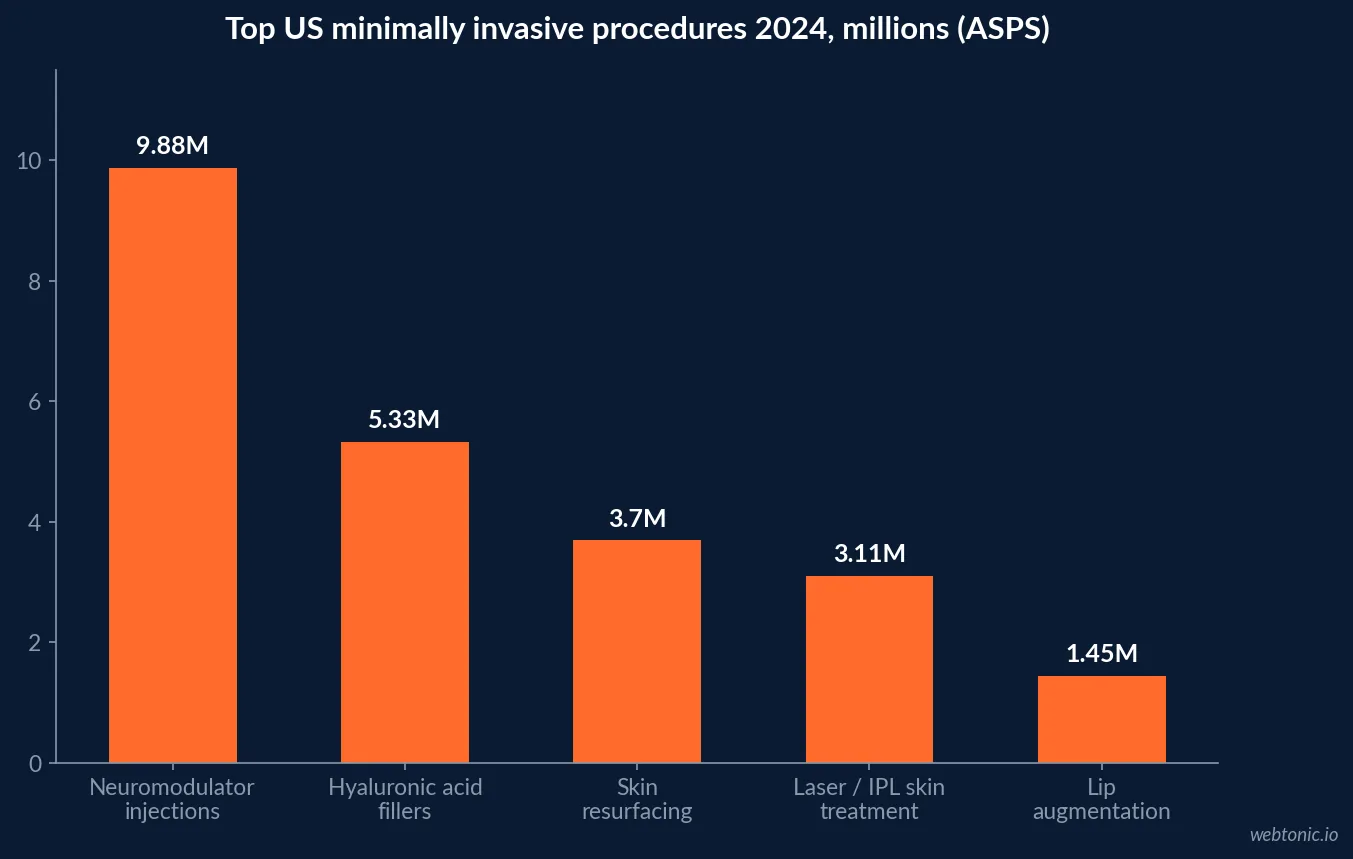
The American Society of Plastic Surgeons 2024 report counts more than 28.5 million minimally invasive procedures. The top five were 9,883,711 neuromodulator injections, 5,331,426 hyaluronic acid fillers, 3,703,305 skin resurfacing procedures, 3,112,056 laser or IPL skin treatments and 1,449,565 lip augmentations.
These are procedure counts, not search volumes, but they rank the treatments a listing's title, subtitle, keywords field and screenshots should name first. Leading with injectables and fillers matches where the volume is.
| Procedure (ASPS 2024) | US procedures | Listing element to use it in | Wording caution |
|---|---|---|---|
| Neuromodulator injections | 9,883,711 | Subtitle and first screenshot | Avoid brand names you do not own |
| Hyaluronic acid fillers | 5,331,426 | Keyword field and screenshot 2 | No guaranteed-result language |
| Skin resurfacing | 3,703,305 | Custom product page theme | Describe the service, not the outcome |
| Laser or IPL skin treatment | 3,112,056 | Custom product page theme | Name device claims carefully |
| Lip augmentation | 1,449,565 | Promotional text in season | Before-and-after images need support |
App Store reach, stated at platform level
Apple's 2025 App Store Transparency Report lists 892,670,823 average weekly visitors, 463,575,966 weekly searching accounts and 2,172,472 apps on the store. Apple Ads says almost 65% of downloads happen directly after a search. These are all-app figures; none of them describes aesthetics apps specifically.
On device mix, Statcounter puts US mobile share at 60.68% iOS and 39.29% Android for August 2026, so a booking app that ships on only one store leaves a large share of patients out.
What paid discovery costs in health-adjacent categories
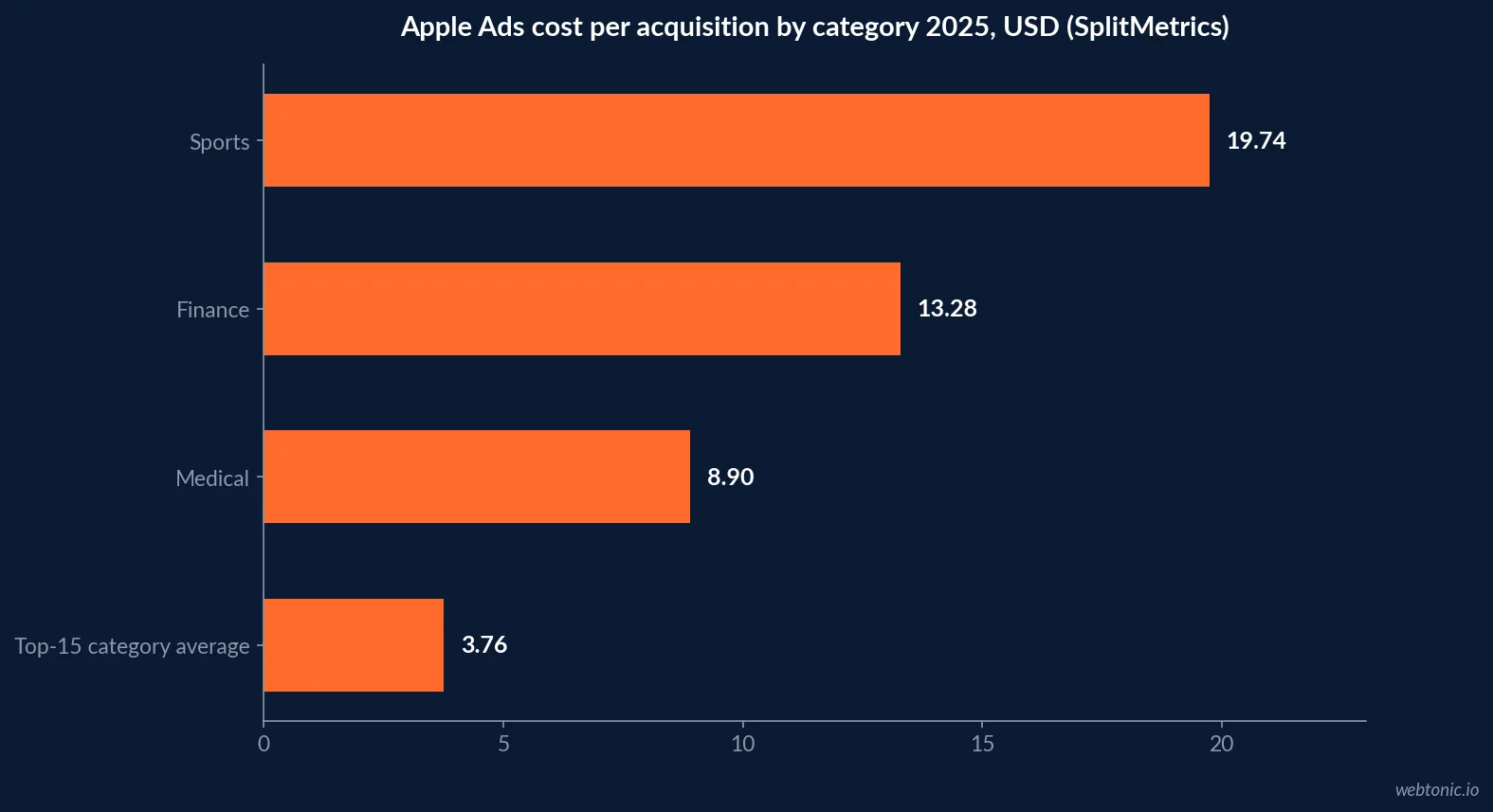
Organic ASO and Apple Ads share one results page, so category ad costs are a fair signal of competition. SplitMetrics' 2025 Apple Ads benchmarks put the top-15-category average at USD 2.25 per tap and USD 3.76 per acquisition, with the Medical category at USD 4.45 per tap and USD 8.90 per acquisition. Those are vendor figures across the vendor's client base.
The gap is a reason to choose the category carefully. A loyalty and booking app is not a clinical tool, and filing it under Medical can put it in a pricier and more scrutinised auction than it needs.
| Apple Ads metric, 2025 | Medical category | Category average | Vendor |
|---|---|---|---|
| Cost per tap | USD 4.45 | USD 2.25 (top 15) | SplitMetrics |
| Cost per acquisition | USD 8.90 | USD 3.76 | SplitMetrics |
| Search results conversion rate | Not published | 65.82% | MobileAction |
| Search results tap-through rate | Not published | 8.08% | MobileAction |
| All-category CPA | Not published | USD 2.51 | MobileAction |
The two vendors measure different client sets, which is why their all-category CPA figures differ (USD 3.76 against MobileAction's USD 2.51). Quote each with its source rather than blending them.
Choosing between Health & Fitness, Lifestyle and Medical
Apple's category definitions describe Health & Fitness as apps related to healthy living, including stress management, fitness and recreational activities, and Lifestyle as apps about a general-interest subject or service. A med spa booking and loyalty app sits closest to those two. Apple reserves Medical for medical education, information management or health reference, and guideline 1.4.1 adds scrutiny for clinical claims.
Health-app rules that shape the listing
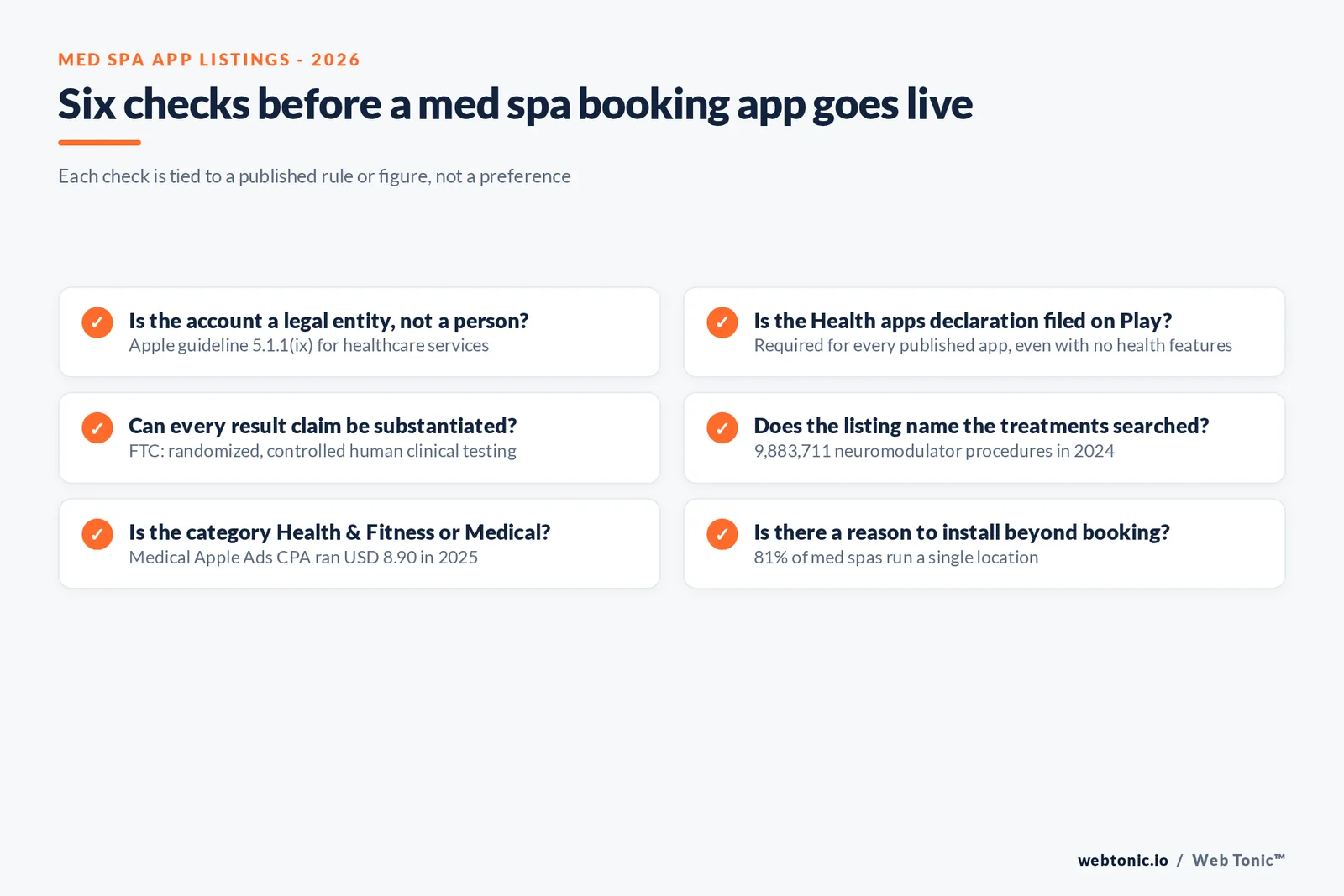
Apple's App Review Guidelines say in 1.4.1 that medical apps that could provide inaccurate data or be used for diagnosing or treating patients may get greater scrutiny, and in 5.1.1(ix) that apps offering services in regulated fields such as healthcare should be submitted by a legal entity that provides the services, not an individual developer. On Android, Google Play's Health apps declaration must be completed by all developers with a published app, including apps with no health features.
Advertising claims travel into the listing too. The FTC's Health Products Compliance Guidance says substantiation of health-related benefits will generally need randomized, controlled human clinical testing. Screenshot captions promising results are ad claims.
| Rule | Issuer | Applies to | Practical effect on ASO |
|---|---|---|---|
| Guideline 1.4.1, medical accuracy | Apple | Apps with health measurement or clinical claims | Keep clinical claims out of the app |
| Guideline 5.1.1(ix), legal entity | Apple | Healthcare service apps | Publish under the practice's company account |
| Health apps declaration | Google Play | Every published app | File it before release |
| Health claim substantiation | FTC | Ads and listing copy | No unsupported result promises |
What cross-industry conversion data can and cannot tell you
AppTweak's 2025 benchmarks put the average US App Store conversion rate at 8.56% and Google Play at 16.15%, with a 3.8% App Store install rate. They are averages across all categories. A small-brand booking app with mostly branded traffic will not look like either number, so use your own App Analytics baseline and treat vendor averages as context.
Testing tools a med spa group can use for free
Apple's product page optimization tests up to three alternate treatments against the original, and Apple's custom product pages allow up to 70 additional versions of a product page. For a multi-location group that means one page per treatment line or per city campaign, linked from the matching ad or email.
What to measure, and where each number comes from
A med spa app lives or dies on rebooking, so store metrics only tell half the story. App Store Connect and the Play Console report the top of the funnel: impressions, product page views, first-time downloads and the conversion between them. Everything after the install, from the first booking to the third injectable appointment, sits in the practice-management or booking system and has to be joined to the store data by campaign or custom product page.
Neither Apple nor Google publishes an aesthetics benchmark for any of these steps, so the only honest target is your own trend line. Set a baseline for the first 90 days, then judge each listing change against it, which is also the window Apple uses for product page tests.
| Metric | Where it is reported | Published benchmark for med spas | Use it for |
|---|---|---|---|
| Product page views | App Store Connect / Play Console | None published | Listing reach after search |
| Page view to download conversion | App Store Connect / Play Console | None published | Screenshot and caption tests |
| Downloads by custom product page | App Store Connect | None published | Treatment-line campaigns |
| Store-listing experiment result | Play Console | None published | Android creative tests |
| First booking after install | Booking software | None published | Whether installs become patients |
| Repeat bookings per patient | Booking software | None published | Whether the app earns its cost |
A realistic ASO plan for medical aesthetics
- Decide first whether the app earns its place; 81% of operators are single-location.
- Name the top treatments by volume in subtitle and keywords: injectables and fillers.
- Choose Health & Fitness or Lifestyle unless the app is clinical.
- Publish under the practice's legal entity and file the Play Health apps declaration.
- Write captions that describe the service, not the result.
- Report page views, downloads and rebookings together, not downloads alone.
For the wider picture on store data, see our app store optimization statistics hub, compare channels in our med spa CTV advertising data, or talk to us about your own growth plan through our growth marketing team.
Frequently Asked Questions
Does a med spa need its own app?
Usually not. AmSpa reports that 81% of medical spas are single-location businesses, and a single clinic rarely generates enough repeat searches in the App Store to justify building, reviewing and maintaining an app. Most patients meet a med spa through search, maps and booking pages. An app makes sense for multi-location groups, which AmSpa says average nine locations, or when it carries a loyalty or membership program.
Which App Store category should a med spa booking app use?
Apple defines Health & Fitness as apps related to healthy living, including stress management and fitness, while Medical covers medical education, information management and health reference for patients or professionals. A booking and loyalty app for aesthetic treatments usually fits Health & Fitness or Lifestyle better than Medical. Category also changes paid costs: SplitMetrics put Medical Apple Ads CPA at USD 8.90 in 2025 against a USD 3.76 average.
Is there a published med spa app conversion rate?
No. We found no study that publishes a conversion rate, click-through rate or ranking benchmark for med spa apps. The closest labelled numbers are cross-industry: AppTweak put the 2025 US App Store average at 8.56% and Google Play at 16.15%, and MobileAction measured a 65.82% Apple Ads search-results conversion rate in 2025. Use them as context, not as targets.
What rules apply to a med spa app listing?
Apple's guideline 5.1.1(ix) asks that apps offering services in regulated fields such as healthcare be submitted by a legal entity that provides the service, not an individual developer, and guideline 1.4.1 applies greater scrutiny to medical claims. Google Play requires every published app to complete its Health apps declaration. Before-and-after claims also fall under the FTC's health products guidance.
What should a med spa track if it does launch an app?
Track what Apple and Google actually report: product page views, first-time downloads, conversion from page view to install, and store-listing experiment results. Pair those with booking data from your practice software. Apple lets you test up to three alternate product page treatments and publish up to 70 custom product pages, which is enough to split injectables, laser and membership messaging.
Sources
AmSpa - 2024 Medical Spa State of the Industry recap
AmSpa - Med spa statistics
ASPS - 2024 procedural statistics release
Apple - App Store Transparency Report 2025
Apple Ads - App Store
Apple - App Review Guidelines
Apple - App Store categories
Google Play - Health apps declaration
FTC - Health Products Compliance Guidance
SplitMetrics - Apple Ads cost benchmarks 2025
AppTweak - App conversion rate by category 2025
MobileAction - Apple Ads 2026 benchmark report
Statcounter - US mobile OS share


