



Table of contents

HVAC is a local service, and in 2026 there is still no published study of HVAC contractors' international or multilingual SEO performance. The international case with real numbers behind it is bilingual Canada: Quebec made up 36% of the country's heat pump additions from 2000 to 2023, and 46.4% of Quebec's population is bilingual. This report lays out that data.
Key Takeaways
- Canada's heat pump stock rose from 238,000 to 1,335,000 units between 2000 and 2023 (CER).
- Heat pumps were 7.9% of residential heating systems in 2023, up from 1.9% in 2000.
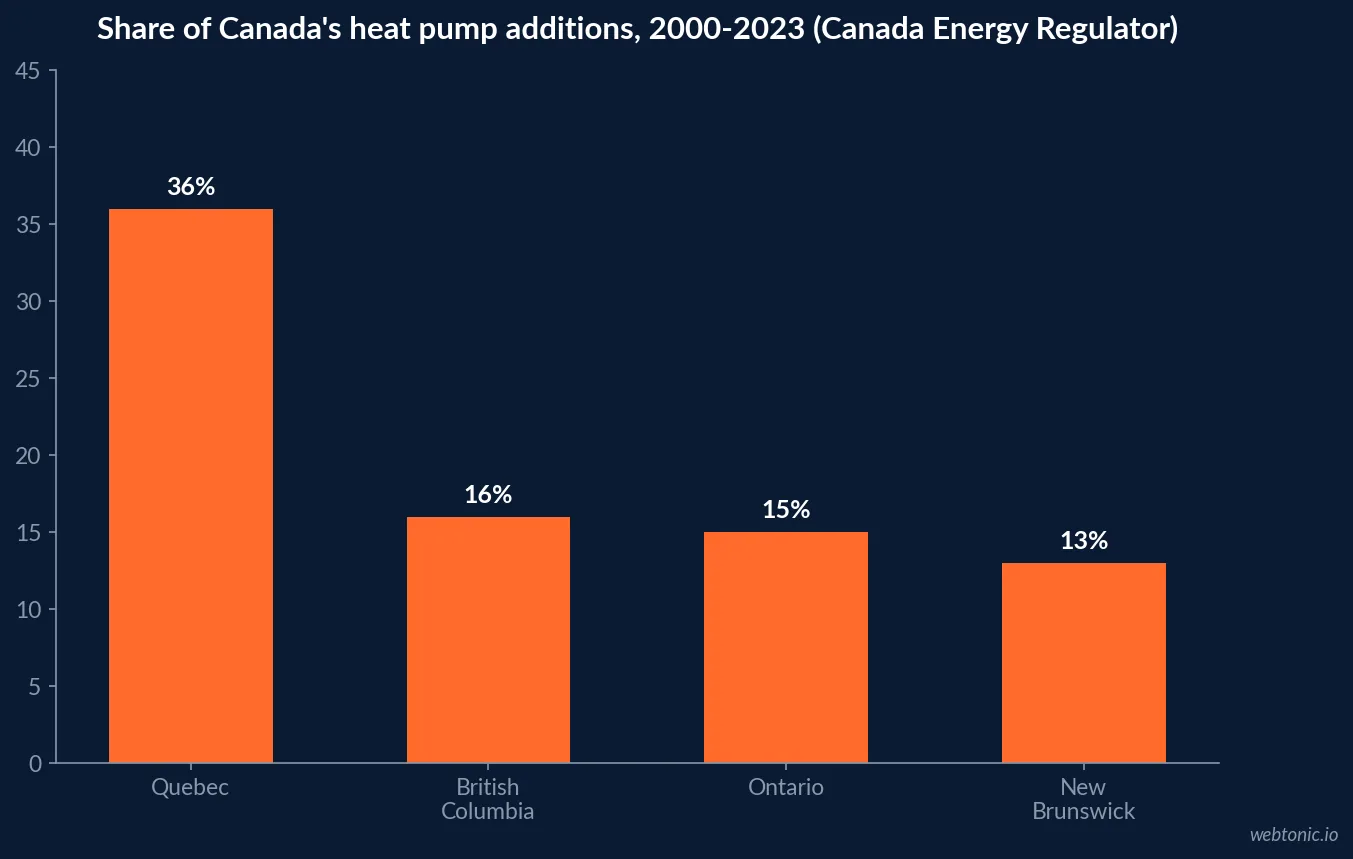
- Quebec made 36% of heat pump additions; British Columbia 16%, Ontario 15%.
- Heat pumps are 40% of heating systems in New Brunswick.
- 83% of heat pumps sit in single detached homes.
- 64% of Canadian households had air conditioning in 2021 (Statistics Canada).
- 26% of Quebec households had a heat pump in 2021.
- Quebec's bilingualism rate reached 46.4% in 2021.
- Google held 85.3% of Canadian search in September 2026.
- French is 4.5% of websites with a known language (W3Techs, October 2026).
Where international SEO fits an HVAC business
A furnace or heat pump is installed where the customer lives, so most HVAC firms never need a multi-country site. Google's multi-regional guidance uses a Canadian business with English and French versions as its very first example of a multilingual site, and that is the shape most HVAC "international SEO" takes: one country, two languages. The other cases are equipment manufacturers and franchise networks that run country sites, and US contractors adding Spanish pages for local customers.
| HVAC indicator | Value | Issuer | Period |
|---|---|---|---|
| Heat pump stock, Canada | 1,335,000 units | Canada Energy Regulator | 2023 |
| Heat pump share of heating systems | 7.9% | Canada Energy Regulator | 2023 |
| Quebec share of heat pump additions | 36% | Canada Energy Regulator | 2000-2023 |
| Households with any air conditioner | 64% | Statistics Canada | 2021 |
| Quebec bilingualism rate | 46.4% | Statistics Canada | 2021 Census |
| Google share of Canadian search | 85.3% | Statcounter | September 2026 |
Heat pump growth is concentrated in French-speaking Canada
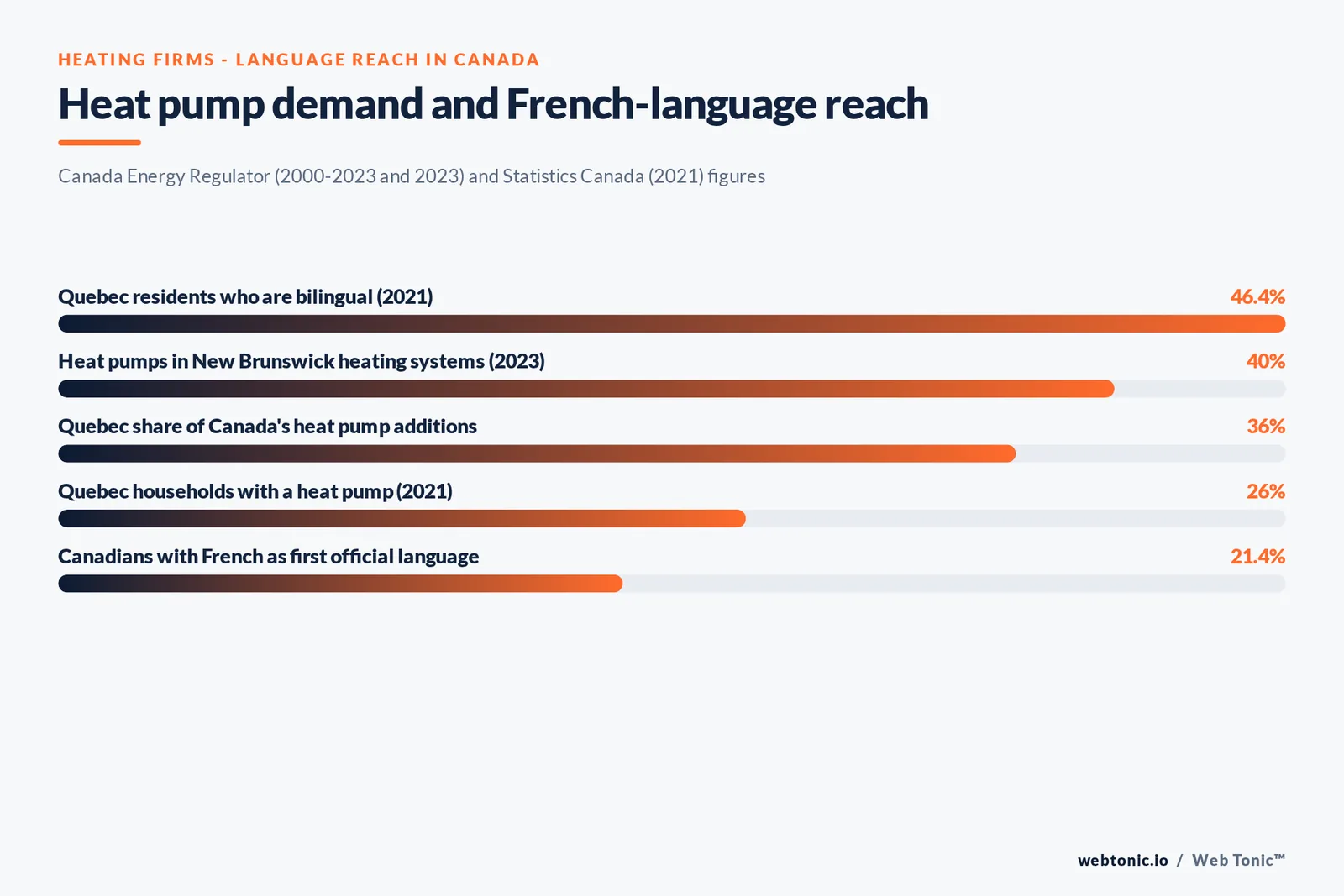
The Canada Energy Regulator's August 2026 market snapshot reports that the heat pump stock grew from 238,000 units in 2000 to 1,335,000 in 2023, a near sixfold increase, and that heat pumps accounted for 7.9% of residential heating systems in 2023. Quebec added the most, at 36% of additions, followed by British Columbia at 16%, Ontario at 15% and New Brunswick at 13%.
For search, that puts the largest single block of new heat pump demand in a market where the default language is French. An HVAC site with only English pages competes for a minority of that demand.
The context matters for keyword planning. Over the same period, total residential heating systems in Canada grew by about 4.35 million, and high-efficiency natural gas stock rose from 1,060,000 to 6,027,000 units, so furnaces still outnumber heat pumps by a wide margin. Single detached homes hold 83% of heat pump installations, 1,108,000 of the 1,335,000 units in 2023. A French-language content plan for a Quebec HVAC firm therefore needs pages for both heat pumps and high-efficiency furnaces, written for owners of detached houses rather than condo buyers.
Atlantic Canada: high adoption, smaller markets
The same snapshot shows where heat pumps already dominate. In 2023 they made up 40% of home heating systems in New Brunswick, 23% in Prince Edward Island, 21.5% in Nova Scotia and 16% in Newfoundland and Labrador. New Brunswick, Canada's only officially bilingual province, also saw heating-oil homes fall by 34,705 while heat pumps rose by 142,414 units.
| Province (CER, 2023) | Heat pumps as share of heating systems | Change over two decades | Language note |
|---|---|---|---|
| New Brunswick | 40% | +142,414 heat pumps; oil homes -34,705 | Officially bilingual province |
| Prince Edward Island | 23% | Not broken out in the snapshot | Mostly English |
| Nova Scotia | 21.5% | +90,379 heat pumps; oil homes -78,261 | Mostly English |
| Newfoundland and Labrador | 16% | +38,260 heat pumps; oil homes -32,843 | Mostly English |
Household equipment by province
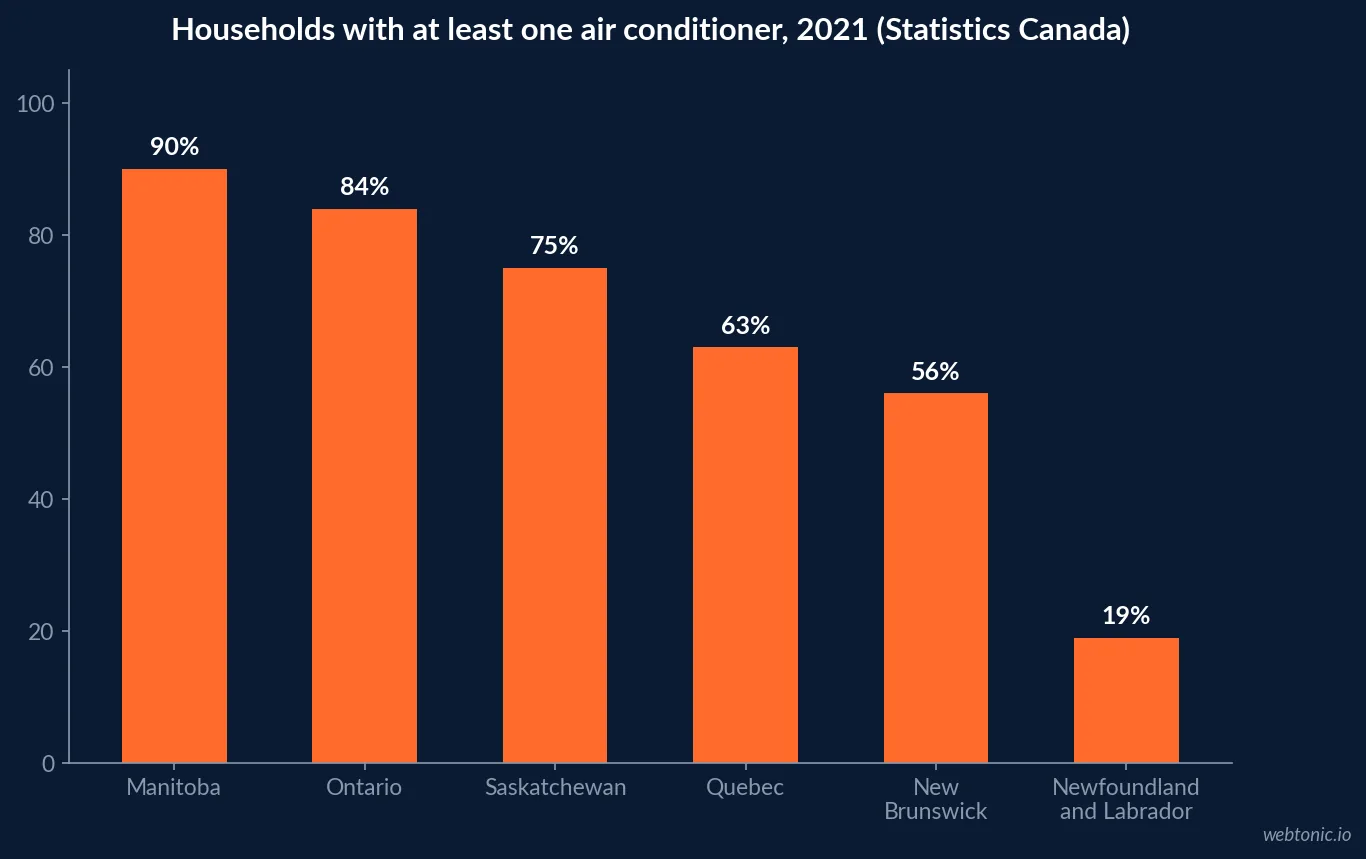
Statistics Canada's Households and the Environment Survey adds a household view for 2021: 64% of households in the provinces had at least one air conditioner, 38% had central air and 10% had a heat pump. Heat pump ownership reached 34% in New Brunswick, 31% in Prince Edward Island, 28% in Nova Scotia and 26% in Quebec. Air conditioning was most common in Manitoba at 90%, followed by Ontario at 84% and Quebec at 63%.
The household survey and the energy regulator's stock model measure different things (any heat pump in the home versus the main heating system), which is why the national figures differ.
| Household measure (Statistics Canada, 2021) | Canada | Quebec | New Brunswick |
|---|---|---|---|
| Any air conditioner | 64% | 63% | 56% |
| Heat pump in the home | 10% | 26% | 34% |
| Central air conditioner | 38% | Not shown in the release | Not shown in the release |
The language market behind those homes
Statistics Canada's 2021 Census release reports English-French bilingualism of 18.0% nationally and 46.4% in Quebec, up from 44.5% in 2016, against 9.5% outside Quebec. French is the first official language spoken by 21.4% of Canadians. Put next to the heat pump data, the reading is direct: the province adding the most heat pumps is the one where a French site is expected and where fewer than half of residents are comfortable in both languages.
Advertising language rules in Quebec
Section 58 of Quebec's Charter of the French Language says commercial advertising "must be in French" and may also be in another language "provided that French is markedly predominant". For an HVAC company, that covers rebate promotions, seasonal tune-up offers and landing pages aimed at Quebec homeowners. This quotes the statute and is not legal advice.
Setting up the bilingual site
Google's localized-versions documentation supplies the rules. Each version must list itself and every other version, URLs must be fully qualified, an x-default value handles unmatched languages, and "if two pages don't both point to each other, the tags will be ignored". Errors are common: the Ahrefs hreflang study found 67% of implementations across 374,756 domains had issues.
| Page version | hreflang value | Example URL pattern | Purpose |
|---|---|---|---|
| French, Canada | fr-CA | example.ca/fr/thermopompe | Quebec and francophone New Brunswick |
| English, Canada | en-CA | example.ca/en/heat-pump | Rest of Canada and anglophone Quebec |
| Fallback | x-default | Language selector page | Visitors whose language matches neither |
| Spanish, US (if relevant) | es-US | example.com/es/bomba-de-calor | Spanish-dominant US service areas |
The US side: Spanish-language demand
For US contractors the multilingual question is domestic. The Census Bureau reports that 78.3% of residents aged 5 and older spoke only English at home in 2018-2022, leaving 21.7% who speak another language; Spanish is 61.1% of that group. Because 61.0% of Spanish speakers also speak English very well, Spanish HVAC pages pay off mainly in service areas where local Census tables show a large Spanish-dominant adult population.
The same Census release shows the age pattern that matters for equipment buyers: among people aged 18-64 who speak another language at home, 61.0% speak Spanish, and 58.3% of those Spanish speakers speak English very well. That leaves a sizeable adult group for whom a Spanish service page, a Spanish-speaking dispatcher and a translated financing page work together. None of these figures is HVAC-specific; they describe the households an HVAC company serves.
Manufacturers and franchise networks: the multi-country case
The firms that genuinely need multi-regional SEO are equipment brands and franchise systems with dealer locators in several countries. Google's guidance lists the trade-offs. A country-code domain such as .ca gives "clear geotargeting" but "can only target a single country" and needs more infrastructure; a subdirectory such as example.com/ca/ is "easy to set up" and low maintenance; URL parameters are "not recommended". Google also says it ignores locational meta tags and that server location is not a definitive signal, so a Canadian dealer page is located by its hreflang, its address and its content, not by where it is hosted.
For a contractor with one .ca domain, the practical choice is simpler: keep both languages on that domain in /fr/ and /en/ folders, and let the address, phone number and Business Profile carry the location.
What the HVAC data does not show
The honest state of the evidence in 2026 is that equipment and language data are strong, while search data specific to HVAC is missing. The table lists what an HVAC marketer would want and what is actually published.
| Metric an HVAC marketer wants | Published for HVAC? | Closest verified proxy on this page |
|---|---|---|
| Share of HVAC searches made in French in Canada | No | Quebec bilingualism 46.4%, French first official language 21.4% |
| hreflang adoption among HVAC sites | No | Cross-industry: 67% of implementations with issues (Ahrefs) |
| Conversion rate of French versus English HVAC pages | No | None; measure on your own site |
| Heat pump demand by province | Yes | Quebec 36% of additions, 2000-2023 (CER) |
| Household equipment ownership | Yes | Heat pump in 10% of homes, 26% in Quebec (2021) |
Anyone quoting an HVAC-specific multilingual conversion rate or international traffic share should be able to name the sample behind it. We could not find one, so none appears here.
Search engines and clicks
Statcounter shows Google at 85.3% of Canadian search in September 2026 and Bing at 10.06%, so a bilingual HVAC site is a Google project first. On the web side, W3Techs counts French on 4.5% of websites against 49.5% for English, a thinner field of competing pages. Clicks are under pressure in both languages: Pew Research Center found users clicked a result on 8% of visits with an AI summary against 15% without one (March 2025 data).
For how larger HVAC brands run SEO, see our HVAC enterprise SEO statistics and HVAC app store data. Our data intelligence team can map provincial demand for your service area.
Frequently Asked Questions
Is there published data on HVAC companies' international SEO?
Not that we could verify. No public study reports HVAC contractors' hreflang adoption, multilingual click-through rates or share of international traffic. What is published is equipment and language data by region, so this page combines the Canada Energy Regulator's heat pump figures with Statistics Canada and US Census language data.
Why does Quebec matter so much for HVAC search in Canada?
The Canada Energy Regulator reports that Quebec made up 36% of heat pump additions across Canada from 2000 to 2023, ahead of British Columbia at 16%, Ontario at 15% and New Brunswick at 13%. Quebec is also where French is the majority language and where the Charter of the French Language governs commercial advertising.
How common are heat pumps in Canadian homes?
The Canada Energy Regulator puts heat pumps at 7.9% of residential heating systems in 2023, up from 1.9% in 2000, with stock rising from 238,000 to 1,335,000 units. Statistics Canada's 2021 Households and the Environment Survey found 10% of households had a heat pump, including 26% in Quebec and 34% in New Brunswick. The two sources measure different things, so the numbers differ.
Which hreflang codes should a bilingual Canadian HVAC site use?
Google's localized-versions documentation supports language-region codes such as fr-CA and en-CA, requires each version to list itself and the others with fully qualified URLs, and recommends an x-default fallback for unmatched languages. If two pages do not point to each other, Google ignores the tags.
Should US HVAC companies build Spanish pages?
Check the service area first. Census data for 2018-2022 shows 21.7% of US residents aged 5 and older speak a language other than English at home, and Spanish is 61.1% of that group, but 61.0% of Spanish speakers speak English very well. The case is strongest where local Census tables show a large Spanish-dominant adult population.
Sources
Canada Energy Regulator - Heat pump market snapshot, 2026
Statistics Canada - Households and the Environment Survey, air conditioning
Statistics Canada - The Daily, languages, 2021 Census
LegisQuebec - Charter of the French Language
Google Search Central - Localized versions of your pages
US Census Bureau - Language spoken at home, ACS 2018-2022
Statcounter - Search engine market share, Canada
W3Techs - Content languages for websites
Ahrefs - Hreflang guide and study
Pew Research Center - Clicks with AI summaries


