



Table of contents
Quick answer: If Performance Max converts far above every other campaign while your brand Search campaign quietly loses clicks, PMax is probably serving on your own name. Prove it with the search terms report and brand impression share, then apply brand exclusions and judge the result on blended account volume.
Last verified: 2026-08-21
Why this happens at all
Performance Max is a goal-driven campaign type that serves across Search, Shopping, Display, YouTube, Discover, Gmail and Maps from a single budget. It optimises towards the conversion goal you give it, and branded queries are the cheapest conversions available in any account. Left unconstrained, an optimiser will take them.
That is not misbehaviour, it is the system doing exactly what it was told. The problem is what it does to your reporting. PMax reports a spectacular return, your Search campaigns look mediocre by comparison, and the natural reaction is to move more budget into PMax — which absorbs more brand traffic, which makes it look better still. The feedback loop is the danger, not the campaign type.
Meanwhile the traffic in question was largely free or near-free. Someone typing your company name was going to arrive anyway, through your brand campaign at a low cost per click or through organic listings at no media cost at all. Paying a higher blended price for the same visit is a real loss even when every dashboard is green.
Proving it in four checks
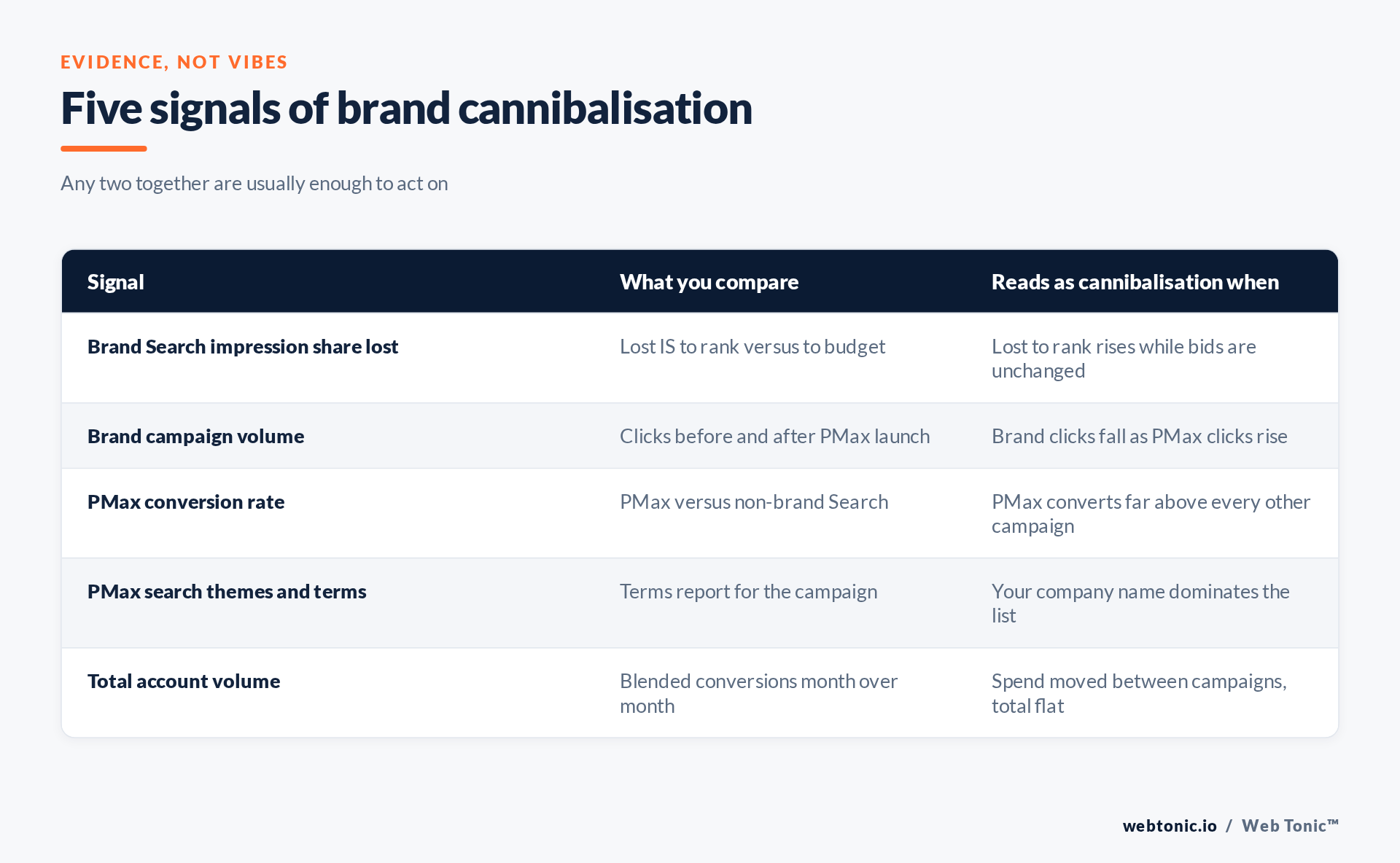
1. Read the search terms the campaign actually matched
Start with the search terms report for the campaign. Visibility into PMax terms is narrower than for Search campaigns, but it is rarely subtle: if your company name and its misspellings dominate what you can see, the question is answered.
2. Check brand impression share, split by reason
In your brand Search campaign, look at impression share alongside the share lost to rank and to budget. Lost impression share to rank climbing while your bids, budgets and ad strength are unchanged means something else is winning those auctions. When that something is your own PMax campaign, you are bidding against yourself.
3. Compare conversion rates across campaigns
Branded traffic converts several times better than cold traffic. A PMax campaign converting at three or four times your non-brand Search rate is not evidence of superior creative; it is evidence of a different, warmer audience. Line the campaigns up side by side and the outlier is obvious.
| Check | Where to look | Cannibalisation looks like |
|---|---|---|
| Search terms | PMax search terms report | Brand name and misspellings dominate |
| Impression share | Brand Search campaign | Lost IS to rank rises with no bid change |
| Conversion rate | Campaign comparison | PMax far above non-brand Search |
| Brand click volume | Brand campaign, month over month | Falls as PMax spend rises |
| Blended account volume | Account totals | Flat while campaign mix shifts |
| Organic brand clicks | Search Console | Falls in step with paid brand growth |
4. Look at the account, not the campaign
The decisive test is blended. If total account conversions are flat while budget migrated from Search to PMax, nothing was gained and reporting simply changed hands. Pull organic branded clicks from Search Console into the same view: paid brand growth that mirrors an organic brand decline is the clearest picture you will get. What you are really testing is cannibalisation in its classic sense: the spend recorded demand rather than creating it.
Stopping it
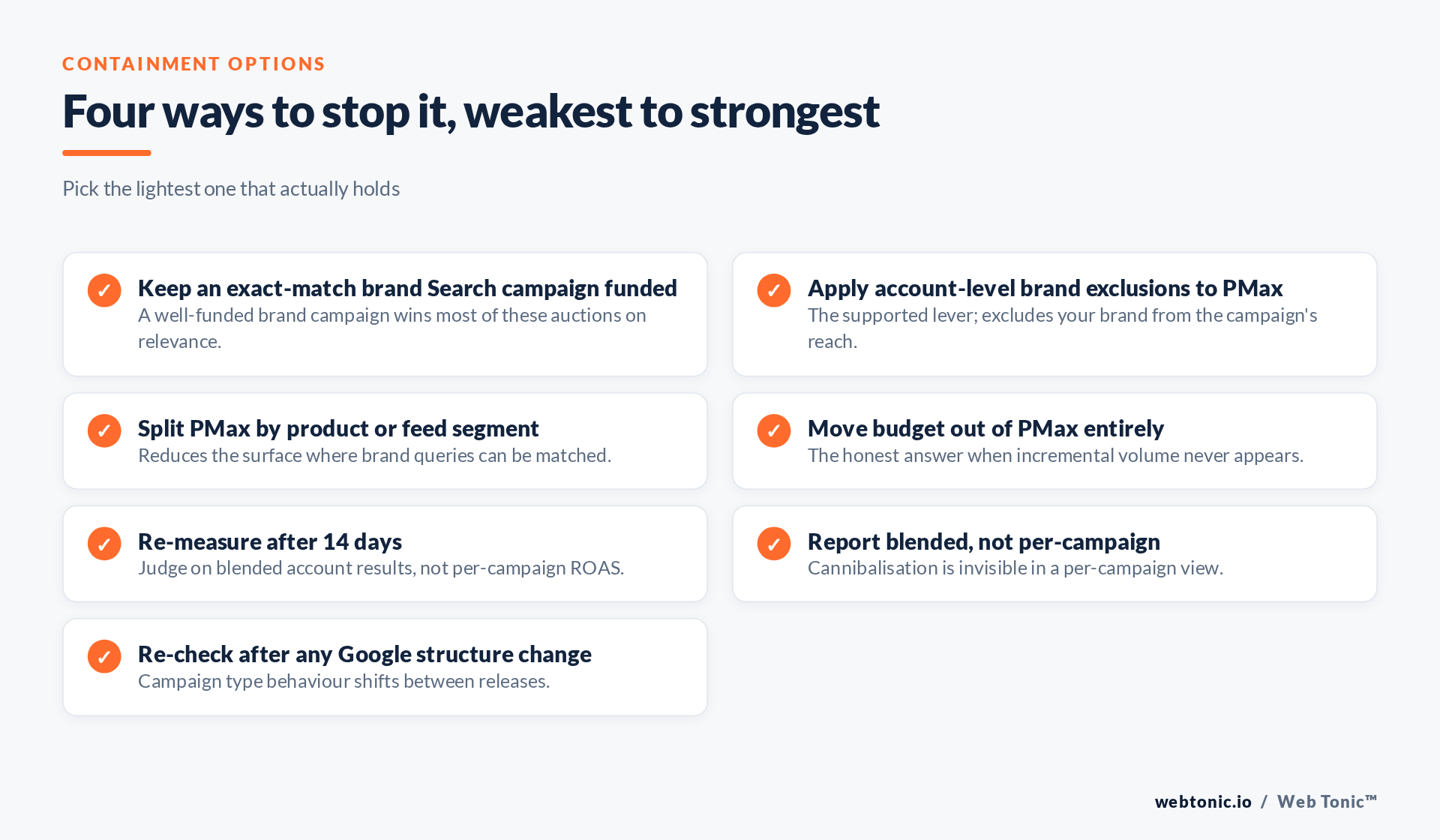
Brand exclusions are the supported lever. Applied to a Performance Max campaign, a brand list keeps the campaign away from queries containing your brand so those searches return to the campaign you built for them. Set the list at account level so it applies consistently, and include misspellings, your product names and any sub-brands.
Fund the brand Search campaign properly. A well-structured exact-match brand campaign with strong ad relevance wins most brand auctions on Quality Score alone, at a cost per click a fraction of PMax's. Starving it to fund PMax is how most accounts get into this position.
Segment PMax. Splitting by product category or feed segment narrows the surface area on which brand queries can be matched, and makes the reporting legible. Or move the budget. If PMax adds no incremental volume once brand is excluded, the campaign was a reporting device rather than a growth channel, and that is a legitimate conclusion.
Measuring whether the fix worked
Wait at least fourteen days. Changing exclusions or structure pushes campaigns back into a learning period, and the first week tells you nothing reliable. The reporting API is useful here if you want a stable comparison built once rather than re-pulled by hand each week.
Judge on three blended numbers: total conversions, total cost, and branded versus non-branded split across paid and organic. The success case is usually undramatic — total volume holds, blended cost falls, and PMax's reported ROAS drops sharply because it is no longer credited with traffic it did not create.
Write that expectation down before you make the change. A PMax ROAS falling from twelve to four looks like a failure to anyone reading the campaign view in isolation, which is why this is a reporting conversation as much as a media one. We handle it as part of our analytics work, alongside the conversion tracking that makes blended measurement trustworthy in the first place, and it sits inside broader growth marketing planning.
Frequently Asked Questions
Do brand exclusions work reliably in Performance Max?
They are the supported mechanism and they materially reduce brand serving, but treat them as strong rather than absolute. Verify with the search terms report after applying them.
Should I just delete my brand Search campaign and let PMax have it?
Rarely. A dedicated brand campaign gives you message control, cheaper clicks and clean reporting. Folding it into PMax trades all three for a prettier campaign-level number.
How much brand traffic is acceptable inside Performance Max?
Enough that it is not distorting your decisions. If brand terms visibly drive the campaign's conversion rate, you can no longer read the campaign's true incremental value.
Does this apply to Demand Gen and Shopping too?
The principle applies to any campaign that can match branded queries. Standard Shopping and Demand Gen show milder versions of the same effect, worth the same blended check.
How long before I can judge the change?
Fourteen days minimum, longer for low-volume accounts. Structural changes restart learning, so the first week of data reflects the transition rather than the outcome.
Sources: Google Ads — Performance Max; search terms report; impression share; Quality Score; Search Console performance report; Google Ads API reporting; cannibalisation. Last verified 2026-08-21.


