



Table of contents
Key Takeaways
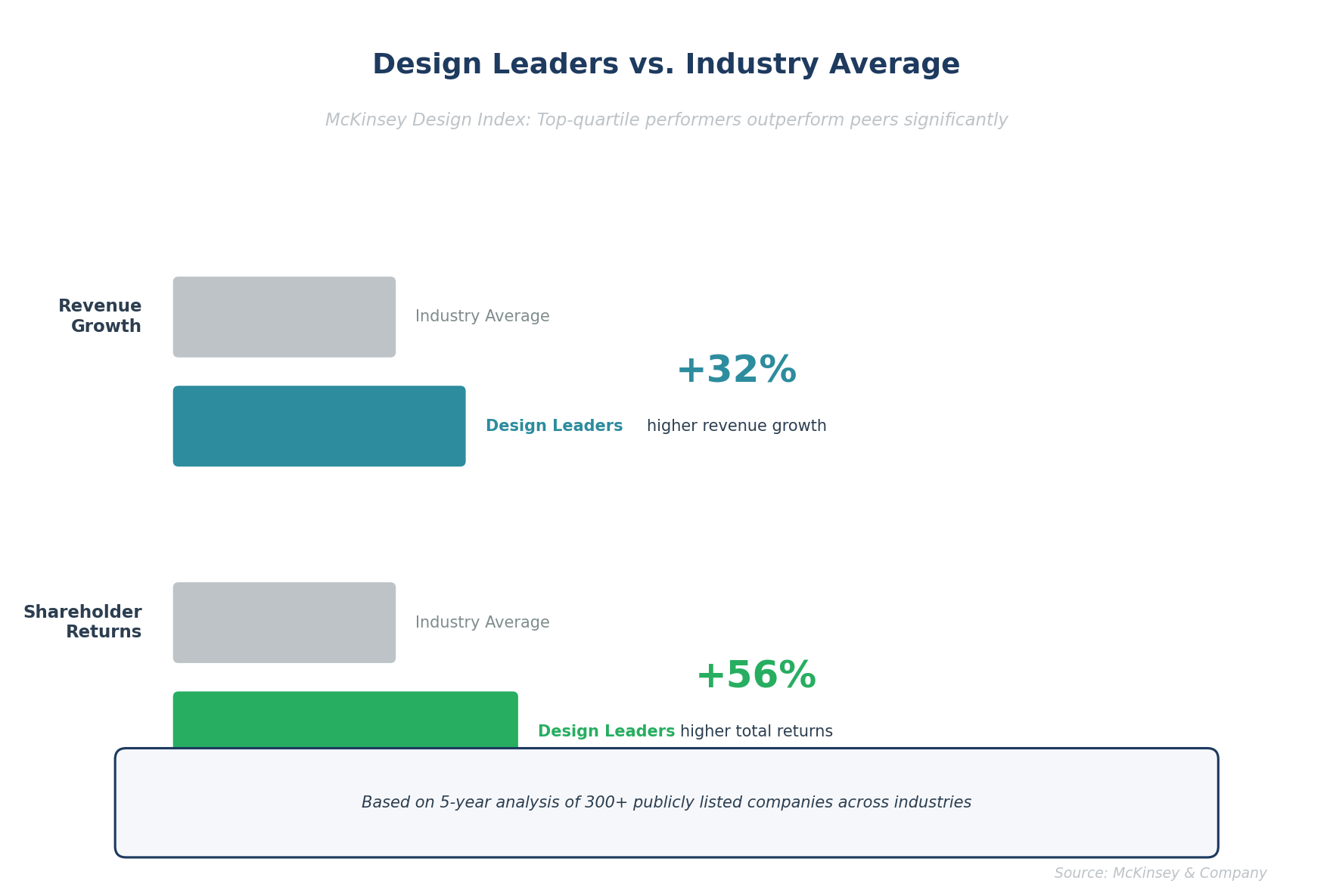
- Marketing design directly impacts business performance, with design-leading companies achieving 32% higher revenue growth and 56% higher shareholder returns compared to industry peers according to McKinsey research
- The human brain processes visual information in as little as 13 milliseconds, making first impressions effectively instantaneous and placing premium importance on immediate visual impact
- Creative quality drives the majority of advertising effectiveness, with research indicating design quality contributes 50% or more to campaign ROI
- Consistency in marketing design builds cumulative brand equity that reduces customer acquisition costs over time while strengthening competitive positioning
- Organizations seeking to improve marketing design effectiveness should consider partnering with specialists who can provide both strategic guidance and execution excellence across campaign types and channels
What Is Marketing Design?
Marketing design encompasses the strategic creation of visual assets that communicate brand messages, drive consumer engagement, and ultimately influence purchasing decisions. It represents the intersection of aesthetic creativity and business objectives, where every color choice, typography decision, and design element serves a measurable purpose within a broader marketing strategy.
The discipline has evolved significantly from its origins in print advertising to become a multidimensional practice spanning digital platforms, social media marketing, experiential marketing, and beyond. According to McKinsey & Company's landmark research tracking design practices across 300 publicly listed companies, organizations that excel at design achieve 32% higher revenue growth and 56% higher total returns to shareholders compared to industry peers over a five-year period. Marketing design is no longer a supporting function. It drives business performance directly.
For mid-market and enterprise businesses, marketing design determines how effectively a brand captures attention in increasingly crowded marketplaces. The visual language of a campaign (from advertising visuals to marketing materials) shapes first impressions, builds trust, and guides consumers through the decision-making journey. Consumers see thousands of marketing messages daily. The quality and strategic alignment of campaign design often determines whether a brand identity breaks through or disappears into the noise.
The Science Behind Visual Processing and Consumer Response
Understanding why marketing design matters requires examining how the human brain processes visual information. Research from MIT neuroscientists published in the journal Attention, Perception, and Psychophysics found that the human brain can identify images seen for as little as 13 milliseconds. That's far faster than the 100 milliseconds previously believed (and faster than a blink). This rapid processing capability means that marketing creative must communicate effectively at near-instantaneous speeds.
How Visual Information Drives Decision-Making
The brain processes images significantly faster than text, which is why leading with strong visuals before supporting copy tends to outperform text-heavy approaches. Images also trigger faster emotional reactions than words alone. Memory retention favors visual information too; it stays in long-term memory longer, which makes consistent visual branding essential for brand awareness and recall. And color and movement draw immediate attention (no surprise there), making strategic use of contrast and visual hierarchy key elements of effective design.
Research published in the Journal of Marketing & Social Research indicates that consumers typically make initial judgments about products within 90 seconds of interaction, with between 62% and 90% of that assessment based solely on color. What does this mean for brands? Color choices aren't decorative decisions. They're strategic ones that shape how audiences perceive value before reading a single word of copy.
The Financial Impact of Creative Quality

The relationship between design quality and campaign performance has been quantified through extensive industry research. Nielsen research found that strong creative was responsible for 86% of sales lift in digital ads, while across all creative, quality contributed to 65% of digital ad sales lift. And the MAGNA Media Study backs this up: creative quality drives 56% of impact on purchase intent.
Investing in quality marketing design delivers measurable advantages. Conversion rates improve and cost per acquisition drops as strong visuals boost ad relevance and engagement. Brand recognition strengthens too, with color alone increasing brand awareness by up to 80% according to industry data. Good design also builds deeper emotional connections with target audiences, fostering brand loyalty and differentiating brands in crowded marketplaces where visual polish signals professionalism.
But there are trade-offs. Higher upfront investment in design talent, tools, and production processes is unavoidable. Development timelines stretch when pursuing excellence over speed-to-market. And there's always the risk of over-design, where aesthetics overshadow clear communication of the value proposition.
Common Misconceptions About Marketing Design
Misconception 1: Beautiful Design Automatically Drives Results
Aesthetically pleasing creative doesn't automatically outperform less polished alternatives. Many organizations make this assumption. They're wrong.
Campaign success depends on strategic alignment between design choices and audience expectations. Research on color psychology demonstrates that predicting consumer reaction to color appropriateness is far more important than the individual color itself. Presenting content in a visually appealing way matters, but a stunning campaign that uses colours or imagery incongruent with brand positioning may actually underperform simpler creative that communicates the brand's message clearly and supports marketing goals.
Misconception 2: Consistency Means Repetition
Brand consistency in marketing design is often misinterpreted as creative stagnation. Same layouts, same images, same approaches across every touchpoint. That's not consistency. That's monotony.
True consistency involves maintaining a cohesive brand identity while adapting creative assets to context, platform, and audience segment. The most effective marketing design systems provide frameworks that enable creativity within established parameters across all marketing channels.
Misconception 3: Design Is a Separate Phase From Strategy
Too many organizations treat design as a downstream activity that happens after strategy is finalized. This siloed approach costs them. Research on integrated marketing teams suggests that organizations where graphic designers and media experts collaborate from the outset tend to produce more effective marketing campaigns.
Design decisions made in isolation from strategic objectives, audience insights, and channel requirements often result in creative that looks impressive but fails to drive business outcomes. Pretty work that doesn't perform is expensive decoration. A strong marketing design strategy integrates creativity with business goals from day one.
Why First Impressions Happen in Milliseconds
The speed at which consumers form impressions about brands has accelerated dramatically in digital environments. A potential customer encounters an advertisement on social media platforms. Split-second decision: engage or scroll past. Whether it's a banner ad, landing page, or social media post, marketing design must communicate value propositions instantly.
Nielsen research commissioned by Meta examined three years of marketing mix modelling data for 41 brands across consumer packaged goods categories and found that campaigns with high-quality creative achieved 35% greater effectiveness. And the benefits compound over time, with consistent visual excellence building cumulative brand equity that reduces customer acquisition costs.
This isn't limited to digital advertising. In retail environments, packaging design influences purchase decisions at the crucial point of sale. In B2B contexts, presentation quality signals organizational capability and attention to detail. Every visual touchpoint represents an opportunity to strengthen or undermine brand perception.
Brands that understand this dynamic invest in design systems that ensure consistent quality across all touchpoints while enabling rapid adaptation to new channels and formats. The goal isn't perfection in any single piece of creative. It's reliable excellence across the entire visual ecosystem.
The Hidden Cost of Creative Inconsistency
Organizations often underestimate the cumulative damage caused by inconsistent or substandard visual creative. When brand presentation varies significantly across advertising campaigns, website design, email, and content marketing efforts, consumers struggle to form coherent brand associations. This fragmentation dilutes marketing effectiveness and requires higher spending to achieve the same level of awareness and consideration.
The numbers are telling.
Nielsen's 2024 Annual Marketing Report found that only 38% of global marketers evaluate the holistic ROI of their marketing efforts by measuring traditional and digital marketing together. This siloed measurement approach often masks the impact of creative inconsistency, as poor performance in one channel may be attributed to media factors rather than underlying design principles.
The cost extends beyond immediate campaign performance. Brands with inconsistent visual presentation face higher customer acquisition costs because each touchpoint must work harder to establish recognition and trust. Creative teams waste time repeatedly solving problems that a coherent design system would address systematically.
For enterprise organizations managing multiple product lines, geographic markets, and agency relationships, maintaining design consistency presents significant coordination challenges. Design systems and governance frameworks can establish clear standards while enabling appropriate local adaptation. But building them requires upfront investment that many organizations resist until inconsistency has already eroded their brand equity.
Real-World Examples and Case Studies
Airbnb: Design-Led Brand Transformation
Airbnb went from a startup with inconsistent visual identity to a globally recognized brand. When the company partnered with DesignStudio for a comprehensive rebrand in 2014, they invested heavily in understanding what the brand meant to both hosts and guests. The resulting "Bélo" symbol and "Belong Anywhere" positioning provided a visual and emotional framework that unified all marketing communications.
The rebrand's impact was substantial. The new visual identity trended globally on social media, won numerous design awards, and helped propel Airbnb's valuation significantly above competitors. When Airbnb went public in 2020, its share price more than doubled on the first day of trading, reaching a market capitalization of approximately $86.5 billion. Multiple factors contributed to this success. But the company's investment in design-led brand building was essential to establishing the emotional resonance and trust necessary to succeed in the sharing economy.
A critical early insight involved professional photography. When Airbnb discovered that poor-quality listing photos were hurting bookings, they invested in professional photography services for hosts. This initiative doubled their weekly revenue almost immediately. Visual quality directly impacts conversion rates, even at the level of individual transactions.
McKinsey Design Index Top Performers
McKinsey's research on design-driven companies reveals patterns applicable across industries. The top-quartile performers in their McKinsey Design Index didn't just invest more in design: they integrated design thinking throughout their organizations. These companies measured design performance with the same rigour applied to financial metrics, broke down silos between physical, digital, and service design, and made user-centric design everyone's responsibility rather than isolating it within creative departments.
The results held true across medical technology, consumer goods, and retail banking. Design excellence drives performance regardless of whether a company focuses on physical products, digital experiences, services, or combinations thereof. The market disproportionately rewarded companies that truly stood out, with marginal differences between second, third, and fourth quartile performers but dramatic advantages for top-quartile design leaders.
Frequently Asked Questions
What is the difference between marketing design and graphic design?
Marketing design focuses specifically on visual assets intended to drive business outcomes: awareness, engagement, conversion. It applies graphic design principles to create everything from social media posts to print advertisements and email campaigns. Graphic design is broader, encompassing editorial design, environmental graphics, print design, and visual communication not tied to commercial promotion. The distinction matters. Marketing designers think about performance metrics and audience psychology in ways that purely aesthetic approaches don't require.
How much should companies invest in marketing design?
It depends on industry, competitive intensity, and business model. But research consistently shows that underinvestment in creative quality undermines campaign effectiveness regardless of media spending levels. The question isn't whether to invest. It's whether you're investing enough to produce work that stands out from competitors.
Can small businesses achieve effective marketing design without large budgets?
Absolutely. Big budgets help, but they're not required. Small businesses can leverage marketing design solutions like templates and design systems to ensure consistency across desktop and mobile devices. They can prioritize quality over quantity by focusing resources on key touchpoints. And they can utilize design tools that enable non-specialists to produce competent creative within established brand guidelines. The key is establishing clear visual standards and applying them consistently.
How do you measure the ROI of marketing design improvements?
A/B testing creative variations is the most direct approach. It isolates design impact from other variables. Beyond that, tracking brand metrics over time shows whether design quality improvements are registering with audiences. Analyzing creative performance data identifies patterns in high-performing assets. Marketing mix modelling can include creative quality as a variable. The most sophisticated organizations develop creative scoring systems that predict performance based on design attributes. They optimize before campaign launch, not after.
What role does color play in marketing design effectiveness?
Color influences emotional response, brand recognition, and product perception at both conscious and subconscious levels. Combined with other design elements like white space and typography, color shapes how audiences perceive brand marketing messages. But effectiveness depends heavily on context: product category, brand positioning, competitive landscape, and cultural associations all matter. Research indicates that color appropriateness to brand and category matters more than universal color meanings. There's no magic formula. Strategic color selection requires understanding your specific audience and market context. For global brands, cultural variations in color associations add another layer of complexity.


