Table of contents
Key Takeaways
- Creative quality is the largest controllable driver of advertising ROI, contributing approximately 47-56% of sales lift according to multiple research sources—more than targeting, reach, or media optimization combined.
- A systematic 9-step ad design process—from objective setting through iteration—produces consistently better results than ad-hoc creative development, while building organizational capabilities over time.
- Platform-specific optimization is essential, not optional: mobile-first design, vertical video formats, and platform-native aesthetics significantly impact engagement and conversion metrics across social media and display ads alike.
- Testing multiple creative variations should be standard practice rather than exception, with appropriate statistical rigour and sufficient test duration to generate reliable insights.
- Investing adequate time and resources in the creative process produces returns that typically exceed marginal gains from media optimization, making creative development a strategic priority for organizations seeking good advertising outcomes.
- For brands seeking to maximize advertising performance, working with experienced marketing design professionals can accelerate capability development and reduce the learning curve associated with building effective in-house processes.
What is advertising design?
Advertising design is the strategic process of combining visual elements, messaging, and brand identity to create advertisements that capture attention and drive consumer actions. It's the visual communication discipline at the heart of digital marketing, where every choice must serve measurable business objectives. Whether that's building brand awareness or generating direct conversions, good design alone isn't enough. The creative must leave a lasting impression that moves people to act.
So what separates advertising design from general graphic design? The accountability.
According to research published in the PMC (National Institutes of Health), advertising appeals' effectiveness in engagement and changing behaviour represents a critical area where limited guidance exists to provide implementation roadmaps that deliver behaviour change. This gap makes a structured approach to ad creative design essential for marketers seeking predictable results.
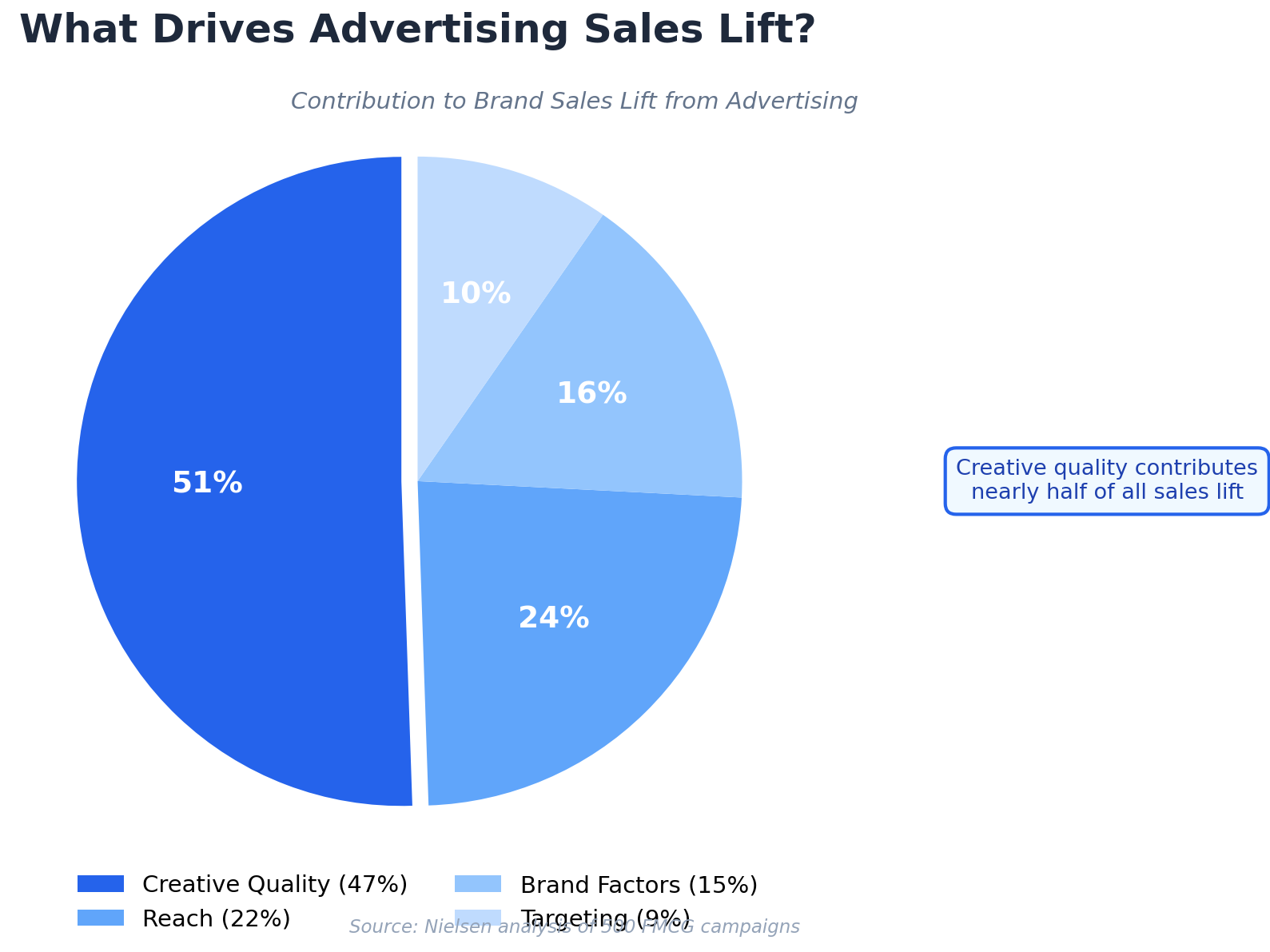
For mid-market and enterprise businesses, creative quality remains the single most controllable variable affecting campaign performance. Nielsen research analyzing 500 FMCG campaigns found that creative quality contributes to 47% of a brand's sales lift from advertising, which is more than reach (22%), brand factors (15%), or targeting (9%) combined. The ad design process is a business competency, and treating it as purely aesthetic misses the point entirely.
The 9-step ad design process
Developing effective advertising requires balancing strategic rigour with creative exploration. The framework below provides a repeatable process for producing high-converting ad creative across digital channels and formats, whether you're launching an ad campaign for social media or building a broader marketing strategy.
One caveat before diving in: this framework is optimized for digital and social advertising. Print, out-of-home, and broadcast have overlapping principles but different technical constraints that warrant their own treatment.

Step 1: Define clear campaign objectives
Every successful ad design project begins with specific objectives. Vague marketing goals produce vague creative.
Before any visual work begins, establish measurable targets. Are you driving brand awareness (measured by recall and recognition), consideration (measured by engagement and click-through rates), or conversion (measured by direct response actions)? This step also requires defining the specific call-to-action the creative must support and ensuring the brand's message comes through clearly. Research indicates that clearly defined CTAs significantly impact whether audiences take desired actions.
What single action do you want the viewer to take after seeing this ad? Answer that question first.
Step 2: Develop a comprehensive creative brief
The creative brief serves as the strategic foundation for all design decisions. According to Adobe's creative brief guidelines, effective briefs maintain brand consistency by ensuring that all creative output aligns with the brand's identity and messaging guidelines.
A complete advertising creative brief should include project objectives and success metrics, target audience demographics and psychographics, key messaging hierarchy, brand voice and visual guidelines, competitive context and differentiation requirements, deliverable specifications (formats, sizes, placements), budget and timeline constraints, and approval workflows.
| Brief Component | Purpose | Common Mistake |
|---|---|---|
| Objective Statement | Aligns team on single measurable goal | Making it too broad or listing multiple competing goals |
| Target Audience | Defines who the ad must resonate with | Using only demographics without psychographics |
| Key Message | Establishes the core takeaway | Including too many messages that dilute impact |
| Brand Guidelines | Ensures consistency and recognition | Treating guidelines as optional suggestions |
| Deliverables | Specifies exact technical requirements | Assuming format requirements are obvious |
Step 3: Research your audience and competitive landscape
Effective ad design requires deep understanding of both your target audience and how competitors communicate with them.
Research from the Journal of Marketing & Social Research indicates that consumers typically make initial judgments about products within 90 seconds of interaction, with 62-90% of that assessment based solely on color. Visual choices directly impact perception, often before any copy is read.
Audience research should examine pain points and aspirations your product addresses, visual preferences and aesthetic sensibilities, platform behaviour and content consumption patterns, and language that resonates with your target segments.
Competitive analysis should document visual conventions in your category (what to leverage or deliberately challenge), messaging approaches being used, and gaps in communication that represent differentiation opportunities. Where are competitors all saying the same thing? That's where the opportunity sits.
Step 4: Establish visual hierarchy and layout
Visual hierarchy guides the viewer's eye through your ad in a deliberate sequence. With shrinking attention spans across digital platforms, the most effective layouts follow natural reading patterns while emphasizing elements in order of importance. Good visual content respects how people actually consume information, prioritizing user experience over aesthetic indulgence.
Principles of effective ad layout:
- Every ad needs a single dominant visual element that anchors attention
- Leverage natural eye movement patterns (Z-pattern or F-pattern) for digital placements
- Strategic negative space increases comprehension and reduces cognitive load
- Consistent underlying grid structure creates professional polish
Research on emotional design in visual advertisements published in the Journal of Marketing & Social Research found that layout establishes message clarity and ease of visual navigation, both of which have a major impact on persuasion and customer engagement.
Step 5: Select strategic color palettes
Color selection in advertising design extends far beyond aesthetic preference. Colours trigger psychological and emotional responses that directly influence perception, memory, and action.
| Color | Primary Associations | Common Applications |
|---|---|---|
| Red | Urgency, excitement, passion | Clearance sales, food brands, CTAs |
| Blue | Trust, security, professionalism | Finance, technology, healthcare |
| Green | Growth, health, nature | Sustainability, wellness, finance |
| Orange | Energy, enthusiasm, affordability | E-commerce, entertainment |
| Black | Luxury, sophistication, power | Premium brands, fashion |
| White | Purity, simplicity, cleanliness | Tech products, minimalist brands |
But here's the catch: color appropriateness matters more than individual color psychology.
According to the Institute for Color Research (as cited by Help Scout), up to 90% of snap judgments made about products can be based on color alone. Context, cultural differences, and brand fit significantly moderate these effects. A color that works brilliantly for one brand may fall flat for another in the same industry.
Step 6: Craft compelling copy and messaging
Visual design and copywriting must work in concert. The strongest ad creative integrates message and image so completely that removing either would diminish the whole. Brand messages that create an emotional connection outperform purely rational appeals in most categories.
Effective ad copy principles:
- Focus on what the product does for the customer, not feature lists
- Use active voice and action verbs to create momentum toward the CTA
- Match tone to audience and platform (formal for B2B LinkedIn, conversational for Instagram)
- Maintain clear message hierarchy: primary headline, supporting subhead, body copy, CTA
- Test different angles including emotional appeals, rational benefits, social proof, and urgency
Research from the U.S. Postal Service Office of Inspector General found noteworthy differences in the effectiveness of basic advertising design categories across age cohorts. Younger participants responded more to ads designed to elicit emotional responses. Older adults? They preferred functional appeals. Same product, different creative approach needed.
Step 7: Optimize for platform and format
Each advertising platform has unique technical specifications, user behaviours, and creative conventions. Effective ad design adapts core concepts to meet platform-specific requirements. What works for display ads and banner ads on the Google Display Network won't necessarily translate to social media platforms like Instagram or TikTok.
Mobile optimization:
- Design for vertical viewing (9:16 or 4:5 aspect ratios)
- Front-load key messages since users scroll quickly
- Use large, legible typography
- Ensure touch-friendly CTA buttons that link to a mobile-optimized landing page
- According to EMARKETER data via QuickFrame, U.S. advertisers will spend $85 billion on mobile video ads in 2025
Video advertising and motion graphics:
- Hook viewers in first 3 seconds
- Include brand identity early
- Design for both sound-on and sound-off viewing
- Current advertising statistics show short-form videos under 30 seconds convert 3x better than longer formats
- Digital advertising research indicates vertical video ads drive 21% higher engagement on mobile than horizontal formats
Step 8: Build and test multiple variations
The era of creating a single "perfect" ad is over.
Modern marketing campaigns require producing multiple creative variations for systematic testing and optimization. Why? Because what resonates with audiences often surprises even experienced marketers.
What to test:
- Headlines with different value propositions, emotional appeals, or benefit focuses
- Images comparing photography vs. illustration, lifestyle vs. product shots, different subjects
- Background color variations, CTA button colours, accent changes
- Copy length from short punchy lines to longer explanatory text
- CTA variations including different action verbs, urgency levels, and button placement
Research published in the Journal of Marketing highlights an important caveat: online advertising platforms' experimentation tools deliver different ads to distinct and undetectably optimized mixes of users that vary across ads, even during tests. Because exposure to ads in tests is nonrandom, estimated comparisons may confound the effect of ad content with algorithmic targeting effects.
Run tests for sufficient duration (minimum 7 days or 100 conversions), interpret results directionally rather than absolutely, and combine platform testing with other research methods for validation.
Step 9: Iterate based on performance data
The ad design process doesn't end at launch.
Continuous optimization based on performance data separates good advertising campaigns from great ones. Establish a regular review cadence: daily monitoring for immediate issues, weekly analysis for optimization opportunities, and monthly strategic reviews for larger creative refreshes.
Key metrics to monitor:
- Awareness metrics like impressions, reach, frequency, and video views
- Engagement metrics including click-through rate, video completion rate, and social engagement
- Conversion metrics such as conversion rate, cost per acquisition, and return on ad spend
- Brand metrics covering brand lift, ad recall, and message association
Common misconceptions
Misconception 1: Beautiful design automatically equals effective advertising
Aesthetic excellence and advertising effectiveness are related but separate things. An ad can win design awards while failing to drive business results. And conversely, some of the most effective ads use deliberately simple or even "ugly" design elements that cut through visual clutter.
Nielsen and Nielsen Catalina Solutions research found that when creative is strong, sales lift is higher and the creative has a much higher contribution to performance. But "strong creative" means creative that resonates with the target audience and drives action. That's different from creative that designers find sophisticated.
Misconception 2: More information in an ad is better
Many advertisers try to cram every product benefit, feature, and proof point into a single ad. This approach typically backfires.
Cognitive overload reduces comprehension and retention, while visual clutter makes it harder for key messages to stand out. Research consistently shows that simplicity and focus produce better results. Effective ads communicate one primary message with absolute clarity, using visual hierarchy to guide attention and supporting information to reinforce the core proposition rather than compete with it.
Misconception 3: Once you find a winning ad, you can run it forever
Creative fatigue is real.
Audiences exposed to the same ad repeatedly experience diminishing engagement over time. Industry analysis notes that even while creative quality is responsible for nearly half of advertising's sales contribution, this effect depends on maintaining freshness and relevance.
Best practice involves systematic creative refresh schedules: monitoring frequency metrics to identify fatigue signals, developing creative variations proactively rather than reactively, and maintaining consistent brand elements while varying execution details. The brand stays the same. The creative evolves.
Why creative quality matters more than media optimization
The advertising industry has spent the past decade emphasizing targeting, programmatic optimization, and media efficiency. These factors matter. But the data suggests creative quality has been undervalued.
According to analysis from Nielsen and Advertising Week, strong creative was responsible for 86% of sales lift in digital ads. The MAGNA Media Study found that creative quality drives 56% of impact on purchase intent, while Google research indicates 70% of a campaign's success is determined by creative.
What does this mean for budget allocation?
Many organizations over-invest in media buying and under-invest in creative development. Given that creative quality has 4-5x the potential impact of targeting optimization, returns from improving creative processes often exceed returns from further media optimization. For mid-market and enterprise businesses, this suggests a rebalancing: ensure creative development receives appropriate resources relative to its impact on outcomes.
The hidden satisficing problem in ad design
Here's something the industry rarely discusses openly: most ad creative is "good enough" rather than optimized.
Behavioural economists call this satisficing, and it's rampant in advertising workflows. Teams hit tight deadlines, stakeholders approve the first concept that doesn't raise objections, and campaigns launch with creative that meets minimum requirements rather than maximizes performance. The difference between satisficed creative and optimized creative can be 2-3x in conversion rates.
Research on the drivers of advertising profitability from Thinkbox identified creative execution as by far the single most important element under a marketer's direct control when it comes to ROI.
The fix isn't necessarily more time. It's building creative testing into the workflow from the start. When testing is baked into the timeline, teams produce variations knowing the best one will win rather than defending a single concept through approval.
Real-world examples and case studies
Nike: visual storytelling that drives results
Nike's "Just Do It" campaign, launched in 1988, transformed the company's fortunes by shifting advertising design from product features to emotional storytelling. The creative approach encouraged people to overcome challenges in sports and life, speaking to athletes and non-athletes alike. It built brand loyalty that persists decades later.
The business impact was substantial.
Nike's sales grew from $877 million in 1988 to over $9 billion by 1998. More recently, Nike's 2018 campaign featuring Colin Kaepernick demonstrated how brand-aligned creative can drive both cultural conversation and commercial results, with online sales surging by 31% in the days following the campaign launch.
Nike's creative success illustrates several advertising design principles: consistent visual identity built over decades, emotional appeals that transcend product categories, and willingness to take creative risks aligned with brand values.
Apple: simplicity as strategic advantage
Apple's advertising design philosophy centers on visual simplicity and product focus.
The company demonstrates that restraint can be as powerful as complexity. Clean backgrounds, minimal copy, and product-as-hero imagery have become synonymous with the brand. The "Shot on iPhone" campaign extended this philosophy by featuring user-generated content that showcased product capability through authentic images rather than technical specifications.
Apple's design system shows how consistent visual standards, applied rigorously across touchpoints, build recognition and trust that amplify every individual creative execution.
Frequently asked questions
What is the difference between advertising design and graphic design?
Advertising design is a specialized discipline focused on creating commercial communications intended to drive measurable business outcomes. Graphic design is the broader field. The key difference is accountability to metrics.
How long does the ad design process typically take?
It depends. A single digital ad variation might take 1-2 weeks from brief to launch. A comprehensive multi-channel campaign with extensive testing typically requires 6-8 weeks, sometimes stretching to 12+ weeks for enterprise campaigns with extensive stakeholder review. The key is building adequate time for strategic planning, concept development, revision cycles, and pre-launch testing. Smart teams pad timelines by at least 20% for unexpected revisions.
What tools do professional advertising designers use?
The standard toolkit includes Adobe Creative Suite (Photoshop, Illustrator, After Effects) for asset creation and Figma for collaborative design. Lesser-known tools worth mentioning: Foreplay and AdSpy for competitive creative research, Motion for After Effects-quality animation without the learning curve, and Superside or Design Pickle for scaling production. Small businesses often start with Canva before graduating to more sophisticated tools. The specific toolset matters less than the process.
How do you measure advertising design effectiveness?
Multiple metric categories matter: attention metrics (viewability, video completion rates), engagement metrics (click-through rate, social interactions), brand metrics (recall, message association), and conversion metrics (CPA, ROAS). Most sophisticated advertisers also conduct creative pre-testing using tools like Zappi or System1 before full campaign launch to reduce risk and optimize creative before significant media investment.
Should advertising design prioritize brand consistency or platform optimization?
This is a false choice. Effective advertising design achieves both. Brand consistency ensures recognition and builds equity over time. Platform optimization ensures creative performs effectively in specific environments. The solution is developing flexible design systems: core brand elements remain consistent while execution details adapt to platform requirements.