



Table of contents

Key Takeaways
- The most effective marketing strategies integrate multiple channels rather than relying on any single distribution method—omnichannel approaches deliver 13.5% EBIT growth compared to 1.8% for single-channel strategies.
- Email marketing delivers the highest average ROI (3,800%) among digital channels, while SEO drives the largest volume of trackable website traffic (53.3%) and generates leads that convert at 8.5 times higher rates.
- Channel selection should follow audience behaviour rather than industry trends—73% of customers use multiple channels in their buying journey and expect seamless experiences across touchpoints.
- Hidden costs of channel fragmentation include duplicated efforts, inconsistent messaging, and lost customer insights—integration challenges rank as the primary barrier to understanding marketing's business impact.
- For businesses seeking to optimize their marketing channel strategy, working with experienced digital marketing professionals can accelerate results and avoid costly missteps in channel selection and integration.
What Are Marketing Channels?
Marketing channels move products, services, and brand messages from businesses to consumers. Each distribution channel serves as connective tissue between what a company sells and who ends up buying it, spanning digital ad platforms, retail partnerships, email lists, and social feeds.
The International Journal of Research in Marketing found that channel intermediaries like distributors, wholesalers, and retailers handle transportation, storage, sales, financing, and relationship-building more efficiently than most manufacturers manage alone. Specialization matters.
For mid-market and enterprise businesses, channel selection directly impacts revenue, acquisition costs, and competitive positioning. Reaching the right target audience through the right pathways determines growth trajectory. McKinsey's 2024 B2B Pulse Survey tracked companies with successful omnichannel strategies at 13.5% EBIT growth versus 1.8% for those without integrated approaches.
The 12 Essential Marketing Channel Types
1. Search Engine Optimization (SEO)
Organic visibility in search results built through content optimization, technical improvements, and authority signals. No ad spend required.
BrightEdge research puts organic search at 53.3% of all trackable website traffic, the single largest source across industries. B2B companies see even higher concentration: organic and paid search combined account for roughly 76% of traffic. Organic alone generates twice the revenue of any other channel.
SEO leads close at 14.6% versus 1.7% for outbound. That's 8.5x higher. Returns compound over time without ongoing ad costs. The drawbacks: 6-12 months before results materialize, algorithm updates can tank rankings overnight, and competition for high-value commercial keywords is intense in most industries. But when potential customers search online platforms for solutions, organic visibility captures demand at peak intent.
2. Email Marketing
The channel that refuses to die.
DMA (Data & Marketing Association) data shows $38 returned for every $1 spent, a 3,800% ROI. HubSpot's State of Marketing Report confirms email generates the best ROI among digital channels for B2C brands. Automated campaigns generate 320% higher returns than manual sends.
You own your list with no algorithm throttling reach. Unlike direct mail, delivery costs remain minimal at scale. But deliverability keeps getting harder as spam filters improve, lists decay constantly requiring ongoing acquisition, and GDPR plus CAN-SPAM add compliance overhead.
3. Social Media Marketing
Organic content and community management across Facebook, Instagram, LinkedIn, TikTok, X.
Sprout Social's 2025 research counts 5.66 billion active users globally, with the typical person using 6.75 different networks monthly. 81% of consumers admit social media has pushed them into spontaneous purchases multiple times a year. Short-form video hits 41% ROI, highest among content formats.
The tension: massive reach potential and two-way communication that builds community, but organic reach keeps declining across platforms. Algorithm changes wreck strategies overnight. The content treadmill never stops.
4. Paid Search Advertising (PPC)
Sponsored listings at the top of search results, charged per click.
The Nielsen 2024 Annual Marketing Report surveyed nearly 2,000 marketers and found search still ranks among the most effective channels for ROI. Google estimates $8 profit generated for every $1 in ad spend. Visibility is immediate, targeting is precise across intent and demographics, and attribution is clean from click to conversion.
Costs keep climbing in competitive verticals. Traffic vanishes the moment spending stops. Click fraud eats into budgets on high-value terms.
5. Content Marketing
Blog posts, videos, podcasts, whitepapers, guides. Assets that attract and retain audiences.
60% of marketers rank inbound strategies like SEO and content marketing as their highest-quality lead source. The compounding effect matters most: one strong article keeps generating traffic and leads for years. Unlike ads, content doesn't deplete with each impression. But investment is front-loaded, months pass before meaningful results appear, most companies quit too early, and tying content directly to business goals remains tricky compared to performance marketing.
6. Influencer Marketing
Individuals with established audiences promote products through sponsored content, reviews, endorsements.
Sprout Social's 2024 Influencer Marketing Report found 86% of consumers make at least one influencer-driven purchase per year. Average return: $6.50 per $1 spent. 94% of organizations say influencer marketing outperforms traditional digital advertising.
Trust transfer is the mechanism, and younger demographics respond especially well. Influencer content often outperforms brand-produced material. But finding aligned partners requires serious vetting, ROI measurement is inconsistent, and one influencer scandal can create brand association problems.
7. Affiliate Marketing
External publishers promote products for commission on sales or leads. Results vary by industry, but companies deploying affiliate programs strategically report strong performance. E-commerce fits naturally since commission structures align with purchase-based compensation.
Payment happens only when results happen, and these channel partners extend reach with lower risk than upfront ad buys. Commissions can eat margins on lower-priced items though, quality control across diverse affiliate networks gets difficult, and attribution becomes messy when affiliates overlap with other channels.
8. Direct-to-Consumer (DTC) Channels
Bypassing retail intermediaries entirely to sell through owned websites, apps, and physical stores. This direct channel approach captures full margin and customer data.
Business of Fashion's Nike case study documents how cutting wholesale distribution and investing in owned experiences drove share prices to all-time highs during the pandemic. Nike's president of consumer and marketplace noted that "consumers wanted a more direct relationship with us today."
Complete control over customer experience, higher margins without intermediary cuts, and direct access to customer preferences and data. Infrastructure costs are significant though (logistics, fulfillment), marketing burden shifts entirely to the brand, and reach stays limited compared to established retail networks.
9. Wholesale and Retail Distribution
The traditional model: selling through intermediaries like wholesalers, distributors, and retailers who then sell to end consumers. These traditional channels handle the distribution process from manufacturer to shelf.
Physical experience, immediate availability, and established shopping habits still matter for many product categories. Research indicates nearly 50% of sophisticated consumers find products online but purchase from physical stores. Immediate access to existing customer traffic, partners handling fulfillment complexity, and physical presence enabling product trial all count as advantages.
Lower margins due to wholesale pricing and retailer markups, limited control over customer experience, and dependence on partner priorities for shelf space are the costs. But for brands seeking broad target market coverage quickly, retail distribution remains essential.
10. Video Marketing and YouTube
Content distributed through YouTube, social platforms, and owned channels, both long-form educational content and short-form viral formats. Digital distribution through video reaches audiences where attention increasingly resides.
HubSpot's 2024 research ranks YouTube as delivering the highest ROI among social platforms, with more than 54% of marketers planning to increase YouTube investment. The platform reaches 2.50 billion users monthly. Video generates 157% more organic traffic than text-only pages, and YouTube functions as the world's second-largest search engine with 3+ billion monthly searches. Short-form video delivers the highest ROI among all content formats.
Production quality expectations keep rising though. Algorithm changes affect discoverability unpredictably. Content creation requirements are substantial for consistent channel growth.
11. SMS and Mobile Marketing
Promotional messages, alerts, and transactional communications delivered directly to mobile devices via text. Open rates hover around 98%, and mobile devices now account for 62.54% of global organic search traffic.
Near-universal open rates mean messages actually get seen, delivery and response are immediate, and time-sensitive offers plus appointment reminders perform especially well. Character limits restrict complexity, TCPA and similar regulations create legal exposure, and consumers tolerate lower frequency than other channels before opting out.
12. Podcast and Audio Marketing
Branded audio content and advertising through existing podcast networks. Podcast audiences keep growing, listeners demonstrate higher engagement and brand recall than other media consumers, and host-read endorsements carry authenticity from the intimate nature of audio consumption.
Audiences engage deeply with minimal multitasking, and host endorsements transfer credibility effectively. Competition is lighter than in saturated visual channels. Measurement and attribution remain challenging, production requires consistent commitment, and building audience takes substantial time before reaching meaningful scale.
Channel Comparison
| Channel | Average ROI | Time to Results | Best For |
|---|---|---|---|
| Email Marketing | 3,800% | Immediate | Customer retention, nurture sequences |
| SEO | 825% | 6-12 months | Long-term traffic, authority building |
| Paid Search (PPC) | 800% | Immediate | High-intent capture, testing |
| Social Media | Variable | 3-6 months | Brand awareness, community building |
| Influencer Marketing | 650% | 1-3 months | Product launches, audience expansion |
| Content Marketing | Variable | 6-12 months | Thought leadership, lead generation |
| Video/YouTube | High | 3-6 months | Engagement, brand building |
| DTC | Varies by margin | 6-12 months | Brand control, customer data |
| Affiliate | Variable | 1-3 months | Performance-based scaling |

Choosing the Right Channel Mix
Channel strategy means matching distribution methods to business objectives, audience behaviours, and resource constraints. McKinsey research shows B2B companies have gone from an average of five distinct channels in 2016 to ten today. That complexity is not reversing.
Three Misconceptions Worth Addressing
More channels equal better results. Most businesses assume presence everywhere maximizes outcomes, but research shows the opposite. Strategic focus typically outperforms channel proliferation, and companies spread across too many channels underperform those with deeper investment in fewer, well-aligned methods. Understanding specific audience channel preferences and concentrating resources where engagement actually happens matters more than broad coverage.
Digital has replaced traditional distribution. McKinsey's B2B Pulse Survey found digital preference grew from 20% to roughly 67% among industrial companies, but buyers still prefer a multi-channel mix over any single channel. They choose in-person, remote, and digital self-service in roughly equal measure. Effective strategies embrace integration rather than replacement.
Social media delivers the best acquisition ROI. Social generates engagement and awareness, but direct acquisition ROI often trails other channels. BrightEdge data shows organic social contributes just 5% of trackable website traffic, one-eleventh of organic search. For acquisition specifically, email outperforms social by 40x. Social excels at community building, awareness, and retention; relying on it primarily for acquisition usually disappoints. The performance metrics tell a clear story.
Why Single-Channel Strategies Fall Short
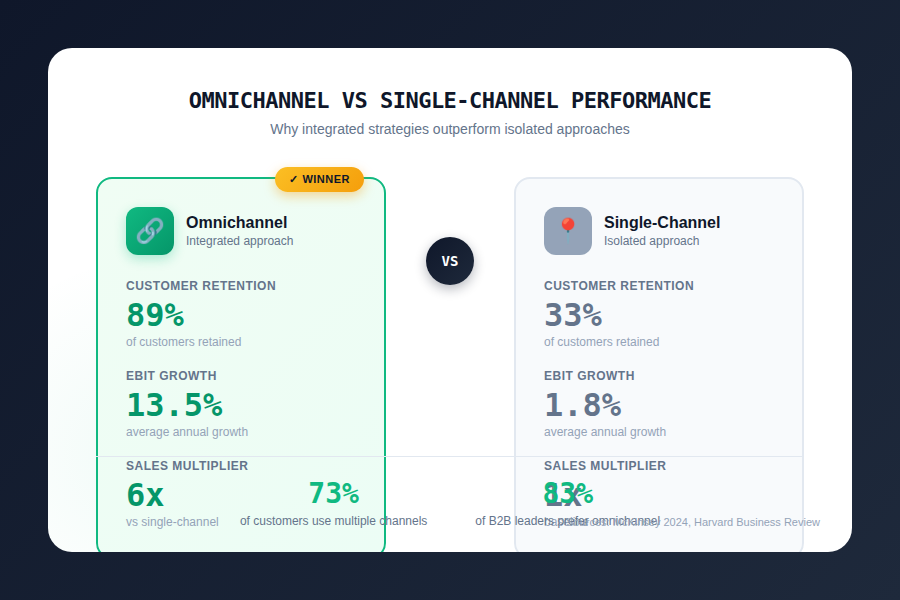
Integrated omnichannel strategies outperform single-channel approaches across every meaningful metric. McKinsey found 83% of B2B decision-makers believe omnichannel sales match or exceed traditional methods in effectiveness, up from 54% at the pandemic's start.
Customer behaviour explains why. Harvard Business Review research shows 73% of customers use multiple channels within their buying journey, and 90% expect seamless communication across services. Customers research on one platform, compare on another, and purchase through a third.
Companies with strong omnichannel engagement retain 89% of customers versus 33% for weak omnichannel engagement. Omnichannel marketing generates nearly six times the sales of single-channel approaches.
The Hidden Costs of Fragmented Channels
Channel fragmentation creates costs beyond the obvious platform management challenges. The 2025 Sprout Social Index found over half of marketing leaders cite poor integration between social tools and other tech as the primary reason they cannot measure social's business impact.
This extends across all channels. Customer data sitting in separate platforms (email here, social engagement there, purchase history somewhere else) means losing the unified view enabling personalized communication. Duplicated efforts, inconsistent messaging, and missed opportunities to engage customers at optimal moments follow.
Real-World Examples
Nike's DTC Transformation
Nike cut back wholesale distribution radically and invested in owned digital and retail experiences. Business of Fashion's analysis documents record performance even during pandemic disruption.
The approach involved raising the bar for brand experience with remaining third-party partners, expanding content and customization to deepen customer relationships, and investing heavily in data analytics. When the pandemic hit, online sales spiked and share price reached all-time highs despite widespread retail closures.
Walmart's Omnichannel Integration
Think with Google research shows omnichannel strategies contributed to approximately 80% of customer visits to brick-and-mortar stores. Companies achieving seamless execution report higher customer satisfaction, faster growth, and lower operational costs.
Walmart's click-and-collect strategy stands out. In 2021, click-and-collect e-commerce orders reached $20.4 billion, with Walmart capturing 25% of that volume.
Frequently Asked Questions
What is the most effective marketing channel for small businesses?
Email typically delivers the highest ROI for small businesses given low costs and direct audience access. For acquisition, SEO provides sustainable long-term results but requires patience. Most successful small businesses combine email for retention with one primary acquisition channel like SEO or paid search.
How many marketing channels should a business use?
Enterprise organizations typically run 5-10 integrated channels effectively, while smaller businesses often succeed with 3-5 well-executed channels. The right number depends on resources, audience behaviour, and industry dynamics. Deeper investment in fewer channels typically outperforms spreading thin across many.
What's the difference between a sales channel and a marketing channel?
Sales channels are where transactions happen: e-commerce sites, retail stores, sales reps, marketplaces. Marketing channels create awareness, generate interest, and drive customers toward purchase. Many channels serve both functions; a website is both a marketing channel through content and brand messaging and a sales channel through e-commerce transactions.
How do you measure marketing channel effectiveness?
Track attribution metrics showing which channels drive conversions alongside engagement metrics like reach, clicks, and time spent. Most organizations combine last-click attribution for immediate ROI with multi-touch models for understanding the full customer journey. Key metrics include customer acquisition cost per channel, conversion rates, and customer lifetime value by acquisition source.
Should B2B and B2C companies use different marketing channels?
The channels overlap, but effectiveness differs. B2B typically sees strongest results from LinkedIn, email, content marketing, and search, while B2C often finds more success with social platforms, influencer partnerships, and DTC channels. Both B2B and B2C buyers increasingly expect omnichannel experiences; the specific mix matters more than rigid B2B/B2C distinctions.


