



Table of contents
Key Takeaways
- Google Ads intelligence encompasses systematic competitive data analysis across Auction Insights, the Transparency Center, and third-party tools
- Auction Insights provides irreplaceable first-party competitive data, but requires consistent monitoring and integration with performance metrics
- The Transparency Center enables free competitive creative analysis, revealing ad formats, messaging strategies, and seasonal patterns
- Proactive competitive intelligence consistently outperforms reactive approaches by identifying threats early and capturing opportunities competitors miss
- Negative intelligence (what competitors don't do) often provides more actionable opportunities than observing their current activities
- For organizations seeking to maximize competitive intelligence ROI, working with experienced PPC professionals can accelerate translating data into strategic advantage
What Is Google Ads Intelligence?
Google Ads intelligence is the systematic collection, analysis, and application of competitive data to improve paid search performance. It covers everything from auction dynamics and competitor bidding patterns to ad creative strategies and landing page approaches across the Google Ads platform.
Here's the core idea: raw competitive data becomes actionable strategic insight. According to Harvard Business Review research, companies increasingly face information overload regarding markets and competitors. This noise often prevents leadership from making optimal decisions. PPC competitive intelligence cuts through that clutter by providing structured frameworks for understanding competitor behaviour in paid search.
For mid-market and enterprise businesses, mastering Google Ads research has become essential. WordStream's 2025 benchmark analysis of over 16,000 campaigns shows the average cost per click across all industries hit $5.26, with costs still climbing year over year. In this environment, understanding competitor strategies determines whether you maintain market position or slowly lose ground to rivals who do their homework.
7 Strategies for Leveraging Competitive Data in Google Ads
1. Master Auction Insights for Real-Time Competitive Positioning
Google Ads Auction Insights is your most valuable first-party competitive intelligence tool. This built-in auction insights report shows exactly who you're competing against in actual auctions, with accuracy that third-party tools simply cannot match.
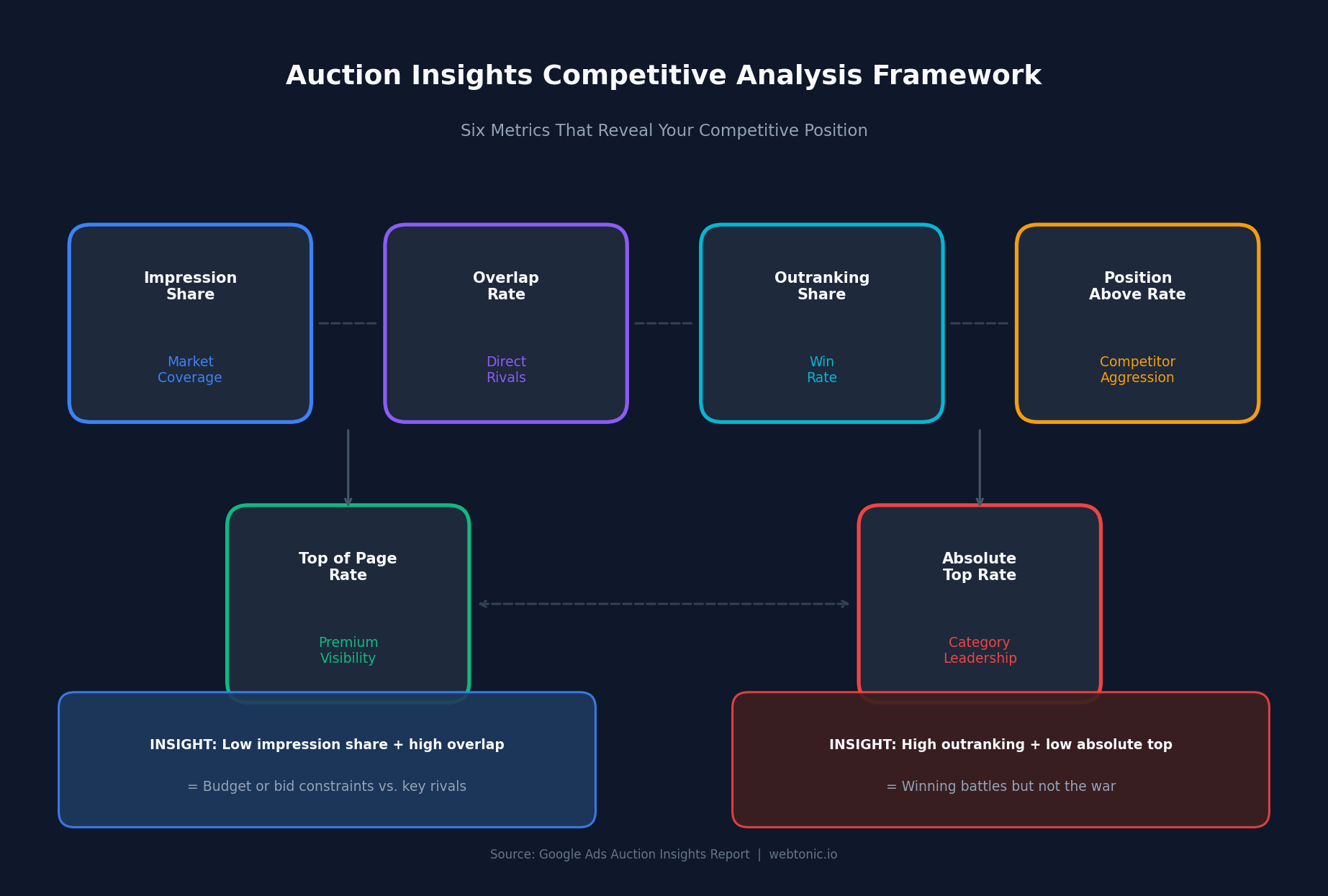
The report provides six critical metrics for Search campaigns:
| Metric | What It Measures | Strategic Application |
|---|---|---|
| Impression Share | Percentage of eligible auctions where your ad appeared | Identifies market coverage gaps |
| Overlap Rate | How often another advertiser's ad appears alongside yours | Reveals primary auction rivals |
| Outranking Share | Frequency your ad ranked in a higher position than competitors | Measures competitive dominance |
| Position Above Rate | How often competitor ads appear above yours | Signals bidding aggression levels |
| Top of Page Rate | Percentage of impressions at top of the page | Indicates premium placement success |
| Absolute Top Rate | Frequency of appearing as the very first ad | Shows category leadership status |
To access this data, navigate to your campaign, ad group, or keyword level, then select "Auction Insights" from the left-hand menu. The report requires roughly 1,000 impressions (the number of impressions threshold) over your selected period to generate meaningful insights.
Pros:
- First-party data directly from Google provides unmatched accuracy for auction-specific intelligence
- Available at no additional cost within your existing Google Ads account
- Shows real competitors you're actually facing in Google Ads campaigns, not theoretical market players
Cons:
- Only reveals competitors in auctions you've already entered, missing potential rivals targeting different keywords
- Historical data limited to 90 days, restricting long-term trend analysis
- Doesn't show specific keywords competitors bid on or their actual ad copy
- Cannot compare your paid performance against organic search results
2. Leverage the Google Ads Transparency Center for Creative Intelligence
The Google Ads Transparency Center launched in March 2023 as a searchable database of ads run by verified advertisers across Google's platforms. It reveals competitor ad creative across Search, Display, Gmail, and YouTube. Free intelligence that used to require expensive third-party tools.
The platform lets you search by advertiser name and filter by ad format, time frame, and geographic region. When analyzing competitor ads, focus on three elements.
Creative Pattern Analysis: Which ad formats do competitors use most frequently? A B2B SaaS company running video ads alongside text ads signals a multi-format testing strategy. Worth watching.
Longevity Signals: Ads running for extended periods typically indicate proven performers. Rapid creative rotation? That suggests active testing or underperforming campaigns. The longest-running ads often reveal what actually converts.
Messaging Evolution: Track how competitor messaging shifts over time. Seasonal adjustments, new value propositions, changed calls-to-action. These reveal strategic pivots you can learn from (or counter).
3. Conduct Systematic Keyword Gap Analysis
Understanding which keywords competitors target, and which they've overlooked, creates strategic advantage. The process involves comparing your keyword portfolio against competitor coverage to spot both threats and opportunities.
Start by combining Auction Insights data with third-party keyword research tools. You can also use Keyword Planner to discover new keywords and analyze search volume for terms competitors might be missing. When you identify competitors with high overlap rates in Auction Insights, dig into their broader keyword strategy using SEMrush or SpyFu. Look for three things.
High-Value Gaps: Keywords with strong commercial intent where competitors have minimal presence. Use keyword suggestions from Google Keyword Planner to find terms with solid monthly searches but low competitive density. For e-commerce brands competing on Shopping, this might mean product-specific long-tails that category leaders ignore. These represent efficient market capture opportunities.
Competitive Clusters: Keyword groups where multiple competitors concentrate spend. High competition signals proven demand. But it also means premium bids. A legal services firm might find "personal injury lawyer" clusters cost $50+ per click while "motorcycle accident attorney [city]" variations run $15-20. Monitor search trends to identify when competition intensifies seasonally.
Long-Tail Opportunities: Specific, lower-volume keywords competitors overlook. These often convert at higher rates with lower CPCs. Smaller competitors frequently employ creative approaches here that larger advertisers miss entirely.
4. Analyze Competitor Landing Page Strategies
Competitive intelligence extends beyond ads to the destinations those ads promote. Landing page analysis reveals how competitors approach conversion optimization, value proposition presentation, and user experience.
When a competitor maintains high impression share and strong position metrics in Auction Insights, their landing pages likely contribute to a favorable Quality Score. What should you examine?
Above-the-Fold Content: What primary message and call-to-action do competitors present immediately? This reflects their understanding of user intent. A B2B software company leading to a demo request form signals bottom-funnel targeting. Leading to educational content signals awareness-stage focus.
Social Proof Placement: How prominently do competitors feature testimonials, reviews, or trust signals? Prominent placement suggests these elements drive conversions for that audience.
Form Complexity: For lead generation, compare form field requirements. Competitors requesting fewer fields may prioritize volume over quality. Or they've optimized through testing and discovered shorter forms convert better for their specific offer.
Mobile Experience: With mobile devices generating over 60% of global web traffic, evaluate competitor mobile landing page performance. Slow load times or poor mobile design create real competitive opportunities. If a dominant competitor neglects mobile, that's your opening to capture potential customers they're losing.
Ensure your conversion tracking is properly configured before drawing conclusions from competitor landing page analysis. Without accurate tracking, you cannot measure whether your landing page improvements actually outperform competitor approaches.
5. Monitor Bidding Pattern Signals
You cannot see competitors' actual bids. But Auction Insights metrics reveal bidding behaviour patterns when analyzed over time. These patterns help you anticipate competitive moves and identify strategic windows.
Watch for these signals:
Sudden Impression Share Increases: When a competitor's impression share spikes significantly, they've likely increased budget or bid more aggressively. Does this coincide with a product launch? Promotional period? Seasonal pattern? A home services company might see competitors surge in March as spring project season begins.
Position Fluctuations: If a competitor's "position above rate" drops while their impression share stays stable, they may be shifting to efficiency-focused bidding rather than position-based goals. They're prioritizing ROAS over visibility.
Day-Part Patterns: Segment Auction Insights by time periods to identify when competitors reduce presence. Early mornings, evenings, or weekends often present opportunities for lower-competition visibility. Some B2B advertisers pause campaigns entirely on weekends, creating gaps for competitors willing to capture weekend researchers.
Research indicates businesses effectively using Auction Insights often achieve 2:1 return on ad spend or better. The key: translate competitive patterns into bidding adjustments rather than just observing data.
6. Track Seasonal and Promotional Intelligence
Competitor advertising patterns shift based on seasonal factors, promotional calendars, and business cycles. Tracking these patterns enables proactive rather than reactive ad campaign management.
Build a competitive monitoring calendar that tracks:
Industry Events: Major conferences, trade shows, and industry announcements trigger advertising surges. Anticipate increased competition during these periods. A cybersecurity company should expect competitor spend spikes around RSA Conference or major breach news cycles.
Promotional Cycles: Monitor when competitors run sales, discounts, or special offers through their ad creative. Understanding their promotional rhythm helps you time counter-campaigns. Or avoid head-to-head battles during their peak promotional periods. This applies to both search campaigns and shopping campaigns.
Market Trends: Many competitors increase spending toward quarter-end or year-end. Others reduce activity during budget transition periods. Identifying these market trends reveals windows of opportunity when CPCs temporarily drop. Use Google Trends data alongside Auction Insights to spot these patterns.
The Google Ads Transparency Center proves particularly valuable here. Filter competitor ads by date range to see how messaging and creative change throughout the year.
7. Integrate Competitive Intelligence with Performance Data
The most sophisticated advertisers don't analyze competitive data in isolation. They integrate it with their own performance metrics. This transforms competitive intelligence from interesting information into actionable strategy.
Connect these data points:
Correlation Analysis: When your impression share drops, does cost per conversion increase? Understanding these relationships helps quantify the business impact of competitive pressure. A 10% impression share loss might correlate with 15% higher CPAs, or it might have minimal impact. The data tells you which battles matter.
Attribution Context: Before reacting to competitive moves, verify whether they actually impact your outcomes. A competitor's increased visibility matters most if it correlates with declines in your qualified lead volume or revenue. Sometimes competitors gain share in segments you don't actually want.
Quality Score Dynamics: Monitor how competitive pressure affects your Quality Scores. If competitors improve their landing page experience or ad relevance, your relative scores may suffer even without changes to your campaigns. Quality Score is comparative.
According to McKinsey's marketing ROI research, analytics that don't translate to practical business decisions provide limited value. The goal: develop intuitive understanding of how competitive dynamics affect your specific business outcomes.
Common Misconceptions
Misconception 1: Higher Impression Share Always Means Better Performance
Many advertisers assume maximizing impression share should be a primary objective. Reality check: impression share optimization without conversion context drains budgets fast.
A competitor showing 90% impression share may be overspending on low-intent queries while you efficiently capture high-converting traffic at 50% share. Always evaluate impression share alongside conversion metrics and ROAS before making strategic adjustments. The advertiser winning the impression share battle often loses the profitability war.
Misconception 2: You Should Match Competitor Bids to Remain Competitive
The instinct to match or exceed competitor bids reflects a fundamental misunderstanding of Google's auction mechanics. Quality Score significantly influences ad rank. Higher-quality ads achieve better positions at lower costs.
Rather than engaging in bidding wars, focus on improving ad relevance, expected click-through rate, and landing page experience. A well-optimized campaign can consistently outrank higher-spending competitors. We've seen accounts with $3 CPCs outperform competitors paying $8+ for the same keywords simply through better Quality Scores.
Misconception 3: Competitor Ad Copy Should Be Directly Emulated
Competitor ad analysis provides valuable insights. But directly copying successful ads rarely produces equivalent results. What works for a competitor depends on their specific brand positioning, landing page experience, and audience relationships.
Instead of copying, identify the strategic principles behind successful competitor ads. Are they emphasizing specific value propositions? Using urgency tactics? Featuring trust signals? Digital marketing best practices suggest adapting these principles to your unique brand context rather than lifting headlines verbatim.
Why Reactive Competitive Intelligence Fails
Most advertisers approach competitive analysis reactively. They check Auction Insights after performance declines. They review competitor ads when launching new campaigns. This approach consistently underperforms.
Research from Harvard Business Review on market research transformation emphasizes that firms gain unprecedented opportunities when they systematically integrate intelligence gathering into operations. The same principle applies to PPC.
Proactive monitoring enables early threat identification. When you notice a new competitor entering Auction Insights with rapidly increasing impression share, you adjust strategy before experiencing conversion declines. Reactive analysis identifies these threats after damage occurs. That's an expensive lesson.
And proactive intelligence reveals opportunities that reactive approaches miss entirely. Market gaps, seasonal windows, competitor weaknesses. These appear briefly and disappear quickly. Organizations monitoring continuously capture them. Those checking periodically miss them.
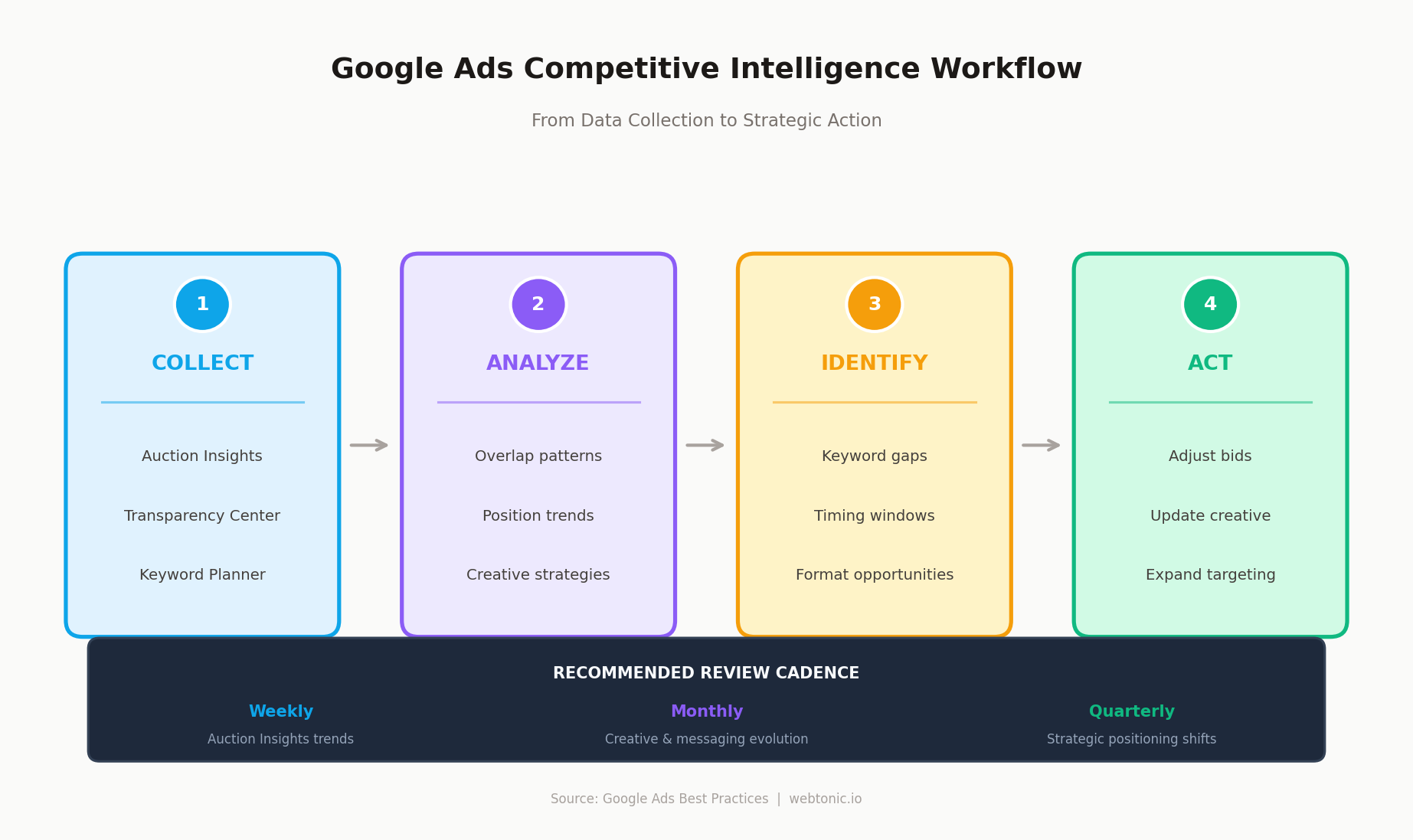
The most effective programs establish regular review cadences: weekly monitoring of Auction Insights trends, monthly analysis of competitor creative evolution, quarterly strategic assessments of positioning shifts.
The Hidden Value of Negative Intelligence
What competitors don't do often matters more than what they do.
Understanding competitor limitations and blind spots creates opportunities for differentiation and capturing new customers. According to industry research on marketing ROI, organizations investing deeply in competitive analysis see sales ROI improvements of 10-20% on average when they act strategically. Much of this improvement comes from identifying gaps competitors leave unaddressed.
Consider these sources of negative intelligence:
Geographic Gaps: Many competitors concentrate on major metros while undeserving secondary markets. A regional insurance carrier might discover national competitors ignore rural counties entirely. Auction Insights segmented by geography reveals these coverage gaps.
Device Neglect: Some competitors optimize heavily for desktop while underinvesting in mobile. With mobile traffic dominating most industries, this creates real opportunities. An e-commerce brand might find competitors' mobile impression share 30% lower than desktop, signaling poor mobile experience or deliberate deprioritization.
Keyword Blind Spots: Long-tail keywords, emerging search terms, niche variations. These often receive minimal competitor attention. They typically offer lower costs and higher conversion rates for advertisers willing to do the keyword research work.
Negative intelligence also applies to ad format adoption. If major competitors ignore responsive search ads, video extensions, or other format innovations, early adoption creates visibility advantages before competitors catch up.
Real-World Examples and Case Studies
Samsung Galaxy Launch Campaign
When promoting a new Galaxy smartphone, Samsung demonstrated sophisticated competitive intelligence applications. The company analyzed competitor messaging across audience segments, using Google Analytics insights combined with competitive positioning data.
The result: over 400 ad variations tailored to more than 300 audience segments. In just five days. This granular approach to competitive differentiation enabled precise messaging that addressed specific competitor weaknesses for each audience group. Rather than one-size-fits-all creative, Samsung built ads that countered specific competitor claims for specific audience segments.
Rakuten Brand Transformation
The company formerly known as Ebates leveraged competitive intelligence during its rebrand to Rakuten. Understanding how competitors positioned themselves in the cashback and rewards space, Rakuten developed a multichannel strategy spanning Search and YouTube Ads.
The campaign's success depended on identifying competitive messaging patterns and positioning Rakuten distinctly from established players. Rather than competing on the same value propositions as competitors, they found differentiated positioning the competitive analysis revealed was underutilized.
E-Commerce Competitive Repositioning
One documented case study describes an e-commerce brand that grew from $14,347 to $114,188 in monthly revenue over 198 days. The mechanism: systematically applied competitive intelligence.
The team identified that 50% of their sales came from a product category receiving only 15-20% of budget allocation. This misalignment emerged through competitive analysis of where rivals concentrated. By launching Performance Max campaigns targeting this category exclusively and monitoring competitor position changes, they achieved sustained growth while reducing reliance on branded search terms from 49% to 31% of conversions.
Frequently Asked Questions
How often should I check Google Ads Auction Insights?
For actively managed campaigns, review Auction Insights weekly to catch emerging trends early. Conduct deeper monthly analysis to identify patterns and inform strategic adjustments. During product launches or seasonal peaks, daily monitoring may be appropriate. The key: consistent review cadences rather than sporadic checking when problems arise.
Can competitors see my Google Ads data in their Auction Insights?
Yes. The relationship is reciprocal. Competitors participating in the same auctions see your impression share, overlap rate, and position metrics just as you see theirs. But they cannot see your actual bids, keywords, ad copy, or campaign structure. Only aggregated competitive metrics for shared auctions.
What's the difference between auction competitors and business competitors?
Auction competitors bid on the same keywords. Business competitors offer similar products or services. These groups often differ significantly.
A local HVAC company might face auction competition from national franchises, lead aggregators, and even unrelated businesses accidentally triggering on broad match keywords. Focus competitive intelligence on advertisers with high overlap rates in Auction Insights. These represent your actual auction rivals regardless of business model.
How can I identify new competitors entering my market?
Monitor Auction Insights regularly for new domain names appearing with meaningful impression share. Set up alerts for significant changes in your competitive metrics. Use the Google Ads Transparency Center to search for ads in your industry and identify unfamiliar advertisers. You can also run a Google search for your target keywords and note which advertiser's ad appears that you haven't seen before.
Track your impression share trends closely. Sudden drops often indicate new competitive pressure even before specific competitors become visible in reports.
Should I bid on competitor brand keywords?
This strategy requires careful evaluation. Clicks on competitor brand terms come from users actively seeking that specific competitor. Conversion is harder.
Evaluate whether cost per acquisition from competitor brand campaigns delivers acceptable returns. Consider the competitive relationship. Aggressive brand bidding may provoke retaliation. Many advertisers find protecting their own brand keywords while focusing acquisition on category terms delivers better overall efficiency.


