



Table of contents
Key Takeaways
- Implement comprehensive conversion tracking, including offline conversions, before launching PMax to ensure effective campaign management. This data fundamentally shapes algorithm optimization and determines lead quality.
- Provide maximum asset coverage (15 headlines, 5 descriptions, 20 images, 5 videos) to unlock all Google channel placements and give the AI sufficient creative combinations to test
- Segment asset groups by theme, audience, or product category to enable meaningful performance analysis and targeted optimization rather than aggregated campaign-level data
- Review search terms insights weekly and add campaign-level negative keywords to maintain traffic quality. This discipline separates high-performing campaigns from wasted spend.
- Consider working with experienced Performance Max specialists who can implement advanced strategies like customer lifetime value optimization, margin-based segmentation, and multi-campaign orchestration that maximize returns beyond basic setup
What Is Google Performance Max?
Performance Max represents Google's most ambitious evolution in automated advertising. Unlike traditional campaign types that require separate management across Search, Display, YouTube, Gmail, Discover, and Maps, Performance Max consolidates these channels into a single AI-driven campaign that optimizes ad placement, bidding, and creative assembly in real time.
According to Google's official 2025 highlights, the platform leverages advanced machine learning to analyze thousands of signals simultaneously. Device type, time of day, search history, user engagement patterns, and campaign performance: the algorithm weighs all of this to deliver the most relevant ad format to each individual user. This represents a fundamental shift from manual channel management to goal-based optimization where advertisers define objectives and let Google's AI determine optimal execution.
The significance for mid-market and enterprise businesses extends beyond operational efficiency. Performance Max campaigns use data-driven attribution, assigning credit based on each touchpoint's actual contribution to conversions rather than relying on simplistic last-click models. For organizations managing complex customer journeys across multiple digital touchpoints, this provides visibility into how different channels work together to drive results, and integrating a target ROAS (Return on Ad Spend) can further enhance campaign effectiveness, which was simply impossible with legacy campaign structures.
15 High-Converting Performance Max Ad Examples by Industry
Not every brand should rush to PMax. Some businesses see incredible results with YouTube ads; others waste budget for months before realizing their setup was wrong from day one. The examples below show what works, but pay attention to the context. Your industry, your data quality, and your creative assets will determine whether you land closer to the success stories or the cautionary tales.
E-Commerce Success Stories
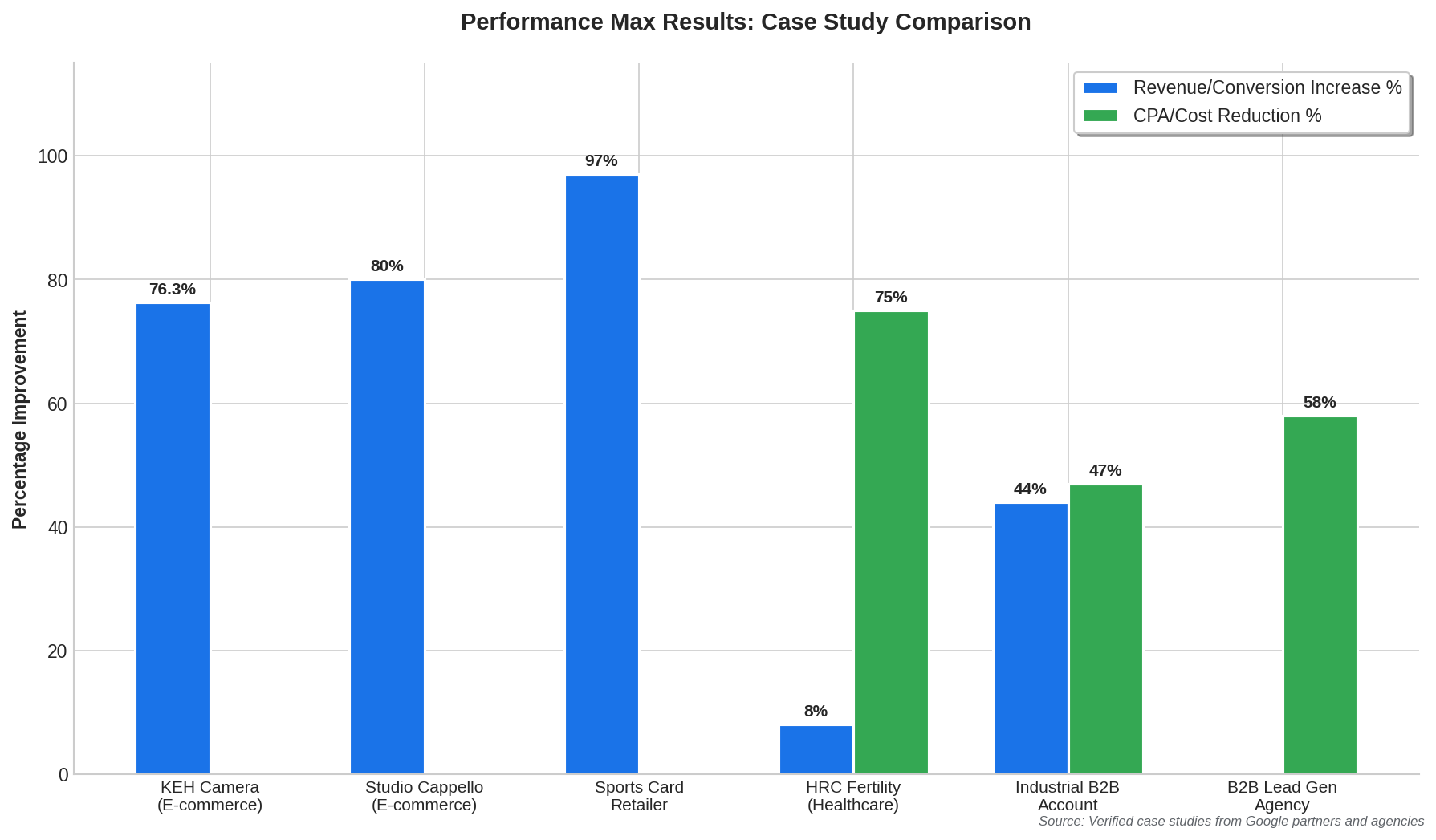
1. KEH Camera: 76.3% Revenue Increase
This Georgia-based pre-owned camera retailer transitioned from Standard Shopping to Google Performance Max ads over a six-month testing period in 2022-2023. The results speak for themselves: first quarter 2023 showed a 76.3% increase in advertising revenue compared to the same period using Standard Shopping campaigns.
What made the difference? Patience and incremental scaling. They ran targeted 14-day overstock sale campaigns, gradually increasing PMax ad spend allocation from 0.3% to 56%, and allowed sufficient learning time before evaluating performance. Too many advertisers kill campaigns after two weeks. KEH gave theirs six months.
2. Studio Cappello: 80% Revenue Growth
Italian web marketing agency WMR - Studio Cappello integrated CRM data directly into their Performance Max campaigns using feed optimization tools and final URL expansion. This approach enabled precise product listing optimization and audience targeting based on actual customer purchase behaviour. The outcome: stable advertising costs while revenue increased by 80%. First-party data made the difference here.
3. Sports Card Retailer: 97% Revenue Lift
Here's one that surprised me. A retail client in the sports card industry replaced their shopping campaigns with Performance Max and achieved a 97% lift in revenue with only a 23% increase in cost. That's a 60% improvement in ROAS. The visual nature of collectible cards played perfectly into PMax's strength with image-rich Display and YouTube placements.
Lead Generation Examples
4. HRC Fertility: 4x Lower CPA
Healthcare marketing presents unique challenges. Compliance restrictions, sensitive subject matter, long consideration cycles. Yet HRC Fertility achieved an 8% increase in lead volume at a $35 CPA (four times lower than their previous Search campaigns). The campaign succeeded by combining precise audience signals with compelling creative assets that addressed the emotional journey of fertility treatment seekers.
5. Culligan Water Systems: 1,867% ROAS
The numbers here don't tell the full story. Analysis of 12 Performance Max campaigns for Culligan dealers across the United States and Canada revealed ROAS ranging from 700% to an exceptional 1,867.37%, averaging 804.49%. The campaigns generated 732.46 leads at cost-per-conversion rates between $15.62 and $26.51. But here's what matters: this was a franchise network with consistent branding and offer structure across locations. That uniformity gave the algorithm clean signals to optimize against. Fragmented franchise systems rarely see results this strong.
6. MoneyMe: $800K in Six Weeks
Australian fintech company MoneyMe partnered with agency Sparro to drive leads for newly funded loans. Six weeks. $800,000 in revenue. 22% increase in conversions. Cost-per-acquisition dropped 20%. Financial services advertisers often struggle with compliance restrictions, which makes this result worth studying closely.
B2B Performance Max Examples
So why do B2B advertisers still hesitate? Fair question. The concerns are legitimate: longer sales cycles, smaller target audiences, and the risk of optimizing for junk leads instead of qualified opportunities. But the campaigns below show what's possible when the setup is right and you define clear conversion goals.
7. Industrial B2B Account: 44% Conversion Increase
A B2B industrial supplier initially hesitated to implement Google Performance Max Campaigns due to concerns about traffic quality and the inability to add campaign-level negative keywords. Valid concerns at the time.
After implementing highly targeted B2B search themes (10-12 per asset group) alongside first-party audience data including past converters and customer lists, the campaign achieved a 44% increase in conversions with a 47% decrease in CPA. The search insight reports showed dramatically improved traffic quality compared to their previous shopping campaigns. Targeted signals matter more in B2B than any other vertical.
8. B2B Lead Generation Agency: 58% Lower CpQL
An experienced PPC manager documented her journey from PMax skeptic to advocate after driving $5 million in revenue with Performance Max generating qualified leads through display ads at 58% lower cost than standard nonbranded search campaigns. Critical success factors: importing offline conversions, syncing first-party data, and maintaining rigorous negative keyword management. Skip any of these steps and the results flip from impressive to disastrous.
9. Trade School Lead Quality Optimization
This one illustrates the learning curve. A tech/trade school with multiple Midwest campuses used Performance Max for enrollment lead generation. Initial results? High volume, low-quality leads. Setting clear goals, the sales team was drowning in inquiries that never converted to enrollments.
The fix required patience and better data. They implemented offline conversion tracking tied to actual enrollment outcomes, teaching Google's algorithm to optimize for students who actually enrolled rather than just form submissions. The lesson: PMax optimizes for whatever you tell it to optimize for. Feed it form fills, you get form fills. Feed it enrollment data, you get enrollees.
Hospitality and Travel
10. Hotel Direct Booking Campaigns
Performance Max for travel goals enables hotels to serve ads across Google Maps, Search, YouTube, and Hotel Ads from a single campaign. Google's specialized travel campaign type allows property-specific asset groups with automated rate and availability integration, driving local store visits effectively. What previously required managing multiple campaign types now lives in one place.
11. Multi-Property Hotel Group
Hotels leveraging Performance Max for travel goals report expanded reach during critical trip-planning moments. The campaign type automatically creates diverse hotel ad formats optimized for each channel, pulling availability and pricing directly from hotel feeds. The requirements for success: high-quality property images, compelling descriptions highlighting unique amenities, and accurate location data for Maps placements. Miss any of these and the algorithm has nothing compelling to show potential guests.
Retail and Local Business
12. Athletic Apparel Store: URL-Based Targeting
Google's 2025 updates expanded "URL contains" rules to Performance Max campaigns with product feeds across all of Google’s advertising channels. An athletic apparel retailer used this feature to create separate campaigns targeting specific product categories, directing ads about shoes only to landing pages containing that term in the URL. This approach improved relevance scores and allowed category-specific budget allocation without creating separate feeds. A small feature that solves a big headache.
13. Franchise Network Campaign
Multi-location businesses use Performance Max for store goals to share location details, operating hours, and special offers with potential customers near each property. The campaigns automatically serve across Google Search, Maps, YouTube, Gmail, and Display Network. For franchisees, this provides automated local advertising that previously required significant manual configuration or expensive agency retainers.
High-Value Customer Acquisition
14. Customer Lifetime Value Optimization
The 2025 rollout of high-value new customer mode enables advertisers to specify high-value customers and their long-term value through Customer Match. Google AI then predicts which new users are likely to maximize lifetime value in **digital advertising** and bids more aggressively for them. Campaign-level reporting shows both total new customers acquired and how many qualified as high-value. This is where PMax starts feeling less like a black box and more like a strategic tool.
15. Retention-Focused Loyalty Campaign
Google's 2025 updates introduced loyalty features allowing advertisers to highlight member-exclusive pricing and shipping benefits directly in ads. Combined with new retention goals, brands can now tailor bidding to reach high-value existing customers. The result: Performance Max campaigns specifically designed to reduce churn and increase repeat purchase rates rather than just chasing new acquisitions.
Performance Max Strategy Comparison
| Strategy Approach | Best For | Typical Results | Key Requirements |
|---|---|---|---|
| Feed-Only (No Assets) | Pure e-commerce, limited creative resources | Shopping placements only, narrower reach | Product feed optimization, competitive pricing |
| Full Asset Coverage | Brand building + conversions | Access to all Google channels, broader reach for various customer segments. | 20 images, 5 videos, complete text assets |
| Segmented by Margin | Profitable product prioritization | Budget efficiency, profit optimization | Accurate margin data, custom labels |
| Audience Signal Focus | B2B, high-value customer targeting | Quality over quantity, lower CPL | CRM integration, customer match lists |
| New Customer Acquisition | Growth-focused brands | Efficient expansion, LTV optimization | Conversion history, customer value data |
Common Misconceptions About Performance Max
Misconception 1: Performance Max Is "Set and Forget"
This might be the most expensive misconception in paid media right now.
Despite the automation, successful PMax campaigns require continuous optimization. Research analyzing over 24,000 campaigns found that 82% of advertisers run PMax alongside other campaign types, and performance varies significantly based on ongoing management. Weekly review of search term insights, regular asset performance checks, and systematic addition of negative keywords separate high-performing campaigns from budget drains.
Misconception 2: You Cannot Control Where Your Ads Appear
This was true in 2023. It's not true anymore.
The 2025 updates introduced substantial control mechanisms. Advertisers can now add campaign-level negative keywords, view channel performance breakdowns showing exactly which platforms drive conversions, apply brand exclusions to specific ad formats, and implement age-based demographic exclusions and device targeting through beta features. The transparency gap has narrowed considerably. Not eliminated, but narrowed.
Misconception 3: Performance Max Cannibalizes Other Campaign Types
Analysis of over 4,000 campaigns indicates more nuanced dynamics. PMax cost share peaked at nearly 82% in May 2024 but has since declined approximately 0.65% per month as advertisers with a Google Ads account rediscover value in Standard Shopping and Search for specific use cases. The most successful advertisers typically allocate 60-70% of budget to PMax for e-commerce (30-40% for B2B) while maintaining Search campaigns for high-intent keywords and brand terms. It's not either/or. It's portfolio management.
Real-World Performance Benchmarks
Testing across 247 accounts from March 2023 to January 2025 comparing Performance Max versus Search campaigns revealed that PMax delivered better results for 58% of accounts, while Search campaigns won for 42%. But here's the real insight: 73% of accounts performed best using both campaign types strategically across the entire Google Network rather than choosing exclusively.
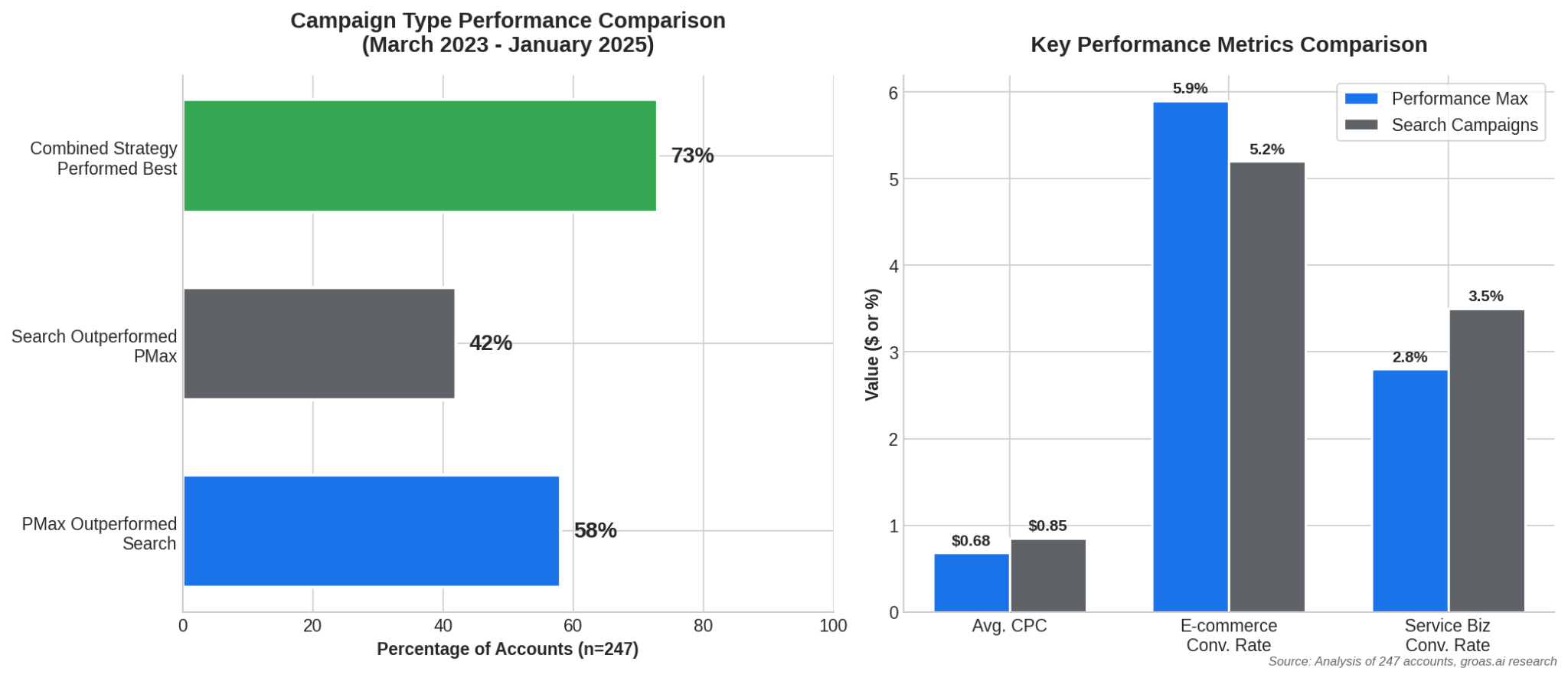
E-commerce accounts with 50+ products achieved average 5.9% conversion rates and $51 CPA when visual assets, including a square logo, were strong and conversion paths were clear. Service businesses with complex sales cycles averaged lower conversion rates (2.8%) and higher CPAs ($94). PMax requires adaptation for longer consideration cycles.
The average CPC for Performance Max campaigns runs approximately $0.68 versus Google Ads' overall average of $0.85. PMax finds lower-cost inventory across Google's network while maintaining conversion quality. Additionally, video ads can benefit from this strategy as they are included in Display and Discover placements. The tradeoff: click-through rates are typically lower than pure Search campaigns due to inclusion of Display and Discover placements where user intent differs.
Frequently Asked Questions
How long does Performance Max take to optimize?
Performance Max campaigns typically require a learning period of 2-4 weeks before the algorithm stabilizes, leveraging final URL expansion to enhance ad performance. Google recommends allowing at least 6 weeks before making major strategic changes, as the system needs sufficient conversion data to optimize effectively. Campaigns with fewer than 30 conversions per month may struggle to exit the learning phase. Conversion volume is a critical consideration for campaign viability.
Can I use Performance Max for brand campaigns?
The 2025 updates allow advertisers to apply brand exclusions specifically to Search text ads while keeping Shopping ads active for branded terms in the Google Merchant Center. This enables precise control over brand traffic management. For retailers who value Shopping ad visibility on brand terms but want to manage brand Search differently, this represents a significant improvement over previous all-or-nothing brand exclusion approaches.
What budget is required for Performance Max?
Google doesn't mandate specific minimums. Industry practitioners recommend starting budgets sufficient to generate 30+ conversions within the first month to provide adequate learning data around conversion value. For most e-commerce businesses, this translates to minimum daily budgets of $50-100. B2B advertisers with higher CPAs may need $200+ daily to achieve similar conversion velocity during the learning phase.
How does Performance Max handle video if I don't have video assets?
If you don't upload video assets, Google auto-generates videos from your provided headlines, descriptions, and long headlines, and images. These automatically created videos typically appear as basic slideshows with system-selected music. They often don't align with brand guidelines and, frankly, they look like what they are: auto-generated content.
Upload at least one branded video of 10-15 seconds to every asset group. It maintains creative control and ensures professional presentation on YouTube placements.
Should I run Performance Max alongside Search campaigns?
Evidence supports running both campaign types with clear role definitions. Allocate Performance Max for broad acquisition across all Google channels while maintaining Search ads campaigns for high-intent specific keywords, brand terms, and situations requiring precise messaging control. The key is avoiding overlap that creates internal competition. Use negative keywords in PMax to exclude terms covered by Search ads campaigns and segment branded versus non-branded traffic deliberately.
Performance Max Best Practices for 2026
Google recommends filling all available asset slots, including ad extensions. But quality matters more than simply reaching minimums. Google's official best practices emphasize using the Ad Strength indicator to determine if an asset group has sufficient assets, ensuring all asset types (text, images, videos) are covered, and creating variations to identify top performers. Replace assets rated "Low" systematically rather than accumulating underperforming creative.
Asset Quality Over Quantity
Google recommends filling all available asset slots. But quality matters more than simply reaching minimums. Google's official best practices emphasize using the Ad Strength indicator to determine if an asset group has sufficient assets, ensuring all asset types (text, images, videos) are covered, and creating variations to identify top performers. Replace assets rated "Low" systematically rather than accumulating underperforming creative.
First-Party Data Integration
The most successful Performance Max campaigns integrate CRM data, customer match lists, and offline conversion tracking. This first-party data provides Google's algorithm with precise signals about high-value customers, shortening the learning curve and improving targeting accuracy from campaign launch. For B2B advertisers especially, importing offline conversions showing which leads became sales-qualified opportunities transforms PMax from a volume generator into a machine focused on driving online sales and quality leads. This single factor separates campaigns that scale profitably from campaigns that generate expensive noise.
Strategic Audience Signals
Audience signals guide Google's AI without restricting automated targeting. Combine Customer Match lists of past converters with custom segments based on relevant interests and in-market audiences. The algorithm uses these signals as starting points for optimization on Google Discover, expanding beyond provided audiences when it identifies promising new segments. The initial signals shape the direction of that expansion.
Feed Optimization for E-Commerce
Product feed quality directly impacts Performance Max performance for retail advertisers. Optimize product titles with relevant keywords, use lifestyle images rather than exclusively relying on Merchant Center product photos, and implement custom labels for margin-based segmentation. Poor feed data limits the algorithm's ability to match products with relevant queries and audiences.
Web Tonic works across SEO, paid search and paid social, and you can book a consultation to talk through your own plan.


