



Table of contents
Key Takeaways
- Establish systematic competitive analysis with weekly, monthly, and quarterly review cadences. One-time analysis produces dated insights that decay rapidly in dynamic auction environments, making it essential to refine your own PPC strategy.
- Combine platform-native tools like Google Ads Auction Insights with third-party solutions for comprehensive visibility. Each tool type offers capabilities the others lack, and serious practitioners use both.
- Focus keyword gap analysis on user intent segments. Informational, commercial investigation, and transactional keywords require different bidding strategies and creative approaches, especially when considering competition levels.
- Extend analysis beyond ads to landing pages. This is where conversion actually happens, and it's where most competitor analysis falls short. Examine form length, social proof placement, page speed, and mobile experience.
- Limit your competitive focus to 3-5 core PPC competitors. More than that creates noise without additional signal. Depth beats breadth.
- Use competitive intelligence to differentiate your strategy rather than copying competitor approaches. What works for their brand, margin structure, and customer base may fail for yours.
- Consider working with a specialized PPC agency if competitive analysis reveals optimization opportunities requiring dedicated expertise and toolsets you don't have in-house.
What Is PPC Competitor Analysis?
PPC competitor analysis is the systematic process of examining how your rivals use paid advertising to capture market share. You're looking at their keywords, ad copy, landing pages, bidding strategies, and budget allocation to find opportunities they've missed and gaps you can exploit.
Why does this matter more now than ever? According to the WordStream 2025 Search Advertising Benchmarks report, which analyzed 16,446 US-based campaigns, cost per click increased for 87% of industries year-over-year. The average CPC across all industries hit $5.26 in 2025. That's real money leaving your account with every click, and understanding where competitors allocate their budgets can mean the difference between profitable campaigns and expensive lessons.
For mid-market and enterprise businesses, competitive PPC research goes beyond identifying who bids on similar keywords. It reveals positioning strategies, messaging approaches, and seasonal patterns that should inform everything from budget planning to creative development. Organizations that systematically analyze competitor activity often discover underserved keyword segments, identify ad formats worth testing, and anticipate market shifts before those shifts tank their performance.
8 Ways to Outperform Your Competition
Effective AdWords competitor research requires combining platform-native tools with third-party intelligence solutions. The following strategies represent proven methods for extracting actionable insights from your competitive landscape.
1. Master Google Ads Auction Insights for Real-Time Competitive Intelligence
Google Ads Auction Insights is your foundational tool for understanding competitive dynamics within the Google ecosystem. Unlike third-party tools that estimate competitor data based on crawling and algorithms, Auction Insights provides actual performance metrics from live auctions where your ads compete directly with others.
The report delivers six metrics for Search campaigns: impression share, overlap rate, outranking share, position above rate, top of page rate, and absolute top of page rate. According to Google's official documentation, you'll only see insights when your impression share exceeds 10%, which ensures the data is statistically meaningful.
Here's what each metric actually tells you:
| Metric | What It Measures | Strategic Application |
|---|---|---|
| Impression Share | Percentage of eligible impressions received | Identifies budget or bid limitations |
| Overlap Rate | How often competitor ads appear alongside yours | Reveals true PPC competitors vs. business competitors |
| Outranking Share | Percentage of auctions where you ranked higher | Measures competitive positioning effectiveness |
| Position Above Rate | How often competitors appear above your ad | Signals bid or quality score disparities |
| Top of Page Rate | Frequency of appearing above organic results | Indicates premium placement competitiveness |
A high overlap rate combined with a low position above rate? That's actually good news. It means you're frequently beating a competitor who's active in your space. But watch out for competitors with low impression share and high position above rate. They're cherry-picking high-value keywords and bidding aggressively only on terms that matter most to their bottom line.
The "Ghost Competitor" Problem
Here's something most competitive analysis guides won't tell you: your most dangerous PPC competitors often aren't visible in Auction Insights at all. They're bidding on adjacent keywords you haven't considered, capturing your potential customers before those customers even search for terms you're targeting. A B2B software company might obsess over competitors bidding on "project management software" while a savvy rival quietly dominates "how to run better meetings" and builds brand awareness upstream. Auction Insights only shows competitors in auctions you've entered. It can't show you the auctions you should have entered but didn't. Combine your Auction Insights data with third-party keyword research to find these blind spots before competitors exploit them further.
2. Conduct Keyword Gap Analysis
Keyword gap analysis identifies valuable search terms that competitors target but you don't. These represent immediate expansion opportunities sitting right in front of you.
Tools like SEMrush and SpyFu offer dedicated gap analysis features that visualize competitive keyword landscapes. SEMrush's Keyword Gap tool compares your domain against up to four competitors, showing missing keywords, shared keywords, and unique terms each competitor owns. According to SpyFu, their Kombat tool provides 15 years of historical PPC data (deeper than most competitors), allowing you to see which keywords have consistently performed over time rather than just what's working this month.
When conducting gap analysis, segment your discoveries by user intent. Informational keywords are queries where users seek knowledge, like "what is PPC advertising," and these work well for upper-funnel brand awareness campaigns. Navigational keywords target specific brands or products (think "SEMrush login") and prove valuable for brand protection and competitor conquesting. Transactional keywords indicate purchase intent, such as "buy CRM software," delivering the highest value for conversion-focused campaigns. And commercial investigation queries compare options ("best PPC management tools") to capture prospects in the consideration stage.
One often-overlooked tactic: pay attention to keywords competitors avoid. If multiple competitors exclude terms like "free" or "DIY," they've probably learned the hard way that those segments don't convert. Add them to your negative keyword list and save yourself the testing budget.
3. Analyze Competitor Ad Copy and Messaging
Examining competitor ad creative reveals messaging strategies, unique value propositions, and promotional tactics that resonate with your shared audience. But don't just skim the surface. Look for patterns.
The Google Ads Transparency Center provides free access to any advertiser's current creative, letting you see exactly what competitors communicate to prospects. For historical analysis, SpyFu's Ad History feature shows complete Google Ads campaign histories, including ads that ran for months (likely winners) versus short-lived tests that got killed quickly.
What should you actually look for? Start with headline patterns to understand what pain points or benefits competitors emphasize. Examine their call-to-action language: do they use "Get Started," "Book a Demo," or "Get Pricing"? Check for social proof elements like reviews, awards, or customer counts. Note promotional offers that appear consistently (discounts, free trials, guarantees). And don't ignore ad extensions, because the sitelinks, callouts, and structured snippets competitors choose reveal what they believe converts.
Here's something that trips up a lot of marketers: ads that run for months are almost certainly working. Short-lived ads tell you what didn't work. Both insights have value, but the long-runners deserve closer study.
4. Reverse-Engineer Landing Page Strategies
This is where most competitor analysis falls short. Marketers obsess over ad copy while completely ignoring landing pages, which is where conversion actually happens.
According to research cited by industry analysts, personalized landing pages can boost PPC campaign effectiveness by 5%. That might sound modest, but on a $100,000 monthly ad spend, 5% improvement represents significant revenue.
When analyzing competitor landing pages, examine headline alignment (does the landing page headline match the ad promise?), form complexity (how many fields do competitors require?), social proof placement (where do testimonials and trust badges appear?), page speed (how fast do competitor pages load?), and mobile experience (how do competitors handle mobile visitors?).
Compare their structure to yours. Look at the offer, proof elements, call-to-action placement, and overall user experience. If competitor paid landing pages look dramatically different from their standard website, that's a massive signal. It means they've built and tested pages specifically optimized for paid traffic conversion, not just sent visitors to their homepage and hoped for the best.
5. Decode Budget and Bidding Patterns
You can't see exact competitor budgets. Google doesn't share that data. But several indicators reveal spending patterns and strategic priorities if you know where to look.
Auction Insights impression share data serves as a proxy for relative competitor spending. Here's the rough math: if a competitor maintains 60% impression share against your 40%, and your daily budget is $500, they're likely spending around $750 daily on similar keyword sets. It's not precise, but it's directionally useful for understanding competitive intensity.
Monitor impression share trends over time. Declining share while CPCs rise often signals new competitor entry or increased bidding aggression from existing players. Track time-of-day patterns to identify when competitor ads appear most frequently (this reveals scheduling strategies). Watch for seasonal variations in competitor visibility, which helps you anticipate budget fluctuations during peak periods. And pay attention to the balance between branded and non-branded investment: heavy branded spending suggests brand protection priorities, while non-branded focus indicates conquest strategies.
According to the WordStream 2024 Google Ads Benchmarks report, CPC increased by an average of 10% year-over-year across industries, likely due to continued inflationary pressures. Understanding whether competitors absorb these increases or adjust their strategies helps inform your own budget planning.
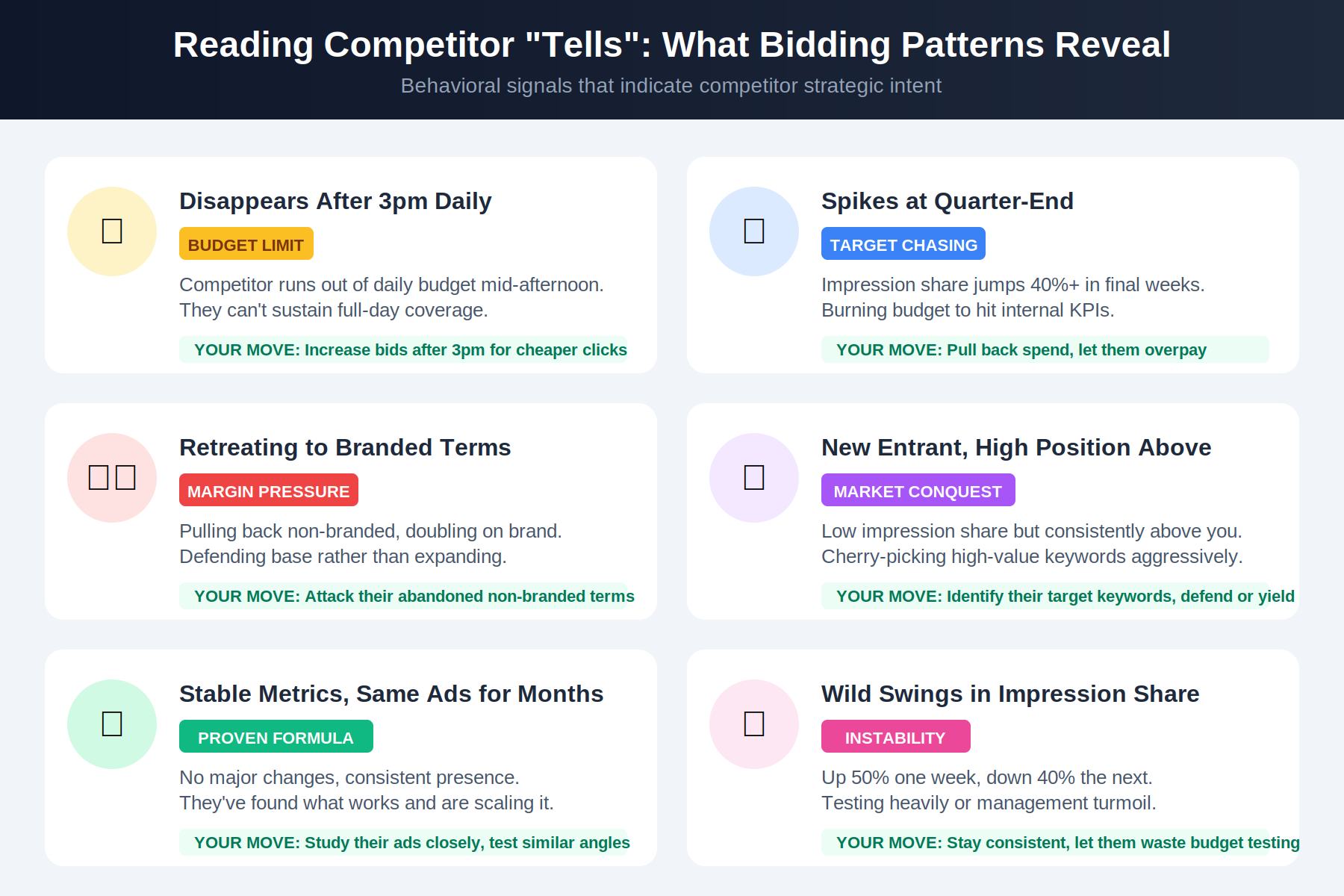
Reading Competitor "Tells" Through Timing Patterns
Experienced poker players watch for tells. Smart PPC marketers should do the same. Competitor bidding patterns reveal strategic intent if you track them over time. A competitor who consistently disappears from auctions after 3pm likely has budget constraints and runs out of daily spend by mid-afternoon. That's your window to capture cheaper clicks with less competition. A competitor who dramatically increases impression share every quarter-end might be chasing internal targets or burning remaining budget before it expires. If you notice competitors pulling back on non-branded terms while doubling down on branded keywords, they're probably seeing margin pressure and retreating to defend their existing customer base. These behavioural patterns don't show up in any standard report. You have to track Auction Insights weekly, note the changes, and look for the story behind the numbers. The data exists; most marketers just don't connect the dots.
6. Use Third-Party Competitive Intelligence Tools
Platform-native tools like Auction Insights provide accurate real-time data, but third-party platforms offer broader visibility across the competitive landscape, historical trends, and features you simply can't get from Google directly.
| Tool | Key Strengths | Best For |
|---|---|---|
| SEMrush | Comprehensive keyword database, 142 geo databases, traffic analytics | Enterprise-level competitive intelligence |
| SpyFu | 15+ years ad history, unlimited searches, budget-friendly pricing | Historical PPC trend analysis |
| Ahrefs | Superior backlink analysis, paid keyword research integration | Combining PPC and SEO competitive data |
| SimilarWeb | Traffic source analysis, audience insights, market share data | Understanding competitor channel mix |
SEMrush currently manages over 25 billion keywords and 808 million domains across its international database. SpyFu differentiates through deeper historical data at a more accessible price point, making it particularly valuable for understanding long-term competitor keyword performance rather than just current snapshots.
Most serious PPC practitioners don't pick one tool. They combine several: Google Ads Auction Insights for real-time auction data, SEMrush or SpyFu for historical keyword and ad research, and Google Ads Transparency Center for current creative analysis. The tools complement each other rather than compete.
7. Benchmark Against Industry Performance Data
Context matters. Your metrics mean nothing in isolation. You need to understand whether underperformance stems from campaign-specific issues or broader market dynamics affecting everyone in your space.
The 2025 LocaliQ Search Advertising Benchmarks report provides critical reference points based on analysis of 16,446 campaigns. The average click-through rate across industries reached 6.66%, up 3.74% year-over-year. Average cost per click hit $5.26, rising 12.88%. Conversion rates averaged 7.52%, with 65% of industries showing improvement. Cost per lead increased only 5% (down significantly from the 25% spike between 2023 and 2024).
Industry-specific numbers matter even more than averages. Arts & Entertainment leads with 13.10% CTR while Dentists and Dental Services trail at 5.44%. For CPC, Attorneys and Legal Services face the highest average at $8.58, while Arts & Entertainment enjoys the lowest at $1.60. These differences are enormous.
Compare your metrics against both broad industry benchmarks and direct competitor data from Auction Insights. If your conversion rate exceeds industry averages but trails competitors in your specific auctions, your opportunity lies in competitive positioning rather than fundamental campaign optimization. Different diagnosis, different treatment.
8. Build a Systematic Analysis Process
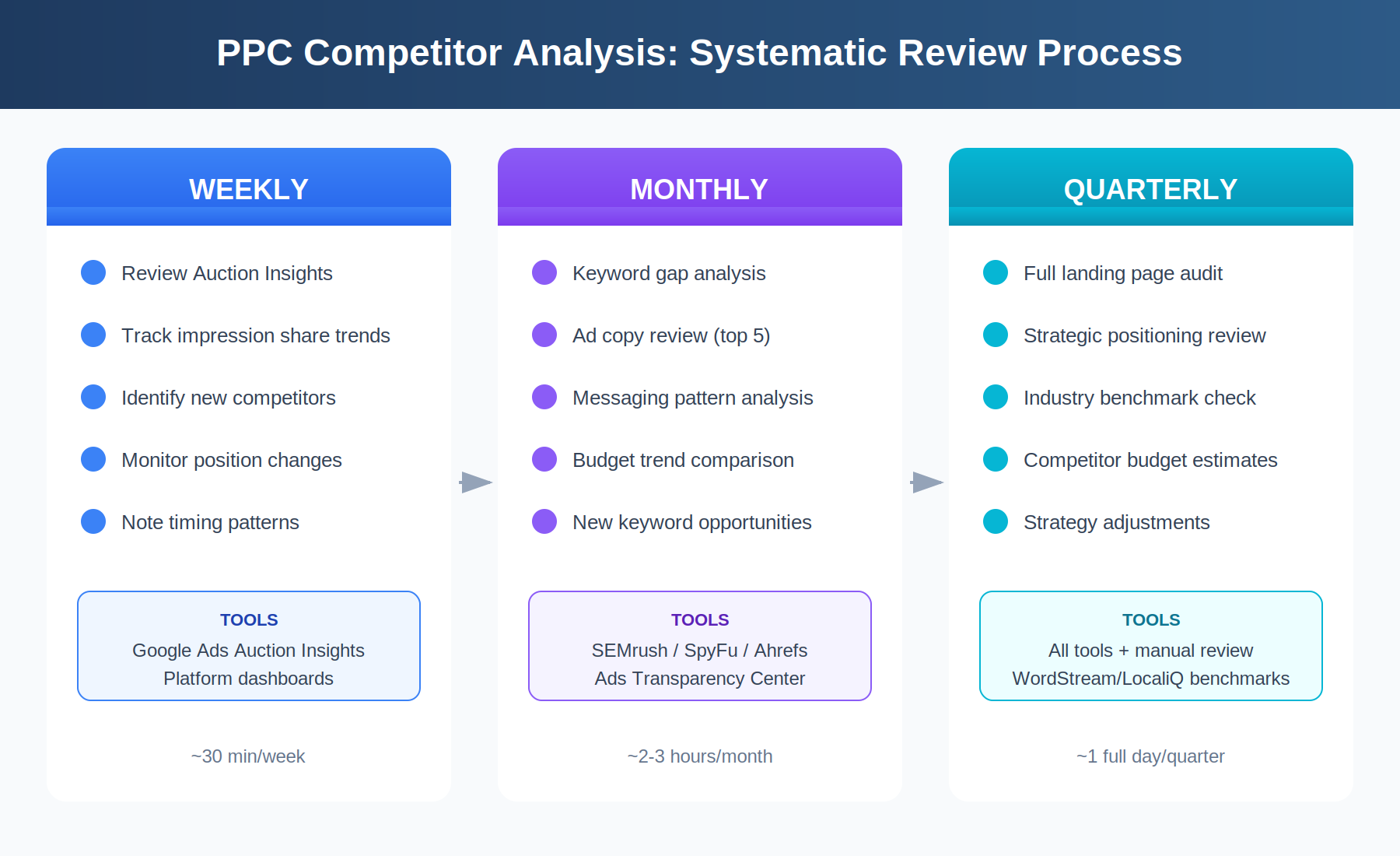
One-time competitor analysis gives you a snapshot. Systematic ongoing monitoring delivers sustained strategic advantage.
Establish different frequencies for different analysis types. Weekly, review Auction Insights for impression share trends and watch for new competitors entering your auctions. Monthly, conduct keyword gap analysis and review ad creative across your top competitors. Quarterly, perform comprehensive audits including landing pages, budget patterns, and strategic positioning. Annually, complete full market analysis covering emerging competitors and benchmark comparisons.
Limiting your focus to 3-5 core competitors prevents analysis paralysis while ensuring meaningful depth. And remember: your PPC competitors aren't always your business competitors. Focus on domains that consistently appear in your Auction Insights reports rather than the companies you'd list as rivals in a business plan. A software company might discover their biggest PPC competitors include comparison websites, review platforms, or adjacent solution providers rather than direct product competitors.
Common Misconceptions
Copying Competitors Guarantees Success
Many advertisers assume replicating successful competitor campaigns will yield similar results. It won't. What works for competitors may fail for your brand due to differences in Quality Score, landing page relevance, brand awareness, and conversion infrastructure. You don't know their margin structure, their customer lifetime value, or their tolerance for loss-leader acquisition strategies.
Competitor analysis should inform and inspire your strategy. It shouldn't replace original thinking. The goal is differentiation, not imitation.
Competitor Analysis Is a One-Time Project
Treating PPC competitor analysis as a project rather than an ongoing process creates dangerous blind spots. The paid search landscape changes constantly. New competitors enter markets. Bidding strategies shift. Seasonal patterns emerge and evolve. A quarterly competitive audit might miss an aggressive expansion campaign that impacts your performance within weeks.
Embed competitive intelligence into regular campaign management workflows. Make it routine, not an event.
More Data Always Means Better Decisions
Access to extensive competitive data can create analysis paralysis rather than actionable insights. Studying too many competitors simultaneously, obsessing over minor metric fluctuations, or collecting data without clear strategic questions leads to wasted effort and delayed action.
Focus competitive analysis on answering specific questions. Which keyword opportunities do competitors own that we don't? What messaging angles resonate with our shared audience? Where do competitors show vulnerability we can exploit? Targeted analysis with clear objectives outperforms comprehensive data collection without purpose every time.
Real-World Results
Enterprise SaaS: 40% Lead Increase Through Keyword Gap Discovery
A mid-market SaaS company selling project management software discovered through keyword gap analysis that competitors heavily targeted long-tail comparison keywords ("Monday.com vs Asana," "best project management for agencies") while they focused primarily on generic category terms. They were fighting expensive battles on broad keywords while competitors quietly captured high-intent comparison traffic.
By shifting 30% of their PPC budget toward comparison and consideration-stage keywords identified through competitive analysis, the company increased qualified leads by 40% within one quarter while maintaining cost per acquisition. The insight came from analyzing competitor keyword portfolios and identifying the commercial investigation intent segment they had completely underserved.
E-commerce: 25% Conversion Lift From Landing Page Analysis
An e-commerce retailer competing in the home goods space used competitive landing page analysis to identify patterns among top performers. Winning competitors featured customer reviews directly above the fold and used significantly shorter checkout forms, while emphasizing effective ad copy like free shipping guarantees prominently. The retailer's own pages buried reviews, required eight form fields, and mentioned shipping terms only in the footer.
After implementing optimizations based on these competitive insights (repositioning social proof, reducing form fields from eight to four, adding shipping guarantee badges), conversion rates improved by 25% on their highest-spend PPC campaigns. No changes to ad creative or bidding strategies, just better landing pages informed by ad copy analysis of what competitors had already proven works.
Frequently Asked Questions
What tools do I need for effective PPC competitor analysis?
Start with free platform-native tools like Google Ads Auction Insights and Google Ads Transparency Center for accurate auction data and current competitor creative. For deeper keyword research and historical analysis, use tools like SEMrush, SpyFu, or Ahrefs. Most practitioners combine platform data for real-time insights with third-party tools for historical trends and gap analysis.
How often should I analyze my PPC competitors?
Monitor Auction Insights weekly to catch impression share changes quickly. Conduct keyword gap and ad creative analysis monthly. , ensuring you know your target audience. Perform deep strategic audits quarterly. This layered approach balances thoroughness with practical time constraints.
How do I identify my true PPC competitors versus business competitors?
Your PPC competitors are brands appearing in the same ad auctions, not necessarily traditional business rivals. Use Auction Insights to identify domains that frequently overlap with your ads and can impact your ad performance. A software company might discover their biggest PPC competitors include comparison websites or review platforms rather than direct product competitors.
What metrics matter most when analyzing competitor PPC performance?
Focus on impression share (relative market presence), overlap rate (true competitive overlap), and outranking share (positioning effectiveness). Beyond Auction Insights, track competitor keyword portfolios, ad creative patterns, and landing page elements to gain valuable insights. Avoid fixating on metrics you can't act upon.
Can competitor analysis help reduce my PPC costs?
Yes. Gap analysis uncovers lower-competition keywords competitors overlook and highlights valuable opportunities. Negative keyword patterns eliminate wasted spend. Budget pattern analysis reveals off-peak opportunities with lower CPCs. But the primary value is strategic improvement, not pure cost reduction.


