



Table of contents
Key Takeaways
- Web marketing encompasses all internet-based promotional activities including SEO, content marketing, PPC, email, social media, and mobile marketing—each serving distinct purposes within customer journeys from awareness through retention.
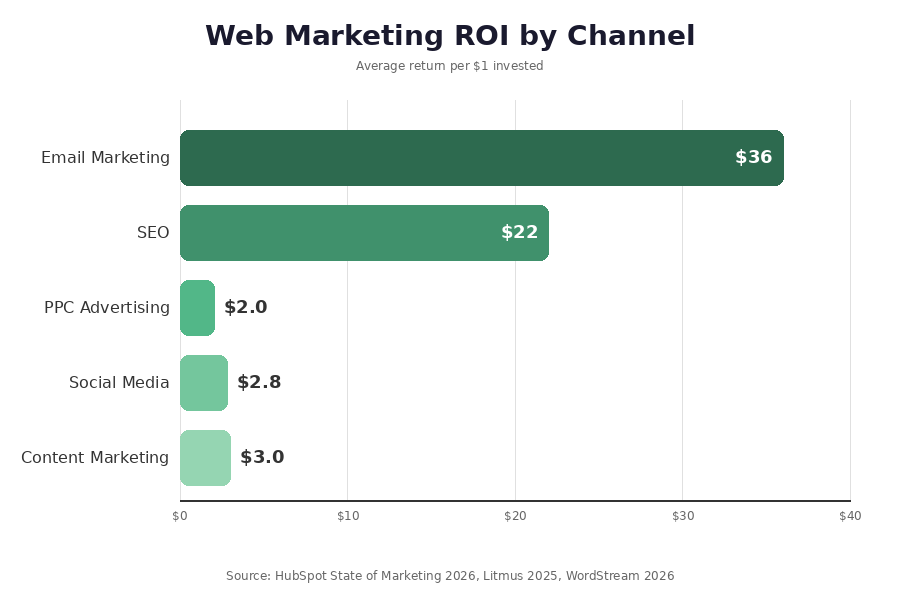
- ROI varies significantly by channel: email marketing delivers approximately $36-42 per dollar invested, SEO produces $22 return per dollar spent, and PPC averages 200% returns—but optimal channel mix depends on specific business models, audiences, and objectives.
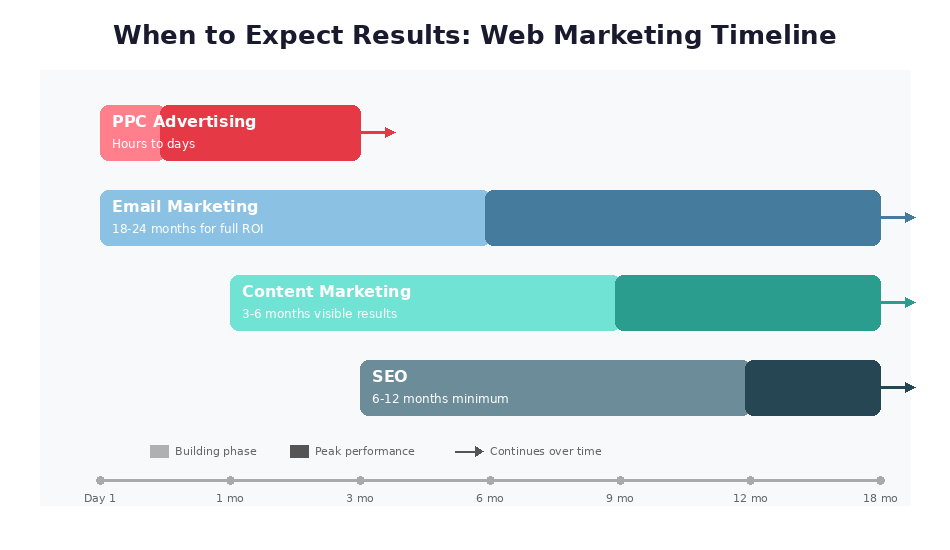
- Successful web marketing requires long-term commitment rather than quick fixes; SEO typically needs 6-12 months for meaningful results, content marketing compounds over years, and even paid channels require optimization periods to achieve efficient performance.
- Attribution complexity means traditional ROI calculations often mislead; multi-touch customer journeys require sophisticated measurement approaches that accept inherent uncertainty while balancing quantitative data with qualitative customer understanding.
- For organizations seeking to accelerate results or navigate channel complexity, partnering with specialized agencies can provide expertise, tools, and bandwidth that internal teams may lack—particularly valuable during strategic transitions or rapid scaling periods.
What is web marketing?
Web marketing encompasses all marketing efforts that leverage the internet to promote brands, products, and services. You might hear it called online marketing, internet marketing, or digital marketing. The terms overlap significantly, but they all point to the same shift: moving from traditional advertising toward data-driven, measurable promotional strategies.
The American Marketing Association defines marketing as the activity, set of institutions, and processes for creating, communicating, delivering, and exchanging offerings that have value. Apply that to web-based channels, and you get search engines, social media platforms, email, websites, mobile apps, and digital advertising networks working together to reach potential customers.
What separates web marketing from traditional marketing? Three things: interactivity, measurability, and precision targeting.
Traditional marketing broadcasts messages to broad audiences. A TV commercial reaches everyone watching that channel, regardless of whether they care about the product. Web marketing flips this model. Businesses can reach their target market through online platforms, track engagement in real time, and adjust digital campaigns based on actual performance data. Research from HubSpot's 2026 State of Marketing Report shows that website marketing, blog content, and SEO efforts remain the top ROI-generating channel for marketers.
For mid-market and enterprise organizations, web marketing has become essential infrastructure. Global digital advertising spend reached $667 billion in 2024 and continues climbing, with digital formats capturing approximately 73% of total advertising investment worldwide. This reflects how consumers actually behave: research shows 68% of online experiences begin with a search engine.
9 essential web marketing strategies
The following strategies form the foundation of effective web marketing. Each serves distinct purposes within the customer journey, from initial awareness through conversion and long-term retention. But not all deserve equal attention for every business.
1. Search engine optimization (SEO)
Search engine optimization improves website visibility in search engine results through technical optimization, content development, and authority building. SEO represents one of the highest-ROI marketing investments available. Research indicates organic search drives approximately 53% of all website traffic across industries.
The discipline breaks down into four interconnected areas. Technical SEO covers site architecture, page speed, responsive design, and crawlability. On-page optimization involves keyword research, content quality, meta tags, and internal linking. Off-page SEO focuses on backlink acquisition, brand mentions, and domain authority development. And local SEO handles Google Business Profile optimization along with local citation building.
Here's what most guides won't tell you: the companies seeing the best SEO results in 2024-2025 aren't the ones obsessing over keyword density or backlink counts. They're the ones treating SEO as a byproduct of genuinely useful content. A regional healthcare network we've observed doubled organic traffic over 18 months by shifting from "SEO-optimized articles" to detailed condition guides written by their actual physicians. The content ranked because it answered questions better than competitors, not because it hit arbitrary optimization targets.
According to SeoProfy's 2026 digital marketing research, 91% of marketers reported that their SEO strategy helped improve website performance and marketing goals in 2024. The catch? SEO requires patience. Most competitive keywords take 6-12 months before showing meaningful ranking improvements. Companies that abandon SEO efforts at month four because "nothing is happening" waste their entire investment.
2. Content marketing
Content marketing creates and distributes valuable, relevant content to attract and retain defined audiences. Instead of promoting products directly, content marketing establishes thought leadership and builds trust through educational resources, entertainment, and practical information that reinforces your value proposition.
Different content formats serve different purposes and timelines:
| Format | Best use case | Typical ROI timeline |
|---|---|---|
| Blog posts | SEO, thought leadership | 3-6 months |
| Video content | Engagement, social sharing | Immediate to 3 months |
| Whitepapers | Lead generation, B2B | 1-3 months |
| Case studies | Sales enablement | Ongoing |
| Podcasts | Brand building, audience development | 6-12 months |
Research from Siege Media shows that 90% of content marketers plan to use AI in their 2025 strategies. But here's what matters: the successful ones maintain focus on original, human-centred content that demonstrates genuine expertise.
3. Pay-per-click advertising (PPC)
PPC advertising places targeted ads on search engines, social networks, and display networks. Businesses pay only when users click through to their landing pages. The model delivers immediate visibility and measurable results.
| Platform | Average ROI | Best for |
|---|---|---|
| Google Ads | 200% ($2 per $1 spent) | Search intent, high-purchase intent |
| Facebook Ads | 4-5x spend | Brand awareness, retargeting |
| LinkedIn Ads | Varies by industry | B2B lead generation |
| Microsoft Ads | 200% | Lower competition, older demographics |
According to WordStream's 2026 digital marketing analysis, 84% of brands reported positive PPC results.
4. Email marketing
Email marketing maintains the highest ROI among digital marketing channels, consistently delivering returns of $36 to $42 for every dollar invested. This strategy encompasses email campaigns, automated nurture sequences, transactional messages, and newsletter communications.
Why does email outperform everything else? Businesses own their email list directly, independent of platform algorithms that can change overnight. Segmentation enables highly personalized messaging. And automated workflows reduce manual effort while maintaining consistent engagement.
The tradeoffs matter too. Email requires substantial list building investment before generating meaningful returns. Deliverability challenges demand ongoing attention. And growing inbox competition means content must earn attention rather than expecting it.
But here's the contrarian insight most marketers miss: email's ROI numbers are inflated by survivorship bias. The $36-per-dollar figure comes from companies with mature, well-segmented lists built over years. A manufacturing company that starts email marketing today won't see those returns for 18-24 months minimum. The businesses that abandon email after six months of "disappointing results" never reach the compounding phase where returns accelerate. Email is a long game disguised as a quick win.
Research from HubSpot indicates email marketing delivers a 2.8% conversion rate for B2C brands and 2.4% for B2B organizations.
5. Social media marketing
Social media marketing leverages digital platforms like Facebook, Instagram, LinkedIn, TikTok, and YouTube to build online presence, engage audiences, and drive traffic. With over 5.4 billion social media users worldwide, these online channels represent essential touchpoints throughout the customer journey.
A Sprout Social 2024 survey revealed that Facebook delivers the highest perceived ROI among marketers (28% of respondents), followed by Instagram (22%) and YouTube (12%).
6. Affiliate marketing
Affiliate marketing creates partnerships where external publishers promote products in exchange for commission on resulting sales. This performance-based model shifts risk from advertisers to affiliates. Works particularly well for e-commerce, software, and service providers with clear conversion events.
7. Influencer marketing
Influencer marketing partners brands with individuals who have established audiences and credibility within specific niches. Research indicates it delivers approximately $5.20 for every $1 spent. Micro-influencers (10,000-50,000 followers) often generate 60% higher engagement rates than larger accounts. According to Sprout Social's 2024 Influencer Marketing Report, 86% of consumers make at least one influencer-driven purchase annually.
8. Video marketing
Video marketing has become essential as consumer preferences shift toward visual content. Research shows 91% of businesses now use video. Short-form video delivers the highest reported ROI.
Video ad spending is projected to hit $236 billion in 2026. YouTube reaches over 2.49 billion users, functioning as the second-largest search engine globally.
9. Mobile marketing
Mobile marketing encompasses strategies for smartphone and tablet users: mobile-optimized websites, app-based marketing, SMS messaging, and location-based targeting. With mobile devices accounting for over 60% of global web traffic, mobile-first approaches have become baseline requirements rather than optional enhancements.
Common misconceptions about web marketing
Misconception 1: Web marketing delivers instant results
Many organizations approach web marketing expecting immediate returns. Flip a switch, watch the revenue flow. But sustainable success requires significant investment in foundations that compound over time.
SEO typically requires 6-12 months before demonstrating substantial organic traffic improvements. Content marketing builds authority gradually through consistent publication. Email marketing demands list development before campaigns generate meaningful revenue.
The companies achieving the highest returns understand this: web marketing is a marathon, not a sprint. They use paid channels for near-term results while building toward sustainable organic performance.
Misconception 2: More channels always means better results
The assumption that presence on every available platform maximizes reach leads many businesses to spread resources too thin. The reality? Organizations frequently achieve superior outcomes by mastering fewer channels aligned with their specific audiences.
A B2B software company may generate 80% of qualified leads from LinkedIn and SEO while seeing minimal returns from Instagram or TikTok. A consumer e-commerce brand might thrive on Instagram and email while finding LinkedIn irrelevant. Effective web marketing requires understanding where target audiences spend time and what content formats resonate with them, then concentrating efforts accordingly.
Misconception 3: Web marketing can replace product quality
No amount of sophisticated marketing can sustain a business with fundamental product or service problems. Web marketing amplifies existing business qualities, both positive and negative.
Strong marketing accelerates growth for companies delivering genuine value. For those with underlying issues, it simply surfaces problems faster through reviews, social commentary, and increased customer service demands. The most successful web marketing programs integrate closely with product development, customer experience, and service delivery.
Why "best practices" often fail mid-market companies
Most web marketing advice is written for two audiences: beginners with no budget, or enterprises with dedicated teams for each channel. Mid-market companies ($10M-$500M revenue) fall into a gap where standard recommendations actively hurt them.
Consider a $50M industrial equipment manufacturer. The typical playbook says: invest in SEO, run Google Ads, build email nurture sequences, maintain active social media, create video content, and develop thought leadership through content marketing. Sounds reasonable. But executing a comprehensive digital marketing strategy across all six requires either a substantial in-house team or significant agency spend. Most mid-market companies have neither. They hire one or two marketing generalists, spread them across everything, and achieve mediocrity everywhere.
The companies that break through take a strategic approach. They identify the one or two online channels where their specific audience concentrates and go deep. A commercial HVAC company might ignore social media entirely and dominate local SEO plus Google Ads for emergency repair searches. A specialized software vendor might skip online advertising and build an industry podcast that positions them as the obvious expert. A regional law firm might focus exclusively on referral marketing and Google Business Profile optimization.
This isn't just about resource constraints. It's about competitive advantage. Doing three things exceptionally creates more market impact than doing nine things adequately. The companies spreading thin convince themselves they're "building a foundation" when they're actually building nothing with permanence.
Why attribution complexity undermines traditional ROI measurement
Traditional marketing ROI calculations assume straightforward cause-and-effect relationships: spend X on online advertising, generate Y in sales, calculate return. Web marketing's multi-touch reality makes such simplicity misleading.
Consider a typical customer journey. It might begin with a display ad impression, continue through organic search, involve email nurture sequences, include social media engagement, and culminate in a direct website visit for purchase. Attribution models attempt to assign credit across these touchpoints, but each methodology produces different conclusions about channel value.
First-touch attribution credits the display ad. Last-touch credits direct traffic. Linear models divide credit equally. Data-driven approaches use analytics tools and algorithms that few marketers fully understand.
Research from McKinsey indicates that companies applying data-driven performance marketing to branding activities report marketing efficiency gains of up to 30% and incremental top-line growth of up to 10% without increasing budgets. But achieving these results requires sophisticated measurement approaches that most organizations haven't fully implemented.
The practical implication? Web marketing investment decisions should incorporate multiple measurement approaches and accept inherent uncertainty in attribution. Organizations over-relying on single attribution models frequently cut upper-funnel investments that appear unproductive under last-touch attribution while actually driving awareness that enables eventual conversions.
The hidden cost of channel fragmentation in enterprise marketing
Enterprise organizations face unique web marketing challenges as they scale across multiple brands, regions, and business units. What appears efficient at small scale (separate teams managing different digital marketing campaigns independently) creates substantial hidden costs as complexity increases.
Fragmented channel management produces several measurable problems. Audiences receive inconsistent messaging across touchpoints, reducing brand coherence and trust. Customer data remains siloed, preventing the unified view necessary for effective personalization and user experience optimization. Teams duplicate efforts in content creation, tool procurement, and vendor management. And strategic decisions suffer from incomplete pictures of customer behaviour and channel interaction effects.
Research from Deloitte indicates that 63% of high-growth companies use AI to support marketing processes, with cross-channel integration as a primary use case.
The solution isn't centralization for its own sake. It's intentional architecture: shared customer data infrastructure, consistent measurement frameworks, and governance models that balance autonomy with alignment.
Real-world examples and case studies
Nike: Digital-first transformation
Nike invested heavily in mobile applications (Nike Run Club and Nike Training Club) that provide genuine utility while gathering behavioural data for personalization. Through its apps, Nike tracks workout behaviours and tailors messaging accordingly. Their "You Can't Stop Us" campaign combined personalization with emotional storytelling, generating millions of views across platforms.
The key principle: providing genuine value through digital products creates engagement opportunities that pure advertising cannot match.
Airbnb: User-generated content strategy
Airbnb built its marketing around user-generated content rather than traditional advertising. The company encourages users to share authentic stories and photos from their stays, creating organic content that resonates worldwide while reducing production costs.
According to DigitalDefynd's 2026 case study analysis, Airbnb's influencer-driven campaigns helped drive a 36% increase in bookings tied to influencer content. Empowering customers to tell brand stories builds both trust and measurable results.
The regional player who ignored conventional wisdom
A building materials distributor in the Southwest faced intense competition from national chains with massive marketing budgets. The standard advice would be: match their channel presence, invest in brand awareness, compete on reach. They did the opposite.
Instead of spreading resources across SEO, social, email, PPC, and content, they focused exclusively on two things: Google Business Profile optimization for their 23 locations, and a simple email program targeting existing customers with inventory alerts and seasonal promotions. The first step was identifying what actually drove their business.
The results after 18 months: local search visibility increased 340%, email-driven repeat purchases grew 28%, and customer acquisition cost dropped 45%. They never posted on Instagram. They don't have a blog. Their LinkedIn page has 200 followers. But they dominate the searches that actually drive their business, and their existing customers buy more frequently. Sometimes the best way to approach web marketing is knowing what to ignore.
Frequently asked questions
How much should businesses spend on web marketing?
Marketing budget allocation varies significantly by industry, growth stage, and business objectives. General guidelines suggest established companies typically allocate 5-10% of revenue to marketing, with growth-focused organizations often investing 15-20% or more. Within marketing budgets, digital typically commands 60-80% of total spend. The optimal investment level depends on customer acquisition costs, lifetime value, competitive intensity, and growth targets specific to each organization.
What is the difference between web marketing and digital marketing?
The terms are largely interchangeable in contemporary usage. Both refer to marketing activities conducted through digital channels including websites, search engines, social media, email, and mobile applications. Some practitioners distinguish "web marketing" as specifically internet-based activities while considering "digital marketing" a broader category that might include non-internet digital channels like SMS or digital signage. But this distinction has become increasingly academic as channels converge.
How long does it take to see results from web marketing?
Timelines vary dramatically by channel. Paid advertising can generate traffic within hours but requires weeks of optimization. SEO typically needs 6-12 months for competitive keywords. Email marketing generates returns immediately for organizations with established lists but requires months of list building for new programs. Content marketing compounds over years. Organizations should plan for mixed timelines with quick wins from paid channels while building toward sustainable organic results.
Which web marketing channels work best for B2B companies?
B2B web marketing typically emphasizes different online channels than B2C. LinkedIn consistently ranks as the most effective social platform for B2B lead generation, with 40% of B2B marketers citing it as their top source for quality leads. Content marketing (particularly blog posts, whitepapers, and case studies) drives both SEO results and sales enablement. Email campaigns remain highly effective, with B2B email showing slightly higher click rates than B2C despite lower open rates. Search engine marketing captures high-intent traffic from prospects actively researching solutions. The optimal mix depends on sales cycle length, average deal size, and target buyer characteristics.
How do I measure web marketing success?
Effective measurement combines multiple approaches. Traffic metrics indicate reach. Engagement metrics suggest content relevance. Conversion metrics measure business impact. Attribution modelling connects marketing activities to outcomes across touchpoints. Customer lifetime value calculations reveal whether acquisition investments generate profitable relationships. The specific metrics prioritized should align with business objectives: awareness-focused campaigns emphasize different indicators than conversion-focused efforts.


