



Table of contents
Key Takeaways
- SEO drives 53% of all website traffic and delivers an average ROI of 22:1, making it one of the most effective marketing investments available
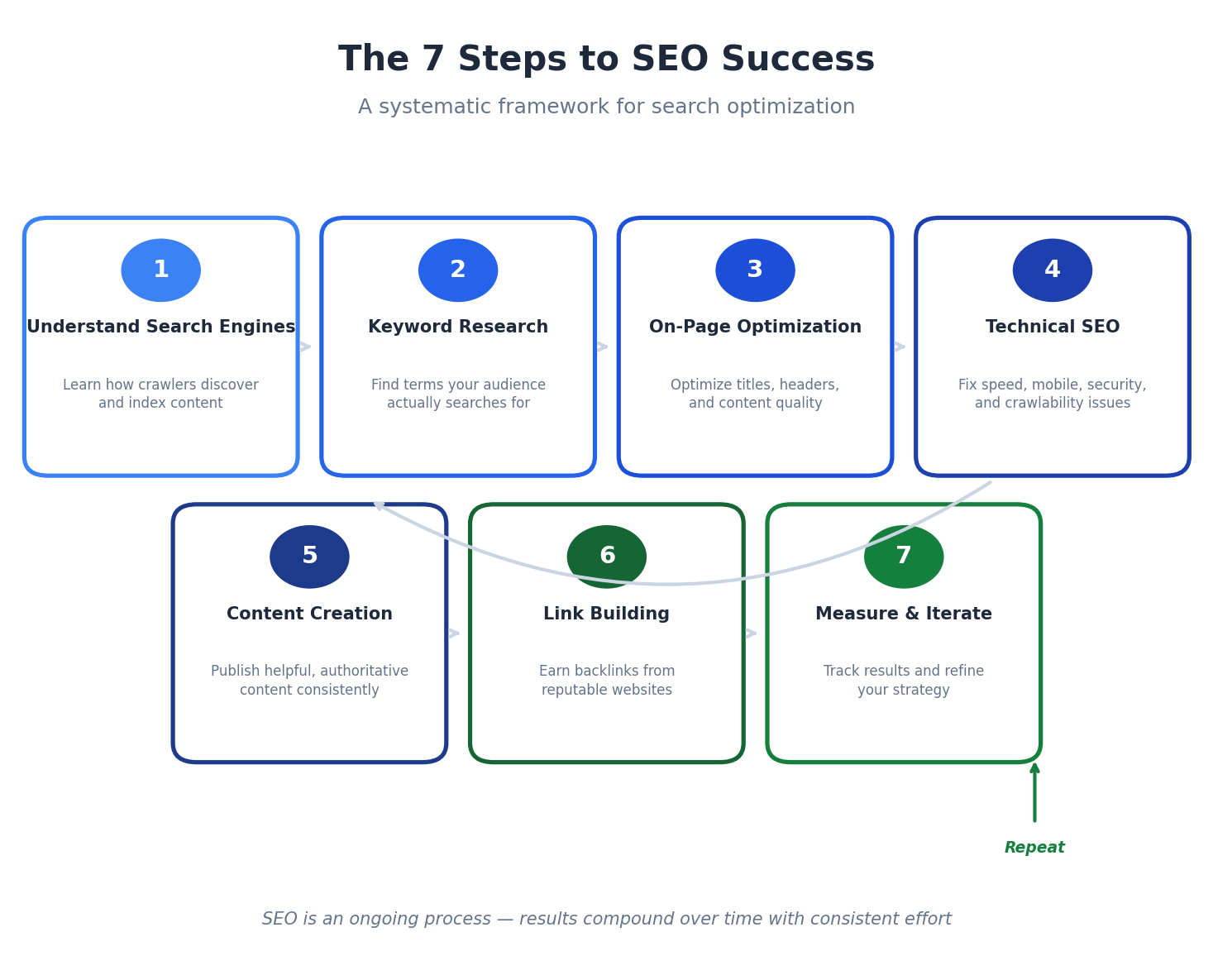
- The seven steps to SEO success include understanding search engines, keyword research, on-page optimization, technical foundations, quality content, link building, and ongoing measurement
- Modern SEO success requires aligning content creation with user experience—algorithms increasingly reward pages that genuinely serve visitor needs
- Results take time, with most campaigns requiring 6-12 months to achieve positive ROI, but the compounding returns justify patient, consistent investment
- For organizations seeking to maximize their organic search potential, partnering with experienced SEO professionals can accelerate results and avoid costly mistakes
What Is SEO?
Search engine optimization (SEO) is the practice of improving a website's visibility in search engine results pages (SERPs). The goal is simple: get more organic search traffic instead of relying on ads. According to Google's SEO Starter Guide, SEO helps search engines understand your content while helping internet users find your site through search queries.
Why does this matter?
Research from BrightEdge found that organic search delivers 53% of all trackable website traffic. Not paid ads. Not social media marketing. Organic search. That makes it the dominant source of web visitors across industries. For B2B companies, organic and paid search combined account for approximately 76% of all search engine traffic.
For mid-market and enterprise organizations, SEO keeps working after you stop paying. Paid advertising stops generating traffic the moment the budget runs out. SEO doesn't. It creates compounding returns over time. Companies that invest in SEO report an average return on investment of 22:1. That means $22 returned for every $1 spent. Paid search? Typical ROI is 2:1 according to industry benchmarks. Big difference. Understanding the basics of SEO is essential for any digital marketing strategy.
The 7 Essential Steps to Search Engine Optimization
This beginner's guide covers seven steps that provide a framework for SEO basics. But here's what most guides won't tell you: the order matters less than consistency. Pick one area, get it right, then move to the next step.
Step 1: Understand How Search Engines Work
The first step before optimizing anything is understanding the mechanics.
Google and other search engines use search engine crawlers (automated programs called "bots") to discover and index web content. These crawlers follow links between pages, analyze content, and store information in massive databases. When someone enters a search query, search engine algorithms evaluate hundreds of factors to determine which pages best answer that query.
Google has never disclosed its exact algorithm. Industry research suggests over 200 ranking factors influence search engine rankings. Content quality. Backlinks. Technical performance. User experience signals. The list goes on.
The process works in three stages. First, crawling: bots discover pages by following links. Your site needs clear internal linking and XML sitemaps or bots can't find your pages. Second, indexing: content gets analyzed and stored. No unique, valuable content means nothing to index. Third, ranking: the algorithm determines position based on relevance, authority, and user experience. Miss any of these three stages and your pages won't appear in top results. Period.
Step 2: Conduct Keyword Research
Keyword research forms the foundation of any SEO strategy. This process involves identifying the search terms potential customers use when looking for products, services, or information related to your business.
But here's the trap most beginners fall into: chasing high-volume terms without considering keyword difficulty.
Effective keyword research goes beyond volume. You need to understand search intent. What's the underlying purpose behind a query? Search intent typically falls into four categories: informational (seeking knowledge), navigational (looking for a specific website), commercial (researching before purchase), and transactional (ready to buy).
Prioritize relevant keywords over raw search volume. A highly targeted keyword that gets 500 monthly searches but matches buyer intent will outperform a generic term with 10,000 searches. Every time. Look at what your competitors rank for and spot the gaps they've missed. Long-tail phrases of four or more words deserve attention because keyword difficulty is lower and visitors who search specific phrases convert at higher rates. Every target keyword you identify should map to a specific page based on what the searcher actually wants. One keyword, one page, one intent.
Step 3: Optimize On-Page Elements
On-page SEO involves optimizing individual web pages to rank higher and earn more relevant traffic. This includes both the relevant content itself and the HTML source code. These technical elements form the foundation of on-page optimization.
The title tag is the clickable headline in search results. Include your primary keyword naturally while keeping titles under 60 characters. Go over and Google truncates it. Meta descriptions appear as summary text below the title. They're not a direct ranking factor, but compelling descriptions improve click-through rates. Header tags (H1-H6) structure your content hierarchically, helping both readers and search engines understand your page organization.
Content quality matters most. Create comprehensive, original content that thoroughly addresses user queries. Research indicates that top-ranking pages provide in-depth coverage of their topics. Thin content doesn't rank. Internal linking connects related pages on your site. Each internal link helps distribute authority and guides users through your content. Think of your site's information architecture as a roadmap for both users and search engine crawlers.
Anchor text (the clickable text in a hyperlink) should describe the destination page. Don't use generic phrases like "click here." Use descriptive anchor text that tells readers and search engines what they'll find.
Step 4: Build Technical SEO Basics Foundations
Technical SEO ensures search engines can effectively crawl, index, and render your website. Poor technical performance can undermine even the best content strategy. Great content on a slow, broken website? Still won't rank. SEO tools like Google Search Console and Screaming Frog help identify technical issues.
Site speed affects both user experience and search engine rankings. Faster pages rank higher. Optimize images, leverage caching, minimize code. Mobile-friendliness is non-negotiable since most searches occur on mobile devices. Use responsive design and test on multiple devices. Not optional.
HTTPS security is a ranking factor. Install an SSL certificate and redirect HTTP to HTTPS. Crawlability means search engines can access your content. Fix broken links, create XML sitemaps, manage your robots.txt file. Core Web Vitals are Google's metrics for page experience. They measure loading speed, interactivity, and visual stability. Fail these metrics and your chances of ranking suffer.
Step 5: Create Quality Content Consistently
Good content drives rankings. Search engines are designed to surface the most helpful, authoritative content for any given query. Creating different types of content (blog posts, guides, videos, infographics) helps you reach more potential customers.
Quality content demonstrates what Google calls E-E-A-T: Experience, Expertise, Authoritativeness, and Trustworthiness. This framework guides how Google evaluates content quality, particularly for topics that could impact users' health, finances, or safety. YMYL topics (Your Money or Your Life) face even stricter scrutiny.
Answer questions comprehensively rather than superficially. Support claims with credible sources and data. Update content regularly to maintain accuracy and relevance. Structure each piece of content for readability with clear headings, short paragraphs, and visual elements. Address related questions and subtopics that searchers commonly explore. A table of contents helps readers navigate longer articles.
According to First Page Sage research, thought leadership content campaigns that prioritize comprehensive, high-quality content achieve significantly higher ROI than basic content marketing approaches. The gap isn't small. It's massive.
Step 6: Build Authority Through Backlinks
Backlinks are links from other websites to yours. They serve as votes of confidence in your content. When reputable sites link to your pages, search engines interpret this as a signal that your content is valuable and trustworthy.
Create link-worthy content such as original research, comprehensive guides, or unique tools. Build relationships with industry publications and thought leaders. Pursue guest posting opportunities on relevant, authoritative sites. Reclaim unlinked brand name mentions by requesting links from sites that reference your company. Analyze competitor backlink profiles to identify potential opportunities. Resources like Search Engine Land and Google Search Central offer guidance on white hat link building strategies.
Quality matters far more than quantity. One link from a highly authoritative domain can carry more weight than dozens of links from low-quality sites. Focus on earning links naturally through valuable content rather than pursuing manipulative link schemes. Black hat SEO tactics like buying links or participating in link farms result in penalties. Sometimes permanent ones. Stick to white hat methods that build long-term authority.
Step 7: Measure, Analyze, and Iterate
SEO is not a one-time project. It's ongoing.
Effective measurement allows you to understand what's working, identify problems, and make data-driven decisions. Track organic search traffic volume and trends. Monitor keyword rankings for priority terms. Watch click-through rates from search results. Measure bounce rate and time on page. Calculate conversion rates from organic traffic. Track backlink growth and quality.
Google Search Console and Google Analytics provide free, robust SEO tools for monitoring performance. In recent years, these platforms have added features that make tracking easier than ever. Regular analysis of this data helps you refine your digital marketing strategy and allocate resources effectively. What gets measured gets improved.
Common Misconceptions
Misconception 1: SEO Is Just About Keywords
Many beginners believe SEO success comes from stuffing keywords into content as often as possible. Wrong.
Modern search engine algorithms understand context, synonyms, and user intent. Research from BrightEdge shows that keyword density has actually been declining among top-ranking pages. Content quality and user experience signals have become more important. Search engines reward relevant content that serves user needs. Not content that mechanically repeats target phrases.
Misconception 2: SEO Provides Instant Results
SEO takes time. That's the hard truth.
Paid ads can flood your site with visitors tomorrow. Organic rankings need 6-12 months to generate positive ROI according to industry data. The timeline varies based on competition, domain authority, and resource investment. Companies that expect overnight results often abandon effective strategies prematurely. They miss out on the compounding returns that make SEO valuable. Patience isn't optional here.
Misconception 3: You Can "Set It and Forget It"
Some organizations treat SEO as a one-time project. Bad idea.
Search engine algorithms evolve continuously. Google releases multiple core updates annually. 2024 saw four core updates plus several spam updates. 2025 continued this pattern with updates in March, June, and December. Content that ranks well today may need updating as competitors improve and algorithms shift. Rankings require maintenance. Always have, always will.
Why User Experience Determines Search Success
The relationship between SEO and user experience (UX) has grown increasingly important. Google's algorithm updates have progressively emphasized signals that indicate whether internet users find content helpful.
Page experience factors like loading speed, mobile responsiveness, and visual stability directly influence rankings. But search engines also evaluate behavioural signals. Do users click on your result? Do they stay on your page or immediately return to search results? Do they explore other pages on your site? Google watches all of this.
Sites that invest in user experience consistently outperform those focused solely on traditional aspects of SEO. According to BrightEdge's research on SEO trends, pages that rank in top results have improved their Core Web Vitals scores significantly compared to previous years. Better Lighthouse performance scores correlate with higher search engine rankings. The correlation is strong.
This convergence of SEO and UX means optimization efforts should serve human visitors first. Create genuinely useful content in an accessible, engaging format. You'll satisfy both users and search engine algorithms. Two birds, one stone.
The ROI Advantage: Why SEO Outperforms Other Channels
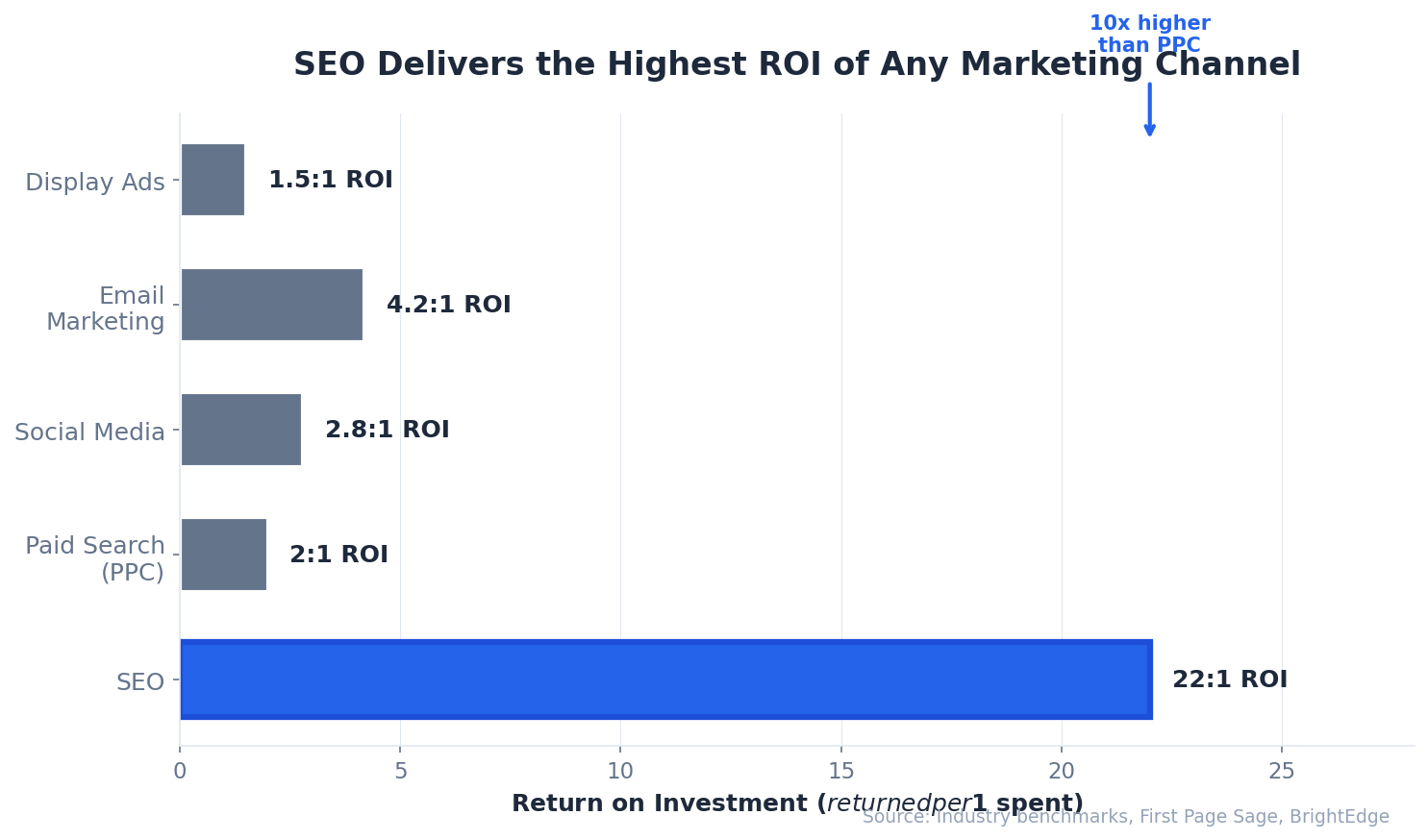
Understanding SEO's return on investment helps justify the time and resources required. Multiple studies demonstrate that organic search delivers superior returns compared to other digital marketing channels.
According to First Page Sage research comparing SEO and PPC, SEO leads convert at significantly higher rates than paid search leads across most industries. In financial services, SEO converts at 7.3 times the rate of PPC. In real estate, 3.5 times. Why? Users trust organic results more than advertisements. They're often further along in their decision-making process when they click through.
Click-through rates for top organic positions underscore this advantage. The first organic position receives an average click-through rate between 27% and 40% depending on the study and SERP layout. The top three organic results capture over two-thirds of all clicks. Paid search ads in top positions? They typically see click-through rates between 2% and 6%. Not even close.
For B2B companies, the case is compelling. HubSpot's research has consistently shown that website, blog, and SEO rank as the number one ROI-driving channel for B2B brands. B2B companies generate twice as much revenue from organic search compared to any other marketing channel. Twice. Search engine marketing (which includes both SEO and paid search) should be the foundation of any digital marketing strategy.
The Rise of Generative Engine Optimization
In recent years, a new concept has emerged: generative engine optimization (GEO). This refers to optimizing content not just for traditional search engines but also for AI-powered search experiences like Google's AI Overviews and ChatGPT.
The good news? The fundamentals remain the same. High-quality, authoritative content that demonstrates E-E-A-T performs well in both traditional search and AI citations. AI systems tend to pull from content that already ranks well organically. Building brand awareness through comprehensive, expert content is a great way to ensure visibility across all search interfaces.
Real-World Examples and Case Studies
DreamBox Learning
DreamBox, an educational technology company, shows what happens when SEO strategy expands beyond branded searches.
The company grew organic search traffic by 733% in just three months. Their approach involved developing a dedicated resource hub for math education, growing from 44 to 183 URLs in their math subdirectory. This expansion into non-branded, educational content captured a much wider audience. Non-branded search eventually accounted for 92% of their total organic traffic. The branded traffic they had before? Still there. They just added a massive new channel on top of it.
Marco's Pizza
The franchise restaurant chain provides a case study in content-driven SEO.
By committing to consistent, high-quality blog content production, Marco's achieved a 2,500% increase in organic traffic within one year. Their strategy centered on publishing 16-20 posts monthly. Volume combined with quality drove exponential growth. Most companies publish 2-4 posts per month and wonder why results are slow. Marco's went all-in. The results speak for themselves.
Frequently Asked Questions
How long does it take to see results from SEO?
Most SEO campaigns begin showing meaningful results within 4-6 months. Significant ROI typically arrives between 6-12 months. The timeline depends on your site's current authority, competitive landscape, and resource investment. Industries with less competition see faster results. Highly competitive niches require more patience. There's no shortcut here.
Is SEO still relevant with the rise of AI search?
Yes. Absolutely.
AI search features like Google's AI Overviews are appearing on more queries. But organic search continues driving the vast majority of website traffic. Research shows AI search currently accounts for less than 1% of referral traffic. Traditional organic search remains the primary traffic and conversion driver. Many AI citations draw from content that already ranks well organically. SEO optimization benefits AI visibility too.
How much should a business invest in SEO?
Investment varies based on company size, industry competition, and goals. Professional SEO services typically range from $1,500 to $5,000+ per month for ongoing campaigns. The appropriate investment depends on the potential value of organic traffic to your business. B2B SaaS companies report average returns exceeding 700% from SEO over a three-year period. The ROI justifies serious investment for most businesses. This is a good place to start when building your digital marketing strategy.
What's the difference between SEO and SEM?
SEO focuses on improving organic, unpaid search visibility. Search engine marketing (SEM) is a broader term that encompasses both SEO and paid search advertising (PPC). SEO requires time to build momentum but generates sustainable search engine traffic without ongoing ad spend. PPC delivers immediate visibility but requires continuous investment. Most comprehensive search strategies use both. They complement each other.
Can I do SEO myself, or do I need to hire an agency?
Many SEO basics can be implemented by anyone willing to learn. Small businesses with limited budgets can achieve meaningful results through consistent content creation, basic technical optimization, and local SEO practices. Competitive industries, complex technical elements, or aggressive growth goals often benefit from professional expertise. The decision depends on available time, technical comfort level, and stakes involved. High-stakes situations usually warrant professional help.


