



Table of contents

Key Takeaways
- Prioritize local search optimization: With 46% of Google searches having local intent and 76% of local mobile searchers visiting a business within 24 hours, your Google My Business profile is your most important digital asset.
- Build systematic review generation: 84% of patients check reviews before choosing providers, and 61% trust online reviews more than personal recommendations—make review acquisition a daily priority.
- Diversify acquisition channels: Rising advertising costs and declining organic reach require spreading investment across SEO, paid search, social media, email, and referral programs.
- Measure patient lifetime value: Understanding that aesthetic clients generate thousands of dollars over their relationship with your practice enables strategic customer acquisition spending.
- Invest in retention alongside acquisition: Patient retention improvements of just 5% can increase profitability by 75%, making loyalty programs and email marketing critical complements to new client acquisition.
- Consider expert guidance for complex strategies: Med spa marketing requires specialized knowledge spanning healthcare compliance, local SEO, and multi-channel coordination—partnering with experienced professionals can accelerate results.
What Is Med Spa Marketing?
Med spa marketing is the promotion of medical aesthetic services to attract, convert, and retain clients seeking treatments like Botox, dermal fillers, laser therapies, and body contouring. These businesses sit at an unusual intersection: part luxury spa, part medical clinic. That dual identity shapes everything about how they need to market themselves.
What makes med spa marketing different from standard healthcare marketing? The elective, cash-pay nature of aesthetic treatments. Patients aren't coming in because they have to. They're coming because they want to. According to the International Society of Aesthetic Plastic Surgery's 2024 Global Survey, aesthetic procedures worldwide reached nearly 38 million in 2024, a 42.5% increase over four years. The American Med Spa Association's 2024 State of the Industry Report documents the U.S. industry growing from 8,899 locations in 2022 to 10,488 in 2023. That's $4 billion in new revenue and over 30,000 new jobs in just one year.
The numbers tell a clear story. The global medical spa market reached $21.21 billion in 2024 and is projected to grow at 15.77% annually through 2033. But growth brings competition. And competition means practices can no longer rely on word-of-mouth alone.
14 Proven Strategies for Med Spa Marketing Success
What actually works for med spa lead generation in 2026? The strategies below address every stage of the client journey, from first Google search to repeat bookings.
1. Optimize your Google Business Profile for local search
Local search is where med spa marketing begins. 46% of all Google searches have local intent, and 76% of people who search locally on their phone visit a business within 24 hours. Miss the local pack, miss the patient.
The Google 3-Pack (the top three local results shown with a map) secures the top local rank 93% of the time. Healthcare providers appearing there average a 183% increase in listing views. To get there: keep your Name, Address, and Phone number consistent across all directories. Upload professional photos. List every service with detailed descriptions. And actively collect and respond to reviews.
2. Build a review acquisition system
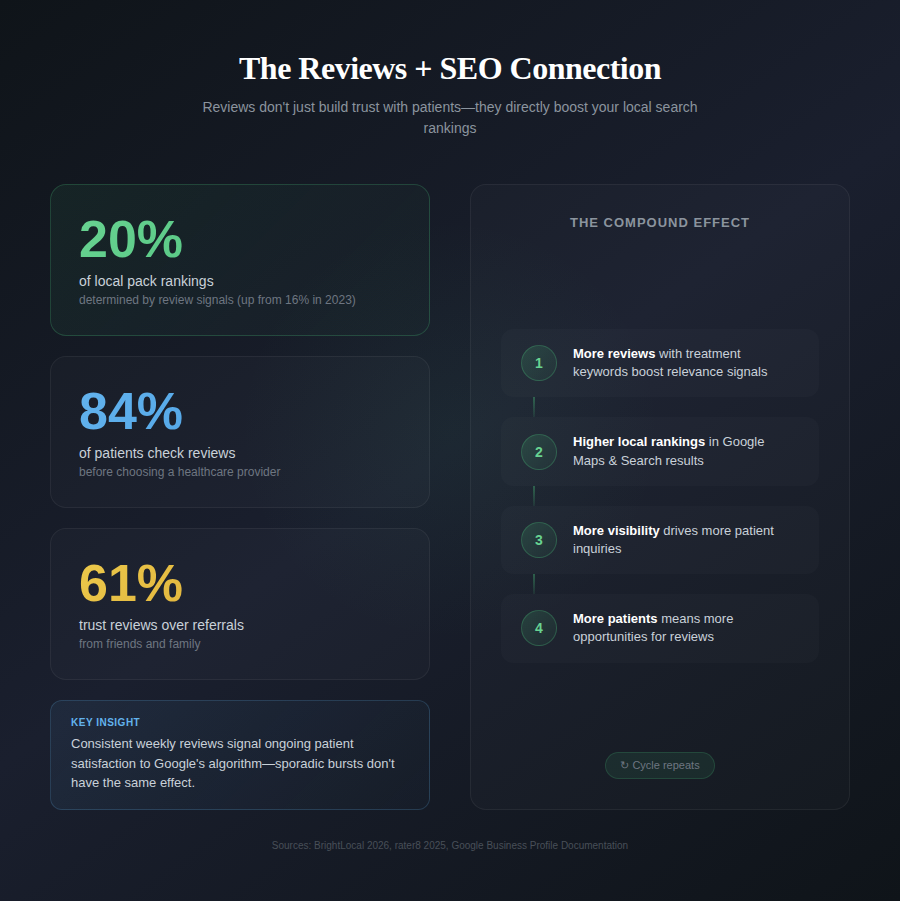
Reviews aren't optional anymore. They're the primary decision-making factor for prospective clients. According to rater8's 2025 report, 84% of patients check online reviews before choosing a healthcare provider. And here's the kicker: 61% trust online reviews more than referrals from friends and family.
The downside risk is real. 40% of patients have canceled or avoided an appointment based on negative reviews, even when people they know recommended the practice. So what works? Automated post-treatment email requests. Front desk staff trained to mention reviews at checkout. Prompt responses to all feedback (provider responses increase trust by 42%).
3. Get search engine optimization right
SEO for med spas goes well beyond stuffing "Botox near me" into page titles. Search engines deliver 350% more website traffic than social media for healthcare websites. The average conversion rate? 5.6% for organic search in healthcare, which beats most paid channels.
What does good med spa SEO actually require? Service pages for each treatment. Location-specific content targeting your geographic market. Educational blog content that builds topical authority. And technical fundamentals like mobile responsiveness and fast page loads. Worth noting: AI-generated answers appear for only 17% of healthcare queries. Traditional SEO still dominates.
4. Use paid search advertising
Google Ads still works for med spa lead generation. Businesses earn roughly $8 in profit for every $1 spent on combined search and display advertising. Healthcare conversion rates average 11% for physicians and surgeons.
But there's a catch. Cost-per-click for healthcare keywords jumped 40-60% between 2022 and 2025. Cosmetic treatment terms routinely exceed $45 per click in competitive markets. The fix? Structure campaigns around specific services. Build landing pages matched to each ad group. And track actual appointment bookings, not just clicks.
5. Develop a social media content strategy
Social media matters for med spas, but maybe not the way you'd expect. 41% of consumers use social media to choose doctors or hospitals. For med spas specifically, visual platforms win. Instagram carousels outperform both Reels and static photos for healthcare organizations. Focus on before-and-after content, educational posts, and staff introductions that let potential clients see the humans behind the practice.
6. Set up email marketing automation
Email remains one of the highest-ROI channels available. $36 return for every $1 invested. Healthcare email campaigns see open rates around 41%, well above most industries.
What should those automated sequences include? Appointment reminders (they reduce no-shows). Post-treatment follow-ups with aftercare instructions. Birthday specials. Treatment series reminders for clients who started packages but haven't finished. Seasonal promotions timed to popular treatment windows. And if you're creating video content, put it in your emails: healthcare emails with video see up to 300% higher click-through rates.
7. Create high-converting landing pages
Generic homepages kill paid ad performance. Dedicated landing pages fix that. One med spa case study showed conversion rates jumping from 1.3% to 2.74% through A/B testing and landing page optimization with Performance Max campaigns. That's a 125% increase in leads on similar ad spend.
What makes a landing page convert? A headline that addresses the visitor's actual concern. Concise benefit statements. Social proof (reviews, before-afters). A prominent call-to-action. And minimal navigation so visitors don't wander off. Build separate landing pages for each major service instead of sending all traffic to your homepage.
8. Set up a referral program
Referrals convert better than any other channel. 7.2% conversion rate in healthcare, beating organic search, paid ads, and social media. A study on word-of-mouth in healthcare found that 84% of patients used recommendations from other patients when searching for a provider.
Structure your program with incentives for both sides: the referrer and the new client. Treatment credits work. So do complimentary add-on services or early access to new treatments. Track which clients generate the most valuable referrals. Those relationships are worth nurturing.
9. Invest in professional video content
85% of healthcare marketers now use video. For med spas, video does things photos can't: it shows treatment processes, shows results over time, and builds the personal connection that makes someone comfortable trusting you with their face. Educational explainers, virtual facility tours, provider introductions, and client testimonials with documented before-and-afters all perform well.
10. Develop a content marketing strategy
Content builds authority and pulls in organic traffic. 72% of healthcare marketers rank content creation as their best SEO approach. Long-form posts generate 56% more social shares than shorter content.
What should you actually write? Guides on popular treatments. Comparison content that helps readers weigh options. Seasonal pieces (pre-summer body contouring, fall skin renewal). FAQ content targeting voice search. Each piece needs to show expertise through authoritative sourcing and genuine clinical knowledge.
11. Use retargeting campaigns
Most website visitors don't book on their first visit. Retargeting keeps your practice visible while they're thinking it over. Full-funnel strategies that follow patients across their decision journey work best for aesthetic services.
Set up pixel-based retargeting on Facebook, Instagram, and Google Display Network. Segment audiences by the pages they visited. Someone who looked at Botox should see different ads than someone exploring body contouring. Use sequential messaging that addresses common objections and builds trust over multiple touchpoints.
12. Build local partnerships
Local business partnerships extend reach without advertising costs. High-end salons, fitness studios, bridal boutiques, luxury retailers: any business whose clientele overlaps with yours is a potential partner. Joint events, shared offers, and mutual referral agreements all work.
13. Start membership and loyalty programs
Memberships create predictable recurring revenue and improve retention at the same time. Include monthly service credits, member-only pricing, priority booking, and complimentary consultations. A 5% increase in patient retention can boost profitability by 75%. Tiered membership levels encourage clients to progress to higher spending over time.
14. Track and optimize marketing performance
Without tracking, you can't tell what's working. Digital advertising campaigns deliver 3-5x ROI when properly optimized. Content marketing typically returns 2-4x.
What to track: call tracking to attribute phone inquiries to specific campaigns, UTM parameters on all links, conversion paths from first touch to booked appointment, and patient acquisition cost by channel. Most med spas see patient acquisition costs between $250 and $500. Knowing your cost per acquisition by channel tells you where to put your budget.
Marketing channel comparison for med spas
| Channel | Avg. Conversion Rate | Relative Cost | Best For |
|---|---|---|---|
| Referral | 7.2% | Low | High-trust conversions |
| Organic Search (SEO) | 5.6% | Medium | Long-term visibility |
| Google Ads | 6.4% avg CTR | High | Immediate lead generation |
| Email Marketing | 2.6% conversion | Low | Retention and reactivation |
| Social Organic | 3.0% | Low | Brand building |
| Social Paid | Varies | Medium-High | Awareness and retargeting |

Evaluating in-house vs. agency marketing
Should you hire internally or work with an agency? Both have tradeoffs.
In-house gives you direct control over messaging and timing, deeper knowledge of your specific patient demographics, and lower ongoing costs once systems are running. But it pulls staff time away from patient care, limits your access to specialized tools and benchmarks, and makes it harder to stay current with platforms that change constantly.
Common Misconceptions
Misconception 1: Social media followers equal revenue
A big following feels like success. But follower counts don't correlate with booked appointments. Engagement rates have dropped across most industries, with Health & Beauty showing near-zero engagement on platforms like X/Twitter. What matters is engagement quality and conversion metrics, not vanity numbers.
Misconception 2: Discounting drives long-term growth
Heavy discounts attract price-sensitive clients. Those clients rarely convert to full-price services or become loyal patients. Marketing budgets across the aesthetic industry range from 2% to 15% of revenue. Spending those dollars on brand-building and reputation management delivers more sustainable growth than constant promotions that erode perceived value.
Misconception 3: Online marketing replaces patient experience
No marketing strategy compensates for poor clinical experiences. 45% of patients value providers who actively respond to reviews, but that only matters if the underlying experience generates positive feedback. Marketing amplifies what already exists. Get the experience right first.
The Hidden Connection Between Reviews and SEO
Most med spa owners treat reviews and SEO as separate initiatives. They're not. Review signals directly influence local search rankings. The result is a compound effect that either accelerates growth or undermines it.
According to BrightLocal's 2026 Local Search Ranking Factors study, reviews now account for 20% of local pack rankings, up from 16% in 2023. Google's algorithm weighs review quantity, recency, sentiment, and whether businesses respond to feedback. Google's own documentation confirms that reviews and ratings help determine local ranking as part of measuring business prominence.
The practical implication? Consistent review generation (new reviews weekly, not sporadic bursts) signals ongoing patient satisfaction to algorithms. And when reviews naturally mention specific treatments and locations, they contribute keyword relevance on top of social proof. A good review strategy builds trust with human readers. It also improves search visibility.
Why Patient Acquisition Costs Have Increased (and What to Do About It)
Patient acquisition costs in aesthetics have climbed. A lot. According to the Gartner 2025 CMO Spend Survey, 59% of CMOs report insufficient budget to execute their strategy, with healthcare among the industries seeing the smallest marketing budgets relative to revenue. Meanwhile, patient acquisition costs rose roughly 56% since 2022, driven by competition for digital ad inventory and declining social conversion rates.
The answer isn't just spending more. Practices achieving sustainable growth take a different approach: they diversify channels, invest in retention to maximize lifetime value, build owned assets like email lists and content libraries, and develop referral infrastructure that turns satisfied clients into acquisition sources.
Understanding lifetime value matters here. If a cosmetic patient generates $15,000 over their relationship with your practice, spending $2,000 on acquisition makes sense. Practices that calculate these metrics can bid more aggressively for high-value prospects. Competitors who don't know their numbers end up retreating from channels they could actually afford.
Real-World Examples and Case Studies
LaserSkin MedSpa: Integrated digital transformation
A Philadelphia-area med spa partnered with a digital marketing agency for a full overhaul. They rebuilt the website for conversions, started consistent blog publishing, and put solid SEO practices in place. The results: their Google Business Profile hit 410 monthly interactions, including 270 direct website clicks. Searches like "laser treatments near me" and "best botox in Philadelphia" consistently placed them in the top 3 Google Maps positions. They accumulated over 144 positive reviews, which boosted both credibility and local rankings.
Radiant A MedSpa: Local SEO dominance
A Naperville, Illinois med spa focused on local search optimization. After putting a custom SEO strategy in place, they saw a 12x increase in business impressions on Google Maps and Search. Website users grew to nearly 5x the original base. Geogrid analysis showed they'd secured the top position for key local keywords, capturing nearly 100% of local voice share in their market.
Frequently Asked Questions
What percentage of revenue should a med spa spend on marketing?
According to the American Med Spa Association's 2024 report, the average is about 7% of revenue. But the range is wide: 2% to 15% depending on growth goals, competition, and market maturity. Startups typically invest 10-15%. Established practices with steady patient flow often allocate 5-8%.
How long does SEO take to show results for a med spa?
Expect 4-6 months for meaningful ranking improvements. Full results typically materialize over 12-18 months. Local SEO (especially Google Business Profile optimization) often produces faster wins. The investment compounds: established practices eventually enjoy sustainable organic traffic that reduces paid advertising dependence.
Which social media platform works best for med spa marketing?
Instagram delivers the strongest results for most med spas. Its visual nature fits before-and-after content naturally. Carousels generate the highest engagement for healthcare organizations. Facebook still works for community building and reaching audiences over 35. TikTok is growing among younger consumers exploring aesthetic treatments.
How can med spas generate more online reviews?
Build review requests into your post-treatment workflow. Send automated email or SMS requests within 24-48 hours. Train staff to mention reviews at checkout. Make leaving a review simple with direct links. And respond to feedback promptly: 45% of patients value providers who actively engage with reviews.
What is the average patient acquisition cost for a med spa?
Most med spas see costs between $250 and $500, though this varies by market and channel mix. Practices with strong organic presence and active referral programs can get below $150 when using medical spa marketing strategies. Heavy reliance on competitive paid search in major markets can push costs above $500 per new patient.


