



Table of contents
Key Takeaways
- Graphic design subscription services offer predictable costs and scalable creative capacity, with monthly investments ranging from $500 to $5,000+ depending on service level and provider.
- "Unlimited" describes request volume, not output speed. Evaluate providers based on actual turnaround times, revision policies, and complete project delivery metrics.
- Dedicated designer assignment significantly improves consistency and efficiency for brands with established visual systems. Premium tiers often justify their cost through reduced brief time and fewer revisions.
- Match provider strengths to organizational needs: budget-focused teams benefit from services like Penji or ManyPixels, while enterprises requiring comprehensive creative support should evaluate Superside or Design Pickle's premium offerings.
- Organizations with complex or strategic creative needs should consider professional consultation to optimize the balance between subscription services, agency partnerships, and in-house resources.
What Is a Graphic Design Subscription Service?
A graphic design subscription service—sometimes called design-as-a-service—flips the traditional agency model on its head. Instead of per-project billing or hourly freelance rates, you pay a flat monthly rate for access to a team of designers. The promise? Predictable costs and theoretically unlimited graphic design output.
This model has exploded in popularity. McKinsey & Company found that subscription-based businesses grew more than 300 percent from 2012 to 2018, roughly five times faster than S&P 500 revenues. The trend has since spread well beyond Netflix and Spotify into professional services, creative design included. McKinsey's research also shows these models can achieve two to five times higher customer lifetime value compared to traditional transactional businesses.
Here's how the design process typically works. You submit a design brief through the provider's platform. They match you with a designer based on your specific needs. You get a draft in 24 to 48 hours. Don't like it? Request revisions until you do. Most services use a queue system where design requests are completed one at a time, though premium tiers sometimes offer parallel processing or a dedicated design team.
The math makes sense for mid-market and enterprise buyers. The U.S. Bureau of Labour Statistics puts the median graphic designer salary at $61,300 as of May 2024. Factor in benefits, software licenses, equipment, and overhead, and you're looking at $80,000 to $100,000 annually for one full-time hire. A $500 to $1,500 monthly subscription plan delivers consistent design capacity at a fraction of that cost.
That said, most small business owners don't actually need these services. Canva and similar tools handle 80% of basic design needs. Unlimited graphic design services make sense when you're producing enough volume that DIY becomes a bottleneck, or when brand identity consistency matters enough to justify professional execution.
The 8 Best Graphic Design Subscription Services Compared
Not all unlimited design services are created equal. Pricing structures differ. Turnaround times vary. Some specialize in motion graphics and video design; others won't touch video at all. The comparison below breaks down the leading providers across the metrics that actually matter for ongoing design needs.
| Service | Starting Price | Turnaround | Best For | Key Differentiator | Limitations |
|---|---|---|---|---|---|
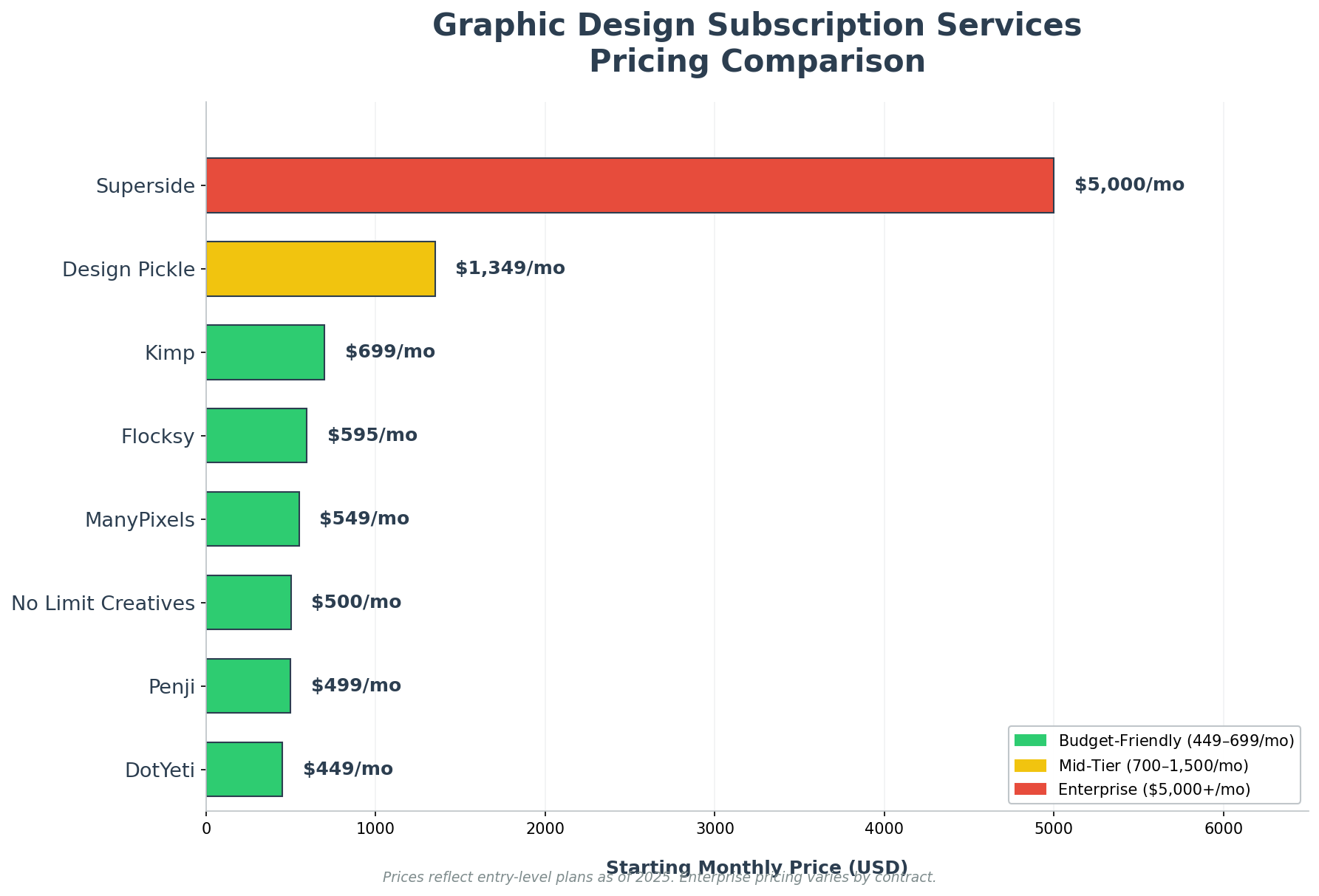
| Design Pickle | $1,349/mo | 24-48 hours | High-volume enterprises | Motion graphics, Slack integration | No web/UX design |
| Penji | $499/mo | 24-48 hours | SMBs, startups | 120+ design categories | Entry plan excludes website design |
| ManyPixels | $549/mo | 1-2 days | Budget-conscious teams | Free illustration library | No real-time communication on lower tiers |
| Kimp | $699/mo | 24-48 hours | Video + graphic needs | Combined graphics and video design services | Uses Trello workflow |
| Flocksy | $595/mo | 24-48 hours | Full-service creative needs | Includes copywriting, voiceover, web dev | Quality can vary across teams |
| Superside | $5,000+/mo | 12-24 hours | Enterprise creative teams | AI-enhanced, strategic design partner model | High minimum commitment |
| DotYeti | $449/mo | 1-2 days | Growing businesses | Boutique agency experience | Limited active requests |
| No Limit Creatives | $500/mo | Same day | E-commerce, social-first brands | Layered pricing by service type | Base plan limited to social graphics |
1. Design Pickle
Design Pickle essentially invented this category. Russ Perry founded the company in 2015, and it remains one of the largest players with over three million graphic design requests completed. Their client roster includes UPS, RE/MAX, and CrossFit.
This is the best design subscription to beat for enterprises with serious design volume. Pricing starts at $1,349/month for the Graphics Pro plan, which covers graphic design, illustrations, and fast turnaround within 24 hours. Step up to Graphics Premium at $2,049/month and you add motion graphics, video editing, and Slack integration. Enterprise buyers can negotiate custom Power Plans with a dedicated account manager.
The real draw is operational maturity. Design Pickle has spent nearly a decade refining their workflow, and it shows. You get a dedicated designer who learns your visual identity, a platform that integrates with tools teams already use, and motion graphics capability that most competitors lack. The company publishes case studies from recognizable brands—not just logos on a website, but actual documented implementations.
The trade-off is price. At $1,349/month minimum, Design Pickle costs nearly triple what budget competitors charge. And if you need website design or UI design, look elsewhere. It's not on the menu.
For high-volume marketing teams at established companies, Design Pickle is the safest choice. For startups watching every dollar, the premium isn't justified.
2. Penji
Penji targets startups and SMBs who need professional design without enterprise budgets. The company claims to hire only the top two percent of designer applicants and offers over 120 design categories—everything from marketing materials to print design to business cards.
At $499/month, the Pro plan handles one design project at a time across most design types. The Team plan ($699/month) bumps that to two simultaneous design projects and adds website design. Agencies can negotiate custom pricing with a creative director and strategy calls.
What sets Penji apart: competitive entry pricing, a 30-day money-back guarantee (one of the longest in the industry), and a point-and-click revision tool that makes feedback precise. The revision tool alone saves significant back-and-forth compared to describing changes over email.
Fair warning: the $499 plan excludes website and app design, and there's no real-time designer communication on any tier. If you need to hop on a quick call to explain something visual, that's not how Penji works.
3. ManyPixels
Founded in 2018, ManyPixels has quietly built a solid reputation. Over 150,000 designs delivered. More than 3,000 customers. A 4.8-star Trustpilot rating. The team of designers operates remotely across Southeast Asia and Eastern Europe, which keeps pricing competitive.
Three tiers: Advanced at $549/month for one daily output, Business at $999/month for two daily outputs plus motion graphics, and Dedicated Designer at $1,299/month for same-day delivery with real-time collaboration and a dedicated project manager.
ManyPixels earns points for transparency. They're upfront about what they don't do—no audio editing, no UI design, no coding—and they include a free illustration library that's genuinely useful. Lower-tier plans rotate designers rather than assigning dedicated ones, and Slack communication requires the top plan. You also get full rights to all completed work.
4. Kimp
Kimp separates graphic design and video editing into distinct subscriptions. Graphics runs $699/month, Video costs $799/month, and the bundle is $1,195/month. All plans include unlimited design requests and revisions.
The scope is unusually broad—vehicle wraps, mascot design, animated GIFs all fall within bounds. Kimp frequently offers 50% off the first four months. A project manager handles your design tasks through Trello, which works great if you're already using it and adds friction if you're not.
5. Flocksy
Flocksy isn't just design. It's copywriting, video editing, voiceover, and web development bundled into one subscription. Silver ($595/month) covers design and illustrations. Gold ($995/month) adds copywriting and video. Platinum is custom-priced for everything.
The appeal is obvious: one vendor acting as a complete design partner for multiple creative needs. The complexity is real too. Separate teams handle different services, which can create workflow friction when design projects span categories. Quality consistency gets mixed reviews.
6. Superside
Skip this unless the budget allows $5,000/month minimum.
Superside operates as an enterprise creative partner, not a budget design service. Clients include Shopify, Salesforce, and Amazon Pharmacy. Pricing scales to $100,000/month for large enterprises.
What justifies that price? 24/7 timezone coverage. Strategic marketing support beyond execution. Capabilities extending into 3D, AR/VR, and product design. AI-enhanced workflows. Compared to traditional design agencies, Superside functions as an extension of the internal design team. For everyone else, it's out of reach.
7. DotYeti
DotYeti is the boutique option. Founded in 2020 in Singapore, the company emphasizes personalized service over volume. Basic plan costs $449/month for one active request with 2-day delivery. Premium ($999/month) allows two active requests.
Strong reputation for design quality. Month-to-month flexibility. Limited throughput—only one or two active graphic design requests even on expensive plans.
8. No Limit Creatives
No Limit Creatives uses à la carte pricing. The Growth plan ($500/month) covers social media graphics and videos only. Logos, print design, and website work require higher tiers.
Turnaround is fast—same-day or next-day. For brands focused purely on social content, the model works. The risk: pricing gets confusing as you add categories, and most businesses outgrow the base plan quickly.
Common Misconceptions About Unlimited Design Services
Misconception 1: "Unlimited" means instant and endless output
It doesn't. "Unlimited" refers to how many design requests you can submit, not how much work gets produced. Most services assign one designer who completes design tasks sequentially. Realistically, expect 10 to 30 finished designs per month depending on complexity.
That's still significant value. But if you're expecting to replace an entire in-house design team's output with a single subscription, recalibrate those expectations.
Misconception 2: Quality is consistent across providers
Far from it. Some services employ hundreds of designers with widely varying experience levels—that's how they keep prices low. Others, like a traditional graphic design agency, maintain smaller, more selective teams. User reviews repeatedly flag quality inconsistency as a concern, especially at lower price points.
Before committing, dig into portfolios. Read detailed reviews, not just star ratings. Ask for sample work in your industry.
Misconception 3: These services can replace all creative functions
Subscription services excel at production work: social graphics, marketing materials, presentation decks, brand asset variations. They're built for volume and speed.
Strategic brand identity development? Complex UX research? Interactive design requiring technical depth? That's not what these services do. Smart buyers treat subscription design as a complement to strategic creative resources, not a replacement.
Does Turnaround Time Matter More Than "Unlimited" Claims?
Yes. Marketing teams fixate on the "unlimited" promise when they should focus on turnaround time—specifically, how long from brief submission to approved final asset.
McKinsey research on subscription services found that nearly 40 percent of subscribers cancel due to poor experience delivery. Not pricing. Experience. For graphic design services, experience means fast turnaround and quality consistency.
A provider promising 48-hour turnaround with clean first drafts beats one claiming same-day delivery but requiring three revision rounds. Track the full cycle, not just initial response time.
Revision policies matter here too. Services offering truly unlimited revisions incentivize designers to nail it on the first pass. Services with hidden revision caps? Designers may rush initial outputs knowing you'll iterate anyway. Understanding the accountability structure reveals more about actual speed than any marketing claim.
Dedicated Designers Are Worth the Premium
Most budget-tier subscriptions rotate your work among available designers. Premium plans assign someone dedicated who works exclusively with you. That distinction matters more than it might seem.
McKinsey's subscription research confirms what's intuitive: personalization drives higher retention and satisfaction.
Think about what a dedicated designer accumulates over time. Brand guidelines, yes. But also stakeholder preferences. Project history. Context about what worked and what didn't. That institutional knowledge pays dividends through shorter briefs, fewer revisions, and output that improves month over month.
The feedback loop matters too. Constructive criticism given to the same designer compounds into better performance. Criticism given to a rotating cast? Lost the moment someone new picks up your next request.
For brands with established visual identity systems and high content volume, dedicated designer assignment often justifies premium pricing within 60 to 90 days through efficiency gains alone.
Real-World Examples and Case Studies
Cox Communications
Cox Communications—the third-largest cable TV provider in the U.S.—needed to scale creative output without scaling headcount. Two internal teams adopted Design Pickle's subscription model.
The result, according to Design Pickle's published case study: "on-brand quality creative fast and within budget." Cox used the service for marketing materials production, the exact use case where subscription models shine. High volume. Established brand guidelines. Consistent asset types. The subscription model fit because Cox wasn't asking for strategic creative work—they needed reliable execution against existing templates and standards.
This is the pattern that works. Subscription design as production support for mature brand systems, not as a replacement for creative strategy.
When subscription design fails
The failure cases rarely get published, but they follow a pattern. A company signs up expecting agency-level strategic thinking. They submit vague briefs hoping the designer will "figure it out." Revisions pile up because the vision was never clear. Three months later, they cancel and blame the service.
Subscription design requires clear direction. These services execute well; they don't ideate well. Companies that succeed with the model already know what they want—they just need someone to build it.
Frequently Asked Questions
How many designs can I actually get per month with an unlimited subscription?
Expect 10 to 30 completed designs monthly on standard plans. Simple social graphics might arrive same-day. Complex design projects like multi-page presentations take longer. Premium tiers increase throughput, but no subscription delivers truly unlimited output.
Are graphic design subscription services suitable for enterprise organizations?
Yes, though enterprises typically need premium-tier services like Design Pickle's Power Plans or Superside's custom subscriptions. The model works best as production support for established brand systems rather than primary creative development. Evaluate security practices, onboarding processes, and confidentiality handling before committing. Some enterprises run pilots with a single department before expanding—a reasonable approach given the workflow changes involved.
What types of design work are typically excluded from unlimited subscriptions?
Most providers exclude 3D modelling and animation (Superside is an exception), interactive web development and coding, UX research and user testing, photography and video production (editing is often included, production isn't), and complex illustration requiring specialized artistic styles. Exclusions vary significantly—review scope documents carefully.
Can I cancel my subscription at any time?
Yes, usually. Most services operate month-to-month without long-term contracts. Penji, ManyPixels, and Flocksy offer money-back guarantees ranging from 14 to 30 days. Quarterly or annual commitments come with discounts but may carry early termination restrictions.
How do design subscription services compare to hiring a full-time designer?
A mid-tier subscription plan runs $6,000 to $18,000 annually. A full-time graphic designer costs $60,000 to $100,000 or more when you factor in salary, benefits, software, and overhead. Subscriptions offer flexibility and eliminate HR responsibilities but may lack strategic depth and institutional knowledge. Many organizations combine subscriptions for production volume with in-house or agency resources for strategic work. The hybrid model often delivers better results than going all-in on either approach.


