



Table of contents
Key Takeaways
- A structured design workflow with clearly defined stages reduces revision cycles, improves quality, and accelerates delivery.
- Comprehensive creative briefs prevent the communication failures that contribute to project setbacks one-third of the time, making thorough briefing among the highest-ROI investments in any design engagement.
- Research and discovery phases generate insights that compound throughout subsequent stages, with evidence indicating that user-informed design delivers 25% higher probability of meeting business objectives.
- Iteration and testing consistently produce outcomes that justify development investment through superior market performance and user satisfaction.
- Organizations seeking to maximize design impact should consider partnering with agencies that apply systematic methodology and evidence-based creative development to every engagement.
What Is the Graphic Design Process?
The graphic design process is a structured methodology that transforms client requirements into a polished final product. Professional designers follow a systematic graphic design workflow that moves through clearly defined stages, from initial brief to final delivery. Consistency improves. Costly revisions drop. And outcomes align precisely with business objectives.
Research from the Design Research Society positions the graphic design process steps as systematic problem-solving, comparable to methodologies used in engineering and industrial design. Design functions as a disciplined creative process with measurable, repeatable outcomes.
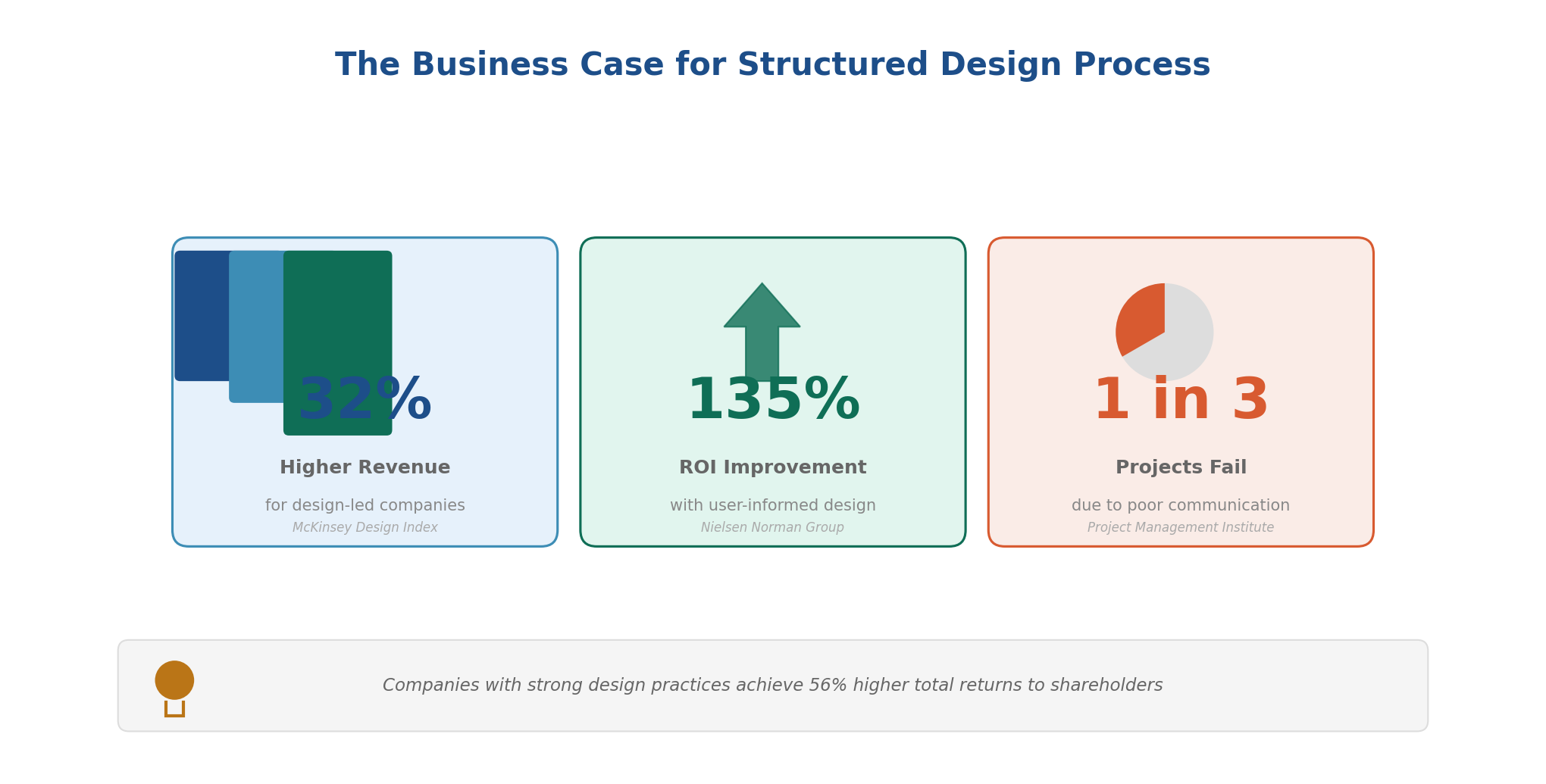
For mid-market and enterprise businesses, understanding this structured design process matters. A McKinsey study tracking 300 publicly listed companies found that organizations with strong design practices achieved 32% higher revenue growth and 56% greater total returns to shareholders compared to industry counterparts. Marketing leaders and business executives who grasp these design project steps gain a measurable competitive edge.
The 7 Essential Steps in the Graphic Design Process
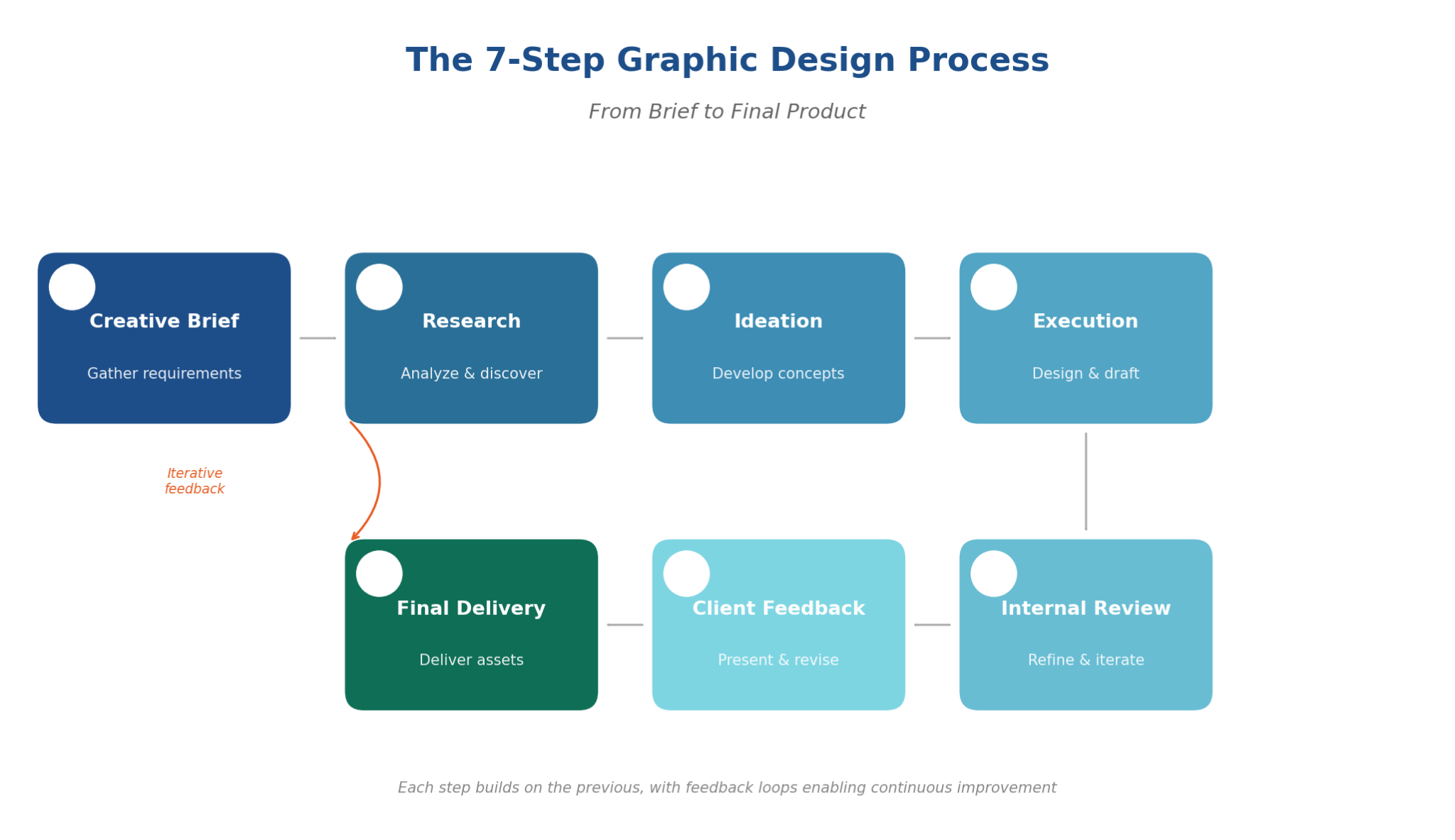
Every successful design project follows a logical progression balancing creative exploration with business discipline. Individual designers adapt this framework to specific contexts, but these seven stages represent the core graphic design workflow used by leading agencies and in-house teams worldwide. Let's take a closer look at each phase of the entire process.
Step 1: Receiving and Analyzing the Creative Brief
The first step in any graphic design workflow is receiving and analyzing the creative brief. This document captures project goals, target audience characteristics, brand guidelines, deliverable specifications, timeline, and budget parameters. A comprehensive brief eliminates ambiguity and establishes shared expectations between client and graphic designer from day one.
Briefing quality directly correlates with project outcomes. Research from the Project Management Institute reveals that ineffective communications contribute to project failure one-third of the time, with poor communication putting $75 million at risk for every $1 billion spent on projects.
Key elements of an effective design brief:
| Brief Component | What to Include | Why It Matters |
|---|---|---|
| Project objectives | Specific, measurable goals | Provides success criteria for evaluation |
| Target audience | Demographics, psychographics, behaviours | Guides visual language and messaging decisions |
| Brand guidelines | Colours, typography, voice, existing assets | Ensures visual consistency |
| Deliverables | Format, dimensions, quantity | Clarifies scope and prevents feature creep |
| Timeline | Key milestones and final deadline | Enables resource planning |
| Budget | Approved investment amount | Sets parameters for production quality |
What happens when the brief is thorough? Revision cycles shrink because expectations are clear from the start. Project scoping becomes accurate. Accountability improves. Client-designer collaboration runs smoother.
And when the brief falls short? Misaligned deliverables require extensive rework. Timelines stretch. Costs balloon. Friction builds between team members, and the final designs miss their business objectives entirely.
Step 2: Research and Discovery
The next step transforms assumptions into evidence through initial research.
This phase involves investigating the competitive landscape, studying the target audience, exploring industry trends, and gathering inspiration. Designers who invest time here produce work that resonates with audiences and differentiates brands in crowded markets.
Market research reveals opportunities for visual differentiation. Audience research uncovers preferences, pain points, and communication styles. Trend analysis identifies emerging aesthetic directions while flagging dated approaches. This evidence-based foundation ensures design decisions serve strategic objectives.
According to research published in academic design literature, approximately 94% of first impressions are design-related. Users form judgments about websites within just 50 milliseconds. Research ensures those critical first impressions align with brand positioning and audience expectations.
The ultimate goal of this phase is to gather the kind of information that prevents costly pivots later in the entire project.
Step 3: Concept Development and Ideation
This is where most projects go wrong.
Designers often rush past ideation to start executing. Big mistake. The concept phase deserves more time than it typically gets, because weak concepts can't be rescued by strong execution. A mediocre idea rendered beautifully is still mediocre.
With research complete, designers move into active ideation. This divergent thinking phase generates multiple design ideas before narrowing to the strongest options. Time to brainstorm freely: mind mapping, mood boards, rapid sketching. The goal is exploring possibilities, not polishing premature solutions.
The Stanford d.school's design thinking methodology emphasizes pushing for the widest possible range of ideas rather than seeking a single solution immediately. This approach prevents premature convergence on obvious solutions and unlocks innovative possibilities. The best way to generate breakthrough concepts is to defer judgment until after the ideation session ends.
Effective concept development produces three to five distinct directions. Each represents a viable approach to the brief's challenges. Visual style varies. Emotional tone shifts. Strategic emphasis differs. Stakeholders get meaningful choices rather than minor variations on a single theme.
Step 4: Design Execution and Drafting
Now the real craft begins. Selected concepts move into full execution, where designers apply typography, color schemes, imagery, and layout principles to create polished drafts.
Technical proficiency across design software matters here. So does restraint. The temptation to over-design is constant, especially when deadlines feel distant. Experienced designers know that the strongest executions often involve removing elements rather than adding them.
File formats must suit intended applications (a billboard and a business card have very different requirements). Color systems must accommodate both digital and print reproduction, which is trickier than it sounds since RGB and CMYK render colours differently across various platforms. Typography must remain legible across sizes and contexts.
During execution, designers continuously reference the original brief and research findings. Each design decision connects to documented strategy. Aesthetic drift happens easily when teams get deep into production mode, and the brief serves as the anchor that keeps final deliverables focused on business purposes.
Step 5: Internal Review and Refinement
Most agencies treat internal review as a checkbox. That's a missed opportunity.
Before presenting work externally, design teams should conduct rigorous internal reviews where team members evaluate work against brief requirements, technical standards, and brand guidelines. Fresh perspectives catch design issues that working designers overlook after staring at the same layouts for days. This step separates good agencies from great ones.
Internal review protocols examine designs from multiple angles and different perspectives: strategic alignment with brief objectives, visual consistency with brand systems, technical soundness for intended applications, and accessibility for diverse audiences. The accessibility check is often skipped, which creates real problems when designs fail WCAG contrast requirements or render poorly for colorblind users.
Industry data indicates that 62% of clients request at least three rounds of revisions for design projects. Rigorous internal review decreases this burden by resolving obvious issues before external presentation.
Step 6: Client Presentation and Feedback Integration
Presenting work effectively is itself a design discipline.
Successful presentations contextualize creative choices and connect visual decisions to strategic rationale documented in the brief. Design becomes problem-solving rather than decoration. Clients who understand why a design works are far more likely to approve it. The goal is giving stakeholders a clear picture of how each concept addresses their objectives.
Client feedback requires skilled interpretation. Surface-level comments like "make it pop" or "can we try it in blue?" often signal deeper concerns about visual hierarchy, brand fit, or audience appropriateness. Experienced designers probe beneath stated feedback to understand underlying objectives. Sometimes "I don't like it" really means "this doesn't feel like our brand," which is a completely different problem to solve.
Constructive feedback integration follows structured processes. Requested changes get documented, prioritized, and implemented systematically. Major strategic redirections return to earlier process stages, while refinement-level feedback proceeds directly to execution adjustments. A great way to manage this phase is creating a feedback template that captures specific, actionable comments rather than vague reactions.
Step 7: Final Delivery and Asset Management
Project completion involves preparing final deliverables across required formats and specifications. High-resolution production files, web-optimized exports, and editable source documents each serve different downstream needs. Comprehensive delivery packages enable future applications without designer involvement.
Here's something most process guides won't mention: file naming conventions matter enormously. Deliverables named "final_v3_FINAL_revised.ai" create chaos for everyone downstream. Professional delivery uses systematic naming (ClientName_ProjectName_AssetType_Date) that makes assets findable months or years later.
Professional delivery also includes documentation: style guides capturing color values and typography specifications, usage guidelines explaining appropriate applications, and file organization systems enabling efficient retrieval. This documentation increases brand visibility and consistency across all future touchpoints.
Post-delivery relationship management maintains client connections for future projects. Brief project retrospectives identify necessary changes to the process. Satisfaction follow-ups gather testimonials and referral opportunities. Single projects transform into ongoing partnerships.
Common Misconceptions
Misconception 1: Great Design Comes from Unbridled Creativity
Many assume exceptional design emerges from unconstrained creative freedom. The opposite tends to be true. The most impactful design work occurs within strategic constraints. Briefs, brand guidelines, and audience requirements provide boundaries that focus creative energy productively.
The McKinsey Design Index study found that top-performing companies treat design with analytical rigour, measuring and managing it like any business function. Organizations where design decisions rely purely on intuition underperform those applying systematic methodology.
Misconception 2: More Revisions Lead to Better Results
Extended revision cycles seem to indicate thorough refinement. But excessive revisions often signal fundamental misalignments that should have been resolved during briefing or concept phases. Research from the Nielsen Norman Group demonstrates that usability improvements follow diminishing returns. Initial iterations capture most value, with subsequent rounds producing progressively smaller gains.
The solution? Front-load effort into early process stages. Comprehensive briefing, thorough research, and robust concept development reduce later revisions while improving final quality.
Misconception 3: Design Process Stifles Innovation
Some fear that structured methodologies constrain breakthrough creativity. Evidence contradicts this assumption. Stanford's design thinking research demonstrates that innovation emerges from disciplined processes alternating between divergent exploration and convergent refinement. That's precisely the structure embedded in professional design workflow.
Process provides scaffolding for innovation. The iterative process separates idea generation from evaluation, ensuring promising concepts receive full exploration before premature dismissal.
Why Skipping Discovery Costs More Than It Saves
Organizations frequently pressure designers to accelerate timelines by reducing research phases. This short-term efficiency creates long-term costs. Without adequate discovery, designers make assumptions that may diverge from audience needs and market realities.
The financial impact is substantial.
Companies that incorporate user insights during development see a 135% improvement in ROI according to Nielsen Norman Group research. The Project Management Institute reports that inadequate requirements gathering (a direct consequence of compressed discovery) contributes to project failure rates approaching one-third.
Time invested in discovery compounds throughout subsequent stages. Research-informed concepts require fewer revision cycles. Audience-validated directions maintain stakeholder confidence. Evidence-based rationales streamline approval processes. These cumulative efficiencies far exceed the initial time investment.
For enterprise organizations, discovery also manages risk. Major rebranding initiatives or campaign launches carry significant exposure, and research-validated creative directions reduce the probability of market rejection.
The Hidden ROI of Iteration and Testing
The iterative process (repeatedly testing and improving designs based on feedback) appears to slow project timelines. But this approach consistently produces superior outcomes that justify extended development cycles.
The return on iterative investment is quantifiable. Research indicates that products utilizing user-driven changes are 25% more likely to meet initial business objectives. Companies implementing continuous feedback loops see 40% higher user satisfaction rates.
Iteration also manages cognitive limitations. Designers carry unconscious assumptions that may not align with audience perspectives. Testing surfaces these blind spots before launch rather than after. Pre-launch testing costs are negligible compared to post-launch corrections.
Modern design processes build iteration into standard workflows. Rapid prototyping tools enable quick validation cycles. Remote testing platforms access diverse audiences efficiently. These capabilities make iterative refinement practical at virtually any project scale. This approach shares principles with the UX design process, where user testing drives continuous improvement.
And the iteration advantage extends beyond individual projects. Each testing cycle generates insights applicable to future work. Organizations that institutionalize iterative practices accumulate competitive knowledge that compounds over time.
Real-World Examples and Case Studies
Apple's Product Design Excellence
Apple consistently demonstrates how a rigorous design process translates to market success. The company iterates through dozens of prototypes before finalizing products, testing physical forms, interface interactions, and user experience details exhaustively.
This disciplined approach has made Apple a case study in design-driven business performance. The company's market capitalization reflects the premium consumers place on thoughtfully designed products. Apple's integration of design leadership at the executive level exemplifies another MDI finding: top-performing companies embed design decisions in C-suite deliberations rather than delegating them to functional departments.
Airbnb's User-Centered Transformation
Airbnb's turnaround from struggling startup to hospitality disruptor illustrates research-driven design impact. Through extensive user research, they discovered that hosts valued their homes as identity extensions. So Airbnb redesigned their platform to highlight unique property stories.
The results? 15% booking increases and 25% host satisfaction improvements.
The case demonstrates how discovery phases generate actionable insights that inform creative direction. Without deep user research, Airbnb might have optimized conventional hotel-industry metrics rather than discovering the emotional dimensions that differentiate their offering.
Slack's Brand Evolution
Slack's 2019 logo redesign offers a useful lesson in process discipline. The company's original logo (a hashtag made of 11 different colours) created production nightmares. It rendered inconsistently across various platforms, clashed with partner brand colours, and required constant manual adjustment.
The redesign simplified the mark to four colours and a cleaner geometric form. Pentagram led the project, and the team's initial research phase identified specific technical failures of the original mark before proposing solutions. The new logo wasn't universally loved at launch, but it solved real operational problems that the design process had surfaced. For teams working on similar projects for the first time, Slack's case demonstrates why a great workflow includes technical requirements alongside aesthetic goals.
Frequently Asked Questions
How long does a typical graphic design project take from brief to final delivery?
Project timelines vary significantly based on scope and complexity. Simple assets like social media graphics may complete within days, while comprehensive brand identity systems typically require eight to twelve weeks. The key variable is revision cycles. Projects with thorough briefing and stakeholder alignment move faster than those requiring extensive direction changes mid-process.
What information should clients provide in a design brief?
Effective briefs include project objectives and success metrics, target audience profiles, brand guidelines and existing assets, competitive context, specific deliverable requirements, timeline milestones, budget parameters, and stakeholder approval processes. The more specific the brief, the more precisely designers can address requirements.
How many revision rounds should be included in a design project?
Industry standard typically includes two to three revision rounds. Comprehensive briefing and concept presentation often reduce revision needs significantly. Projects experiencing excessive revisions usually indicate briefing gaps that should be addressed through process improvements rather than simply adding more rounds.
What's the difference between design methodology and design thinking?
Design methodology refers to the structured process stages that guide projects from brief to delivery (the practical workflow covered in this guide). Design thinking describes a broader problem-solving mindset emphasizing empathy, experimentation, and iteration. Effective design practice integrates both: methodology provides structural discipline while design thinking contributes creative approach.
How do designers balance client preferences with professional expertise?
Professional designers view their role as translating client business objectives into effective visual solutions. When client preferences conflict with evidence-based design principles, skilled designers present rationale explaining potential concerns while respecting ultimate client decision authority. The key is ensuring clients make informed choices.
Web Tonic works across SEO, paid search, paid social and growth marketing, and you can book a consultation to talk through your own plan.


