



Table of contents
Key Takeaways
- Start with first-party data collection and customer consent as the foundation of any data-driven advertising strategy, ensuring compliance with privacy regulations while building direct customer relationships
- Invest in data infrastructure that enables unified customer views across channels and touchpoints—data integration is often the limiting factor in advertising effectiveness
- Balance personalization with privacy by being transparent about data use, providing clear value exchange, and respecting customer preferences for how their information is used
- Implement robust measurement frameworks that go beyond last-click attribution to understand how advertising truly influences customer behaviour across complex journeys
- Build organizational capabilities for continuous testing and optimization; data-driven advertising is an ongoing discipline, not a one-time implementation
- Consider working with specialized partners who can accelerate capability building and provide expertise in rapidly evolving areas like programmatic execution, identity resolution, and privacy-compliant measurement
What Is Data-Driven Advertising? A Primer
Data-driven advertising uses customer data, behavioural insights, and advanced analytics to shape advertising strategy, targeting, creative development, and campaign optimization. Instead of relying on demographic assumptions or gut instinct, this approach leverages actual consumer data to deliver relevant messages to specific audiences at the right moments.
The concept goes far beyond basic demographic targeting.
Modern data-driven advertising pulls in behavioural signals, purchase history, browsing patterns, device usage, geographic location, and contextual factors to build detailed audience profiles. These profiles let advertisers move from broad segments to precise targeting that approaches true one-to-one marketing at scale.
According to research published in the Harvard Business Review, companies deploying advanced advertising analytics have achieved 10% to 30% improvements in marketing performance. The key difference? Understanding how advertising touchpoints interact dynamically rather than treating each channel in isolation. This shift from siloed measurement to holistic approaches has changed how organizations plan, execute, and optimize their advertising investments.
For mid-market and enterprise businesses, data-driven advertising has become essential. Consumer expectations have shifted dramatically. McKinsey research shows that 71% of consumers expect companies to deliver personalized interactions, and 76% get frustrated when that doesn't happen.
The proliferation of digital touchpoints has created both the opportunity and the necessity to understand customer journeys in greater detail. Organizations that fail to adopt data-driven approaches risk falling behind competitors who can target more precisely, optimize more effectively, and demonstrate clearer returns on advertising investment.
The Core Components of Data-Driven Advertising
Effective data-driven advertising relies on several interconnected components working together. Understanding these elements helps organizations build capabilities that deliver sustained competitive advantage.
Data Collection and Management
The foundation of any data-driven advertising program is the quality and comprehensiveness of its underlying data. Marketing teams and organizations typically draw from multiple data sources, each offering distinct insights into customer behaviour and preferences.
| Data Type | Description | Primary Use Cases | Collection Methods |
|---|---|---|---|
| First-Party Data | Information collected directly from customers through owned channels | Personalization, loyalty programs, retargeting | Website analytics, CRM systems, purchase records, email engagement |
| Second-Party Data | Another organization's first-party data shared through partnerships with potential buyers | Audience expansion, co-marketing | Data partnerships, clean rooms, publisher relationships |
| Third-Party Data | Aggregated data purchased from external providers | Prospecting, demographic enrichment | Data marketplaces, identity providers |
| Zero-Party Data | Information customers intentionally and proactively share | Preference-based personalization, product recommendations | Surveys, preference centers, interactive content |
First-party data has become dramatically more important as privacy regulations reshape the advertising landscape. According to Statista research, 85% of advertising professionals now favor first-party data identifiers to address cookieless traffic. That's a major shift in how the industry thinks about data strategy.
Audience Segmentation and Targeting
Once data is collected and organized, the next step involves creating meaningful audience segments that can be targeted with relevant messaging, including insights from email marketing. Advanced segmentation moves beyond basic demographic categories to incorporate behavioural patterns, purchase propensity, lifetime value predictions, and engagement likelihood.
Effective segmentation approaches include:
- Behavioural segmentation based on website interactions, content consumption, and purchase patterns
- Predictive modelling that identifies customers most likely to convert, churn, or respond to specific offers
- Look-alike modelling that finds new prospects sharing characteristics with existing high-value customers
- Contextual targeting that delivers ads based on the content environment rather than individual tracking
- Intent-based targeting that reaches consumers actively researching products or services
Programmatic Advertising Infrastructure
Programmatic advertising is the technological backbone of modern data-driven campaigns. This automated approach to buying and placing digital ads has gone from niche capability to dominant method. Grand View Research reports that the global programmatic advertising market reached approximately $678 billion in 2023 and continues expanding at a compound annual growth rate exceeding 22%.
The programmatic ecosystem includes demand-side platforms (DSPs) that let advertisers purchase inventory across multiple exchanges, supply-side platforms (SSPs) that help publishers monetize their ad space, and data management platforms (DMPs) that organize and activate audience data.
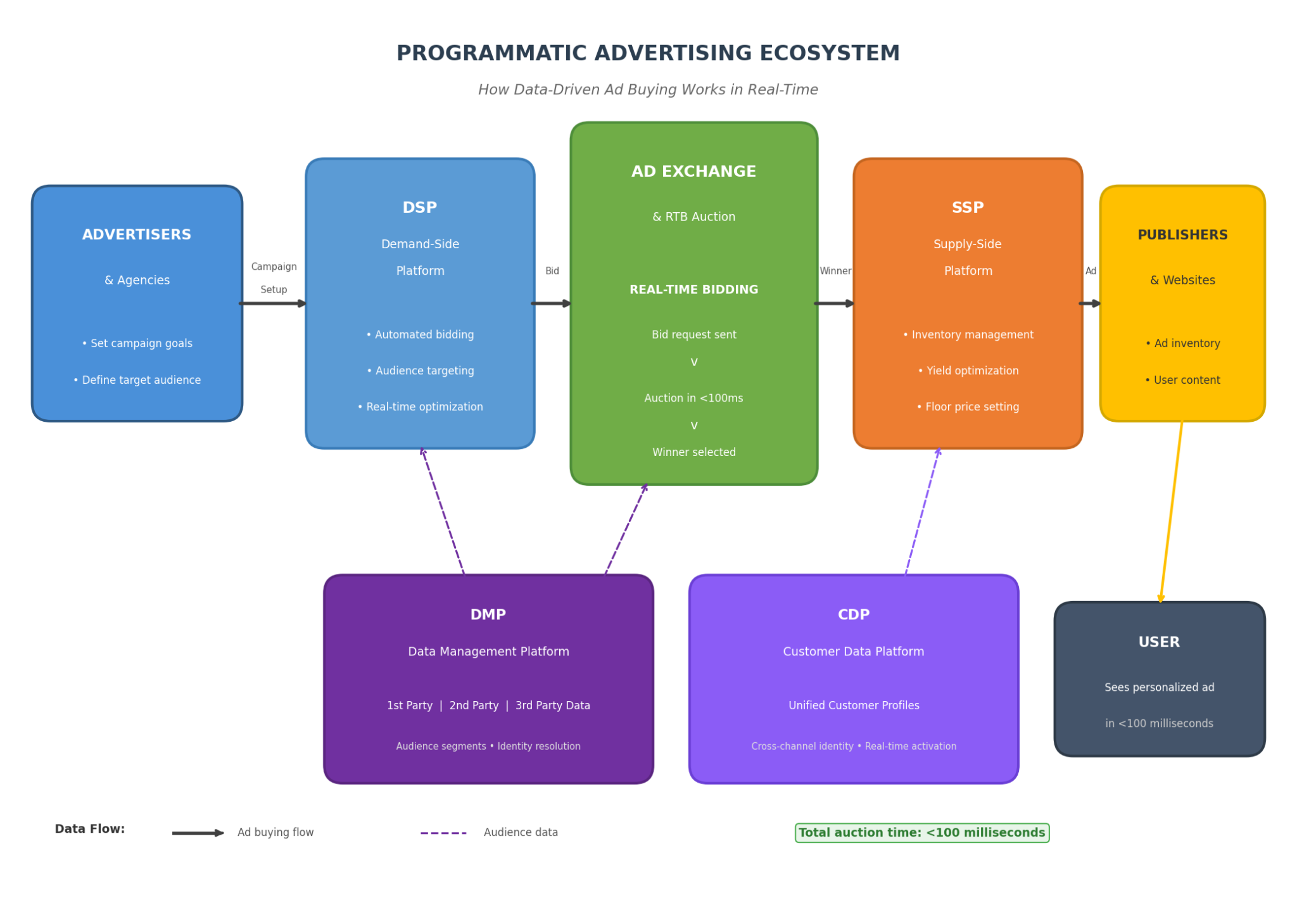
Real-time bidding (RTB) is where it gets interesting.
Advertisers can evaluate and bid on individual ad impressions in milliseconds. That level of precision in audience targeting simply wasn't possible before programmatic infrastructure existed.
Advertising Analytics and Measurement
The final core component involves measuring campaign performance and using those insights from historical data to drive continuous optimization. Modern advertising analytics has evolved far beyond simple click tracking to encompass multi-touch attribution, incrementality testing, and predictive modelling.
Pros of Advanced Advertising Analytics:
- Supports incrementality testing that demonstrates true causal impact of advertising on customer satisfaction.
- Provides real-time optimization signals that improve campaign performance during flight
- Supports incrementality testing that demonstrates true causal impact of advertising
- Facilitates budget allocation decisions based on predicted return across channels using performance metrics.
Cons of Advanced Advertising Analytics:
- Requires significant investment in technology, data infrastructure, and specialized talent
- Privacy regulations and technical changes (such as browser restrictions) can limit measurement accuracy
- Organizational silos can prevent the integration necessary for holistic measurement
Common Misconceptions
Misconception 1: Data-Driven Advertising Means Abandoning Creativity
A persistent myth suggests that data-driven approaches prioritize algorithms over creative innovation. The result, supposedly, is bland, formulaic advertising.
That's not how it works.
Data and creativity are complementary, not competitive. Data provides insights into what resonates with specific audiences. Creative teams then use those insights to develop more relevant and impactful messaging. The most successful data-driven advertisers use analytics to inform creative strategy while maintaining the emotional resonance that drives consumer action.
Netflix exemplifies this integration. The company uses data not just to recommend content but to personalize how that content is presented. They create multiple thumbnail variants for each title and test which images appeal most to specific user segments. A viewer who enjoys romantic content might see a different promotional image than someone who prefers action—even for the same show. This data-informed creativity has contributed to a recommendation engine that drives over 80% of content viewed on the platform.
Misconception 2: More Data Always Produces Better Results
Organizations often assume that collecting more data will automatically improve display advertising performance.
It won't.
Data volume without data quality, integration, and activation capabilities provides limited value. Many organizations possess vast quantities of customer data scattered across disconnected systems. They can't create unified customer views. They can't activate insights in real-time. The data exists, but the infrastructure to use it doesn't.
The critical factor is the ability to transform data into actionable insights and deploy those insights at the moment of customer engagement. This requires investment in data architecture, identity resolution, and activation infrastructure that enables real-time decisioning across channels.
Misconception 3: Privacy Regulations Will Make Data-Driven Advertising Impossible
The deprecation of third-party cookies and the implementation of privacy regulations like GDPR and CCPA have led some to conclude that data-driven advertising faces an existential threat.
Not quite.
These changes require significant adaptation, but they're accelerating data-driven approaches rather than eliminating them. Organizations are shifting toward first-party data strategies, contextual targeting, and privacy-preserving technologies like clean rooms that enable sophisticated advertising while respecting consumer privacy.
According to eMarketer research, 28% of US advertisers' targeting budgets now go toward contextual data while 27% supports first-party data activation. Effective alternatives to third-party tracking already exist and are gaining adoption.
Real-World Examples and Case Studies
Netflix: Personalization as Core Business Strategy
Netflix has built one of the most advanced data-driven recommendation systems in entertainment. The streaming platform analyzes viewing history, search queries, browsing behaviour, time-of-day patterns, device preferences, and countless other signals to gather customer insights that personalize every aspect of the user experience. According to company statements and industry analysis, over 80% of content watched on Netflix is discovered through personalized recommendations rather than user searches.
The business impact extends beyond engagement metrics.
Netflix's recommendation engine reportedly saves the company over $1 billion annually by reducing churn and maximizing content engagement. The company maintains a remarkably low churn rate compared to industry averages. Why? Their ability to consistently surface relevant content keeps subscribers engaged.
The platform also uses viewing data to inform content production decisions. Original productions like "House of Cards" were greenlit based partly on data indicating strong audience interest in the show's genre, director, and lead actors.
Spotify Wrapped: Transforming Data into Viral Marketing
Spotify's annual Wrapped campaign demonstrates how data-driven insights can fuel organic marketing reach that traditional advertising cannot match, influencing marketing decisions. Each December, the platform transforms individual listening data into personalized, visually compelling stories that users eagerly share across social media.
The campaign's success is measurable across social media platforms. According to Clemson University research published in major media, the #SpotifyWrapped hashtag garnered 73.7 billion views on TikTok in 2023. Industry reports indicate that over 156 million users engaged with Wrapped content in 2022. The campaign consistently drives measurable increases in app downloads, with some years showing 20% or greater spikes following Wrapped releases.
What makes Spotify Wrapped instructive for other organizations? It converts private behavioural data into shareable content that strengthens brand relationships, contrasting with traditional marketing methods. The campaign provides inherent value without asking anything of users. It demonstrates the depth of personalization the platform offers. And it creates social moments that generate earned media far exceeding what paid advertising could achieve at equivalent cost.
How to Build a Data-Driven Advertising Strategy
Implementing data-driven advertising requires a structured approach that addresses technology, process, and organizational capabilities.
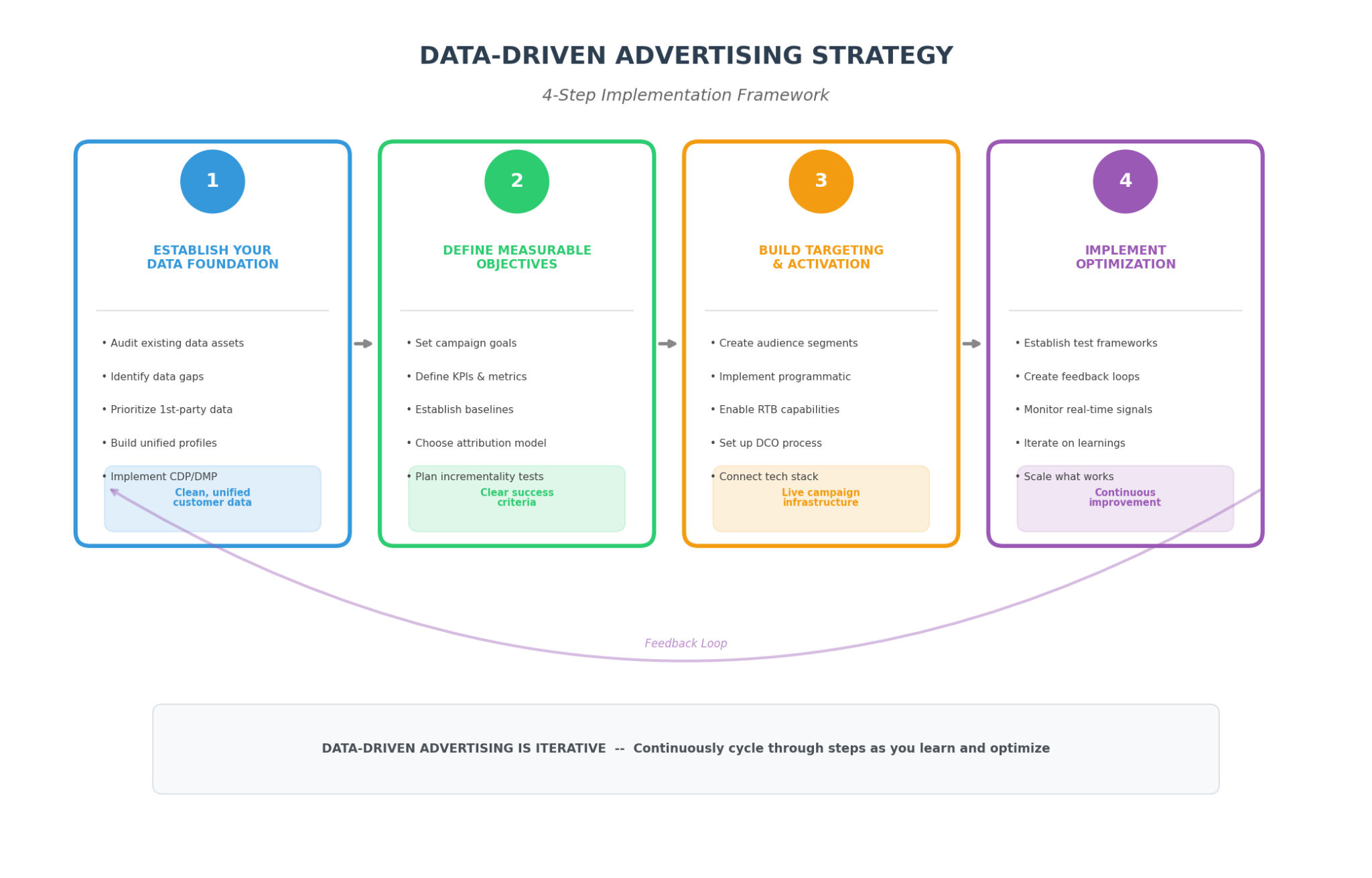
Step 1: Establish Your Data Foundation
Begin by auditing existing data assets across the organization. Identify what customer data currently exists, where it resides, how it's collected, and what gaps exist in your understanding of relevant data on customer behaviour. Prioritize first-party data collection through owned channels. Make sure data capture mechanisms respect privacy requirements and provide clear value exchange for customers sharing their information.
Then invest in data infrastructure that enables unified customer profiles.
This typically requires customer data platforms (CDPs) or similar technologies that consolidate data from multiple sources, resolve identities across devices and channels, and make unified profiles available for activation across marketing systems.
Step 2: Define Measurable Objectives
Data-driven advertising succeeds when it connects to clear business outcomes, including a strong conversion rate. Define specific, measurable objectives that advertising should achieve—whether that's customer acquisition, revenue growth, retention improvement, or brand awareness. Establish baseline metrics. Determine how success will be measured, including the attribution methodology and incrementality testing approaches that will validate advertising impact.
Step 3: Build Targeting and Activation Capabilities
Develop audience segments based on available data. Start with high-value segments where your target audience personalization can demonstrate clear impact. Implement programmatic advertising capabilities that enable real-time bidding and targeting across relevant channels. Establish creative production processes that can generate personalized variants at scale, whether through dynamic creative optimization or modular content approaches.
Step 4: Implement Continuous Optimization
Data-driven advertising is inherently iterative.
Establish testing frameworks that continuously evaluate creative approaches, audience segments, bidding strategies, and channel allocations. Create feedback loops that capture performance data and feed insights back into campaign planning. Build organizational processes that enable rapid response to performance signals rather than lengthy planning cycles that can't adapt to real-time learnings.
Frequently Asked Questions
What is the difference between data-driven advertising and programmatic advertising?
Data-driven advertising is the broader strategy of using customer data and analytics to inform advertising decisions across all aspects of marketing campaigns, campaign planning and execution. Programmatic advertising is a specific method of automated ad buying and placement that's often used to execute data-driven strategies.
Think of it this way: programmatic provides the technological infrastructure for real-time bidding and targeting. Data-driven approaches define how audience data, creative strategies, and optimization decisions are made in modern marketing. Most data-driven advertising strategies incorporate programmatic execution, but data-driven principles can also apply to traditional media planning.
How do privacy regulations like GDPR and CCPA affect data-driven advertising?
Privacy regulations require organizations to obtain appropriate consent for data collection, provide transparency about how data is used, and give consumers control over their information.
For data-driven advertising, this means prioritizing first-party data collected with explicit consent, implementing robust data governance practices, and shifting toward privacy-preserving targeting approaches like contextual advertising and aggregated measurement. Organizations that build advertising strategies on compliant data foundations typically find that first-party relationships with consented customers deliver superior performance compared to broad third-party targeting.
What budget should companies allocate to data-driven advertising?
Budget allocation varies significantly based on industry, competitive dynamics, and organizational maturity. However, McKinsey research indicates that companies excelling at personalization generate 40% more revenue from those marketing efforts than average players.
Initial investments typically include data infrastructure (customer data platforms, identity resolution), advertising technology (demand-side platforms, creative optimization tools), and analytical capabilities (attribution, testing frameworks) to attract potential customers. Organizations should expect to invest across technology, talent, and process development rather than simply reallocating existing media budgets.
How long does it take to see results from data-driven advertising?
Timeline depends on starting point and implementation scope.
Organizations with existing data infrastructure and analytical capabilities may see performance improvements within weeks of implementing new targeting approaches or optimization processes. Those building foundational capabilities from scratch should expect a longer runway—typically six to twelve months to establish data infrastructure, develop initial audience segments, and accumulate sufficient performance data to demonstrate impact. Continuous improvement is ongoing, with sophisticated programs continuously testing and optimizing across all campaign dimensions.
Can small and mid-sized businesses benefit from data-driven advertising?
Absolutely. Data-driven advertising is accessible to organizations of all sizes, though implementation approaches differ.
Small and mid-sized businesses can leverage self-serve programmatic platforms that provide sophisticated targeting capabilities without requiring enterprise-scale technology investments. First-party data strategies based on email lists, website analytics, and customer relationship management systems can drive meaningful personalization without massive data science teams. The key is starting with available data, focusing on highest-impact use cases, and building capabilities incrementally rather than attempting comprehensive transformation all at once.


