



Table of contents
Key Takeaways
- Spotify's freemium model achieves a 46% free-to-paid conversion rate, nearly ten times the 2-5% industry average, through strategic tier differentiation that delivers genuine free value while creating clear upgrade motivation.
- Personalization represents the true competitive moat in commoditized content markets, with features like Discover Weekly generating over 100 billion streams and driving user engagement rates that double non-personalized listening.
- Data-driven viral marketing campaigns like Wrapped generate billions in equivalent advertising value through organic user sharing, demonstrating that the most effective marketing transforms customers into advocates.
- Long-term business growth investment can precede profitability, as evidenced by Spotify's 18-year path to its first annual profit, but sustainable business models ultimately require disciplined cost management alongside revenue growth.
- Spotify's pricing strategy includes family plans and student discounts that expand the target audience while maintaining healthy average revenue per user across the subscriber base.
- Organizations exploring subscription or freemium models should consider consulting with digital marketing specialists who understand the nuanced balance between user acquisition, conversion optimization, and lifetime value maximization.
What Is Spotify's Marketing Strategy?
Spotify's marketing represents one of the most studied examples of subscription service marketing in the digital age. Spotify has transformed from a Swedish startup launched in 2006 into the world's dominant music streaming platform, building a user base of 675 million monthly active users and 263 million premium subscribers by the end of 2024, according to Spotify's Q4 2024 earnings report.
The foundation of Spotify's growth strategy rests on what researchers call a "bundled freemium model," which creates substantial value through free offerings while capturing value through premium upsells. Research published in the Transportation Research journal notes that while typical freemium models achieve conversion rates between 2% and 5%, Spotify has achieved an industry-leading 46% conversion rate from free to paid subscriptions.
For mid-market and enterprise businesses examining subscription-based growth models, Spotify offers critical lessons in balancing user acquisition with revenue optimization. The platform turns data into personalized experiences while maintaining sustainable unit economics, making it worth studying for any organization navigating the transition from traditional business models to recurring revenue streams.
The Freemium Model: Blueprint for Subscription Growth
Spotify's freemium model marketing approach changed how digital services acquire and convert users. The difference is striking. Unlike traditional trial-based approaches that restrict functionality to time-limited windows, Spotify's pricing strategy provides genuine standalone value in the free tier while strategically positioning premium features to address specific user pain points. This approach drives both brand awareness and a steady flow of new users into the conversion funnel.
How Spotify's Freemium Model Compares to Competitors
| Platform | Conversion Rate | Free Tier Features | Premium Price Point |
|---|---|---|---|
| Spotify | 46% | Full catalog with ads, shuffle-only on mobile | $11.99/month |
| Apple Music | ~30% | No free tier (trial only) | $10.99/month |
| Amazon Music | ~25% | Limited catalog with Prime | $9.99/month |
| YouTube Music | ~15% | Ad-supported with background play limits | $10.99/month |
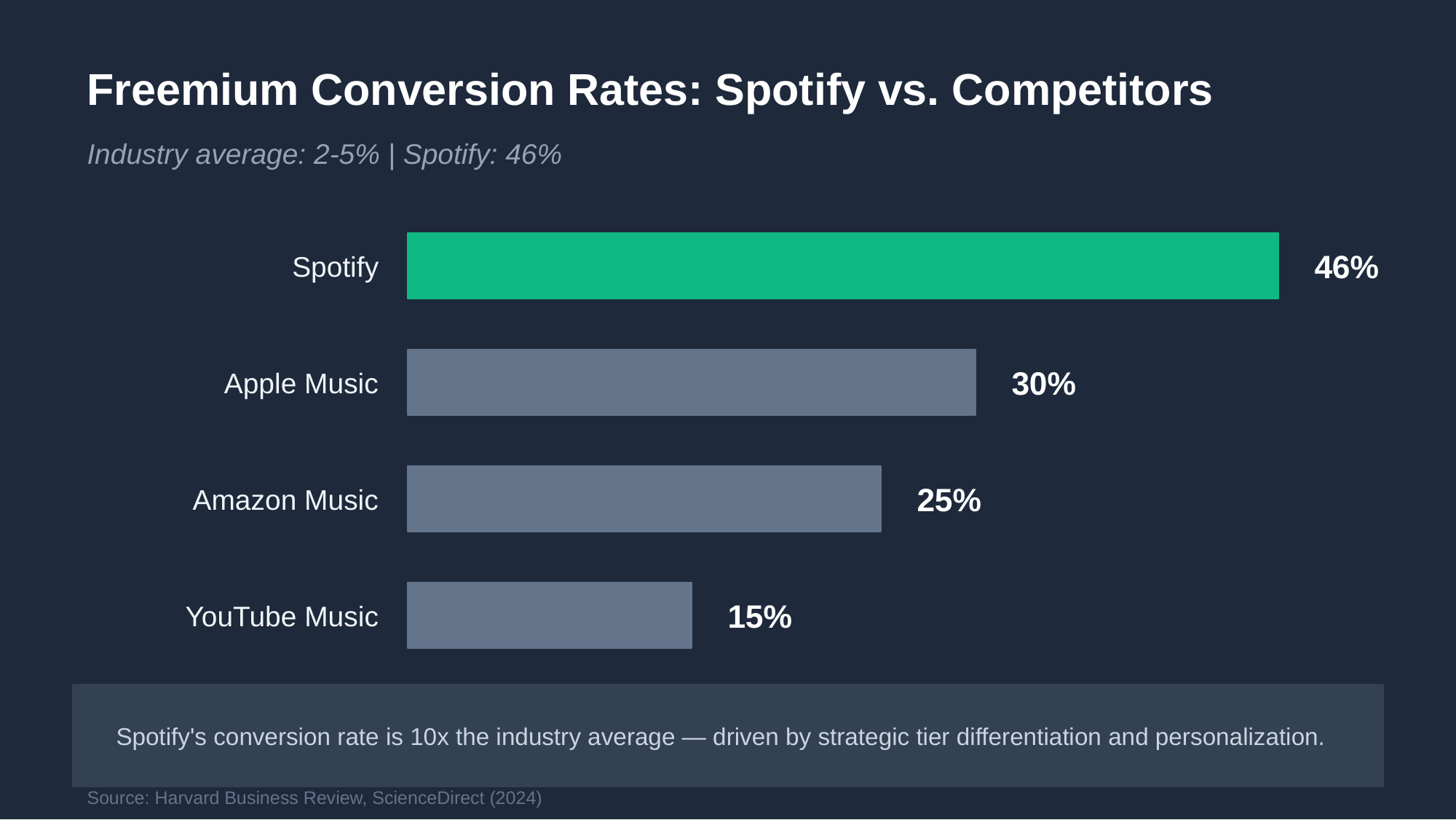
According to Harvard Business Review research on freemium business models, the average conversion rate across industries hovers between 2% and 5%, making Spotify's 46% conversion rate nearly ten times the industry benchmark. Not even close. That gap demands explanation.
The Strategic Balance of Free vs. Premium
Spotify's approach succeeds because it maintains a careful equilibrium between delivering enough value to engage free users while creating clear incentives for upgrade.
The free tier gives users access to over 100 million tracks, personalized playlists including Discover Weekly, social sharing capabilities, and full desktop playback controls. That's a genuinely useful product. But the friction points are strategic: ad interruptions every few songs, shuffle-only playback on mobile, and no offline listening capability. These limitations don't destroy the experience, they just make the premium feel worth it.
And that's exactly the point. Premium removes ads entirely, unlocks offline downloads for commutes and flights, delivers higher audio quality, and gives mobile users full playback control. The upgrade path feels natural rather than forced.
The psychological mechanisms driving conversion follow predictable patterns identified in behavioural economics research. Users create playlists, follow artists, and build personalized recommendation profiles, establishing what economists call "switching costs." After approximately three months of regular usage, typical Spotify users have created seven or more playlists, generating the personal investment that motivates subscription decisions.
This approach differs fundamentally from time-limited free trials. Rather than creating artificial urgency through countdown timers, Spotify builds natural conversion momentum through accumulated value. Users don't upgrade because a trial is expiring; they upgrade because they've invested enough in the platform that premium features become genuinely valuable to protect and enhance that investment.
The music streaming marketing industry has validated this model's effectiveness. Spotify's premium subscriber base grew from 71 million in 2017 to 263 million by the end of 2024, representing a compound annual growth rate that far outpaces the broader industry. This growth trajectory demonstrates that patient conversion strategies can outperform aggressive sales tactics when the underlying product delivers genuine value.
Common Misconceptions About Spotify's Success
Misconception 1: Spotify's Success Is Primarily About Having the Largest Music Library
While Spotify offers over 100 million tracks, competitors like Apple Music and Amazon Music provide comparable catalogues. The real differentiator is discovery. Personalized playlists account for over 30% of all listening hours on the platform, according to industry analysis. The recommendation algorithm makes a huge catalog feel personal, surfacing the right song at the right moment from millions of options.
Misconception 2: The Freemium Model Loses Money on Free Users
Many assume that supporting free users represents a pure cost center. Here's the thing: Harvard Business School research found that freemium users typically generate 15% to 25% of the value of premium subscribers through referrals alone. Free users serve as product evangelists, with significant value stemming from word-of-mouth acquisition that reduces customer acquisition costs.
Misconception 3: Spotify Wrapped Is Just a Fun Year-End Feature
Spotify Wrapped generates measurable business impact far beyond entertainment value. The 2024 campaign produced approximately 2.1 million social media mentions within 48 hours and over 400 million TikTok views in three days, according to marketing analysis. In 2020, Wrapped drove a 21% increase in mobile app downloads during launch week, demonstrating its role as a strategic acquisition tool rather than merely an engagement feature.
Why Personalization Drives More Value Than Content Volume
The streaming music market has become commoditized in terms of content availability, with major platforms offering nearly identical catalogues due to universal licensing agreements. Discovery is the differentiator.
Spotify's Discover Weekly playlist exemplifies this principle. Launched in 2015, this single feature has accumulated over 100 billion track streams and ignites more than 56 million new artist discoveries weekly, with 77% coming from emerging artists, according to Spotify's official announcement.
The business case for personalization extends beyond user engagement metrics. Users who engage with Discover Weekly stream more than twice as long as non-users, according to Spotify's advertising division. This increased engagement correlates directly with retention and, ultimately, lifetime value.
Research from academic sources supports this observation. A critical analysis of Spotify's business model published on Semantic Scholar concludes that personalized recommendation systems sit at the heart of Spotify's competitive advantage, enabling value creation that competitors struggle to replicate despite having access to identical music catalogues.
Internal surveys reveal that 81% of Spotify users cite personalization as their favorite platform feature, transforming casual listeners into engaged subscribers who feel understood by the platform.
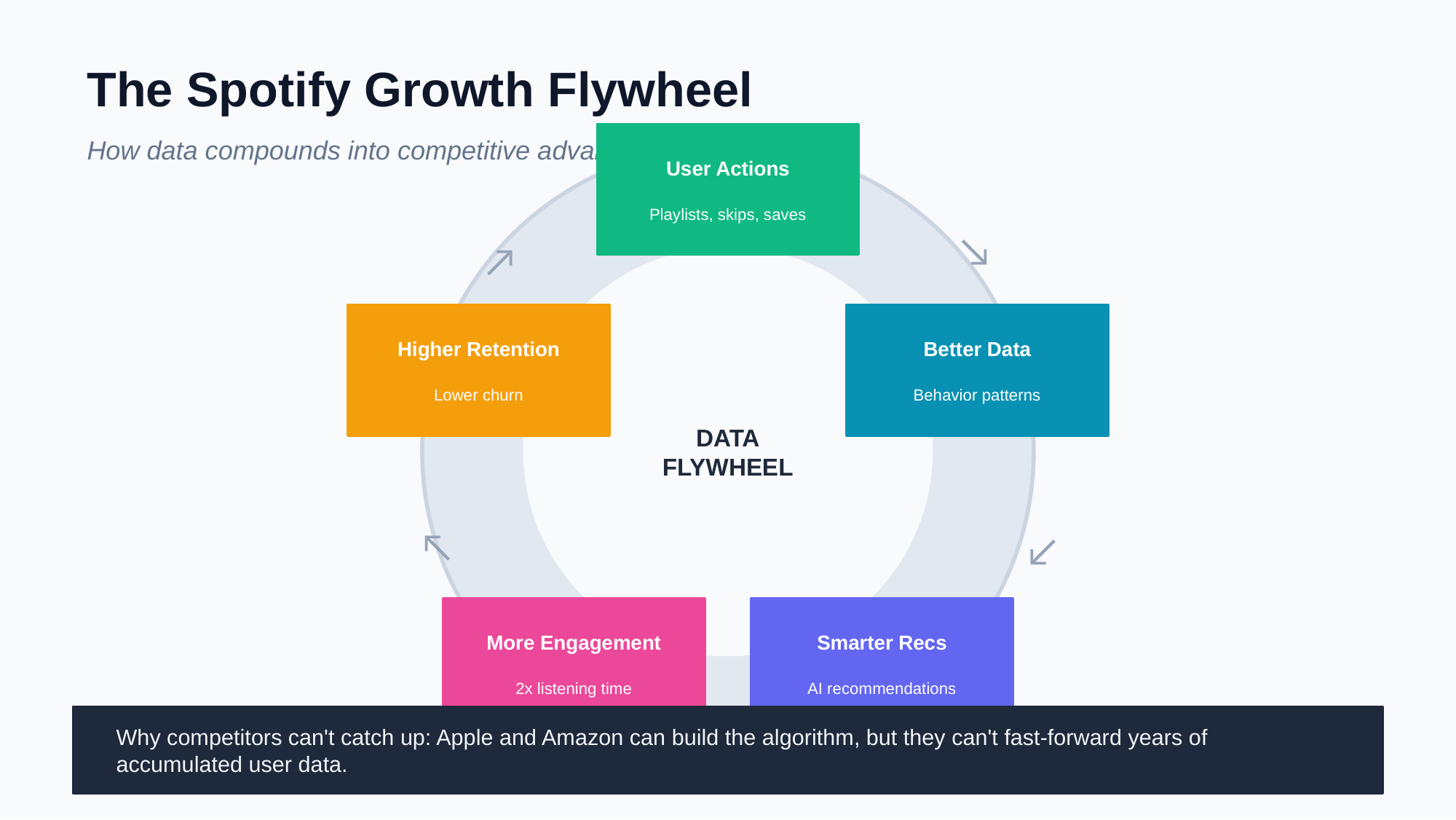
Here's what most analyses miss: Spotify's personalization advantage is largely self-reinforcing and nearly impossible to replicate quickly. Every playlist a user creates, every song they skip, every artist they follow adds user data that improves recommendations, which increases engagement, which generates more data. So why can't Apple or Amazon close the gap? They have the engineering talent and capital to build comparable algorithms, but they can't fast-forward through years of accumulated user behaviour data. This creates a compounding advantage that widens over time rather than narrowing, which explains why Spotify maintains market leadership despite competitors offering identical catalogues at lower prices and bundling music with other services users already pay for.
The Hidden Economics of Viral Marketing Campaigns
Spotify Wrapped demonstrates how data-driven marketing can generate advertising-equivalent value without traditional media spend. The numbers are staggering. The campaign achieves what most marketers only dream about: users voluntarily promoting the brand at massive scale.
The 227 million users who interacted with Wrapped in 2023 generated an estimated 2.3 billion social media impressions, according to marketing case study analysis. In traditional advertising terms, achieving comparable reach would require hundreds of millions in media spending. But Spotify pays nothing for this exposure. Because users do the work themselves.
This organic amplification stems from a psychological insight: people love sharing information that reflects their identity. Wrapped transforms personal listening data into social currency, allowing users to signal belonging to cultural communities while expressing individual uniqueness. The campaign taps into what social psychologist Marilynn Brewer termed "optimal distinctiveness theory," the fundamental human need to simultaneously belong and stand apart. When users share their Wrapped results across social media platforms, they're reinforcing both Spotify's brand identity and their own.
The campaign has achieved consistent industry recognition, winning multiple Webby Awards including honors for Best Data Visualization, Best User Experience, and Viral Marketing. More importantly, it has spawned widespread imitation, with Apple Music, Netflix, Uber, and Duolingo all launching similar year-in-review features.
Real-World Examples and Case Studies
Spotify's Path to Profitability
For the first 18 years of operation, Spotify prioritized growth over profitability, accumulating operating losses while building market share. This changed dramatically in 2024. According to Variety's earnings analysis, Spotify posted its first annual net profit of €1.138 billion on revenue of €15.673 billion, representing an 18.3% year-over-year revenue increase.
The turnaround involved multiple strategic levers: two subscription price increases, workforce reductions from 9,123 to 7,261 employees, and continued investment in podcast and audiobook content that drives differentiated value. And it worked. Operating income reached €1.4 billion for the full year, demonstrating that the freemium model can ultimately generate substantial returns when combined with disciplined cost management.
The Discover Weekly Launch
Spotify's most successful product launch originated not from a corporate initiative but from an internal hackathon project. The Discover Weekly team built upon the foundation of a 2014 "Year in Music" feature called "Play it Forward" and transformed it into a weekly personalized playlist powered by machine learning.
During internal testing, the team placed a Google form link in the playlist description to gather feedback. Over 1,500 listeners responded, providing validation that exceeded expectations. According to Spotify Engineering's retrospective, the overall response during testing was "off the charts."
Within months of launch, Discover Weekly accumulated 1.7 billion streams. By 2025, the feature accounts for approximately 20% of Spotify's total streaming volume and has become synonymous with algorithmic music discovery. The playlist resonates particularly well with Gen Z and millennial listeners, a target audience that expects personalization as standard.
Global Expansion Through Localization
Spotify operates in 184 markets and 53 languages, achieving this global reach through deliberate localization strategy. Rather than simply translating interfaces, Spotify invests in regional playlist curation that reflects local music culture.
The platform creates market-specific playlists like "New Music Friday Naija" for Nigeria and "Éxitos México" for the Mexican market. This localization extends to Wrapped campaigns, with strategic partnerships like the FC Barcelona collaboration that generated over 1.28 million Instagram likes and approximately $12.4 million in estimated media value, according to Meltwater's social listening analysis.
The localization strategy addresses a fundamental challenge in global expansion: music preferences vary dramatically by culture and region. What resonates in Stockholm differs from what works in São Paulo or Mumbai. By empowering regional editorial teams while maintaining consistent personalization technology, Spotify achieves the difficult balance of global scale with local relevance.
Strategic Content Investments
Beyond music, Spotify has invested heavily in podcast and audiobook exclusive content to differentiate its offering and justify premium pricing. The platform hosts approximately 6.5 million podcast titles, with around 330,000 offering video content. In January 2025, Spotify launched the Partner Program, which pays video podcast creators based on Premium user watch time, creating alignment between creator incentives and subscription value.
The company paid out $10 billion to the music industry in 2024 alone, bringing cumulative payouts to approximately $60 billion since founding. While artist compensation remains controversial, these figures demonstrate the scale at which Spotify operates and the significant revenue it generates for rights holders.
Frequently Asked Questions
How does Spotify achieve such a high conversion rate from free to premium?
Spotify's 46% conversion rate stems from strategic tier differentiation that creates genuine friction points for free users without destroying the value proposition. Ad interruptions, shuffle-only mobile playback, and lack of offline access create upgrade motivation, while personalized playlists build the switching costs that make leaving the platform psychologically difficult. The combination of value delivery and strategic limitation drives conversion far above industry benchmarks.
What role does Spotify Wrapped play in user acquisition and retention?
Wrapped functions as both an acquisition and retention tool. The campaign creates massive FOMO among non-users during December, driving app downloads as people seek to participate in the cultural moment. For existing users, Wrapped reinforces engagement by celebrating their platform relationship and providing shareable content that deepens emotional connection to the service.
How does Spotify's marketing budget compare to its revenue?
According to industry analysis, Spotify allocated approximately $1.5 billion to sales and marketing in 2024, representing roughly 10% of total revenue. This investment supports targeted digital advertising, out-of-home campaigns in major cities, and partnership programs. The company's marketing efficiency benefits significantly from organic amplification through features like Wrapped and social sharing functionality.
Can smaller subscription businesses replicate Spotify's freemium model?
The principles underlying Spotify's success transfer across industries, though execution requires adaptation. Key elements include delivering genuine value in the free tier, creating clear premium upgrade triggers, investing in personalization to build switching costs, and designing for social shareability. Businesses should expect lower conversion rates than Spotify's exceptional 46% benchmark while still potentially outperforming the 2-5% industry average through strategic tier design.
What is Spotify's market share in the music streaming industry?
Spotify maintains the leading position in global music streaming with approximately 32% market share as of 2024, according to industry analysis. Apple Music follows at approximately 16%, with Amazon Music at 13% and YouTube Music at 10%. The remaining market comprises smaller platforms including Deezer, Tidal, and regional services.
Web Tonic works across SEO, paid search and paid social, and you can book a consultation to talk through your own plan.


